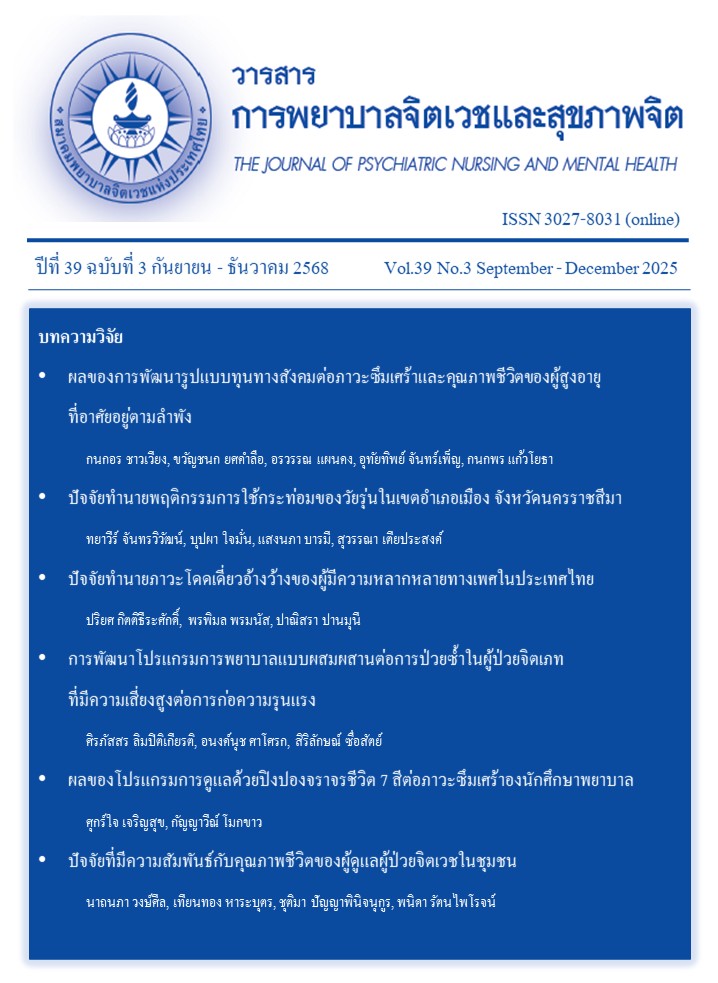
ปัจจัยทำนายพฤติกรรมการใช้กระท่อมของวัยรุ่นในเขตอำเภอเมือง จังหวัดนครราชสีมา
Article Sidebar
Main Article Content
บทคัดย่อ
วัตถุประสงค์ : เพื่อศึกษาปัจจัยที่มีอิทธิพลต่อพฤติกรรมการใช้กระท่อมของวัยรุ่นในเขตอำเภอเมือง จังหวัดนครราชสีมา
วิธีการศึกษา : กลุ่มตัวอย่างที่ศึกษา คือวัยรุ่นที่ใช้บริการร้านกระท่อมในเขตพื้นที่อำเภอเมือง จังหวัดนครราชสีมา จำนวน 136 คน ได้จากการสุ่มแบบเฉพาะเจาะจง เครื่องมือที่ใช้ในการวิจัยเป็นแบบสอบถาม ประกอบด้วย 3 ส่วนได้แก่ 1) ข้อมูลส่วนบุคคล 2) แบบสอบถามด้านความรู้ ทัศนคติ แรงจูงใจ และการเปิดรับสื่อ และ3) แบบสอบถามพฤติกรรมการใช้กระท่อม วิเคราะห์ข้อมูลด้วยสถิติเชิงพรรณนา สัมประสิทธิ์สหสัมพันธ์ของเพียร์สัน และการวิเคราะห์ถดถอยพหุคูณ
ผลการศึกษา : พฤติกรรมการใช้กระท่อมของวัยรุ่นในเขตอำเภอเมือง จังหวัดนครราชสีมา พบว่า ค่าเฉลี่ยความรู้ อยู่ในระดับปานกลาง (mean = 9.85, S.D. = 1.92) ทัศนคติ อยู่ในระดับปานกลาง (mean = 3.42, S.D. = 0.46) แรงจูงใจ อยู่ในระดับมาก (mean = 3.53, S.D. = 0.75) การเปิดรับสื่อ อยู่ในระดับมาก (mean = 3.60, S.D. = 0.70) และพฤติกรรมการใช้กระท่อมอยู่ในระดับปานกลาง (mean = 2.96, S.D. = 0.97) ปัจจัยด้านทัศนคติ แรงจูงใจ และการเปิดรับสื่อ มีความสัมพันธ์ทางบวกกับพฤติกรรมการใช้กระท่อมอย่างมีนัยสำคัญทางสถิติ (r = .570, .699, .519, p < .01 ตามลำดับ) โดยปัจจัยความรู้ ทัศนคติ แรงจูงใจ และการเปิดรับสื่อ ร่วมกันทำนายพฤติกรรมการใช้กระท่อมของวัยรุ่นได้ร้อยละ 52.90 อย่างมีนัยสำคัญทางสถิติ (R2 = .529, p < .01) ปัจจัยที่มีอิทธิพลมากที่สุด ได้แก่ ด้านแรงจูงใจ (Beta = 532, p < .01) รองลงมาด้านทัศนคติ (Beta = 202, p < .01)
สรุป : ปัจจัยด้านแรงจูงใจ และปัจจัยด้านทัศนคติ มีผลต่อพฤติกรรมการใช้กระท่อมของวัยรุ่น หากวัยรุ่นลดแรงจูงใจและปรับทัศนคติในการใช้กระท่อม จะทำให้ลดพฤติกรรมการใช้กระท่อมตามมาได้ ซึ่งนำไปสู่การวางแผนป้องกันพฤติกรรมการใช้กระท่อมของวัยรุ่นต่อไปในอนาคต
Article Details

อนุญาตภายใต้เงื่อนไข Creative Commons Attribution-NonCommercial-NoDerivatives 4.0 International License.
บทความที่ได้รับการตีพิมพ์แล้ว เป็นลิขสิทธิ์ของสมาคมพยาบาลจิตเวชแห่งประเทศไทย
เอกสารอ้างอิง
กุสุมาลย์ น้อยผา, วิทวัส หมาดอี, สรายุทธ หวังเกตุ, และอนินธิตา ดำกระ. (2565). ปัจจัยที่มีความสัมพันธ์กับพฤติกรรมการใช้พืชกระท่อมในการดูแลตนเองของประชาชนในพื้นที่อำเภอขนอม จังหวัดนครศรีธรรมราช. วารสารหมอยาไทยวิจัย, 8(2), 81-98.
ทยาวีร์ จันทรวิวัฒน์, และชนกฤทัย ชื่นอารมณ์. (2561). การเจริญสติในผู้ป่วยติดสารเสพติด: มุมมองทางด้านสมองและประสาทวิทยา. วารสารวิจัยและพัฒนาระบบสุขภาพ, 11(2), 166-175.
บุญชม ศรีสะอาด. (2554). การวิจัยเบื้องต้น (พิมพ์ครั้งที่ 9). บริษัทสุวีริยาสาส์น.
ปกรณ์ ลิ้มโยธิน, เจตน์สฤษฎิ์สังขพันธ์, เก็ตถวา บุญปราการ, ชิดชนก เชิงเชาว์, และอภิรักษ์ จันทวงศ์. (2564). ความสัมพันธ์ระหว่างปัจจัยครอบครัว ปัจจัยความรู้ และปัจจัยกลุ่มเพื่อนกับพฤติกรรมเสี่ยงใช้สารเสพติดในการจำแนกกลุ่มเพศชายและเพศหญิงของเยาวชนไทยในอำเภอหาดใหญ่ จังหวัดสงขลา. ใน การประชุมหาดใหญ่วิชาการระดับชาติและนานาชาติ ครั้งที่ 12 (น. 542-557). มหาวิทยาลัยหาดใหญ่.
ประเวช สังข์วงษ์. (2564). กระบวนการพัฒนาการมีส่วนร่วมของครูประจำชั้นในการป้องกันการแพร่ระบาดของสารเสพติดในนักเรียนมัธยมศึกษา อำเภอแสวงหา จังหวัดอ่างทอง. วารสารวิชาการสำนักงานสาธารณสุขจังหวัดมหาสารคาม, 5(9), 175-194.
พระราชบัญญัติพืชกระท่อม พ.ศ. 2565. (26 สิงหาคม 2565). ราชกิจจานุเบกษา เล่มที่ 139 ตอนที่ 52 ก หน้า 1-15.
รดาธร อัญภัทรถาวร, และพิพัฒน์ นนทนาธรณ. (2565). ความรู้ ทัศนคติ และการปฏิบัติต่อการใช้กระท่อมของประชาชนในเขตกรุงเทพมหานคร. วารสารสมาคมนักวิจัย, 27(2), 150-165.
ศยามล เจริญรัตน์, อังคณา ชินเดช, อภินันท์ อร่ามรัตน์, และวัชรพงษ์ พุ่มชื่น. (2560). รายงานโครงการการสำรวจและติดตามสถานการณ์พืชกระท่อมในบริบทสังคมไทย เพื่อสร้างแนวทางการควบคุมพืชเสพติดอย่างบูรณาการจากชุมชน. สถาบันวิจัยสังคม จุฬาลงกรณ์มหาวิทยาลัย ศูนย์วิชาการสารเสพติดภาคเหนือ มหาวิทยาลัยเชียงใหม่.
สาวิตรี อัษณางค์กรชัย, อาภา ศิริวงศ์ ณ อยุธยา, ไพศาล ลิ้มสถิตย์, นิวัติ แก้วประดับ, สมสมร ชิตตระการ, จุไรทิพย์ หวังสินทวีกุล, เอกสิทธิ์ กุมารสิทธิ์, สมชาย ศรีวิริยะจันทร์, ดาร์เนีย เจ๊ะหะ, วัชรพงศ์ พุ่มชื่น, และดาริกา ใสงาม. (2563). บทสรุปของพืชกระท่อม (พิมพ์ครั้งที่ 2). ลีโอ ดีไซน์ แอนด์ พริ้นท์.
สุริยัน บุญแท้. (2563). รายงานฉบับสมบูรณ์ โครงการสำรวจทัศนคติและพฤติกรรมการใช้สารเสพติด: กรณีศึกษาประชาชนอายุ 15 - 65 ปี ใน 20 จังหวัดทั่วทุกภูมิภาคของประเทศ. https://cads.in.th/cads/content?id=130
Bandura, A., & Walters, R. H. (1977). Social learning theory (Vol. 1). Prentice-Hall.
Bloom, B. S., Madaus, G. F., & Hastings, J. T. (1971). Handbook on Formative and Summative Evaluation of Student Learning. McGraw-Hill.
Charoenratana, S., Anukul, C., & Aramrattana, A. (2021). Attitudes towards Kratom use, decriminalization and the development of a community-based Kratom control mechanism in Southern Thailand. International Journal of Drug Policy, 95, 103197.
Choden, P., Hengudomsub, P., & Deoisres, W. (2018). Factors influencing substance use among adolescents in a higher secondary school in Thimphu, Bhutan. The Journal of Faculty of Nursing
Burapha University, 26(4), 60-69.
Chongrattanakon, N., Thepthien, B. O., & Hong, S. A. (2018). Prevalence and psycho-social determinants of Kratom (Mitragyna speciosa) juice cocktail consumption among youth in Surat Thani Province, Thailand. Journal of Substance Use, 23(2), 144-153.
Davis, J. P., Pedersen, E. R., Tucker, J. S., Dunbar, M. S., Seelam, R., Shih, R., & D’Amico, E. J. (2019). Long-term associations between substance use-related media exposure, descriptive norms, and alcohol use from adolescence to young adulthood. Journal of youth and adolescence, 48(7), 1311-1326.
Grundmann, O., Veltri, C. A., Morcos, D., Knightes III, D., Smith, K. E., Singh, D., Corazza, O., Cinosi, E., Martinotti, G., Walsh, Z., & Swogger, M. T. (2022). Exploring the self-reported motivations of kratom (Mitragyna speciosa Korth.) use: a cross-sectional investigation. The American Journal of Drug and Alcohol Abuse, 48(4), 433-444.
Khalid, K., Ku Md Saad, S., Soelar, S. A., Mohamed Yusof, Z., & Warijo, O. (2023). Exploring adolescents’ practice and perspective on the use and misuse of kratom in northwest Malaysia. Journal of Ethnicity in Substance Abuse, 22(1), 121-132.
Liao, J. Y., Huang, C. M., Lee, C. T. C., Hsu, H. P., Chang, C. C., Chuang, C. J., & Guo, J. L. (2018). Risk and protective factors for adolescents’ illicit drug use: A population-based study. Health Education Journal, 77(7), 749-761.
National council for mental wellbeing. (n.d.). What you need to know about youth & kratom. https:// https://www.thenationalcouncil.org/wp-content/uploads/2021/11/What-You-Need-to-Know-About-Youth-Kratom-1.pdf
Nickerson, C. (16 October 2023). Theory of reasoned action (Fishbein and Ajzen, 1975). Simply Psychology. https://www.simplypsychology.org/theory-of-reasoned-action.html
Nunez-Smith, M., Wolf, E., Huang, H. M., Chen, P. G., Lee, L., Emanuel, E. J., & Gross, C. P. (2010). Media exposure and tobacco, illicit drugs, and alcohol use among children and adolescents: a systematic review. Substance Abuse, 31(3), 174-192.
Odofin, T., & Igabari, Q. (2023). Assessment of social media exposure and substance abuse among adolescent secondary school students in Delta State, Nigeria. International Journal of Social Science and Education Research Studies, 3(5), 845-851.
Ryan, R. M., & Deci, E. L. (2000). Intrinsic and extrinsic motivations: Classic definitions and new directions. Contemporary educational psychology, 25(1), 54-67.
Schimmel, J., Amioka, E., Rockhill, K., Haynes, C. M., Black, J. C., Dart, R. C., & Iwanicki, J. L. (2021). Prevalence and description of kratom (Mitragyna speciosa) use in the United States: a cross sectional study. Addiction, 116(1), 176-181.
Srisittiyanon, J., Rakangthong, N. K., Ru-zhe, J., & Aujirapongpan, S. (2023). Knowledge and Understanding Kratom Consumption for Healthy of Teenagers in South of Thailand. International Journal of multidisciplinary research and analysis, 6(5), 2129-2136.
Suhaimi, F. W., Zul Aznal, A. N., Mohamad Nor Hazalin, N. A., Teh, L. K., Hassan, Z., & Salleh, M. Z. (2023). Kratom (M. speciosa) exposure during adolescence caused long-lasting cognitive behavioural deficits associated with perturbated brain metabolism pathways in adult rats. Behavioural Brain Research, 446, 114411.
Sum, T. S., Hamsan, H. H., Ma'rof, A. A., Abdullah, H., Rasdi, R. M., Omar, S. Z., & Sadiron, N. (2022). A Systematic Review of The Factors Contributing to Adolescent Illicit Drug Use within Asia. International Journal of Academic Research in Business and Social Sciences, 12(12), 2125-2141.
Zul Aznal, A. N., Mohamad Nor Hazalin, N. A., Hassan, Z., Mat, N. H., Chear, N. J., Teh, L. K., Salleh, M. Z., & Suhaimi, F. W. (2022). Adolescent kratom exposure affects cognitive behaviours and brain metabolite profiles in Sprague-Dawley rats. Frontiers in pharmacology, 13, 1057423.