
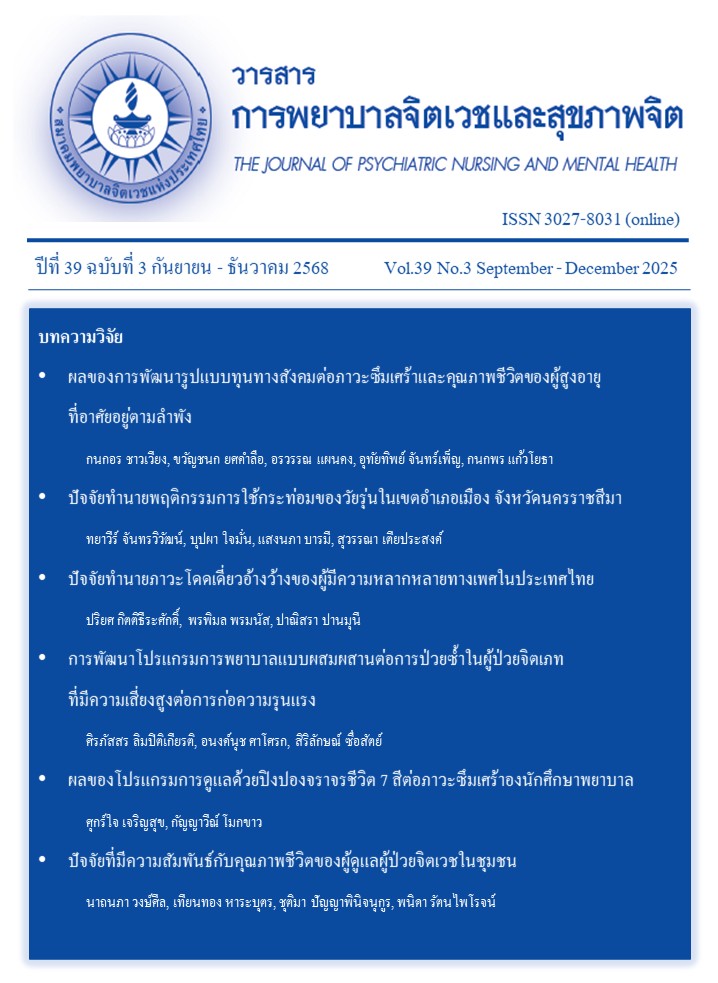
EFFECTS OF USING SOCIAL CAPITAL MODEL ON DEPRESSIVE SYMPTOMS AND QUALITY OF LIFE AMONG THE ELDERLY LIVING ALONE
Article Sidebar
Main Article Content
Abstract
Objective: To develop and examine the effects of a social capital model on depression and quality of life among elderly people living alone.
Methods: This study employed a quasi-experimental design with a one-group pretest-posttest approach. The participants were elderly individuals living alone in Sing Buri Province. The research sites were selected through multi-stage random sampling at both district and sub-district levels, resulting in 2 districts and 2 sub-districts per district. A purposive sampling method was used to recruit 31 participants based on predefined criteria. Data collection tools included a personal information questionnaire, a depression assessment scale, and a quality of life assessment scale, with Cronbach’s alpha coefficient of 0.70 and 0.92, respectively. The intervention involved a social capital model, conducted over 12 weeks with weekly 3 hours sessions. Descriptive statistics, including frequency and percentage, were used to analyze participants' demographic data, and paired t-tests were employed to compare pre and post intervention mean scores for depression and quality of life.
Results: 1) The mean depression score of participants after the social capital intervention (mean = 6.77, S.D. = 4.44) was significantly lower than before the intervention (mean = 13.94, S.D. = 3.89) (t = 8.05, p < .05). 2) The mean of quality of life score after the intervention (mean = 104.12, S.D. = 6.81) was significantly higher than before the intervention (mean = 96.27, S.D. = 13.47) (t = 3.37, p < .05).
Conclusion: The social capital model effectively reduced depression and improved quality of life among elderly people living alone. Therefore, social capital should be promoted for elderly individuals living alone in the community.
Article Details

This work is licensed under a Creative Commons Attribution-NonCommercial-NoDerivatives 4.0 International License.
บทความที่ได้รับการตีพิมพ์แล้ว เป็นลิขสิทธิ์ของสมาคมพยาบาลจิตเวชแห่งประเทศไทย
References
กรมกิจการผู้สูงอายุ กระทรวงการพัฒนาสังคมและความมั่นคงของมนุษย์. (2552). แผนและนโยบายผู้สูงอายุ. http://www.dop.go.th/th/laws/1/28/766
ชุติมา มาลัย, รุ่งทิพย์ ไชยโยยิ่งยงค์, เพ็ญนภา แดงด้อมยุทธ์, และศรีสกุล เฉียบแหลม.(2562). ปัจจัยที่มีความสัมพันธ์ต่อภาวะซึมเศร้าของผู้สูงอายุในชุมชน จังหวัดราชบุรี. วารสารพยาบาลสงขลานครินทร์, 39(3), 67-76.
ไทย พับลิก้า. (2024). เมื่อไทยเข้าสู่สังคมสูงวัยอย่างสมบูรณ์ Aged Society ผู้สูงอายุไทยได้รับสวัสดิการอะไรบ้าง. https://thaipublica.org/2024/02/ thailand-becomes-aged-society/
นิพนธ์ พวงวรินทร์และคณะ. (2536). แบบทดสอบสมรรถภาพสมองของไทย. สารศิริราช, 45(6), 359-374.
นิพนธ์ พวงวรินทร์และคณะ. (2537). แบบวัดความเศร้าในผู้สูงอายุของไทย [Thai geriatric depression scale: TGDS]. สารศิริราช, 46(1), 1-9.
เวธกา กลิ่นวิชิต, และ พิสิษฐ์ พิริยาพรรณ. (2561). การวิจัยเชิงปฏิบัติการแบบมีส่วนร่วมของชุมชนในการพัฒนาคุณภาพชีวิต แบบพอเพียงของผู้สูงวัยไทยในภาคตะวันออก. วารสารวิชาการ ปขมท, 9(1), 80-93.
ศูนย์ความรู้เรื่องโรคซึมเศร้าไทย กระทรวงสาธารณสุข. (2566). รายงานการเข้าถึงบริการของผู้ป่วยซึมเศร้า ปีงบประมาณ2566. https://www.thaidepression.com/www/report/main_ report/.
สายฝน เอกวรางกูร. (2564). ศาสตร์และศิลป์การบำบัดดูแลผู้สูงอายุที่มีภาวะซึมเศร้า. กรุงเทพฯ : สำนักพิมพ์จุฬาลงกรณ์มหาวิทยาลัย.
สุทธิชัย จิตะพันธ์กุล. (2544). หลักสำคัญของเวชศาสตร์ผู้สูงอายุ. (พิมพ์ครั้งที่ 3). กรุงเทพฯ: ภาควิชาอายุรศาสตร์ คณะแพทยศาสตร์ จุฬาลงกรณ์มหาวิทยาลัย.
สุวัฒน์ มหัตนิรันดร์กุล, วิระวรรณ ตันติพิวัฒนสกุล, วนิดา พุ่มไพศาลชัย, กรองจิตต์ วงศ์สุวรรณ, และ ราณี พรมานะจิรังกุล. (2541). เปรียบเทียบแบบวัดคุณภาพชีวิตขององค์การอนามัยโลกชุด 100 ตัวชี้วัด และ 26 ตัวชี้วัด.วารสารสุขภาพจิตแห่งประเทศไทย, 5(3), 4-15.
สำนักงานสถิติแห่งชาติ กระทรวงดิจิตอลเพื่อเศรษฐกิจและสังคม. (2560). รายงานการสำรวจประชากรสงอายุในประเทศไทย พ.ศ. 2559. 20230501001130_41503.pdf
อุมาพร เคนศิลา, เกษฎาภรณ์ นาขะมิน, นิตยากร ลุนพรหม, เสาวลักษณ์ ทาแจ้ง, ณัฐฐากุล บึงมุม, และ นภาจันทร์ ชาปลิก. (2563). การสนับสนุนทางสังคมและภาวะซึมเศร้าของผู้สูงอายุ ในเขตชุมชนเมือง จังหวัดอุดรธานี, วารสารการพัฒนาสุขภาพชุมชน มหาวิทยาลัยขอนแก่น, 8(3), 377-388.
Bai, Z., Wang, Z., Shao, T., Qin, X., & Hu, Z. (2021). Association between social capital and loneliness among older adults: A cross-sectional study in Anhui Province, China. BMC Geriatrics, 21(26), 1-10.
Coll-Planas, L. (2016). Promoting social capital in an ageing society: a win-win proposition?. Gaceta Sanitaria, 30(5), 323-325.
Iamtrakul, P., & Chayphong, S. (2022). Exploring the Influencing Factors on Living Alone and Social Isolation among Older Adults in Rural Areas of Thailand. International Journal of Environmental Research and Public Health, 19(21), 14572.
Juntapim, S., & Theranut, A. (2023). Mental health status and factors related on mental health status of the older adults living alone; Working with Older People. Journal of Nursing Science & Health, 46(1), 114-127.
Lager, D., van Hoven, B., & Huigen, P. (2015). Understanding older adults’ social capital in place: Obstacles to and opportunities for social contacts in the neighbourhood. Geoforum, 59, 87-97.
Nuntaboot, K., Boonsawasdgulchai, P., & Bubpa, N. (2019). Roles of mutual help of local community networks in community health activities: Improvement for the quality of life of older people in Thailand. International Journal of Nursing Sciences, 6, 266 - 271.
Putnam, Robert D. (1993). Making Democracy Work: Civic Traditions in Modern Italy. Princeton: Princeton University Press.
Putnam, Robert D. (2000). Bowling alone: The collapse and revival of American community. Simon & Schuster.
Ryu, S. I., Cho, B., Chang, S. J., Ko, H., Yi, Y. M., Noh, E. Y., Cho, H. R., & Park, Y. H. (2021). Factors Related to Self-Confidence to Live Alone in Community-Dwelling Older Adults: A Cross-Sectional Study. BMC geriatrics, 21(1), 291.
World Health Organization. (2023). Mental health of older adults. https://www.who.int/news-room/fact-sheets/detail/ mental-health-of-older-adults
Zhu, H., He, L., Peng, J., Li, X., Gao, B., Zhou, H., & Wan, Y. (2022). Community social capital and the health-related quality of life among empty-nest elderly in western China: moderating effect of living arrangements. BMC Psychiatry, 22(685), 1-12.
