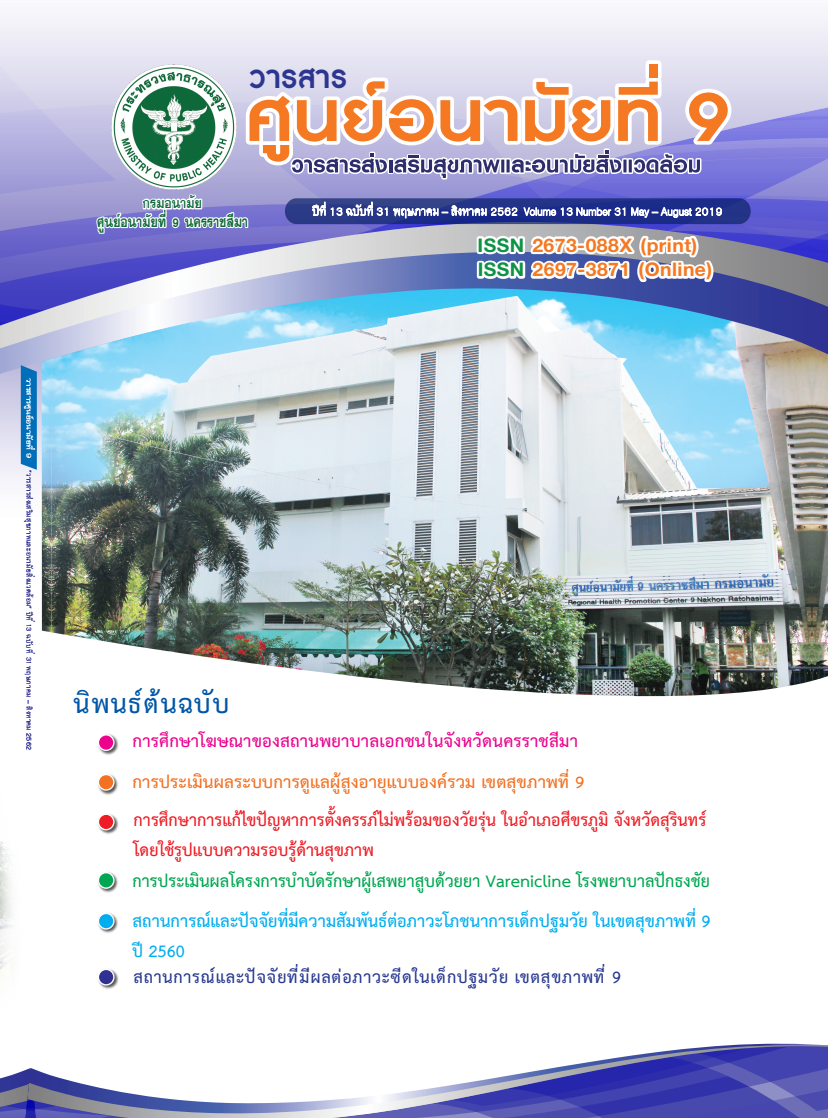
Situation and Factors Associated with Early Childhood Nutritional Status in Health Regional 9
Keywords:
Nutritional status, Early childhoodAbstract
The purpose of this descriptive study was to assess the situations and factors associated with early childhood nutritional status in health region 9. Subjects in this study were mothers, fathers and caregivers and 794 children resided in health region 9. The samples were selected using three-staged cluster sampling technique. Demographic and medical history data were obtained through the maternal and child health record books and questionnaires and Denver II child development measurement. The data were collected from April to June 2017. The descriptive data analysis included frequencies, percentages, arithmetic means and standard deviations. The analyses of association among various factors were done using odds ratio and chi-square.
The results showed that about 72.9 percent of the sample had appropriate nutritional status (Boys: 69.4 % and Girls: 79.4 %, child 0-2 years 71.3 percent and child 3-5 years 73.3 percent). Nutritional status was classified by weight by age, weight by height and height by age comparison between girls and boys had appropriate nutritional status of 80.8, 75.5, 82.3, 75.8, 88.7 and 88.7 respectively. It was found that girls had appropriate nutritional status than boys.
Factors that were found associated with early childhood nutritional status included maternal factors such as attending quality antenatal care 5 times, whether they took iodine and whether they have disease during pregnant. Early childhood factors associated with early childhood nutritional status included birth weight. Environment factors associated with early childhood nutritional status included caregiver aged.
It was suggested from this study that: 1) Development at all level mother and child care system such as increase antenatal care for pregnant women 5 times quality for given standard care, promoting nutrition during pregnancy, include guidelines to prevent premature labor prevent birth. Weight less than 2,500 gms. 2) The measures on the track monitoring evaluation and surveillance development in early childhood.
References
2. ลัดดา เหมาะสุวรรณ. คู่มือเครื่องชี้วัดทางโภชนาการและโรคที่เกี่ยวข้อง. กรุงเทพฯ: องค์การสงเคราะห์ทหารผ่านศึกในพระบรมราชูปถัมภ์; 2555.
3. ราชวิทยาลัยกุมารแพทย์แห่งประเทศไทย. คู่มือสำหรับพ่อแม่สำหรับเผยแพร่ ความรู้ ด้านการดูแลและพัฒนาเด็ก ตอนวัยเด็กเล็ก 0 – 3 ปี. กรุงเทพฯ: สมาคมกุมารแพทย์แห่งประเทศไทย; 2560.
4. World Health Organization. Levels and Trends in Child Malnutrition [Internet]. [cited 2019 Jan 24], Available from: http://www.who.int/nutgrowthdb/estimates2014/en/
5. วิชัย เอกพลากร. ระบบข้อมูลข่าวสารสุขภาพโดยการตรวจร่างกายครั้งที่ 4 พศ 2551-2552 [อินเตอร์เน็ต]. 2552 [เข้าถึงเมื่อ 1 มีนาคม 2562]. เข้าถึงได้จาก: https://www.hiso.or.th/hiso/picture/reportHealth/report6_9.pdf
6. ชัยพร พรหมสิงห์ วรรณภา กางกั้น และพนิต โล่เสถียรกิจ (2557). ภาวะโภชนาการเด็กปฐมวัยไทย พ.ศ. 2557.ชลบุรี: บางแสนการพิมพ์; 2559.
7. สำนักงานสถิติแห่งชาติ สปสช และยูนิเซฟ ประเทศไทย. ผลการสำรวจสถานการณ์เด็กและสตรีในประเทศไทย พศ. 2558-2559 [อินเตอร์เน็ต]. 2560 [เข้าถึงเมื่อ 24 มกราคม 2562] เข้าถึงได้จาก: http://www.nso.go.th/ sites/2014 / DocLib13 /2558/unicef%20MICS% 2014%20Provinces_TH-Hi%20res.pdf
8. พรรณี ไพบูลย์ และคณะ. ศึกษาสถานการณ์และปัจจัยที่มีผลต่อภาวะโภชนาการของเด็กปฐมวัยในเขตสุขภาพที่ 3. วารสารสาธารณสุขนครสวรรค์ 2561; 4(2) พ.ค.–ส.ค.:27–42.
9. Khejonchit P, Chutiman N, Kumphon B. Factor Associated with Under-Nutrition of Preschool Children in Kuchinarai District, Kalasin Province. Khon Kaen University Journal for Public Health Research 2013;6(3):168-175.
10. Sharghi A, Kamran A, Faridan M. Evaluating Risk for Protein - Energy Malnutrition in Under the Age of Six Years: a Case - Control Study from Iran. International Journal of General Medicine 2011;4:607-611.
11. สำนักส่งเสริมสุขภาพ กรมอนามัย. บริการฝากครรภ์คุณภาพครบ 5 ครั้งตามเกณฑ์ [อินเตอร์เน็ต]. 2560 [เข้าถึงเมื่อ 21 กุมภาพันธ์ 2562] เข้าถึงได้จาก: www.healthdata.moph.go.th/kpi/2555/KpiDetail.php?topic
Downloads
Published
How to Cite
Issue
Section
License
บทความหรือข้อคิดเห็นใด ๆ ที่ประกฎในวารสารศูนย์อนามัยที่ 9 เป็นความคิดเห็นของผู้เขียน บรรณาธิการ คณะผู้จัดทำ และศูนย์อนามัยที่ 9 นครราชสีมา (เจ้าของ) ไม่จำเป็นต้องเห็นด้วย ผู้เขียนต้องรับผิดชอบต่อบทความของตนเอง
ผลการพิจารณาของกองบรรณาธิการและผู้ทรงคุณวุฒิถือเป็นที่สิ้นสุด คณะบรรณาธิการวารสารฯ ขอสงวนสิทธิ์ในการตรวจแก้ไขข้อความให้ถูกต้องตามหลักภาษาและมีความเหมาะสม
กองบรรณาธิการวารสารฯ ขอสงวนสิทธิ์มิให้นำเนื้อหาใด ๆ ของบทความ หรือข้อคิดเห็นใด ๆ ของผลการประเมินบทความในวารสารฯ ไปเผยแพร่ก่อนได้รับอนุญาตจากกองบรรณาธิการ อย่างเป็นลายลักษณ์อักษร และผลงานที่ได้รับการตีพิมพ์ถือเป็นลิขสิทธิ์ของวารสารศูนย์อนามัยที่ 9

