
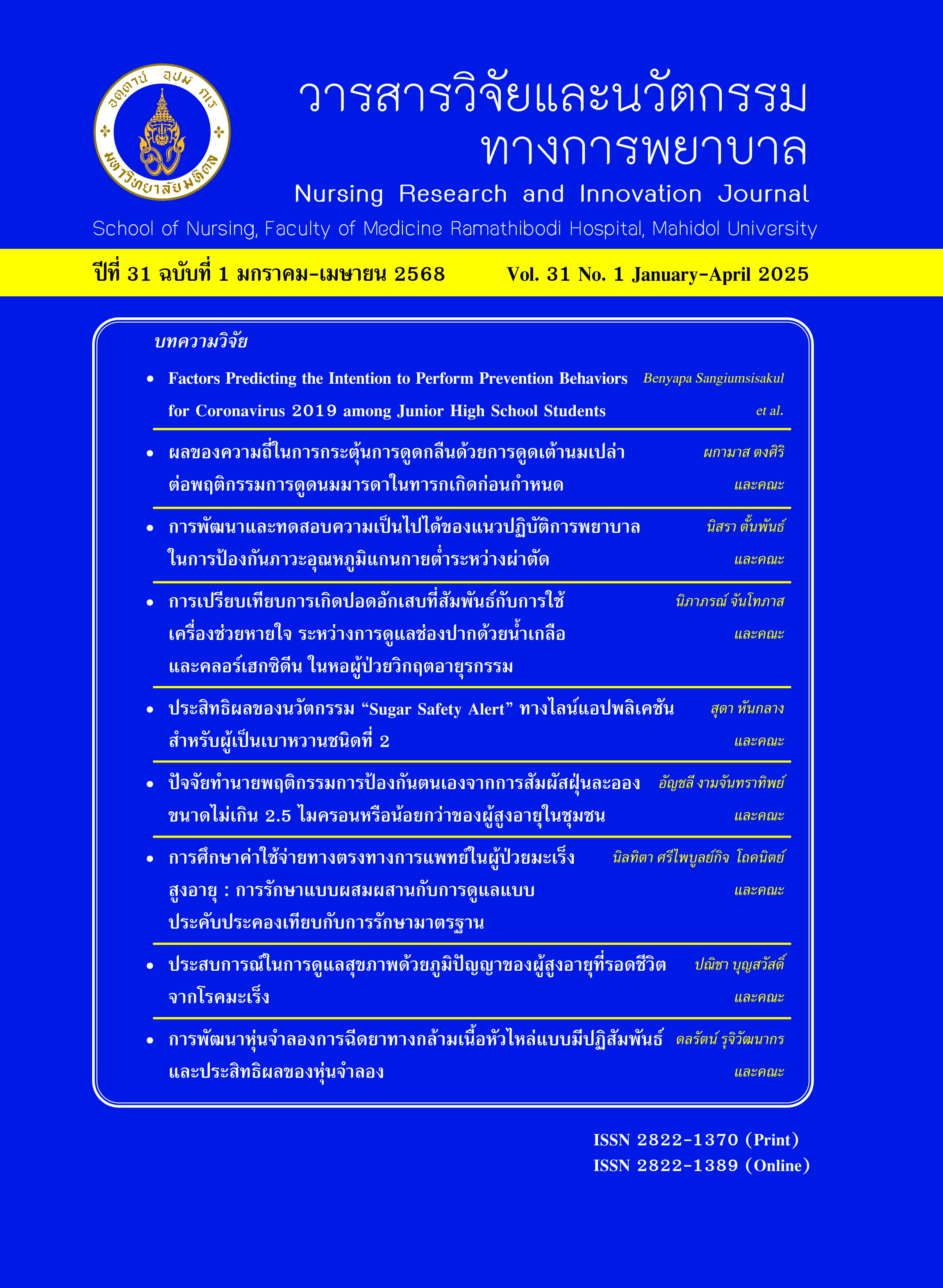
Effectiveness of an Innovation “Sugar Safety Alert” for Using the LINE Application on People with Type 2 Diabetes
Article Sidebar
Main Article Content
Abstract
Type 2 diabetes is a chronic disease and a public health issue that has seen an increasing incidence, with a continuous upward trend. Education and guidance on self-care practices to prevent complications, delivered in an accessible, rapid, and suitable online format, are still limited. This study was a two-group quasi-experimental study with pre- and post-test measurements, aimed at investigating the effectiveness of the “Sugar Safety Alert” innovation via the LINE application for people with type 2 diabetes. The sample consisted of 63 individuals aged 20–65 years with type 2 diabetes, divided into an experimental group (n = 32) and a control group (n = 31). The participants were randomly selected from a list of eligible individuals with type 2 diabetes. The experimental group received content via the LINE application, which was developed based on the Health Belief Model combined with the Seven Colors Life Traffic Ping Pong Program. The content validity of the application was confirmed with a content validity index of .94. The application included features for recording blood sugar levels, displaying blood sugar level warnings, knowledge on self-care for persons with diabetes, risk level of diabetic complications and specific advice on blood sugar levels specific for person with diabetes, including risk, severity of diabetic complications, benefits of preventing diabetic complications, guidelines for the prevention of complications and the promotion of behaviors aimed at preventing and managing the severity of the disease.The application was used for four weeks. In the first week, the researcher explained how to use the application, including access methods, and guided participants through the use of various parts of the LINE application. Participants were also given a blood sugar level situation journal for weeks 1–4, which included various blood sugar levels to be completed by each individual. The experimental group was instructed to enter the information and study the content from the application as a guideline for self-management. For weeks 2–4, participants filled in blood sugar level data according to situational prompts provided in week 1, twice a week with one blood sugar value per session, totaling eight values for the entire period, in order to study the recommendations from the LINE application for future use. The control group received standard healthcare services. After the experiment, the control group was also introduced to the LINE application. The effectiveness of the“Sugar Safety Alert” innovation was assessed in week 4 using a questionnaire that included measures of knowledge about diabetes and complications, perceived risk, perceived severity of diabetes complications, perceived benefits of complication prevention, behaviors to prevent and control diabetes severity, as well as blood sugar levels. Blood sugar data were collected from the participants after the experiment, using data from health records (secondary data) with consent from the participants. Data were analyzed using descriptive statistics, paired t-test for within-group comparisons, and independent t-test for between-group comparisons.The results showed that the experimental group had significantly higher levels of knowledge, perceived risk, severity, and perceived benefits of complication prevention from diabetes compared to the pre-test and compared to the control group. However, no significant differences were found in prevention behaviors or blood sugar levels. This suggests that providing comprehensive information, which is not exclusively focused on complications, along with a shorter trial period than previous studies, might contribute to the lack of noticeable significant changes in prevention behaviors or blood sugar levels. Therefore, extending the trial period is recommended to allow for the manifestation of prevention behaviors and the control of blood sugar levels. Nevertheless, the findings of this study provide healthcare professionals with an alternative approach to conducting activities across various channels more effectively. The LINE application can be used as a tool to educate and promote positive self-care attitudes, and it should be developed further to enable continuous blood glucose monitoring, thereby improving diabetes care in community settings.
Keywords: Blood sugar level, Health Belief Model, LINE application, Type 2 diabetes
Article Details

This work is licensed under a Creative Commons Attribution-NonCommercial-NoDerivatives 4.0 International License.
บทความ ข้อมูล เนื้อหา รูปภาพ ฯลฯ ที่ได้รับการตีพิมพ์ในรามาธิบดีพยาบาลสาร ถือเป็นลิขสิทธิ์ของวารสาร หากบุคคลหรือหน่วยงานใดต้องการนำทั้งหมดหรือส่วนหนึ่งส่วนใดไปเผยแพร่หรือเพื่อกระทำการใด ใด จะต้องได้รับอนุญาตเป็นลายลักษณ์อักษรจากรามาธิบดีพยาบาลสารก่อนเท่านั้น
References
World Health Organization. Diabetes; 2023 [cited 2024 September 18]. Available from: https://www.who.int/health-topics/ diabetes # tab=tab_1
Diabetes Association of Thailand. Clinical practice guideline for diabetes 2023; 2023 [cited 2024 September 28]. Available from:https:// thaipedendo.org/clinical-practice-guideline-for-diabetes-2023/
Health Data Center Dashboard, Ministry of Health Thailand. Diabetes morbidity rate; 2023 [cited 2024 November 14]. Available from: https://hdcservice.moph.go.th/hdc/reports/report.php?&cat_id=6a1fdf282fd28180eed7d1cfe0155e11&id=cefa42b9223ec4d1969c
ce18d762bdd#
Zhang P, et al. Global healthcare expenditure on diabetes for 2010 and 2030. Diabetes Res Clin Pract.2010;87:293–301.
Chatterjee S, et al. Cost of diabetes and its complications in Thailand: a complete picture of economic burden. Health Soc Care Community. 2011;19(3):289–98.
Pettongkhao S, Sukban U, Sungrod T, Choomek T. Effects of a self-care promotion on knowledge, perceptions and self-care behaviors among type 2 diabetes patients with uncontrolled blood sugar. Lanna Public Health Journal.2023;19(2):88-101.(in Thai)
Limrermsakul S, Saneha C, Wattanakitkrileart D,Buranasupkajorn P. (2022). Effects of a Health Literacy Development Program on Self-care Behaviors in Elderly with Type 2 Diabetes Mellitus. Nursing Science Journal of Thailand. 2022;40(1):84-98. (in Thai)
Sakchaisong N, Chiangkhong A, Cherdsuntia V. Effects of self-management program with Baowan Baochai mobile application for foot care behaviors prevention among uncontrolled type 2 diabetes mellitus. Journal of Behavioral Science for Development. 2023;15(2):1-16. (in Thai)
Tubkrong S, Nualcham P, Virojana N, Duangjan P. Effect of using LINE application health media to diabetic knowledge and understanding of schools’ staff. Journal of Nursing Siam University. 2018;19(36):78-87.(in Thai)
Sarnjanthuk S, Anuratpanich L. Evaluation of treatment outcome in type 2 diabetes mellitus patient by line application. Chiang Rai Medical Journal. 2022; 14(2):75-88. (in Thai)
Singkiboot S, Thoraphan R, Pibarnwong P. The development of a monitoring and early warning signs detecting application on the knowledge, behaviour, and FBS of persons with diabetes. Journal of Health and Nursing Education. 2024; 30(2): 56-74. (in Thai)
Pawong N, Sookpier P, Wangsrikhoon S. Effects of health education and health counselling using Line official account application for patients with type 2 diabetes mellitus receiving self-insulin injections. Journal of Nursing Science & Health. 2023; 46(4): 117-31. (in Thai)
Juwa S, Wongwat R, Manoton A. The effectiveness of the health behavior change program with 7 colors ball tool on knowledge, health belief and behaviour related to the prevention and control of hypertension and diabetes mellitus, in Maeka Sub-District, Muang District, Phayao Province. Songklanagarind Journal of Nursing.2021;39(2):127-41. (in Thai)
Becker MH. The health belief model and sick role behaviour. Health Educ Monographs. 1974;2:409-17.
Faul F, Erdfelder E, Buchner A, Lang AG. Statistical power analyses using G*Power 3.1: tests for correlation and regression analyses. Behav Res Methods. 2009;41(4):1149-60. doi: 10.3758/BRM.41. 4.1149.
Kijsanayothin P. The effectiveness of health promoting behavior program on control blood glucose level among elderly patients with type 2 diabetes mellitus in Sukhothai province, Thailand. Research and Development Health System Journal. 2021;14(2):103-13. (in Thai)
Birhanu TE, Guracho YD, Asmare SW, Olana DD. A mobile health application use among diabetes mellitus patients: a systematic review and meta-analysis. Front Endocrinol. 2024;15:1-11.
Smith J, Taylor M, Allen R. Effectiveness of mobile health applications in diabetes care. J Diab Technol.2023;15(3):134-42.
