
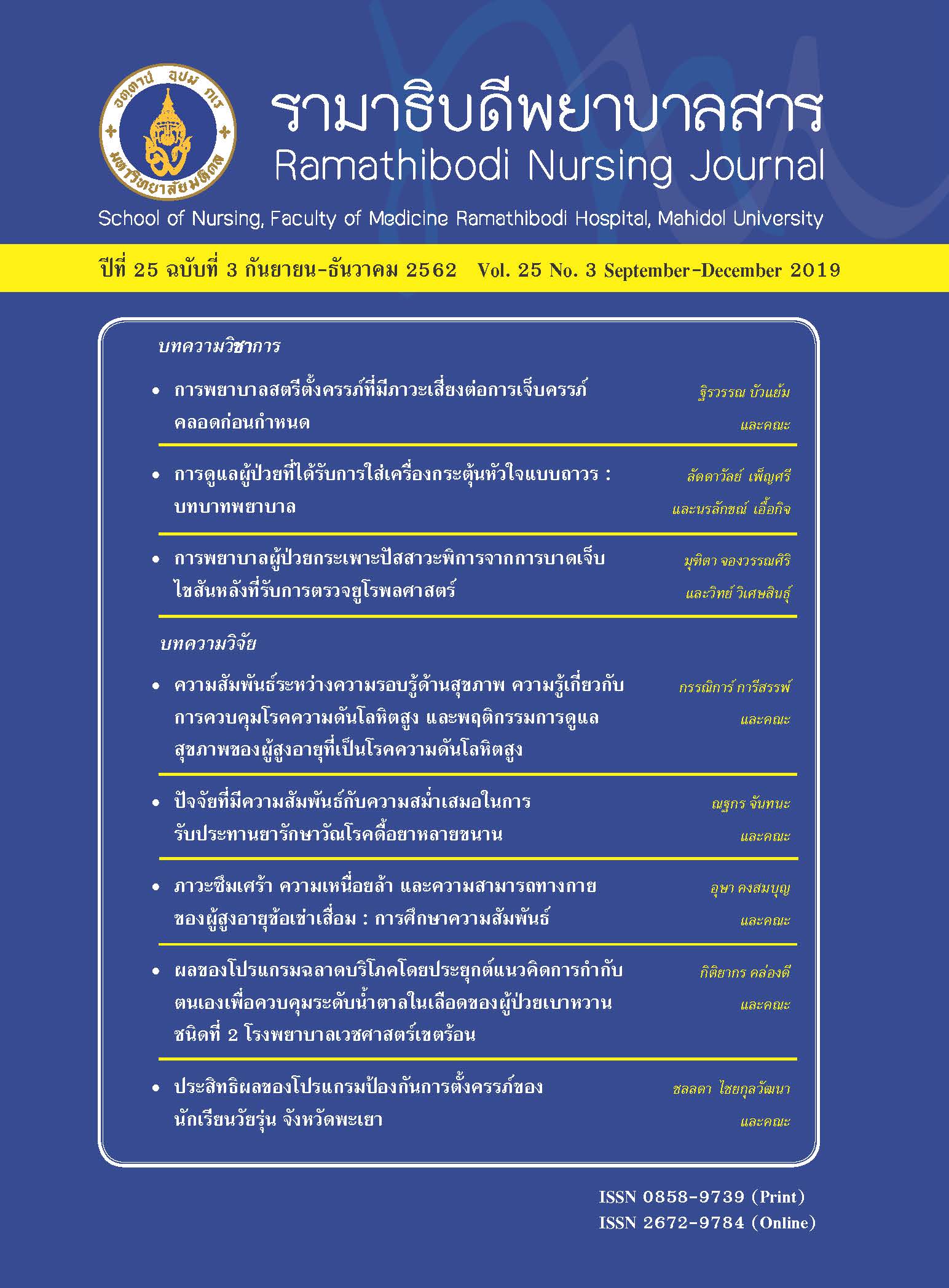
การดูแลผู้ป่วยที่ได้รับการใส่เครื่องกระตุ้นหัวใจแบบถาวร : บทบาทพยาบาล
Article Sidebar
Main Article Content
บทคัดย่อ
บทคัดย่อ
การใส่เครื่องกระตุ้นหัวใจแบบถาวรเป็นการรักษาผู้ป่วยที่มีภาวะหัวใจเต้นผิดจังหวะชนิดช้ามากในรายที่อาการของโรครุนแรงที่อาจเป็นอันตรายถึงชีวิต เพื่อทำให้การทำงานของหัวใจกลับมาทำหน้าที่ได้ใกล้เคียงภาวะปกติทั้งในขณะพักและออกกำลังกาย แต่ภายหลังการใส่เครื่องกระตุ้นหัวใจแบบถาวร ผู้ป่วยจำเป็นต้องอาศัยกลไกการทำงานของเครื่องไปตลอดชีวิต จึงต้องมีการปรับเปลี่ยนพฤติกรรมสุขภาพให้เหมาะสมเพื่ออยู่ร่วมกับเครื่องได้อย่างปลอดภัย แต่พบว่าผู้ป่วยยังมีการปฏิบัติพฤติกรรมสุขภาพไม่เหมาะสม ซึ่งส่งผลให้เกิดผลกระทบต่อผู้ป่วยในด้านต่าง ๆ ตามมา พยาบาลมีบทบาทสำคัญในการช่วยส่งเสริมให้ผู้ป่วยมีพฤติกรรมสุขภาพที่เหมาะสม โดยการให้ข้อมูลที่เป็นประโยชน์กับผู้ป่วยตั้งแต่ระยะพักรักษาตัวอยู่ในโรงพยาบาลจนถึงการเฝ้าติดตามให้การดูแลที่เหมาะสมกับผู้ป่วยแต่ละรายเมื่อผู้ป่วยได้รับการจำหน่ายกลับบ้าน ติดตามประเมินการปฏิบัติพฤติกรรมสุขภาพของผู้ป่วย เพื่อความยั่งยืนของการมีพฤติกรรมที่เหมาะสม มีภาวะสุขภาพ และมีคุณภาพชีวิตที่ดีต่อไป
Article Details
บทความ ข้อมูล เนื้อหา รูปภาพ ฯลฯ ที่ได้รับการตีพิมพ์ในรามาธิบดีพยาบาลสาร ถือเป็นลิขสิทธิ์ของวารสาร หากบุคคลหรือหน่วยงานใดต้องการนำทั้งหมดหรือส่วนหนึ่งส่วนใดไปเผยแพร่หรือเพื่อกระทำการใด ใด จะต้องได้รับอนุญาตเป็นลายลักษณ์อักษรจากรามาธิบดีพยาบาลสารก่อนเท่านั้น
เอกสารอ้างอิง
(in Thai)
2. Asdornwises U. Management of clients with dysrhythmias. In: Srimoragot P, editor. Medical-Surgical nursing: clinical M. Bangkok: iGroup press; 2010. (in Thai)
3. Boonwisut W. Bradyarrhythmia. In: Krittayaphong R, Phankingthongkum R, Wongpraparut N, Maneesai A, editors. Cardiac emergencies. Nonthaburi: Pappim; 2016. (in Thai)
4. Saengern U. Bradyarrhythmias. In: Wattanaprasan P, editor. EKG interpretation and management for ICU nurse.
Bangkok: Chanmuang press; 2012. (in Thai)
5. Kurucova R, Ziakova K, Gurkova E, Simkova E. Quality of life of patients with a permanent pacemaker.
OPAJ.2013;5(1):15-20.
6. Mond HG, Irwin M, Ector H, Proclemer A. The world survey of cardiac pacing and cardioverter-defibrillators:
calendar year 2005 an International Cardiac Pacing and Electrophysiology Society (ICPES) project. Pace 2008;
31(1):1202-12.
7. Mond HG, Proclemer A. The 11th world survey of cardiac pacing and implantable cardioverter-defibrillators:
calendar year 2009–a World society of arrhythmia’s project. Pace 2011;34(1):1013–27.
8. Kasemsuwan P. Annual scientific meeting: The Thai cardiac EP club. Bangkok; 2016. (in Thai)
9. Thachinlert B. The development of self-efficacy program in patients with permanent pacemaker in Srinagarind
hospital.[dissertation]. Khon Kaen: Khon Kaen University;2008. (in Thai)
10. Lelakowski J, Podolec P. Quality of life in patients after implantation of pacemaker type DDD. Polski merkuriusz
lekarski. 2000;50(9):554-6.
11. Dirks JL, Waters JM. Cardiovascular therapeutic management. In: Urden LD, Stacy KM, Lough ME,editors. Priorities in critical care nursing. Canada: Elsevier Health Sciences; 2015.
12. Tantitum P. Nursing care for cardiac pacemaker patients. In: Hanucharurnkul S, editor. Medicine nursing. 16thed.
Bangkok: VJ Printing company; 2009. (in Thai)
13. The Heart Association of Thailand Under the Royal Patronage of H.M. The King Medical treatment for cardiac
arrhythmia and heart failure with electronic implanted 2552 [cited 2016 October 1st]. Available from: https://
www.thaiheart.org/images/column_1291454908/ DeviceGuideline.pdf (in Thai)
14. Malm D, Hallberg L. Patients’experiencesof daily living with a pacemaker a grounded theory study. J Health
Psychol. 2006;11(5):787-98.
15. Aqeel M, Shafquat A, Salahuddin N. Pacemaker patients’ perception of unsafe activities: a survey. BMC Cardiovasc
Disor. 2008;31(8):1-5.
16. Pongsuay C, Choowattanapakorn T. Experiences of older persons living with permanent pacemakers. J Nurs Sci
Chulalongkorn University. 2012;24(3):79-91.(in Thai)
17. Kotsakoul M, Kioumis I, Lazaridis G, Pitsiou G, Lampaki S, Papaiwannou A et al. Pacemaker insertion. ATM J.
2015;3(3):1-8.
18. Palmer SJ. Post-implantation pacemaker complication: the nurse’s role in management. Brit J Cardiac Nurs. 2014;
9(12):592-8.
19. Kanjanarutjawiwat W, Pitaksuteepong T, Dermsomboon R. Permanent pacemakers: Prapokklao hospital experience
complication and management. J Prapokklao Hospital Medical Education Center. 2015;32(1):58-67. (in Thai)
20. Sansaneewitayakul B. Pacemaker electrocardiography. In: Sutthisook S, editor. Textbook of electrocardiogram.
Bangkok: Vinterprint; 2002. (in Thai)
21. Schiariti M, Cacciola M, Puddu PE. Complications of pacemaker implantation. Research Gate. 2011;38(2): 271-98.
22. Totb P, Knecbt J. Pacemaker. LPN.2009;5(1): 40.
23. Arrhythmia Alliance. Pacemaker Patient Information 2014 [cited 2016 October 1].Available from: www.
heartrhythmalliance.org/resources/view/283/pdf
24. American Heart Association. Living with your permanent pacemaker 2014 [cited 2016 May 1]. Available from:
https://www.heart.org/HEARTORG/Conditions/ Arrhythmia/Prevention TreatmentofArrhythmia
25. Figueroa C, Alcocer L, Ramos B. Psychological intervention to modify anxiety, depression and quality of life in patients with an implantable pacemaker. Psychology. 2016;7(3)374-81.
26. Pensri L. The effect of education and social support program on health behaviors in patient with cardiac permanent pacemaker. Chulalongkorn university; 2017.
27. Cynthia M & et al. Description of a nursing intervention program after an implantable cardioverter defibrillator.
Heart & Lung. 2014;3(33):183-90.
28. Rajgopal S and et al. CSI/IHRS practice guidelines on follow-up of patients with permanent pacemakers A
Cardiology Society of India/Indian Heart Rhythm Society task force report on practice guidelines on follow-up of
patients with permanent pacemakers. Indian Heart Journal. 2012;64:12-7.
