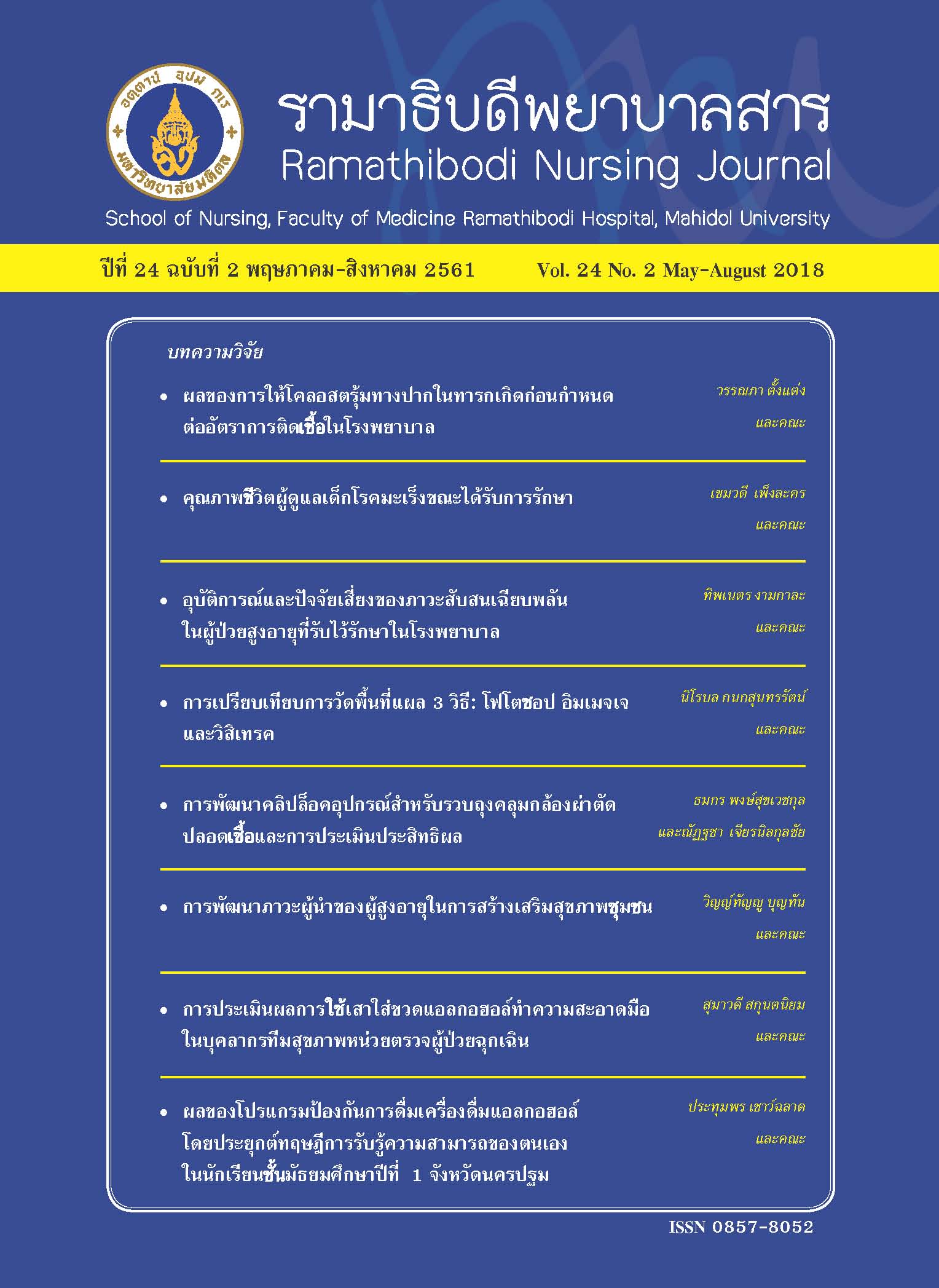
Effect of Oropharyngeal Colostrum Administration in Premature Infants on Nosocomial Infections
Article Sidebar
Main Article Content
บทคัดย่อ
บทคัดย่อ
การศึกษาครั้งนี้เป็นการวิจัยกึ่งทดลอง เพื่อเปรียบเทียบผลของการให้โคลอสตรุ้มทางปากในทารกเกิดก่อนกำหนดต่ออัตราการติดเชื้อในโรงพยาบาลระหว่างกลุ่มที่ได้รับโคลอสตรุ้มทางปากและกลุ่มที่ได้รับการพยาบาลตามปกติ กลุ่มตัวอย่างเป็นทารกเกิดก่อนกำหนด ที่เข้ารับการรักษาในหอผู้ป่วยวิกฤตทารกแรกเกิดจำนวน 60 ราย แบ่งกลุ่มตัวอย่างออกเป็น 2 กลุ่ม กลุ่มละ 30 ราย กลุ่มควบคุมได้รับการพยาบาลตามปกติ และกลุ่มทดลองได้รับการหยดโคลอสตรุ้ม0.2 มิลลิลิตร ทางปากบริเวณกระพุ้งแก้มทั้งสองข้างทุก 3 ชั่วโมง เป็นเวลานาน 7 วัน รวบรวมข้อมูลการติดเชื้อจากทะเบียนรายงานผู้ป่วยติดเชื้อของโรงพยาบาลและวิเคราะห์ข้อมูลโดยใช้สถิติ Chi-square และ odds ratioผลการศึกษาพบว่าอัตราการติดเชื้อในโรงพยาบาลในทารกเกิดก่อนกำหนดที่ได้รับโคลอสตรุ้มทางปากและทารกที่ได้รับการพยาบาลตามปกติไม่แตกต่างกันอย่างมีนัยสำคัญทางสถิติ (OR = .6 , 95% CI = .17- 2.08, p = .65) ดังนั้นจึงควรทำการศึกษาวิจัยเพิ่มเติมเพื่อเข้าใจมากขึ้นเกี่ยวกับการให้โคลอสตรุ้มทางปากในทารกเกิดก่อนกำหนดเพื่อป้องกันการติดเชื้อในโรงพยาบาล อย่างไรก็ตามผลการวิจัยครั้งนี้สามารถนำไปสร้างแนวปฏิบัติการพยาบาลในการให้โคลอสตรุ้มทางปากในทารกเกิดก่อนกำหนดได้ และยังช่วยส่งเสริมการให้นมแม่ในทารกป่วยที่อยู่ในหอผู้ป่วยวิกฤตทารกแรกเกิดอีกด้วย
Article Details
บทความ ข้อมูล เนื้อหา รูปภาพ ฯลฯ ที่ได้รับการตีพิมพ์ในรามาธิบดีพยาบาลสาร ถือเป็นลิขสิทธิ์ของวารสาร หากบุคคลหรือหน่วยงานใดต้องการนำทั้งหมดหรือส่วนหนึ่งส่วนใดไปเผยแพร่หรือเพื่อกระทำการใด ใด จะต้องได้รับอนุญาตเป็นลายลักษณ์อักษรจากรามาธิบดีพยาบาลสารก่อนเท่านั้น
เอกสารอ้างอิง
Philadelphia: Mosby/Elsevier; 2007:318-89.
2. Sharma AA, Jen R, Butler A, Lavoie PM. The developing human preterm neonatal immune system: a case for more
research in this area. J Immunol Res. 2012;145(1):61-8.
3. Crivaro V, Bogdanovic L, Bagattini M, Iula VD, Catania M, Raimondi F, et al. Surveillance of healthcareassociated
infections in a neonatal intensive care unit in Italy during 2006–2010. BMC Infect Dis. 2015;15(1):152-9.
4. Geffers C, Baerwolff S, Schwab F, Gastmeier P. Incidence of healthcare-associated infections in high-risk neonates:
results from the German surveillance system for verylow-birthweight infants. J Hosp Infect. 2008;68(3):214-21.
5. Vergnano S, Menson E, Kennea N, Embleton N, Russell AB, Watts T, et al. Neonatal infections in England:
theNeonin surveillance network. Arch Dis Child Fetal Neonatal Ed. 2011;96(1):F9-F14.
6. March of Dimes, WHO, PMNCH, Save the Children. The Global Action Report on Preterm Birth; 2012. (cited 2015
April 13). Available from March of Dimes Website:https://www.marchofdimes.org/glue/
7. Dudeck MA, Weiner LM, Allen-Bridson K, Malpiedi PJ, Peterson KD, Pollock DA, et al. National Healthcare Safety
Network (NHSN) report, data summary for 2012,Device-associated module. Am J Infect Control. 2013;41(12):1148-66.
8. Payne NR, Carpenter JH, Badger GJ, Horbar JD, Rogowski J. Marginal increase in cost and excess length of stay
associated with nosocomial bloodstream infections in surviving very low birth weight infants. Pediatrics.2004;114(2):348-55.
9. Shah DK, Doyle LW, Anderson PJ, Bear M, Daley AJ,Hunt RW, et al. Adverse neurodevelopment in preterm
infants with postnatal sepsis or necrotizing enterocolitis is mediated by white matter abnormalities on magnetic
resonance imaging at term. J Pediatr. 2008;153(2):170-5.
10. Wormald F, Tapia JL, Torres G, Canepa P, González M,Rodriguez D, et al. Stress in parents of very low birth
weight preterm infants hospitalized in neonatal intensive care units: a multicenter study. Arch Argent Pediatr.
2015;113(4):303-9.
11. Patel AL, Johnson TJ, Engstrom JL, Fogg LF, Jegier BJ, Bigger HR. Impact of early human milk on sepsis and
health-care costs in very low birth weight infants. J Perinatol. 2013;33(7):514-19.
12. Lawrence RM, Pane CA. Human breast milk: current concepts of immunology and infectious diseases. Curr Probl Pediatr Adolesc Health Care. 2007;37(1):7-36.
13. Araújo ED, Gonçalves AK, CornettaMdC, Cunha H,Cardoso ML, Morais SS, et al. Evaluation of the secretory
immunoglobulin A levels in the colostrum and milk of mothers of term and pre-trerm newborns. Braz J Infect
Dis. 2005;9:357-62.
14. Castellote C, Casillas R, Ramírez-Santana C, Pérez-Cano FJ, Castell M, Moretones MG, et al. Premature delivery
influences the immunological composition of colostrum and transitional and mature human milk. J Nutrit.
2011;141(6):1181-7.
15. Spatz D, Edwards T. The use of colostrum and human milk for oral care in the neonatal intensive care unit. NatlAssoc Neonatal Nurses E-News. 2009;1(4):1-3.
16. Rodriguez NA. Colostrum as a Therapeutic for Premature Infants. In: Watson RR, Grimble G, Preedy VR, Zibadi
S, editors. Nutrition in Infancy: Volume 1. Totowa, NJ:Humana Press; 2013. p. 145-55.
17. Gregory KE, Walker WA. Immunologic factors in human milk and disease prevention in the preterm infant.
CurrPediatr Rep. 2013;1(4):222-8
18. Rodriguez N, Meier P, Groer M, Zeller J. Oropharyngeal administration of colostrum to extremely low birth weight
infants: theoretical perspectives. J Perinatol. 2009;29(1):1-7.
19. Lee J, Kim H-S, Jung YH, Choi KY, Shin SH, Kim E-K,et al. Oropharyngeal colostrum administration in extremely
premature infants: an RCT. Pediatr Res. 2015;135(2):e357-e66.
20. Seigel JK, Smith PB, Ashley PL, Cotten CM, Herbert CC,King BA, et al. Early administration of oropharyngeal
colostrum to extremely low birth weight infants. Breastfeed Med.2013;8(6):491-5.
21. Rodriguez NA, Meier PP, Groer MW, Zeller JM, Engstrom JL, Fogg L. A pilot study to determine the safety and
feasibility of oropharyngeal administration of own mother’s colostrum to extremely low birth weight infants. Adv
Neonatal Care. 2010;10(4):206-12.
22. Newburg DS, Walker WA. Protection of the neonate by the innate immune system of developing gut and of human
milk. Pediatr Res. 2007;61(1):2-8.
23. Sharma AA, Jen R, Butler A, Lavoie PM. The developing human preterm neonatal immune system: a case for more
research in this area. ClinImmunol. 2012;145(1):61-8.
24. Strunk T, Currie A, Richmond P, Simmer K, Burgner D. Innate immunity in human newborn infants: prematurity
means more than immaturity. J Matern Fetal Neonatal Med. 2011;24(1):25-31.
25. Torrazza RM, Neu J. The developing intestinal microbiome and its relationship to health and disease in the neonate. J Perinatol. 2011;31(S1):S29-S34.
26. Lawrence RM, Pane CA. Human breast milk: current concepts of immunology and infectious diseases. Curr
Probl Pediatr Adolesc Health Care. 2007;37(1):7-36.
27. Reis Machado J, Soave DF, da Silva MV, de Menezes LB, Etchebehere RM, Monteiro MLGdR, et al. Neonatal sepsis and inflammatory mediators.MediatorsInflamm. 2014;2014:1-10.
28. Penhila IA. Milk-derived transforming growth factov-beta and the infant immune response. J Pediats. 2010;
156:S:21-5.
29. Gephart SM, Weller M, Gephart S. Colostrum as oral immune therapy to promote neonatal health. Adv Neonatal
Care. 2014;14(1):44-51.
30. Rodriguez NA, Vento M, Claud EC, Wang CE, Caplan MS. Oropharyngeal administration of mother’s colostrum,
health outcomes of premature infants: study protocol for a randomized controlled trial. Trials. 2015;16(1):453-66.
31. Bocci V. Absorption of cytokines via oropharyngealassociated lymphoid tissues. Clin Pharmacokinet.1991;21(6):411-7.
32. Faul F, Erdfelder E, Buchner A, Lang A-G. Statistical power analyses using G* Power 3.1: tests for correlation
and regression analyses. Behavior Research Methods. 2009;41(4):1149-60.
33. Gross SJ, Buckley RH, Wakil SS, McAllister DC, David RJ, Faix RG.Elevated Ig Aconcentrationin milk produced
by mothers delivered of preterm infants. J Pediatr. 1981;99:389–93
34. Hutchens TW, Henry JF, Yip T-T, Hachey DL, Schanler RJ, Motil KJ, et al. Origin of intact lactoferrinandits DNAbinding fragments found in the urine of human milk-fed preterminfants. Evaluation by stable isotopic enrichment.
Pediatr Res. 1991;29(3):243-50.
35. Rodriguez NA, Groer MW, Zeller JM, Engstrom JL, Fogg L, Du H, et al. A randomized controlled trial of the
oropharyngeal administration of mother’s colostrum to extremely low birth weight infants in the first days of life.
Neonatal Intensiv Care. 2011;24(4):31-5.
36. Zhang Y, Ji F, Hu X, Cao Y, Latour JM. Oropharyngeal colostrum administration in very low birth weight infants:
a Randomized Controlled Trial. Pediatr Crit Care Med. 2017;18(9):869-75.
