
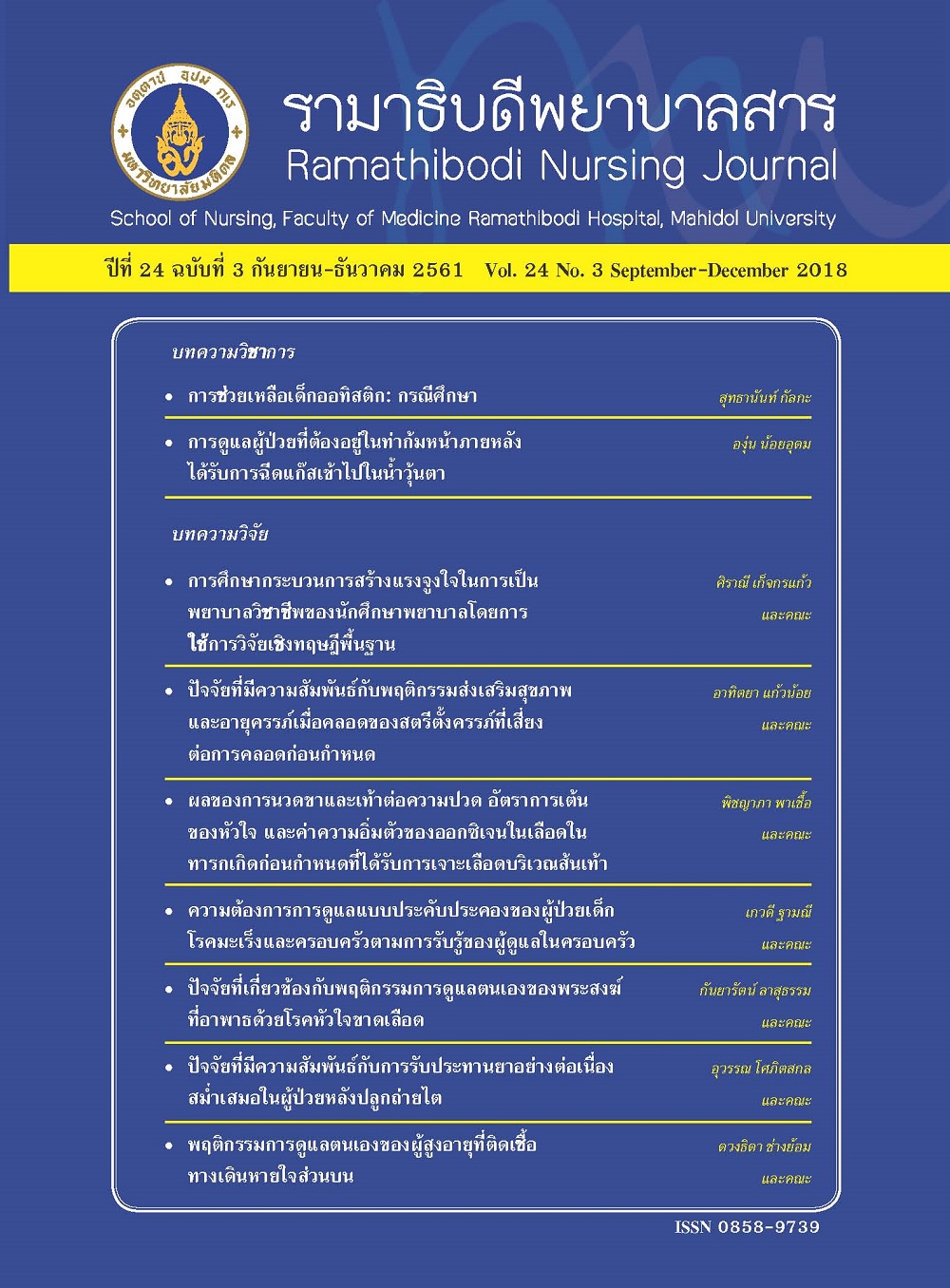
ผลของการนวดขาและเท้าต่อความปวด อัตราการเต้นของหัวใจ และค่าความอิ่มตัวของออกซิเจนในเลือดในทารกเกิดก่อนกำหนดที่ได้รับการเจาะเลือดบริเวณส้นเท้า
Article Sidebar
Main Article Content
บทคัดย่อ
ผลของการนวดขาและเท้าต่อความปวด อัตราการเต้นของหัวใจ และค่าความอิ่มตัวของออกซิเจนในเลือด จากการเจาะเลือดบริเวณส้นเท้าในทารกเกิดก่อนกำหนด
บทคัดย่อ: การวิจัยครั้งนี้เป็นการวิจัยกึ่งทดลองแบบข้ามสลับ (Cross over experimental research) เพื่อศึกษาผลของการนวดต่อการลดความปวดจากการเจาะเลือดบริเวณส้นเท้าในทารกเกิดก่อนกำหนด โดยศึกษาพฤติกรรมการตอบสนองต่อความปวด การเปลี่ยนแปลงของอัตราการเต้นของหัวใจ และการเปลี่ยนแปลงของค่าความอิ่มตัวของออกซิเจนในเลือด กลุ่มตัวอย่างเป็นทารกเกิดก่อนกำหนดจำนวน 30 ราย ที่เข้ารับการรักษาตัวในหอผู้ป่วยวิกฤตทารกแรกเกิด (NICU) ตั้งแต่เดือน มิถุนายน พ.ศ. 2558 ถึง เดือนตุลาคม พ.ศ. 2558 คัดเลือกกลุ่มตัวอย่างแบบเฉพาะเจาะจง และทำการสุ่มว่าจะได้รับเหตุการณ์ใดก่อน กลุ่มตัวอย่างจะได้รับทั้งเหตุการณ์ทดลอง และเหตุการณ์ควบคุม ในคนเดียวกัน เหตุการณ์ทดลองทารกได้รับการนวดก่อนเจาะเลือดบริเวณส้นเท้า และเหตุการณ์ควบคุมทารกได้รับการพยาบาลตามปกติก่อนเจาะเลือดบริเวณส้นเท้า ประเมินพฤติกรรมการตอบสนองต่อความปวดโดยใช้แบบประเมิน The Neonatal Infant Pain Scale (NIPS) วิเคราะห์เปรียบเทียบความแตกต่างของคะแนนความปวด อัตราการเต้นของหัวใจ และค่าความอิ่มตัวของออกซิเจนในเลือดโดยใช้สถิติ Paired t-test และ Wilcoxon’s signed - rank test ผลการศึกษาพบว่า ทารกเกิดก่อนกำหนดระยะที่ได้รับการนวดก่อนการเจาะเลือดบริเวณส้นเท้า มีค่าเฉลี่ยคะแนนความปวดขณะเจาะเลือดบริเวณส้นเท้า และหลังเจาะเลือดบริเวณส้นเท้านาทีที่ 5 มากกว่าทารกเกิดก่อนกำหนดระยะที่ได้รับการพยาบาลตามปกติ อย่างมีนัยสำคัญทางสถิติ ส่วนค่าเฉลี่ยคะแนนความปวดหลังเจาะเลือดบริเวณส้นเท้านาทีที่ 1, 3, 7 และ 10 ค่าเฉลี่ยอัตราการเต้นของหัวใจและค่าเฉลี่ยความอิ่มตัวของออกซิเจนในเลือดทุกช่วงเวลา ไม่แตกต่างกันอย่างมีนัยสำคัญทางสถิติ ดังนั้นจึงควรทำการศึกษาเพิ่มเติมเพื่อให้เข้าใจมากขึ้นเกี่ยวกับการนวดเพื่อลดความปวดในทารกเกิดก่อนกำหนด
คำสำคัญ: นวด เจาะเลือดบริเวณส้นเท้า ความปวด ทารกเกิดก่อนกำหนด
Article Details
บทความ ข้อมูล เนื้อหา รูปภาพ ฯลฯ ที่ได้รับการตีพิมพ์ในรามาธิบดีพยาบาลสาร ถือเป็นลิขสิทธิ์ของวารสาร หากบุคคลหรือหน่วยงานใดต้องการนำทั้งหมดหรือส่วนหนึ่งส่วนใดไปเผยแพร่หรือเพื่อกระทำการใด ใด จะต้องได้รับอนุญาตเป็นลายลักษณ์อักษรจากรามาธิบดีพยาบาลสารก่อนเท่านั้น
เอกสารอ้างอิง
2. Beck S, Wojdyla D, Say L, Betran AP, Merialdi M, Requejo JH, et al. The worldwide incidence of preterm birth: a systematic review of maternal mortality and morbidity. Bulletin of the World Health Organization. 2010;88:31-8.
3. Bureau of Policy and Strategy, Ministry of Public Health. Vital statistics – birth database ; 2015 [cited 2015 June 27]. Available from : http://bps.ops.moph.go.th/Healthinformation/statistic55/2.1.5_55.pdf. (in Thai)
4. Carbajal R, Rousset A, Danan C, Coquery S, Nolent P, Ducrocq S, et al. Epidemiology and treatment of painful procedures in neonates in intensive care units. Jama. 2008;300(1):60-70.
5. Mathew PJ, Mathew JL. Assessment and management of pain in infants. Postgrad Med J. 2003;79(934):438-43.
6. Butt ML, Kisilevsky BS. Music modulates behaviour of premature infants following heel lance. Can J Nurs Res. 2000;31(4):17-39.
7. Kwanjai Piyawattanasakul. Effect of swaddling on pain response form endotracheal suction in premature infant. [thesis]. Nakhon Pathom: Mahidol University; 2004. (in Thai)
8. Pandey M, Datta V, Rehan HS. Role of sucrose in reducing painful response to orogastric tube insertion in preterm neonates. Indian J Pediatr. 2013;80(6):476-82.
9. Leite AM, Linhares MB, Lander J, Castral TC, dos Santos CB, Silvan Scochi CG. Effects of breastfeeding on pain relief in full-term newborns. Clin J Pain. 2009;25(9):827-32.
10. Modarres M, Jazayeri A, Rahnama P, Montazeri A. Breastfeeding and pain relief in full-term neonates during immunization injections: a clinical randomized trial: BMC Anesthesiol. 2013;13:22. doi:10.1186/1471-2253-13-22.
11. Jain S, Kumar P, McMillan DD. Prior leg massage decreases pain responses to heel stick in preterm babies. J Paediatr Child Health. 2006;42(9):505-8.
12. Roongnapa Kittiwat. Infant massage : a handbook for loving touch. 4th ed. Bangkok:Amarin Printing and Publishing Public; 2003. (in Thai)
13. Vimala McClure. Infant massage: a handbook for loving parents. 3rd rev. ed. New york: Bantam books; 2000
14. Melzack R, Wall PD. Pain mechanisms: a new theory. Science. 1965;150(3699):971-9.
15. Mason P. Deconstructing endogenous pain modulations. J Neurophysiol. 2005;94(3):1659-63.
16. Lloyd DM, McGlone FP, Yosipovitch G. Somatosensory pleasure circuit: from skin to brain and back. Experimental Dermatology. 2015;24(5):321-4.
17. Glass GV. Primary, secondary, and meta-analysis of research. Educational Researcher. 1976;5(10):3-8.
18. Cohen J. Statistical power analysis for the behavioral sciences. 2nd ed. Hillsdaler, New Jersey:Lawrence Erlbaum Associates Publishers; 1998.
19. Lawrence J, Alcock D, McGrath P, Kay J, MacMurray SB, Dulberg C. The development of a tool to assess neonatal pain. Neonatal Netw. 1993;12(6):59-66.
20. Supapong S. Effects of soothing and supporting program on heart rate, oxygen saturation and pain among neonates undergoing venipuncture. [thesis]. Khon Kaen: Khon Kaen University; 2000. (in Thai)
21. Ahn Y. The relationship between behavioral states and pain responses to various NICU procedures in premature infants. Journal of tropical pediatrics. 2006;52(3):201-5.
22. Badr LK, Abdallah B, Hawari M, Sidani S, Kassar M, Nakad P, et al. Determinants of premature infant pain responses to heel sticks. Pediatr Nurs. 2010;36(3):129-36.
23. Achara Chinaworn & Kaneungnid Wongpoj. Effect of Massage on Pain During Vitamin K Injection in Neonates. Songklanagarind journal of nursing. 2012;32(3):27-36. (in Thai)
24. Johnston CC, Stevens BJ, Yang F, Horton L. Differential response to pain by very premature neonates. Pain. 1995;61(3):471-9.
25. Johnston CC, Stevens BJ. Experience in a neonatal intensive care unit affects pain response. Pediatrics. 1996;98(5):925-30.
26. Evans JC, McCartney EM, Lawhon G, Galloway J. Longitudinal comparison of preterm pain responses to repeated heelsticks. Pediatr Nurs. 2005;31(3):216-21.
27. Diego MA, Field T, Hernandez-Reif M. Procedural pain heart rate responses in massaged preterm infants. Infant Behav Dev. 2009;32(2):226-9.
