
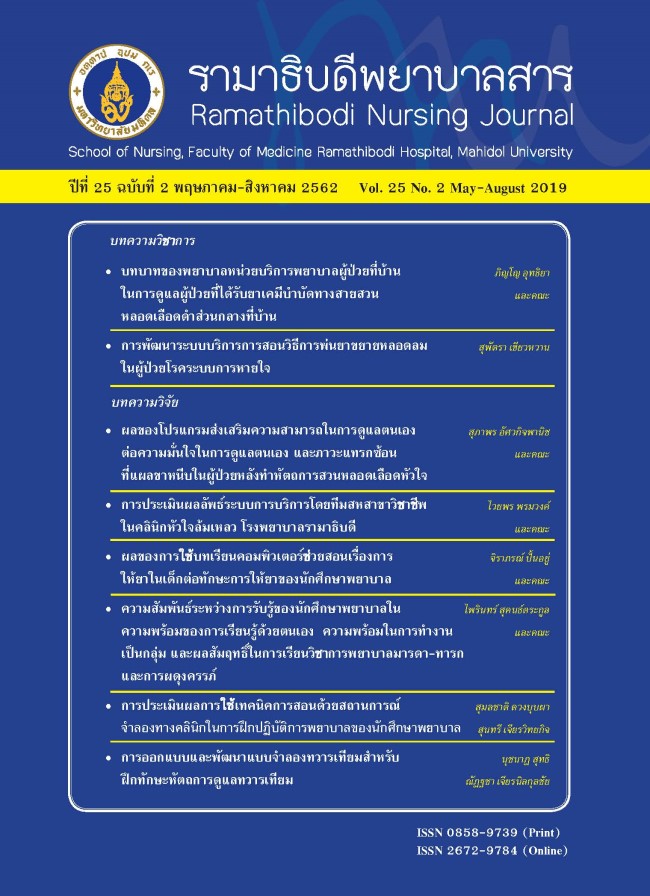
การพัฒนาระบบบริการการสอนวิธีการพ่นยาขยายหลอดลมในผู้ป่วยโรคระบบการหายใจ
Article Sidebar
Main Article Content
บทคัดย่อ
การรักษาผู้ป่วยโรคระบบการหายใจที่มีปัญหาหลอดลมหดเกร็ง ตีบ เช่น โรคหืด โรคปอดอุดกั้นเรื้อรัง มักใช้ยาสูดพ่นขยายหลอดลม เนื่องจากออกฤทธิ์เฉพาะที่ ผลข้างเคียงต่ำ มีประสิทธิภาพในการรักษาสูง ในการช่วยขยายปอดให้อากาศผ่านเข้าไปในปอดมากขึ้น ลดการอักเสบของหลอดลม และอาการเหนื่อยหอบกำเริบเฉียบพลัน ปัจจัยที่สำคัญในการใช้ยาสูดพ่นขยายหลอดลม คือ เทคนิคการหายใจ ความชำนาญในการสูดยาขยายหลอดลมเข้าทางปากของผู้ป่วย การได้รับคำแนะนำ เกี่ยวกับวิธีการเตรียมยา และการฝึกสูดยาที่ถูกต้อง ในแต่ละอุปกรณ์ จึงมีความสำคัญต่อผู้ป่วย เพื่อให้เกิดความชำนาญ มั่นใจในการสูดยา ส่งผลให้ยาเข้าถึงส่วนปลายของหลอดลมอย่างมีประสิทธิภาพ วัตถุประสงค์ของบทความวิชาการนี้ เพื่อพัฒนาระบบบริการการสอนพ่นยาขยายหลอดลมให้มีประสิทธิภาพช่วยให้ผู้ป่วยโรคระบบการหายใจสามารถใช้ยาสูดพ่นขยายหลอดลม ได้ถูกต้องเพิ่มมากขึ้น โดยเน้นการพัฒนาด้านต่างๆ 3 ด้าน (3M) คือ 1) ด้านบุคลากร(Man:M1) ที่เกี่ยวข้องกับการดูแลผู้ป่วยโรคระบบการหายใจ ให้มีความรู้ ความชำนาญในการให้คำแนะนำเกี่ยวกับยาสูดพ่นขยายหลอดลมและอุปกรณ์ชนิดต่าง ๆ 2) ด้านสื่อและอุปกรณ์การสอน (Material:M2) และ 3) ด้านแนวทางการปฏิบัติงาน เกณฑ์การประเมินวิธีการใช้ยาสูดพ่นขยายหลอดลมชนิดต่างๆ (Method:M3) ให้ได้มาตรฐานสากล มีแนวทาง และขั้นตอนการปฏิบัติงานเป็นไปในทางเดียวกัน ซึ่งการพัฒนาดังกล่าวสามารถนำไปใช้ได้จริงในภาคปฏิบัติ
Article Details
บทความ ข้อมูล เนื้อหา รูปภาพ ฯลฯ ที่ได้รับการตีพิมพ์ในรามาธิบดีพยาบาลสาร ถือเป็นลิขสิทธิ์ของวารสาร หากบุคคลหรือหน่วยงานใดต้องการนำทั้งหมดหรือส่วนหนึ่งส่วนใดไปเผยแพร่หรือเพื่อกระทำการใด ใด จะต้องได้รับอนุญาตเป็นลายลักษณ์อักษรจากรามาธิบดีพยาบาลสารก่อนเท่านั้น
เอกสารอ้างอิง
Dekhuijzen PR. The admit series—issues in inhalation
therapy. 2) Improving technique and clinical effectiveness.
Prim Care Respir J. 2009;18(2):76-82.
2. Ganderton D. General factors influencing drug delivery to
the lung. Respir med. 1997;91:13-6.
3. Pavia D. Efficacy and safety of inhalation therapy in chronic
obstructive pulmonary disease and asthma. Respirology
(Carlton, Vic). 1997;2:S5-10.
4. Newman SP. Production of radioaerosols. Aerosols and
the lung: clinical and experimental aspects: Butterworth
London; 1984. p. 71-91.
5. Capstick TG, Clifton IJ. Inhaler technique and training in
people with chronic obstructive pulmonary disease and
asthma. Expert Rev Respir Med. 2012;(1):91-101.
6. Brocklebank D, Ram F, Wright J, Barry P, Cates C, Davies
L, et al. Comparison of the effectiveness of inhaler devices
in asthma and chronic obstructive airways disease: a
systematic review of the literature. Health Technol Assess.
2001;5(26):1-149.
7. Newman S, Agnew J, Pavia D, Clarke S. Inhaled aerosols:
lung deposition and clinical applications. Clin Phys Physio
Meas. 1982;3(1):1-20.
8. Pedersen S, Hansen O, Fuglsang G. Influence of inspiratory
flow rate upon the effect of a turbuhaler. Arch Dis Child.
1990;65(3):308-10.
9. Ho SF, O’mahony MS, Steward JA,Breay P, Burr MC.
Inhaler technique in older people in the community. Age
Ageing. 2004;33(2):185-8.
10. Newman SP. Dry powder inhalers for optimal drug
delivery. Expert Opin Biol Ther. 2004;4(1):23-33.
11. Melani AS, Bonavia M, Cilenti V, Cinti C, Lodi M,
Martucci P, et al. Inhaler mishandling remains common
in real life and is associated with reduced disease control.
Respir Med. 2011;105(6):930-8.
12. Taddese F, Osada H. Process techno-innovation using
TQM in developing countries empirical study of deming
prize winners. J Technol Manag Innov. 2010;5(2):47-65.
13. Ishikawa K, Loftus JH. Introduction to quality control.
Tokyo: 3A Corporation; 1990.
14. Klijn SL, Hiligsmann M, Evers SM, Román-Rodríguez
M, van der Molen T, van Boven JF. Effectiveness and
success factors of educational inhaler technique
interventions in asthma & COPD patients: a systematic
review. NPJ Prim Care Respir Med. 2017;27(1):24.
doi:10.1038/s41533-017-0022-1.
15. Crompton G, Barnes P, Broeders M, Corrigan C, Corbetta
L, Dekhuijzen R, et al. The need to improve inhalation
technique in Europe: a report from the aerosol drug
management improvement team. Respir Med.
2006;100(9):1479-94.
16. Bower L, Barnhart S, Betit P, Care AAFR. AARC Clinical
practice guideline: selection of an aerosol delivery device
for neonatal and pediatric patients. Respir Care.1995;4(12):1325-35.
17. Newman SP. Spacer devices for metered dose inhalers.
Clinical Pharmacokinetics. 2004;43(6):349-60.
18. Dalby R, Spallek M, Voshaar T. A review of the
development of respimat® soft mist™ inhaler. Int J Pharm.
2004;283(1-2):1-9.
19. Baddar S, Rawas Al O. Which device for which patient?
criteria for selecting inhaler devices. Eur Respiratory Soc;
2012;40,p3426.
20. Alagusundaram M, Deepthi N, Ramkanth S,
Angalaparameswari S, Saleem TM, Gnanaprakash K, et
al. Dry powder inhalers-an overview. Int J Res Pharm Sci.
2010;1(1):34-42.
21. Phanphao W, Jenghua S, Supamoon W, Nakham A.
Intervention on manageing drug related problems in
hospitalized patients with asthma and chronic obstructive
pulmonaly disease (COPD) in Buddachinnaraj Phitsanulok
Hospital. NUJST. 2013;13(1):51-9.
22. Panida K, Porntip M, Surakit N, Theerasuk K. Self-care
for medication use in older patient with chronic obstructive
pulmonary disease. Rama Nurs J 2013;17(2):287-304.
23. Global Strategy for Asthma Management and Prevention:
2016. [cited 2019 July 1]. Available from: https://www.
ginasthma.org.
24. Interiano B, Guntupalli KK. Metered-dose inhalers: do
health care providers know what to teach? Arch Intern
Med. 1993;153(1):81-5.
25. Hanania NA, Wittman R, Kesten S, Chapman KR. Medical
personnel’s knowledge of and ability to use inhaling
devices: metered-dose inhalers, spacing chambers, and
breath-actuated dry powder inhalers. Chest.
1994;105(1):111-6.
26. Zainudin B, Sufarlan AW. Incorrect use of pressurised
metered dose inhaler by asthmatic patients. Med J Malasia
1990;45(3):235-8
27. Aydemir Y. Assessment of the factors affecting the failure
to use inhaler devices before and after training. Respir
Med. 2015;109(4):451-8.
28. Evans M. US Department of Health and Human Services
Health Resources and Services Administration. 2011.
29. Sokovic M, Pavletic D, Pipan KK. Quality improvement
methodologies–PDCA cycle, RADAR matrix, DMAIC
and DFSS. JAMME. 2010;43(1):476-83.
30. Gupta S. How to ensure the correct inhaler device is selected
for each patient. Clin Pharmacist. 2009;1:322-3.
31. Davies BL, editor Development of evaluation measures:
promoting asthma control in children. The 17th
International Nursing Research Congress Focusing on
Evidence-Based Practice; 2006.
