
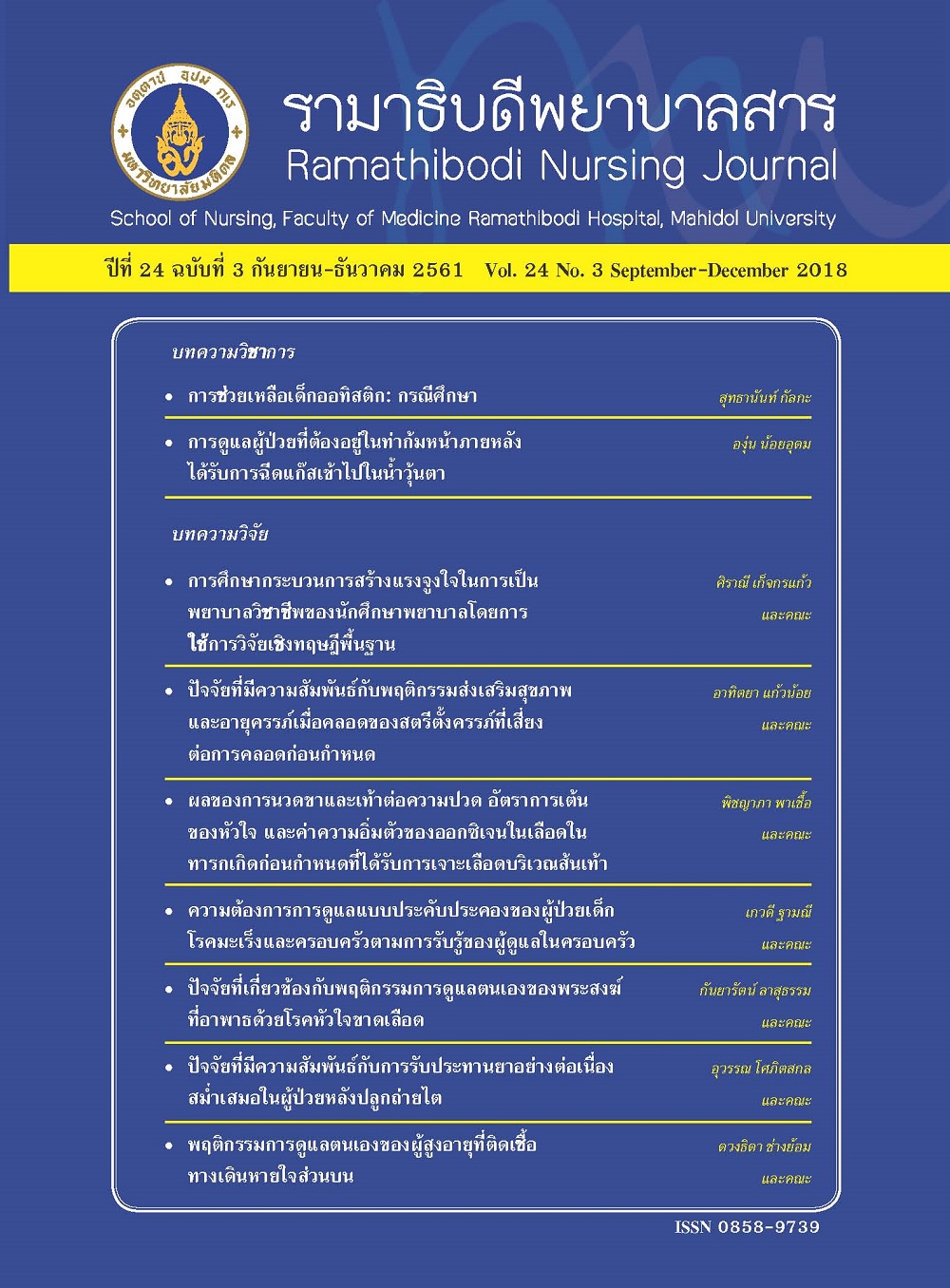
ปัจจัยที่มีความสัมพันธ์กับพฤติกรรมส่งเสริมสุขภาพและอายุครรภ์เมื่อคลอดของสตรีตั้งครรภ์ที่เสี่ยงต่อการคลอดก่อนกำหนด
Article Sidebar
Main Article Content
บทคัดย่อ
การวิจัยเชิงพรรณนาครั้งนี้มีวัตถุประสงค์เพื่อศึกษาความสัมพันธ์ระหว่างการรับรู้ประโยชน์ของการกระทำ การรับรู้อุปสรรคของการกระทำ การรับรู้สมรรถนะแห่งตน การสนับสนุนจากสามี
การสนับสนุนจากพยาบาล กับพฤติกรรมส่งเสริมสุขภาพ และอายุครรภ์เมื่อคลอดของสตรีตั้งครรภ์ที่เสี่ยงต่อการคลอดก่อนกำหนด กลุ่มตัวอย่างคือ สตรีตั้งครรภ์ที่เสี่ยงต่อการคลอดก่อนกำหนดจำนวน 162 ราย ที่มารับบริการที่แผนกฝากครรภ์ โรงพยาบาลนพรัตนราชธานี และโรงพยาบาลภูมิพล ระหว่างเดือนมกราคม พ.ศ. 2561 ถึง เดือนพฤษภาคม พ.ศ. 2561 โดยเลือกกลุ่มตัวอย่างแบบเฉพาะเจาะจงตามเกณฑ์ วิเคราะห์ข้อมูลโดยใช้สถิติบรรยาย สัมประสิทธิ์สหสัมพันธ์แบบเพียร์สัน และสหสัมพันธ์แบบสเปียร์แมน ผลการวิจัยพบว่า คะแนนการรับรู้ประโยชน์ของการกระทำ การรับรู้สมรรถนะแห่งตน การได้รับการสนับสนุนจากสามี การได้รับการสนับสนุนจากพยาบาล พฤติกรรมส่งเสริมสุขภาพในการป้องกันการคลอดก่อนกำหนดอยู่ในระดับมาก และคะแนนการรับรู้อุปสรรคของการกระทำอยู่ในระดับน้อย การรับรู้ประโยชน์ของการกระทำ การรับรู้อุปสรรคของการกระทำ การรับรู้สมรรถนะแห่งตน การสนับสนุนจากสามี และการสนับสนุนจากพยาบาล มีความสัมพันธ์กับพฤติกรรมส่งเสริมสุขภาพของสตรีตั้งครรภ์ที่เสี่ยงต่อการคลอดก่อนกำหนดอย่างมีนัยสำคัญทางสถิติ ส่วนการรับรู้ประโยชน์ของการกระทำ การรับรู้อุปสรรคของการกระทำ การรับรู้สมรรถนะแห่งตน การสนับสนุนจากสามี การสนับสนุนจากพยาบาล และพฤติกรรมส่งเสริมสุขภาพมีความสัมพันธ์กับอายุครรภ์เมื่อคลอดของสตรีตั้งครรภ์ที่เสี่ยงต่อการคลอดก่อนกำหนดอย่างไม่มีนัยสำคัญทางสถิติ ดังนั้น สมมติฐานที่คาดหวังว่าการปฏิบัติพฤติกรรมสุขภาพทางด้านบวกจะส่งผลต่ออายุครรภ์เมื่อคลอดยังไม่ได้รับการสนับสนุน จึงยังคงต้องการการศึกษาเพิ่มเติมต่อไป
Article Details
บทความ ข้อมูล เนื้อหา รูปภาพ ฯลฯ ที่ได้รับการตีพิมพ์ในรามาธิบดีพยาบาลสาร ถือเป็นลิขสิทธิ์ของวารสาร หากบุคคลหรือหน่วยงานใดต้องการนำทั้งหมดหรือส่วนหนึ่งส่วนใดไปเผยแพร่หรือเพื่อกระทำการใด ใด จะต้องได้รับอนุญาตเป็นลายลักษณ์อักษรจากรามาธิบดีพยาบาลสารก่อนเท่านั้น
เอกสารอ้างอิง
2. Blencowe H, Cousens S, Oestergaard MZ, Chou D, Moller AB, Narwal R, et al. National, regional, and worldwide estimates of preterm birth rates in the year 2010 with time trends since 1990 for selected countries: a systematic analysis and implications. Lancet. 2012;379:2162-72.
3. Pramana IA, Latzin P, Schlapbach LJ, Hafen G, Kuehni CE, Nelle M, et al. Respiratory symptoms in preterm infants: burden of disease in the first year of life. Eur J Med Res. 2011; 16(5):223–30.
4. Ralser E, Mueller W, Haberland C, Fink FM, Gutenberger KH, Strobl R. Rehospitalization in the first 2 years of life in children born preterm. Acta Paediatr. 2012;101(1):e1–e5.
5. Murphy JH, Rubin DO. Psychosocial implications of high risk pregnancy. Philadelphia: W.B. Saunders; 1993.
6. Kraikul S, Chaimongkol N, Phaktoop M. Relationships between parental stress and parent-child attachment in sick children who admitted in intensive care unit. Journal of Boromarajonani College of Nursing, Chonburi. 2009;22(1):19-28. (in Thai)
7. Sopajaree C, Ratchukul S. Anxiety of frist-time expectant parents in hight-risk pregnancy. Journal of Nursing Science Chulalongkorn University. 2002;14(3):1-12. (in Thai)
8. Creasy RK, Gummer BA, Nzrn, Liggins GC. System for predicting spontaneous preterm birth. Obstet Gynecol. 1980;55:692-5.
9. Pender NJ, Murdaugh CL, Parson MA. Health promotion in nursing practice. 5th ed. Upper Saddle River, NJ: Prentice Hall; 2006.
10. Chen W, Wen SW, Fleming N, Demissie K, Rhoads GG, Walker M. Teenage pregnancy and adverse birth outcome: a large population based retrospective cohort study. Int J Epidemiol. 2007; 36:368-73.
11. Derakhshi B, Esmailnasab N, Ghaderi E, Hemmatpour S. Risk factor of preterm labor in the West of Iran: a case-control study. Iran J Public Health. 2014;43(4):499-506.
12. Hantanong, B. Incidence and risk factors of preterm delivery at Ramathibodi hospital 2005-2006 [thesis]. Nakhon Prathom: Mahidol University; 2007.
13. Wisavapaisan W, Srithammasak B, Nakkrasae S. Factor affecting the prediction of gravid women giving preterm birth at police general hospital. Journal of The Police Nurse . 2016;8(2):83-90. (in Thai)
14. Ip M, Peyman E, Lohsoonthorn V, Williams MA. A case-control study of preterm delivery risk factors according to clinical subtypes and severity. J Obstet Gynaecol Res. 2010;36(1):34-44.
15. Swingle H, Colaizy T, Zimmerman M, Morriss F. Abortion and the risk of subsequent preterm birth: a systematic review with meta-analyses. J Reprod Med. 2009;54(2):95-108.
16. Edwards DV, Baird D, Hasan R, Savitz D, Hartmann K. First-trimester bleeding characteristics associate with increased risk of preterm birth: Data from a prospective pregnancy cohort. Hum Reprod. 2012;1:54-60.
17. Facchinetti F, Ottolini F, Fazzio M, Rigatelli M, Volpe A. Psychosocial factors associated with preterm uterine contractions. Psychother Psychosom. 2007;76:391-94.
18. Araksomboon, O. Factors associated with preterm labour at Prachuapkhirikhan hospital [thesis]. Nakhon Prathom: Mahidol University; 2001.
19. Ariyadej S. Risk factors predicting preterm labours in Rayong hospital. Health. 2001;24(4):92-103.
20. Niedhammer I, O’Mahony D, Daly S, Morrison JJ, Kelleher CC. Occupational predictors of pregnancy outcomes in Irish working women in the lifeways cohort.BJOG. 2009;116(7):943-52.
21. Nirattharadorn M. The study of perceived benefits, perceived barriers to health promoting behaviors and health promoting behaviors in adolescent pregnant women [thesis]. Nakhon Prathom: Mahidol University; 1996. (in Thai)
22. Lonuch S, Nirattharadorn M, Khampalikit S. Predicting factors of nutritional promoting behaviors among pregnant women over 35 years of age. J Nurs Educ. 2011;4(2):79-93. (in Thai)
23. Wongchantara T. Self-esteem, perceived benefits, and health promoting behaviors in diabetic pregnant women [thesis]. Nakhon Prathom: Mahidol University; 2000. (in Thai)
24. Panyapisit, R. Perceived benefits of action, perceived barriers to action, and health promoting behaviors during pregnancy of mothers experiencing preterm delivery [thesis]. Nakhon Prathom: Mahidol University; 2002.
25. Thaewpia S, Clark MJ, Howland LC, James KS. Factor predicting health promoting behaviors among older pregnant Thai. Pac Rim Int J Nurs Res Thail. 2012; 16(2):113-23.
26. Chumsri T. Relationships between personal factors, perceived benefits, perceived barriers, perceived self-efficacy, interpersonal influences and health promoting behaviors of pregnant adolescents, southern region [thesis]. Bangkok: Chulalongkorn University; 2005. (in Thai)
27. Yusumran C, Kongjira A, Sirisomboon R, Pimon K, Chalermchokcharernkit A. Social support knowledge and self-efficacy in pregnant women preterm labour. Thai Journal of Nursing Council. 2007;22(1):60-72. (in Thai)
28. Choijorhor R, Serisathien Y, Ratinthorn A, Kovavisarach E. The effects of nursing therapeutics on preventive management of preterm labor, readmission and gestational age at birth in pregnant women with preterm labor. J Nurs Sci. 2009;27(2):39-48. (in Thai)
29. Nuiman T. Effect of empowerment program on behaviors for prevention of preterm labour among Muslim teenage pregnant women. Thai J Nurs. 2011;60(2):22-30. (in Thai)
30. Wirifai S. The effects of structured information on perceived self-efficacy, outcome expectation of health behaviors and outcome of pregnancy in pregnant women with premature labor pain [thesis]. Nakhon Prathom: Mahidol University; 2004.
31. Pinkaeo S. The effect of care for pregnant women at risk for preterm labor. The Journal of Faculty of Nursing Burapha University. 2014;22(4):58-70. (in Thai)
32. Sensiri P. Development of the nursing model for pregnant women to prevent preterm labour. J Nurs Health Care. 2016; 34(2):166-3. (in Thai)
33. Orathai P, Phumonsakul S. Power analysis and sample size estimation using G*Power program. Bangkok: Pimdee; 2013. (in Thai)
34. Patanavanichnun, N. Perceived self-efficacy and health promoting behaviors among pregnant industrial workers [thesis]. Nakhon Prathom: Mahidol University; 2000.
35. Tumgunma O. Spouse support and health-promoting behavior in high risk pregnant women [thesis]. Nakhon Prathom: Mahidol University; 1997. (in Thai)
36. Picharn S. Support from nurses and health behaviors of persons with hypertension at Doisaket hospital, Chiang Mai Province [thesis]. Chiang Mai: Chiang Mai University; 2004. (in Thai)
37. Eliyahu S, Weiner E, Nachum Z, Shalev E. Epidemiologic risk factors for preterm delivery. Isr Med Assoc J. (2002); 4:1115-7.
38. Office of the National Economics and Social Development Board. 2016: Thailand [cited 2018 May 12]. Available from: http://social.nesdb.go.th/SocialStat/StatReport_Final (in Thai)
39. Muhlenkamp AF, Sayles JA. Self-esteem, social support and positive health practice. Nurs Res. 1986;35(11):334-8.
40. Phumesawat S, Suvithayasiri K, Chaisup W. Perceived benefits and health promoting behaviors in pregnant women at antenatal clinic of Rajavithi hospital. Journal of Boromarajonani College of Nursing, Bangkok. 2013;29(2):80-94. (in Thai)
