
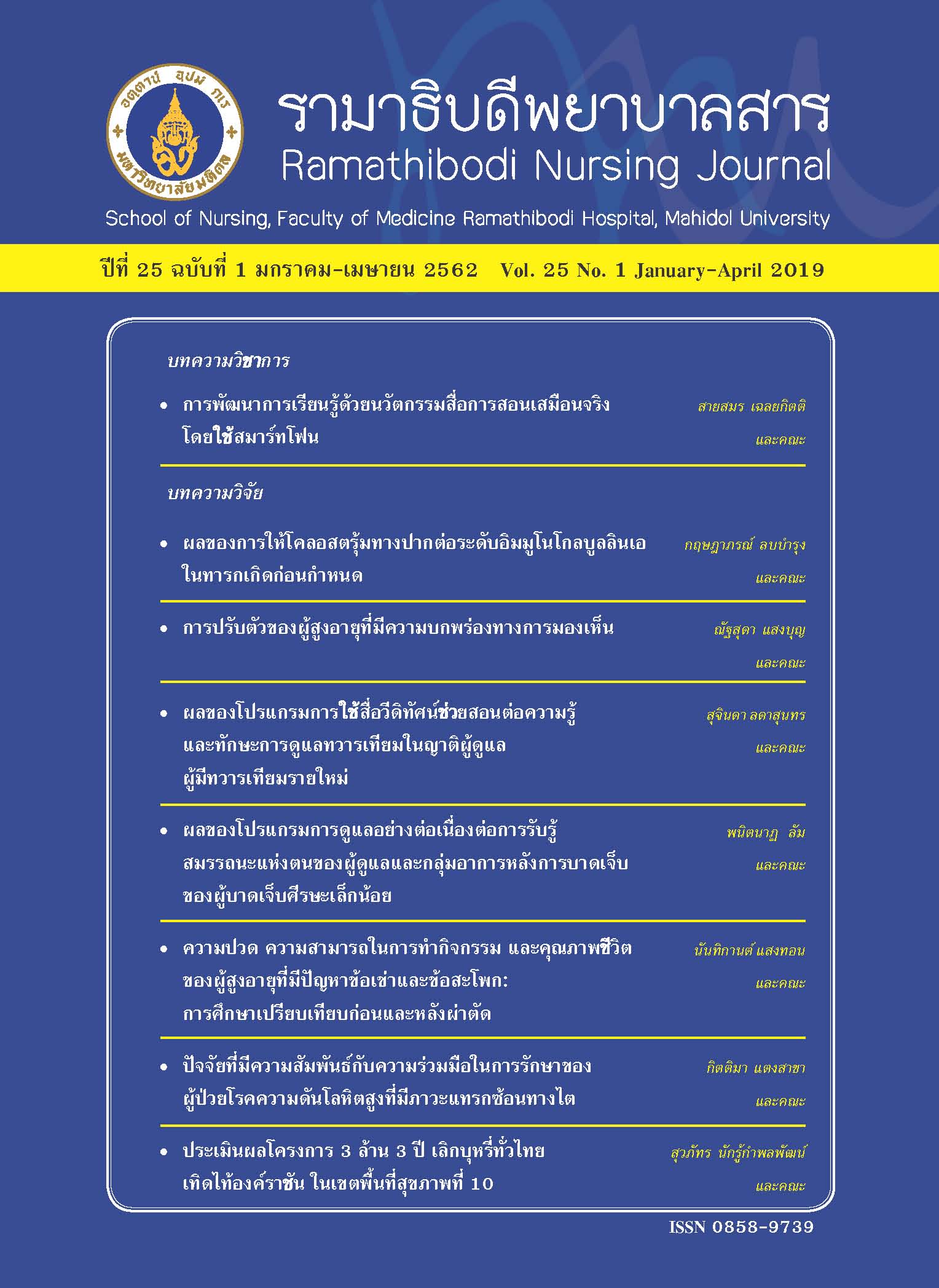
ความปวด ความสามารถในการทำกิจกรรม และคุณภาพชีวิตของผู้สูงอายุที่มีปัญหาข้อเข่าและข้อสะโพก: การศึกษาเปรียบเทียบก่อนและหลังผ่าตัด
Article Sidebar
Main Article Content
บทคัดย่อ
การศึกษาครั้งนี้เป็นการศึกษาเชิงบรรยาย แบบศึกษาเปรียบเทียบไปข้างหน้า เพื่อศึกษาความปวด ความสามารถในการทำกิจกรรมและคุณภาพชีวิตของผู้สูงอายุที่ได้รับการผ่าตัดข้อเข่าและข้อสะโพก ทั้งก่อนผ่าตัดและหลังผ่าตัด 6 สัปดาห์ ในผู้ที่มีอายุ 60 ปีขึ้นไป ที่เข้ารับการรักษาในหอผู้ป่วยออร์โธปิดิกส์สามัญ ออร์โธปิดิกส์พิเศษ ออร์โธปิดิกส์กึ่งวิกฤต ศัลยกรรมอุบัติเหตุ และหอผู้ป่วยในอาคารสมเด็จพระเทพรัตน์ และภายหลังได้รับการผ่าตัด 6 สัปดาห์ ที่มาติดตามการรักษาที่แผนกผู้ป่วยนอกออร์โธปิดิกส์ และแผนกผู้ป่วยนอกออร์โธปิดิกส์พิเศษ โรงพยาบาลตติยภูมิแห่งหนึ่งในกรุงเทพมหานคร กลุ่มตัวอย่าง จำนวน 95 คน คัดเลือกกลุ่มตัวอย่างที่มีคุณสมบัติตามเกณฑ์การคัดเข้า ดำเนินการวิจัยโดยให้กลุ่มตัวอย่างลงนามเข้าร่วมการวิจัยก่อนเริ่มการสัมภาษณ์ โดยใช้แบบสอบถาม แบบประเมินความปวด แบบประเมินดัชนีบาร์เทลเอดีแอล แบบสอบถามคุณภาพชีวิตผู้ป่วยโรคสะโพกและข้อเข่าเสื่อม เก็บข้อมูลขณะผู้ป่วยนอนโรงพยาบาลก่อนผ่าตัด ก่อนจำหน่ายกลับบ้าน และ 6 สัปดาห์หลังผ่าตัดขณะติดตามการรักษาที่หน่วยตรวจผู้ป่วยนอกโรคกระดูกและข้อ วิเคราะห์ข้อมูลโดยใช้โปรแกรมคอมพิวเตอร์สำเร็จรูปด้วยสถิติบรรยาย และสถิติ ทีแบบกลุ่มตัวอย่างไม่อิสระจากกัน กำหนดระดับนัยสำคัญที่ .05 ผลการวิจัย พบว่าความปวดหลังผ่าตัดในระยะก่อนจำหน่ายกลับบ้านและหลังผ่าตัด 6 สัปดาห์ แตกต่างกันอย่างมีนัยสำคัญทางสถิติ (p-value = 0.03) เช่นเดียวกับคุณภาพชีวิตก่อนและหลังผ่าตัด 6สัปดาห์ มีความแตกต่างกันอย่างมีนัยสำคัญทางสถิติ (p-value = 0.02) ในขณะที่ความสามารถในการทำกิจกรรมก่อนและหลังผ่าตัด 6 สัปดาห์ มีความแตกต่างกันอย่างไม่มีนัยสำคัญทางสถิติ (p-value = 0.86) ผลการศึกษาครั้งนี้ช่วยให้ทีมสุขภาพเข้าใจการเปลี่ยนแปลงความปวด และคุณภาพชีวิตของผู้สูงอายุที่เข้ารับการผ่าตัดข้อเข่าและข้อสะโพก รวมทั้งตระหนักถึงแนวทางในการส่งเสริมความสามารถในการทำกิจกรรมของผู้สูงอายุหลังผ่าตัดดังกล่าว และการติดตามการเปลี่ยนแปลงความปวด ความสามารถในการทำกิจกรรม และคุณภาพชีวิตในระยะยาวนานกว่า 6 สัปดาห์หลังผ่าตัด
Article Details
บทความ ข้อมูล เนื้อหา รูปภาพ ฯลฯ ที่ได้รับการตีพิมพ์ในรามาธิบดีพยาบาลสาร ถือเป็นลิขสิทธิ์ของวารสาร หากบุคคลหรือหน่วยงานใดต้องการนำทั้งหมดหรือส่วนหนึ่งส่วนใดไปเผยแพร่หรือเพื่อกระทำการใด ใด จะต้องได้รับอนุญาตเป็นลายลักษณ์อักษรจากรามาธิบดีพยาบาลสารก่อนเท่านั้น
เอกสารอ้างอิง
2. Zhang Y, Jordan JM. Epidemiology of osteoarthritis. Clin Geriatr Med. 2010;26(3):355-69.
3. Moore TJ, Gottschalk MB. Hip fracture. In: Lubin MF, Dodson TF, Winawer HN, editors. Medical management of the surgical patient. New York: Cambridge University Press; 2013. p.724-26.
4. Maradit KH, Larson DR, Crowson CS, Kremers WK, Washington RE, Steiner C, et al. Prevalence of total hip and knee replacement in the United States. J Bone Joint Surg Am. 2015;97(17):1386-97.
5. Rynder SD, Hart JA. Orthopaedics for physician assistants. 1st ed. Philadelphia, PA: Elseiver/Saunders; 2013.
6. Sveinsdottir H, Skuladottir H. Postoperative psychological distress in patients having total hip or knee replacement: an exploratory panel study. Orthop Nurs. 2012;31 (5):302-11.
7. Bade MJ, Kohrt WM, Stevens-Lapsley JE. Outcomes before and after total knee arthroplasty compared to healthy adults. J Orthop Sports Phys Ther. 2010;40(9):559-67.
8. Khamwong W, Nusawad J, Pratanworapanya W, Siripanya J. Factors relating to quality of life of elderly. Journal of Health Science Research. 2010;5(2):32-40. (in Thai)
9. World Health Organization. International classification of functioning, disability, and health; 2001 [cited 2016 Jun 16]. Available from World Health Organization Website: https://www.who.int/classifications/icf/en/
10. Purakom A, Tanomsuk M, Pupanead S, Chanyaem C, Setthasirichot P. Physical activity guidelines for older adults. Nakhorn Prathom: Kasetsart University, Kamphaeng Saen Campus; 2013. (in Thai)
11. Faul F, Erdfelder E, Buchner A, Lang AG. Statistical power analyses using G*Power 3.1: tests for correlation and regression analyses. Beh Res Methods. 2009;41:1149-60.
12. Trongsakul S, Lambert R, Clark A, Wongpakaran N, Cross J. Development of the Thai version of Mini-cog, a brief cognitive screening test. Geriatr Gerontol Int. 2015;15 (5):594-600.
13. Borson S, Scanlan JM, Chen P, Ganguli M. The mini-cog as a screen for dementia: validation in a population-based sample. J Am Geriatr Soc. 2003;51(10):1451-4.
14. Pasero C, McCaffery M, Gordon DB. Build institutional commitment to improving pain management. Nurs Manage. 1999;30(1):27-34.
15. Mawdstly RH, Moran KA, Conniff LA. Reliability of two commanly used pain scales with elderly patients. J of Geriatr Phys Ther. 2002;25(3):16-20.
16. Jitapunkul S, Kamolratanakul P, Ebrahim S. The meaning of activities of daily living in a Thai elderly population: development of a new index. Age Ageing. 1994;23 (2):97-101.
17. Tamsat A, Aree-Ue S, Leelacharas S. Fear of falling and functional ability in older adults undergoing hip surgery. Journal of tje police Nurses. 2015;7(1):64-82.
18. Rat AC, Pouchot J, Coste J, Baumann C, Spitz E, Retel-Rude N, Guillemin F. Development and testing of a specific quality-of-life questionnaire for knee and hip osteoarthritis: OAKHQOL (OsteoArthritis of Hip Knee Quality Of Life). Joint Bone Spine. 2006;73(6):697-704.
19. Kane RL, Ouslander JG, Abrass IB, Resnick B. Essentials of clinical geriatrics. 6th ed. New York: McGraw-Hill; 2009.
20. Visitsakul S. Nursing care of the patient with osteoarthritis knee by supportive treatment. Journal of Thai Orthopaedic Nurses’ Society. 2012;17(1):4-13. (in Thai)
21. U.S. National Library of Medicine. Aging change in the bones–muscles–joint; 2016 [cited 2016 May 9]. Available from United States National Library of Medicine Website: https://www.nlm.nih.gov/medlineplus/ency/article/004015.htm.
22. Kwoh CK, Hwang YG. Osteoarthritis. In: Williams BA, Chang A, editors. Current diagnosis and treatment. Singapore: McGraw-Hill Education; 2014. p.159-68.
23. Haq SA, Davatchi F. Osteoarthritis of the knees in the COPCORD world. Int J Rheum Dis. 2011;14(2):122-9.
24. Lawrence RC, Felson DT, Helmick CG, Arnold LM, Choi H, Deyo RA, et al. Estimates of the prevalence of arthritis and other rheumatic conditions in the United States: part II. Arthritis Rheum. 2008;58(1):26-35.
25. Metzger PC, Lombardi M. Orthopedic trauma. In: Kuaffman TL, Scott R, Barr JO, Moran ML, Wolf SL, editors. A comprehensive guide to geriatric rehabilitation. China: Elsevier; 2014. p.171-7.
26. Esktam AK, Elmstahi S. Do fall-risk-increasing drugs have an impact on mortality in older hip fracture patients? A population-based cohort study. Clin Interv Aging. 2016;11:489-96.
27. Thai Association for the Study of Pain. Clinical guideline for acute pain management. Bangkok; 2009. (in Thai)
28. Thienthong S. Acute pain management. Khonkaen: Khonkaen University Press; 2005. (in Thai)
29. Papakostidou I, Dailiana ZH, Papapolychroniou T, Liaropoulos L, Zintzaras E, Karachalios TS, et al. Factors affection the quality of life after total knee arthroplasties: a prospective study. BMC Musculoskelet Disord. 2012;13(1):1-9.
30. Dailiana ZH, Papakostidou I, Varitimidis S, Liaropoulos L, Zintzaras E, Karachalios T, et al. Patient-reported quality of life after primary major joint arthroplasty: a prospective comparison of hip and knee arthroplasty. BMC Musculoskelet Disord. 2015;16(1):1-8.
31. Puolakka PA, Rorarius MG, Roviola M, Poulakka TJ, Nordhausen K, Lindgren L. Persistent pain following knee arthroplasty. Eur J Anaesthesiol. 2010;27(5):455-460.
32. Veal FC, Bereznicki LR, Thompson AJ, Perterson GM, Orlikowski C. Sub-acute pain as a predictor of long-term pain following orthopedic surgery: an Australian prospective 12 month observation cohort study. Medicine. 2015;94(36):1-6.
33. Ganz SB, Peterson MG, Russo PW, Guccione A. Functional recovery after hip fracture in the sub-acute setting. HSS J. 2007;3(1):50-57.
34. Givens JL, Sanft TB, Marcantonio ER. Functional recovery after hip fracture: the combined effect of depressive symptoms, cognitive impairment, and delirium. J Am Geriatr Soc. 2008;56(6):1075-9.
35. Meeprasert T. Quality of life at preoperative and postoperative period of hip surgery in older patients with hip fracture [thesis]. Nakhon Pathom: Mahidol University; 2007.
36. Nüesch E, Dieppe P, Reichenbach S, Williams S, Iff S, Jüni P. All cause and disease specific mortality in patients with knee or hip osteoarthritis: population based cohort study. BMJ. 2011;342:1-8.
