
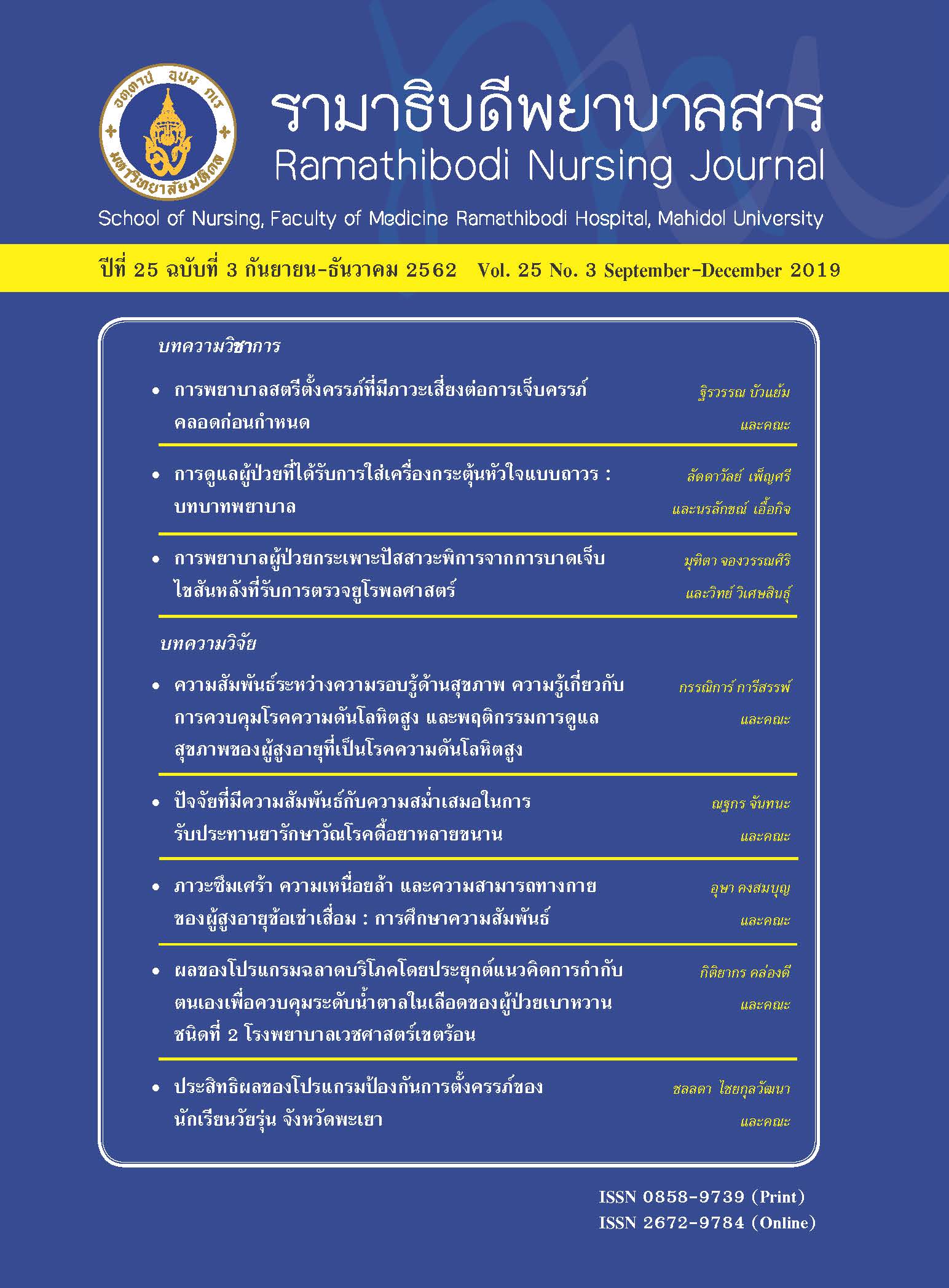
ภาวะซึมเศร้า ความเหนื่อยล้า และความสามารถทางกายของผู้สูงอายุข้อเข่าเสื่อม: การศึกษาความสัมพันธ์
Article Sidebar
Main Article Content
บทคัดย่อ
การวิจัยเชิงบรรยายครั้งนี้มีวัตถุประสงค์เพื่อศึกษาความสัมพันธ์ระหว่างภาวะซึมเศร้า ความเหนื่อยล้า และความสามารถทางกายของผู้สูงอายุโรคข้อเข่าเสื่อม ผู้เข้าร่วมวิจัยคือผู้สูงอายุจำนวน 144 ราย ที่มีคุณสมบัติตามเกณฑ์คัดเข้า ได้แก่ อายุตั้งแต่ 60 ปีขึ้น มีอาการของโรคข้อเข่าเสื่อม ไม่มีความพร่องในการรู้คิด เป็นสมาชิกและเข้าร่วมกิจกรรมในชมรมผู้สูงอายุ 6 แห่ง ที่ตั้งอยู่ในเขตกรุงเทพมหานคร เครื่องมือที่ใช้ในการวิจัยประกอบด้วย 1) แบบสัมภาษณ์ข้อมูลส่วนบุคคล 2) แบบประเมินความเหนื่อยล้าแบบหลายมิติ 3) แบบวัดความซึมเศร้าในผู้สูงอายุของไทยฉบับสั้น 15 ข้อ และ 4) การทดสอบความสามารถในการทรงตัวและการเคลื่อนไหว เก็บข้อมูลระหว่างเดือนสิงหาคมถึงเดือนพฤศจิกายน พ.ศ. 2560 วิเคราะห์ข้อมูลโดยใช้สถิติบรรยาย สถิติสัมประสิทธิ์สหสัมพันธ์แบบเพียร์สัน และสถิติสหสัมพันธ์สเปียร์แมน ผลการวิจัยพบว่า กลุ่มตัวอย่างมีภาวะซึมเศร้าร้อยละ 29.90 (n = 43) ระดับความเหนื่อยล้ารวมอยู่ในระดับเล็กน้อย คะแนนเฉลี่ย 18.14 (S.D. = 8.66) และความสามารถทางกายจากการประเมินการใช้เวลาในการเดินไป-กลับระยะทาง 3 เมตร เฉลี่ย 12.60 วินาที (S.D. = 2.22) ภาวะซึมเศร้ามีความสัมพันธ์ทางบวกในระดับต่ำกับความสามารถทางกาย ความเหนื่อยล้ามีความสัมพันธ์ทางบวกในระดับปานกลางกับภาวะซึมเศร้า และความสามารถทางกายของผู้สูงอายุข้อเข่าเสื่อมอย่างมีนัยสำคัญทางสถิติ ผลการศึกษาครั้งนี้ทำให้ทราบถึงปัญหาทางด้านจิตสังคมของผู้สูงอายุโรคข้อเข่าเสื่อม และสะท้อนให้เห็นถึงความสัมพันธ์ระหว่างภาวะซึมเศร้า ความเหนื่อยล้า และความสามารถทางกาย อันเป็นข้อมูลพื้นฐานที่มีความสำคัญต่อการวางแผนหรือพัฒนาโปรแกรม ลดผลกระทบปัญหาทางด้านจิตสังคม รวมทั้งส่งเสริมความสามารถทางกาย ซึ่งจะนำไปสู่การคงไว้ซึ่งความสามารถทางกาย และคุณภาพชีวิตของผู้สูงอายุที่มีปัญหาข้อเข่าเสื่อม
Article Details
บทความ ข้อมูล เนื้อหา รูปภาพ ฯลฯ ที่ได้รับการตีพิมพ์ในรามาธิบดีพยาบาลสาร ถือเป็นลิขสิทธิ์ของวารสาร หากบุคคลหรือหน่วยงานใดต้องการนำทั้งหมดหรือส่วนหนึ่งส่วนใดไปเผยแพร่หรือเพื่อกระทำการใด ใด จะต้องได้รับอนุญาตเป็นลายลักษณ์อักษรจากรามาธิบดีพยาบาลสารก่อนเท่านั้น
เอกสารอ้างอิง
Nakhon Pathom: Printery; 2017.
2. Jevsevar DS. Treatment of osteoarthritis of the knee,evidence-based guideline, 2nd edition. J Am Acad Orthop
Surg. 2013;21(9):571-6.
3. Veenhof C, Huisman PA, Barten JA, Takken T, Pisters MF. Factors associated with physical activity in patients with osteoarthritis of the hip or knee: a systematic review.Osteoarthritis Cartilage. 2012;20(1):6-12.
4. Cho HJ, Morey V, Kang JY, Kim KW, Kim TK.Prevalence and risk factors of spine, shoulder, hand, hip,and knee osteoarthritis in community-dwelling Koreans older than age 65 years. Clin Orthop Relat Res. 2015;473(10):3307-14.
5. Duangthipsirikul S, Sirisamut T, Tantipisitkun K,Ingsasawang SL, Thirawattananon Y. Report of the Thai
elderly health survey 2013 under the elderly and people health promotion program disabled. Bangkok: Watcharin
Printing Center; 2013. (in Thai)
6. Palazzo C, Nguyen C, Lefevre-Colau MM, Rannou F,Poiraudeau S. Risk factors and burden of osteoarthritis.
Ann Phys Rehabi Med. 2016;59(3):134-8.
7. Heidari B. Knee osteoarthritis prevalence, risk factors,pathogenesis and features: Part I. Caspian J Intern Med.
2011;2(2):205-12.
8. Pukdeesamai R, Panichacheewakul P. Improving care for elderly with knee pain at Ban Bak Tambol Health
Promotion Hospital, Changhan District, Roi Et Province.Journal of Nursing Science & Health. 2011;34(2):46-55. (in Thai)
9. Kuçuksen S, Halim Y, Karahan AY, Bagçaci S. The prevalence of depression and its relevance to clinical and
radiological characteristics among older adults with knee osteoarthritis. Clinical Medicine Research. 2014;3(2):25-30.
10. Murphy SL, Alexander NB, Levoska M, Smith DM.Relationship between fatigue and subsequent physical activity among older adults with symptomatic osteoarthritis.Arthritis Care Res. 2013;65(10):1617-24.
11. Shams A, Poor Hadi S, Sahaf R. Comparing levels of depression in healthy active and inactive elders versus those
with knee osteoarthritis disease. Ann Appl Sport Sci.2016;4(1):49-56.
12. World Health Organization (WHO). International classification of functioning, disability and health: ICF.
[cited 2017 March1]. Available https://apps.who.int/iris/bitstream/10665/43737/1/9789241547321_eng.pdf
13. Aghdam AM, Kolahi S, Hasankhani H, Behshid M.Varmaziar Z. The relationship between pain and physical function in adults with knee osteoarthritis. IJSBR.2013;3(12):1102-6.
14. Rosemann T, Backenstrass M, Joest K, Rosemann A,Szecsenyi J, Laux G. Predictors of depression in a sample
of 1,021 primary care patients with osteoarthritis. Arthritis Rheum. 2007;57(3):415-22.
15. Snijders GF, den Broeder AA, van Riel PL, Straten VH,de Man FH, van den Hoogen, FH, van den Ende CH.
Evidence-based tailored conservative treatment of knee and hip osteoarthritis: between knowing and doing. Scand
J Rheumatol. 2011;40(3):225-31.
16. Brandt KD. Diagnosis and nonsurgical management of osteoarthritis. New York: Professional Communication;
2010.
17. Trongsakul S, Lambert R, Clark A, Wongpakaran N, Cross J. Development of the Thai version of Mini-Cog, a brief
cognitive screening test. Geriatr Gerontol Int. 2015;15(5):594-600.
18. Faul F, Erdfelder E, Buchner A, Lang AG. Statistical power analyses using G*Power 3.1: tests for correlation and
regression analyses. Behavior Research Methods.2009;41(4):1149-60.
19. Possley D, Budiman-Mak E, O’Connell S, Jelinek C,Collins EG. Relationship between depression and functional measures in overweight and obese persons with osteoarthritis of the knee. J Rehabil Res Dev. 2009;46(9):1091-8.
20. Borson S, Scanlan JM, Chen P, Ganguli M. The Mini-Cog as a screen for dementia: validation in a population-based
sample. J Am Geriatr Soc. 2003;51(10):1451-4.
21. Belza BL, Henke CJ, Yelin EH, Epstein WV, & Gilliss CL. Correlates of fatigue in older adults with rheumatoid
arthritis. Nurs Res. 1993;42(2):93-9.
22. Yesavage JA, Brink TL, Rose TL, Lum O, Huang V,Adey M, Leirer VO. Development and validation of a geriatric depression screening scale: a preliminary report.J Psychiatr Res. 1982-1983; 7(1):37-49.
23. Wongpakaran N, Wongpakaran T, & Van Reekum R. The use of GDS-15 in detecting MDD: a comparison between
residents in a Thai long-term care home and geriatric outpatients. J Clin Med Res. 2013;5(2):101-11.
24. Podsiadlo D, Richardson S. The timed “Up & Go”: a test of basic functional mobility for frail elderly persons. J Am
Geriatr Soc. 1991;39(2):142-8.
25. Centers for Disease Control and Prevention. Timed Up &Go Test [cited 2017 January]. Available https://www.
cdc.gov/steadi/pdf/TUG_Test-print.pdf
26. Nimit-arnum N. The epidemiological situation and risk assessment of knee osteoarthritis among Thai people.
Journal of the Roya1 Thai Army Nurses. 2014;5(3):185-94. (in Thai)
27. Phermpool P. Severity of osteoarthritis and self-care behavior of patients with osteoarthritis of the knee in sirirat
hospital. [thesis]. Nakhon Pathom: Mahidol University;2010. (in Thai)
28. Iqbal MN, Haidri FR, Motiani B, Mannan A. Frequency of factors associated with knee osteoarthritis. J Pak Med
Assoc. 2011;61(8):786-9.
29. Kim HS, Shin JS, Lee J, Lee YJ, Kim MR, Bae YH, Ha IH. Association between knee osteoarthritis, cardiovascular
risk factors, and the Framingham risk core in South Koreans: a cross-sectional study. PLos One. 2016;11(10):e0165325. doi: 10.1371/journal.pone.0165325
30. Vohra I, Singh A, Ali S, Verma N, Kumar A, Katiyar V.Correlation of hypertension with the severity of osteoarthritis of knee. Int J Biomed Res. 2015;6(4):238-41.
31. Pitantananukune P, Surit P. Chronic pain management of older person living in a community. Journal of Nurses
Association of Thailand, North-Eastern Division.2011;29(4):58-68. (in Thai)
32. Wiriyawong P, Kespichayawattana J. Selected factors related to depression in older persos with knee osteoarthritis.
Journal of Boromarajonani College of Nursing,Bangkok.2010;26(1): 83-98. (in Thai)
33. Chumtem S, Jitpanya C. The relationships joint pain,fatigue, sleep quality, depression and health related quality
of life in patients with rheumatoid arthritis. Kuakarun Journal of Nursing. 2015;22(1):113-128. (in Thai)
34. Garip Y, Guler T, Tuncer OB. Fatigue among elderly patients with knee osteoarthritis and its association with
functional status, depression and quality of life. Ankara Med J. 2016;16(1): 20-6.
35. Thaweewannakij T, Amatachaya S, Peungsuwan P, Mato L. Balance, fall and quality of life in active and inactive
elderly. J Med Tech Phy Ther. 2010;22(3):271-9.
36. Greenglass E, Fiksenbaum L, Eaton J. The relationship between coping, social support, functional disability and
depression in the elderly. Anxiety, Stress, & Coping 2006;19(1):15-31.
37. Odole AC, Ogunlana MO, Adegoke BOA, Ojonima F,Useh F. Depression, pain and physical function in patients
with osteoarthritis of the knee: implications for interprofessional care. Nigerian Journal of Medical Rehabilitation. 2015;18(1). doi: https://doi.org/10.34058/njmr.v18i1.120
38. Nikolaus S, Bode C, Taal E, van de Laar MA. Fatigue and factors related to fatique in rheumatoid arthritis: a
systematic review. Arthritis Care Res. 2013;65(7):1128-48.
39. Klinpudtan N. Factors predicting fatigue in patients with heart failure. [thesis]. Bangkok: Chulalongkorn University;
2014. (in Thai)
