
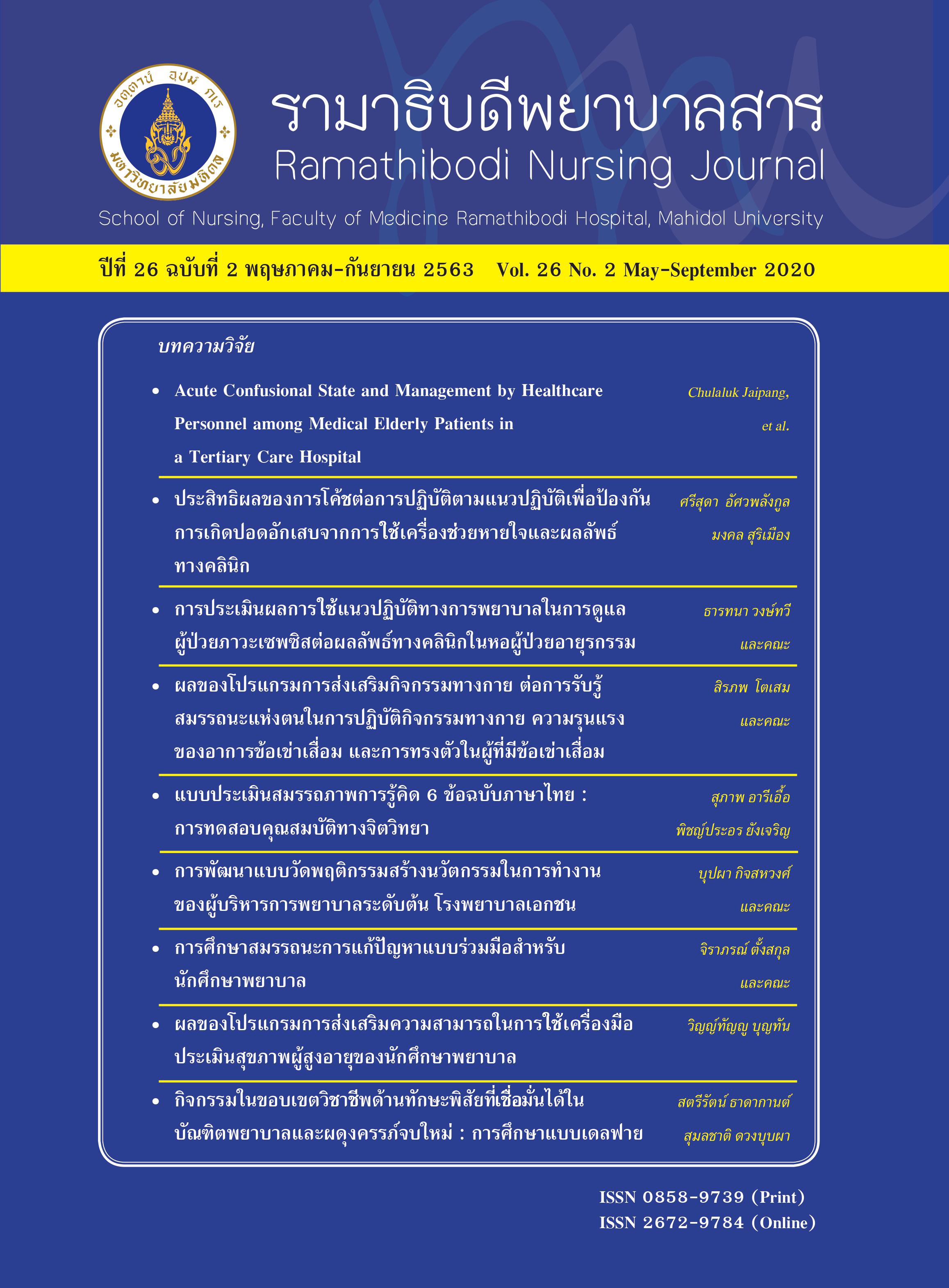
ภาวะสับสนเฉียบพลันและการจัดการโดยบุคลากรด้านสุขภาพในผู้สูงอายุที่พักรักษาในแผนกอายุรกรรม โรงพยาบาลตติยภูมิ
Article Sidebar
Main Article Content
บทคัดย่อ
ภาวะสับสนเฉียบพลันเป็นภาวะที่พบได้บ่อยในผู้ป่วยสูงอายุที่รักษาตัวในโรงพยาบาลอย่างไรก็ตามข้อมูลเกี่ยวกับความชุก อุบัติการณ์ และการจัดการของบุคลากรด้านสุขภาพในผู้สูงอายุที่มีภาวะสับสนเฉียบพลันยังมีค่อนข้างน้อย การศึกษาครั้งนี้จึงเป็นการวิจัยเชิงพรรณาแบบศึกษาไปข้างหน้าที่มีวัตถุประสงค์เพื่อสำรวจความชุกและอุบัติการณ์ของภาวะสับสนเฉียบพลันในผู้ป่วยสูงอายุที่พักรักษาในแผนกอายุรกรรม และการจัดการโดยบุคลากรด้านสุขภาพ โดยการสุ่มตัวอย่างแบบเจาะจง เพื่อคัดเลือกกลุ่มตัวอย่าง
ผู้ป่วยสูงอายุ จำนวน 192 ราย ในหอผู้ป่วยอายุรกรรม โรงพยาบาลตติยภูมิแห่งหนึ่ง และใช้การสุ่มตัวอย่างแบบต่อเนื่อง เพื่อคัดเลือกกลุ่มตัวอย่างจากบุคลากรด้านสุขภาพ จำนวน 31 ราย ที่ปฏิบัติงานในหอผู้ป่วยอายุรกรรม ระหว่างเดือนสิงหาคมถึงพฤศจิกายน 2561 โดยใช้แบบสอบถามและแบบประเมินในการเก็บรวบรวม วิเคราะห์ข้อมูลโดยใช้สถิติเชิงพรรณนา ไคสแควร์ และการวิเคราะห์เนื้อหา ผลการวิจัยพบว่าอัตราความชุกของภาวะสับสนเฉียบพลันในผู้ป่วยสูงอายุ ณ เวลาที่เข้ารับการรักษาเท่ากับร้อยละ 3.65 อุบัติการณ์ของภาวะสับสนเฉียบพลันเท่ากับร้อยละ 5.21 และอัตราความชุกของภาวะสับสนเฉียบพลันในผู้ป่วยสูงอายุ
ช่วงระยะเวลาสามเดือนเท่ากับร้อยละ 8.85 ปัจจัยเสี่ยงที่มีความสัมพันธ์อย่างมีนัยสำคัญกับการเกิดภาวะสับสนเฉียบพลันในผู้ป่วยสูงอายุ คือ ภาวะสมองเสื่อม ภาวะพร่องออกซิเจน อายุที่มากขึ้น ภาวะติดเชื้อ และภาวะนอนไม่หลับ ในส่วนของการจัดการของแพทย์ กลุ่มตัวอย่างทุกคนได้รับการรักษาที่สาเหตุเพื่อลดปัจจัยเสี่ยงของภาวะสับสนเฉียบพลัน ในขณะที่การจัดการโดยไม่ใช้ยาโดยบุคลากรด้านสุขภาพ ได้แก่ การมีส่วนร่วมในการรักษาสาเหตุ การจัดการพฤติกรรม การป้องกันภาวะแทรกซ้อน และการฟื้นฟูสภาพการทำหน้าที่นอกจากนี้ยังพบว่าปัจจัยสนับสนุนในการจัดการภาวะสับสนเฉียบพลันประกอบด้วย ระบบการดูแลที่ส่งเสริม
ให้ครอบครัวมีส่วนร่วม การมีทีมสหสาขาวิชาชีพ การมีแนวทางในการจัดการดูแล และการจัดฝึกอบรมส่วนอุปสรรคสำหรับการจัดการภาวะสับสนเฉียบพลัน ประกอบด้วย ภาระงาน การมีประสบการณ์หรือความรู้ไม่เพียงพอ ผลการวิจัยครั้งนี้ สนับสนุนให้เห็นว่าบุคลากรด้านสุขภาพควรดำเนินการเชิงรุกในการประเมิน ป้องกัน และจัดการภาวะสับสนเฉียบพลันในผู้สูงอายุเพื่อให้กลับคืนสู่ภาวะปกติโดยเร็วที่สุด
Article Details
บทความ ข้อมูล เนื้อหา รูปภาพ ฯลฯ ที่ได้รับการตีพิมพ์ในรามาธิบดีพยาบาลสาร ถือเป็นลิขสิทธิ์ของวารสาร หากบุคคลหรือหน่วยงานใดต้องการนำทั้งหมดหรือส่วนหนึ่งส่วนใดไปเผยแพร่หรือเพื่อกระทำการใด ใด จะต้องได้รับอนุญาตเป็นลายลักษณ์อักษรจากรามาธิบดีพยาบาลสารก่อนเท่านั้น
เอกสารอ้างอิง
Breitbart W, Gibson C, Tremblay A. The delirium experience: delirium recall and delirium related distress in
hospitalized patients with cancer, their spouses/caregivers,and their nurses. Psychosomatics. 2002;43(3):183-94.
Praditsuwan R, Limmathuroskul D, Assanasen J,Pakdeewongse S, Eiamjinnasuwat W, Sirisuwat A, et al.
Prevalence and incidence of delirium in Thai older patients:a study at general medical wards in Siriraj Hospital. J Med Assoc Thai. 2012;95 Suppl 2:S245-50.
Inouye SK. Delirium in Older Persons. N Engl J Med.2006;354(11):1157–65.
Oearsakul B, Intarasombat P, Zartrungpak S. The incidence and factors related to acute confusional states in hospitalized elderly patients. Rama Nurs J. 2002;8(3):209-22. (inThai)
Ahmed S, Leurent B, Sampson EL. Risk factors for incident delirium among older people in acute hospital medical units: a systematic review and meta-analysis. Age Ageing.2014; 43(3):326-33.
Eiamthanasinchai S. Factors associated with delirium of hospitalized patients in medical ward. Medical Journal of Srisaket Surin Burirum Hospital. 2013;28(3):159-68. (in Thai)
McCusker J, Cole MG, Dendukuri N, Belzile E. Does delirium increase hospital stay? J Am Geriatr Soc.
;51(11):1539–46.
Inouye SK, Rushing JT, Foreman MD, Palmer RM,Pompei P. Does delirium contribute to poor hospital
outcomes? A three-site epidemiologic study. J Gen Intern Med. 1998;13(4): 234-42.
Muangpaisan W. Delirium in the elderly and prevention.In Assantachai P, editors. Health Problem in the Elderly and Prevention. 2nd ed. Bangkok: Union Creation; 2011.p. 113-27. (in Thai)
Limpawattana P, Sutra S, Thavornpitak Y, Sawanyawisuth K, Chindaprasirt J, Mairieng P. Delirium in hospitalized elderly patients of Thailand; is the figure underrecognized?J Med Assoc Thai. 2012;95 Suppl 7:S224-8.
Collier R. Hospital-induced delirium hits hard. Can Med Assoc J. 2012; 184(1):23–4.
Tampi RR, Tampi DJ, Barua S, Chandran S. Management of delirium in the elderly patients: a review of evidence. J. Drug Abuse. 2015;1(1:6):1-12.
American Psychiatric Association. Diagnostic and Statistical Manual of Mental Disorders: DSM-5 (5th ed).
United States of America: British Library; 2013. p. 596-601.
Fong TG, Tulebaev SR, Inouye SK. Delirium in elderly adults: diagnosis, prevention and treatment. Nat Rev
Neurol. 2009;5(4):210–20.
Cerejeira J, Mukaetova-Ladinska EB. A clinical update on delirium: from early recognition to effective
management. Nurs Res Pract. 2011;20(11): 1-12. doi:10.1155/2011 /875196
Kalish VB, Gillham JE, Unwin BK. Delirium in older persons: evaluation and management. Am Fam Physician.
;90(3):150-8.
Yevchak AM, Steis M, Diehl T, Hill N, Kolanowski A,Fick D. Managing delirium in the acute care setting: a pilot
focus group study. Int J Older People Nurs.2012;7(2):152–62. http://doi.org/10.1111/j.1748-3743.2012.00324.x
Bonita R, Beaglehole R, Kjellstrom T. Basic epidemiology.2nd ed. Switzerland: WHO Press; 2006.
Inouye SK, van Dyck CH, Alessi CA, Balkin S, Siegal AP, Horwitz RI. Clarifying confusion: the confusion
assessment method. A new method for detection of delirium. Ann Intern Med. 1990;113(12):941-48.
Wongpakaran N, Wongpakaran T, Bookamana P, et al. Diagnosing delirium in elderly Thai patients: utilization
of the CAM algorithm. BMC Fam Pract.2011;12(1):1-5.doi: 10.1186/1471-2296-12-65.
Yuwapattanawong N, Leungratanamart L. Assessment and nursing care delirium in elderly patients who have
undergone surgery. Veridian E-Journal Science and Technology Silpakorn University. 2016;3(6):101-12.
(in Thai)
van de Steeg L, Langelaan M, Ijkema R, Nugus P, Wagner C. Improving delirium care for hospitalized older patients.a qualitative study identifying barriers to guideline adherence. J Eval Clin Pract. 2014;20(6):813-9.
doi:10.1111/jep.12229.
Ngamkala T, Malathum P, Krairit O. Incidence and risk factors of acute confusional state in hospitalized older
patients. Rama Nurs J. 2018;24(2):137-49. (in Thai)
Perese EF. Psychiatric advanced practice nursing: A biopsychosocial foundation for practice. Philadelphia, PA.
F.A. Davis; 2012.
Inouye SK, Viscoli CM, Horwitz RI, Hurst LD, Tinetti ME. A predictive model for delirium in hospitalized elderly
medical patients based on admission characteristics. Ann Intern Med. 1993;119(6):474-81.
Alagiakrishnan K, Wiens C. An approach to drug induced delirium in the elderly. Postgrad Med J. 2004;80
(945):388-93. doi.org/10.1136/pgmj.2003.017236.
Fong TG, Davis D, Growdon ME, Albuquerque A, Inouye SK. The interface between delirium and dementia in elderly adults. Lancet Neurol. 2015;14(8):823–32. doi:10.1016 /S14 74-4422(15)00101-5.
Cunningham C. Systemic inflammation and delirium:important co-factors in the progression of dementia.
Biochem Soc Trans. 201;39(4):945-53.
Ritter C, Tomasi CD, Dal-Pizzol F, Pinto BB, Dyson A,de Miranda AS, et al. Inflammation biomarkers and
delirium in critically ill patients. Crit Care. 2014;18(3):1-6. doi: 10.1186/cc13887.
Ali S, Patel M, Jabeen S, Bailey RK, Patel T, Shahid M,et al. Insight into delirium. Innov Clin Neurosci.
;8(10):25-34.
Maldonado JR. Pathoetiological model of delirium: a comprehensive understanding of the neurobiology of
delirium and an evidence-based approach to prevention and treatment. Crit Care Clin. 2008;24(4):789-856.
Watson PL, Ceriana P, Fanfulla F. Delirium: Is sleep important? Best Pract Res Clin Anaesthesiol.
;26(3),355-66.
Weinhouse GL, Schwab RJ, Watson PL, et al. Bench-tobedside review: delirium in ICU patients-importance of
sleep deprivation. Crit Care. 2009;13(6):234.doi:10.1186/cc8131.
Trzepacz PT, Breitbart CW, Franklin J, Levenson J,Martini R, Wang P. Practice guideline for the treatment of
patients with delirium. United States of America: American Psychiatric Association; 2010.
Lonergan E, Britton AM, Luxenberg J. Antipsychotics for delirium. Cochrane Database Syst Rev. 2007;18(2):
-2. doi: 10.1002/14651858. CD005594.pub2.
Carr FM. The role of sitters in delirium: an update. Can Geriatr J. 2013;16(1):22-36.
Lakatos BE, Capasso V, Mitchell MT, Kilroy SM,Lussier-Cushing M, Sumner L, et al. Falls in the general
hospital: association with delirium, advanced age, and specific surgical procedures. Psychosomatics.
;50(3):218-26.
Kolanowski A, Fick D, Litaker M, Mulhall P, Clare L, Hill N, et al. Effect of cognitively stimulating activities on
symptom management of delirium superimposed on dementia: a randomized controlled trial. J Am Geriatr Soc.
;64(12):2424-32. doi: 10.1111 /jgs. 14511.
