
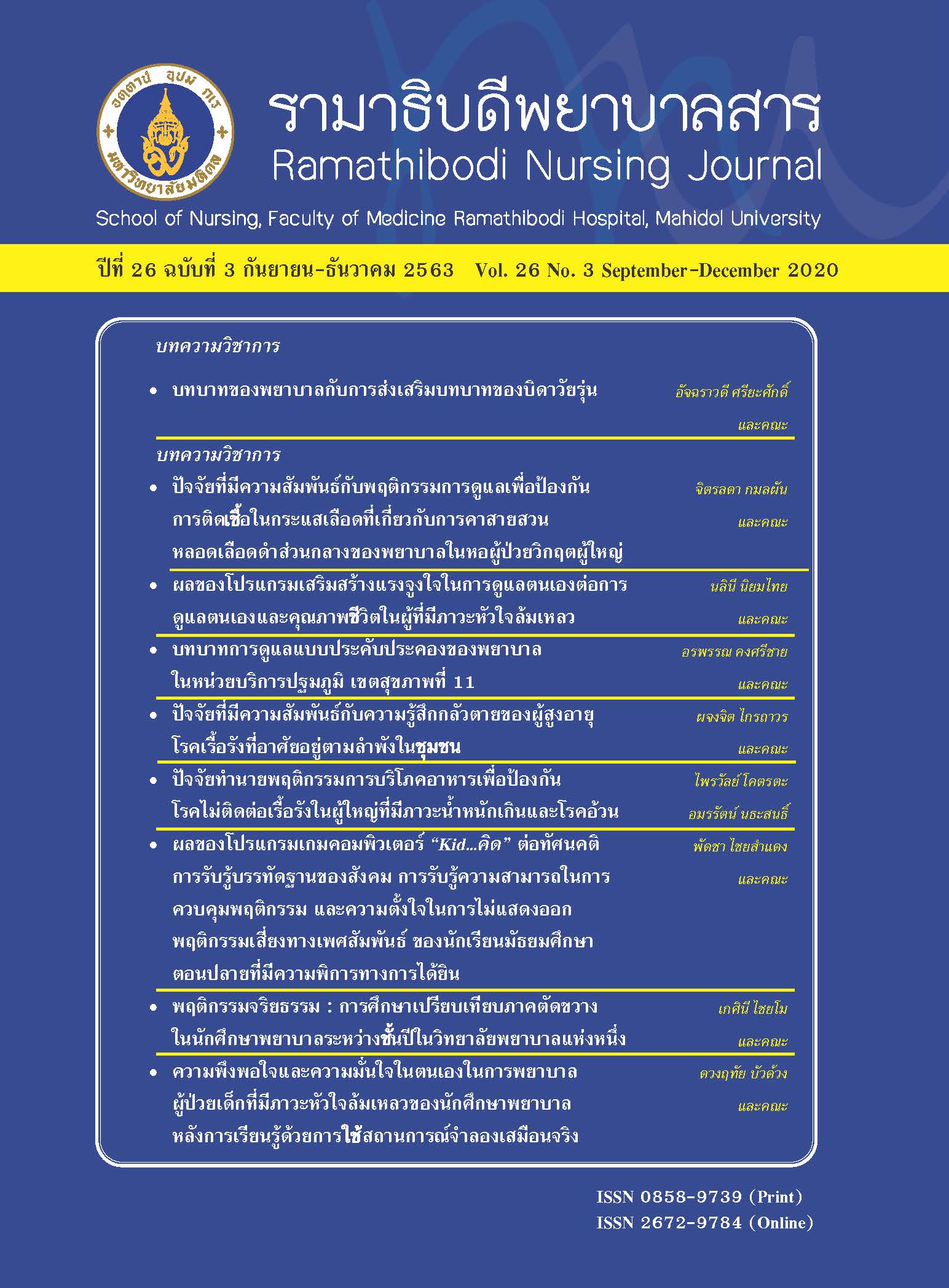
ปัจจัยที่มีความสัมพันธ์กับความรู้สึกกลัวตายของผู้สูงอายุโรคเรื้อรังที่อาศัยอยู่ตามลำพังในชุมชน
Article Sidebar
Main Article Content
บทคัดย่อ
การวิจัยครั้งนี้เป็นการวิจัยเชิงพรรณนา มีวัตถุประสงค์เพื่อศึกษาความรู้สึกกลัวตายของผู้สูงอายุโรคเรื้อรังที่อาศัยอยู่ตามลำพังในชุมชน และความสัมพันธ์ระหว่างปัจจัยส่วนบุคคลและปัจจัยทางสังคมกับความรู้สึกกลัวตายของผู้สูงอายุโรคเรื้อรังที่อาศัยอยู่ตามลำพังในชุมชนกลุ่มตัวอย่างคือ ผู้สูงอายุโรคเรื้อรังที่อาศัยอยู่ตามลำพัง ในจังหวัดทางภาคตะวันออกเฉียงเหนือจำนวน 262 ราย เก็บข้อมูลโดยแบบสอบถามข้อมูลส่วนบุคคล แบบประเมินการสนับสนุนทางสังคม และความรู้สึกกลัวตาย วิเคราะห์ข้อมูลด้วยสถิติบรรยาย สถิติไบซีเรียล และสถิติสหสัมพันธ์สเปียร์แมน ผลการศึกษาพบว่า ผู้สูงอายุเฉลี่ย 70.92 ปี (SD = 7.36) เกินครึ่งได้รับการสนับสนุนทางสังคมโดยรวมระดับปานกลางและมีความรู้สึกกลัวตายในระดับมาก รายได้และระดับการศึกษามีความสัมพันธ์ทางลบกับความรู้สึกกลัวตาย ส่วนการสนับสนุนทางสังคมโดยรวม การสนับสนุนด้านวัตถุสิ่งของ และการสนับสนุนด้านการประเมินคุณค่ามีความสัมพันธ์ทางบวกกับความรู้สึกกลัวตาย แต่เพศ อายุ และสถานภาพสมรสไม่มีความสัมพันธ์กับความรู้สักกลัวตายข้อเสนอแนะในการดูแลผู้สูงอายุกลุ่มนี้จึงจำเป็นต้องคำนึงถึงความรู้สึกกลัวตาย การให้ครอบครัวหรือบุคคลที่เกี่ยวข้องเข้ามามีส่วนร่วมในการดูแล ให้ข้อมูลแก่ผู้สูงอายุให้เกิดความรู้ความเข้าใจเกี่ยวกับการเจ็บป่วยและการรักษาโดยเฉพาะผู้ที่มีการศึกษาน้อย และรายได้ต่ำ จะช่วยให้ผู้สูงอายุเกิดความมั่นใจในการดูแลตนเองและอาจทำให้ความรู้สึกกลัวตายลดลง
คำสำคัญ : ผู้สูงอายุโรคเรื้อรัง อาศัยตามลำพัง ชุมชน ความรู้สึกกลัวตาย การสนับสนุนทางสังคม
Article Details
บทความ ข้อมูล เนื้อหา รูปภาพ ฯลฯ ที่ได้รับการตีพิมพ์ในรามาธิบดีพยาบาลสาร ถือเป็นลิขสิทธิ์ของวารสาร หากบุคคลหรือหน่วยงานใดต้องการนำทั้งหมดหรือส่วนหนึ่งส่วนใดไปเผยแพร่หรือเพื่อกระทำการใด ใด จะต้องได้รับอนุญาตเป็นลายลักษณ์อักษรจากรามาธิบดีพยาบาลสารก่อนเท่านั้น
เอกสารอ้างอิง
Wachira Methi W. One death, millions of people wake up.(11th ed.) Nonthaburi: Pran; 2012. (in Thai)
Taghiabadi M, Kavosi A, Mirhafez SR, Keshvari M,Mehrabi T. The association between death anxiety with
spiritual experiences and life satisfaction in elderly people.Electronic Physician (ISSN: 2008-5842). 2007 [cited
Oct 11];9(3):3980-85. Available from: http://www.ephysician.ir, DOI: http://dx.doi.org/10.19082/ 3980
Roach SS. Introductory gerontological nursing.Philadelphia. PA: Lippincott; 2001.
Oliveira A, Céu Sá Maria do, Freitas A. Learning to live with a chronic illness, without thinking about death. AJIS.
;2(9):326-34.
Cicirelli VG. Fear of death in older adults: predictions from Terror Management Theory. J Gerontol B Psychol Sci Soc Sci.2002;57B(4):358-66.
Phatharapreeyakul L, Kraithaworn P, Piaseu N. Perceived social isolation, self-care behaviors and health status
among community dwelling older adults living alone.The Bangkok Medical Journal. 2016;11:17-23.
Cicirelli VG. Personality and demographic factors in older adults’ fear of death. Gerontologist. 1999;39(5):569-
Cicirelli VG. Older adults’ fear and acceptance of death:A transition model. Ageing Int. 2003;28(1):66-81.
Sujaritwarakul M, Somanusorn S. Factors related to death preparation among Thai Buddhist elderly. Kuakarun
Journal of Nursing. 2018;25(1):154-68. (in Thai)
Petburi P. The effect of a social program on the mental health of the elderly. [Thesis]. Bangkok: Thammasat
University. 2016. [cited 2019 Oct 11]. Available from:https://bit.ly/2Gg8wI5 (in Thai)
Cicirelli VG. Fear of death in mid-old age. The Journals of Gerontology: Series B. 2006;61(2):75-81.
Neimeyer RA. Special Article: Death anxiety research: the state of the art. OMEGA. 1998;36(2):97-120.
Tang PL, Chiou CP, Lin HS, Wang C, Liand SL. Correlates of death anxiety among Taiwanese cancer patients. Cancer Nurs. 2011;34(4):286-92.
Assari S, Lankarani MM. Race and gender differences in correlates of death anxiety among elderly in the United States. Iran J Psychiatry Behav Sci. 2016;10(2): e2024:1-7.
Nal B, Aydın AI, Ayyildiz M. The correlation between death anxiety and anxiety in elderly with chronic
obstructive pulmonary disease. Prog Health Sci. 2016;6(1):63-9.
Adeeb M, Saleem M, Kynat Z, Tufail MW, Zaffar M.Quality of life, perceived social support and death. Pak
Heart J. 2017;50(02):84-8.
Chokami AA, Razavi V. Relationship between social support and hope and death anxiety among the old people of Tehran Omid Cultural Center. IJLSCI. 2015;9(2):65-70.
National Statistical Office. (2018). Press release “What does the statistics tell? The present and future aged people”.[cited 2019 November 15] Available from: http://www.nso.go.th/sites/2014/Pages/Press_Release/ 2561/
N10-04-61-1.aspx (in Thai)
Park EJ, Sohn HS, Lee EK, Kwon JW. Living arrangements,chronic diseases, and prescription drug expenditures among Korean elderly: vulnerability to potential medication underuse. BMC Public Health. 2014;14(1284):1-8.
Sarwari AR, Freedman L, Langenberg P, Magaziner J.Prospective study on the relation between living arrangement and change in functional health status of women. AJE.1998;14(7):370-8.
National Statistical Office. Report on the 2017 survey of the older persons in Thailand. Bangkok: Statistical
Forecasting Division, National Statistical Office; 2018.
House JS. Work stress and social support. Reading, MA:Addison-Wesley; 1981.
Boonpha R, Kraithaworn P, Piaseu N. Social support and health status among community dwelling older people living alone with chronic disease.Thai Journal of Nursing Council. 2019;34(2):112-26. (in Thai)
FaulF, Erdfelder E, Lang AG, Buchner A. G*Power 3: a flexible statistical power analysis program for the social,
behavioral, and biomedicalsciences. Behav ResMethods.2007;39(2):175-91.
Chuen-im K. Health-related quality of life amongst elderly people with osteoarthritis at a community in Samut Sakhon Province. [Master Thesis] Nakhon Pathom: Christian University; 2007.
Rangsikosai S, Piphatvanitcha N. & Paokunha R. Factors related to behavior for preparing to cope with dying and death among older adults in the elderly cub, Pattani Province. Songklanagarind Journal of Nursing. 2013;33:
-56.
Chaiyo W. (2012). An opinion on happiness in the elderly:a case study of Ban Nanthong Niwet. The Journal of Human Sciences. 2012;13(1):16-30. (in Thai)
Dadfar M, Lester D, Bahrami F. Death anxiety, reliability,validity, and factorial structure of the Farsi form of the Arabic Scale of Death Anxiety in Iranian old-aged persons.J Aging Res. 2016;52:1-7. [cited 2019 November 11]
Available from: http://dx.doi.org/10.1155/2016/2906857
Adeeb M, Saleem M, Kynat Z, Tufail MW, Zaffar M.Quality of life, perceived social support and death. Pak
Heart J. 2017;50(02):84-8.
Missler M, Geurtsen L, Mastenbroek MH, Chmoun S.Exploring death anxiety among elderly people in The
Netherlands: a multidimensional approach. [Thesis]. Netherlands: Utrecht University; 2009.
