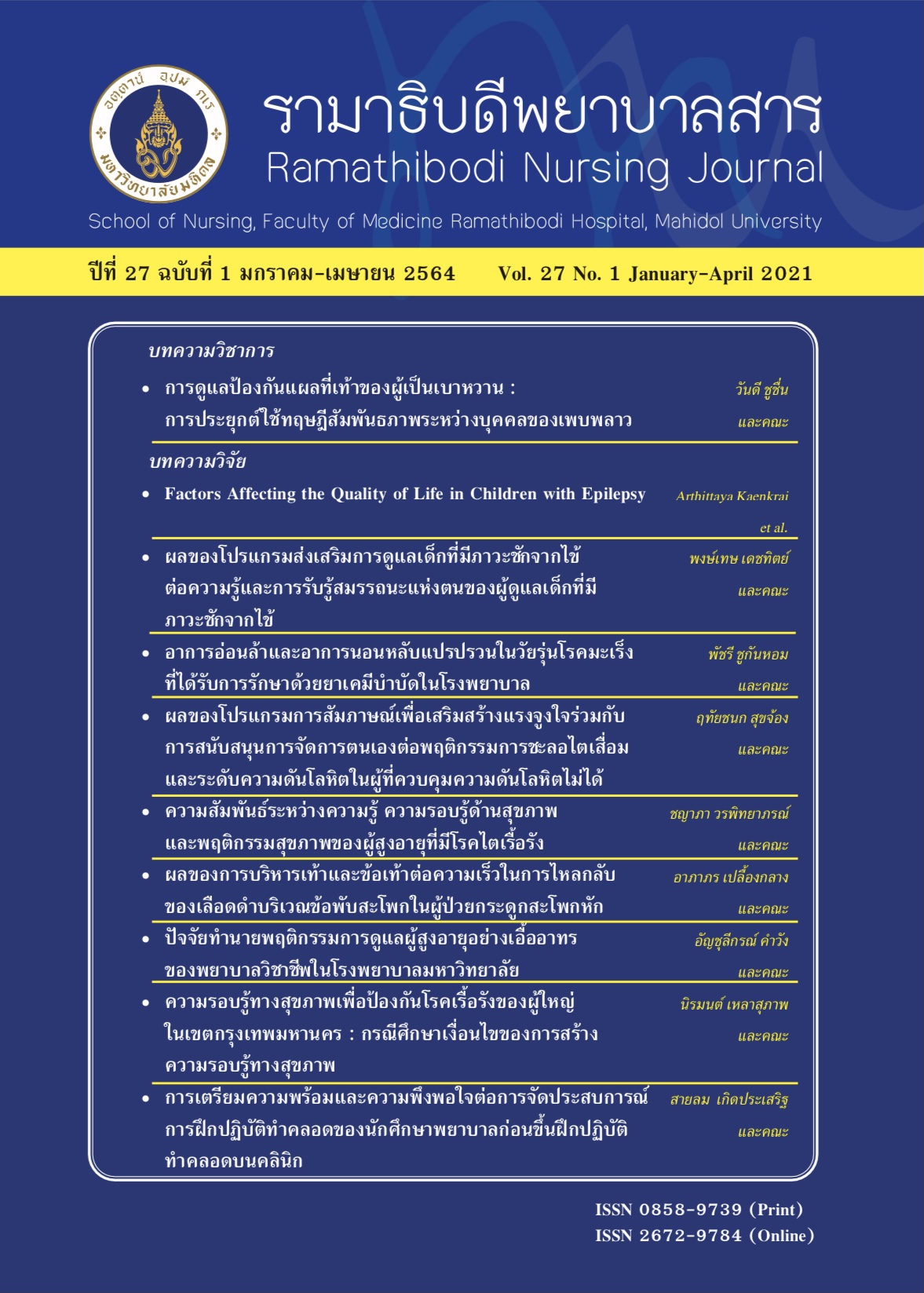
ผลของโปรแกรมการสัมภาษณ์เพื่อเสริมสร้างแรงจูงใจร่วมกับการสนับสนุนการจัดการตนเองต่อพฤติกรรมการชะลอไตเสื่อมและระดับความดันโลหิตในผู้ที่ควบคุมความดันโลหิตไม่ได้
Article Sidebar
Main Article Content
บทคัดย่อ
การวิจัยครั้งนี้เป็นการวิจัยกึ่งทดลองชนิดกลุ่มเดียว โดยเปรียบเทียบก่อนและหลังการทดลอง มีวัตถุประสงค์เพื่อศึกษาผลของโปรแกรมการสัมภาษณ์เพื่อเสริมสร้างแรงจูงใจร่วมกับการสนับสนุนการจัดการตนเองต่อพฤติกรรมการชะลอไตเสื่อมและระดับความดันโลหิตในผู้ป่วยโรคความดันโลหิตสูงที่ควบคุุมความดันโลหิตไม่ได้ แบ่งระยะดำเนินการออกเป็น 2 ระยะคือ ระยะได้รับการดูแลตามปกติ (สัปดาห์ 1-6) และระยะได้รับโปรแกรมการสัมภาษณ์เพื่อเสริมสร้างแรงจูงใจร่วมกับการสนับสนุนการจัดการตนเอง (สัปดาห์ 7-12) กลุ่มตัวอย่างคัดเลือกแบบเจาะจงจำนวน 32 ราย เป็นผู้ป่วยโรคความดันโลหิตสูงที่ควบคุมความดันโลหิตไม่ได้ และได้รับการวินิจฉัยจากแพทย์ว่ามีภาวะไตเสื่อมระยะที่ 1 และระยะที่ 2 วิเคราะห์ข้อมูลโดยเปรียบเทียบคะแนนเฉลี่ยพฤติกรรมการชะลอไตเสื่อม และค่าเฉลี่ยระดับความดันโลหิตเมื่อสิ้นสุดสัปดาห์ที่ 6 และสัปดาห์ที่ 12 โดยการวิเคราะห์ความแปรปรวนทางเดียวแบบวัดซ้ำ และเปรียบเทียบความแตกต่างรายคู่โดยใช้วิธีบอนเฟอโรนี พบว่าคะแนนพฤติกรรมการชะลอไตเสื่อมหลังการทดลองสูงกว่าก่อนการทดลองอย่างมีนัยสำคัญทางสถิติ สำหรับค่าเฉลี่ยระดับความดันโลหิต หลังการทดลองต่ำกว่าก่อน
การทดลองอย่างมีนัยสำคัญทางสถิติ การวิจัยครั้งนี้แสดงให้เห็นว่าโปรแกรมการสัมภาษณ์เพื่อเสริมสร้างแรงจูงใจร่วมกับการสนับสนุนการจัดการตนเอง สามารถส่งเสริมให้ผู้ป่วยโรคความดันโลหิตสูงที่ควบคุุมความดันโลหิตไม่ได้ ปรับเปลี่ยนพฤติกรรมการชะลอไตเสื่อมได้ดีขึ้น และทำให้ระดับความดันโลหิตลดลง
คำสำคัญ : การสัมภาษณ์เพื่อเสริมสร้างแรงจูงใจ การสนับสนุนการจัดการตนเอง พฤติกรรมการชะลอไตเสื่อม ความดันโลหิต โรคความดันโลหิตสูง
Article Details
บทความ ข้อมูล เนื้อหา รูปภาพ ฯลฯ ที่ได้รับการตีพิมพ์ในรามาธิบดีพยาบาลสาร ถือเป็นลิขสิทธิ์ของวารสาร หากบุคคลหรือหน่วยงานใดต้องการนำทั้งหมดหรือส่วนหนึ่งส่วนใดไปเผยแพร่หรือเพื่อกระทำการใด ใด จะต้องได้รับอนุญาตเป็นลายลักษณ์อักษรจากรามาธิบดีพยาบาลสารก่อนเท่านั้น
เอกสารอ้างอิง
Bureau of Non Communicable Disease. Annual report 2015. [Internet]. 2015 [cited 2019 Oct 30]. Available
fr om: http://www.thaincd.com/document/file/download/paper-manual/ Annual-report-2015.pdf
Information and Communication Technology Center,Ministry of Public Health. Standard report group: noncommunicable diseases. [Internet]. 2018 [cited 2019 Aug20]. Available from:https://hdcservice.moph.go.th/hdc/main/index_pk.php
Tanakitjaru P. Treatment of hypertension in patients with chronic kidney disease. Journal of the Department of
Medical Services. 2015;40(5):36-48. (in Thai)
The Nephrology Society of Thailand and National Health Security Office. Manual of management and care for early kidney disease patient. [Internet]. 2012 [cited 2019 Aug20]. Available from: http://110.164.147.155/
kmhealth_new/Documment/kidney/knowlage/manual1.pdf
Yala Provincial Public Health Office. Health data center [Internet]. 2018 [cited 2019 Oct 21]. Available from:
https://yla.hdc.moph.go.th/hdc/r epor ts/r epor t.php?source=kpi/kpi_ckd2.php &cat idb6d05c2c354a
Jirubapa M. The slowly progressive chronic kidney disease from adult to elder persons. Journal of Boromarajonani College of Nursing, Nakhonratchasima. 2014;20(2):5-16. (in Thai)
National Kidney Foundation. KDIGO clinical practice guideline for the management of blood pressure in chronic kidney disease. Kidney Int. 2012;2:337–414.
Miller WR, Rollnick S. Motivational interviewing preparing people to change addictive behavior. New York:
Guilford Press; 1991.
Kanfer FH, Gaelick-Buys L. Self-management methods.In FH Kanfer & AP Goldstein (Eds.). Helping people
change: a textbook of methods (pp. 305-360).New York: Pergamon Press; 1991.
Cohen J. Statistical power analysis for the behavioral science (2nded.) New Jersey: Lawrence Erlbaum
Associates; 1998.
Chaikul C. Effects of self-management and family participation enhancing program on health behavior and
blood pressure among elderly with hypertension. [thesis].Prince of Songkla University; 2014.
Thungtong S. Delayed progression diabetic nephropathy in patients with uncontrolled type 2 diabetes mellitus. Journal of The Royal Thai Army Nurses. 2017;18:17-24. (in Thai)
Tiansarrd J, Kanogsunthorntrat N, Kitiyakara C. Effects of counseling and educational program based on
motivational interviewing on health behaviors and clinical outcomes in patient with pre-dialysis chronic kidney
disease. Thai Journal of Nursing and Midwifery Practice 2018;5(2):19-38. (in Thai)
Suwanwaha S, Wonghongkul T, Panuthai S, Chaiard J.Effectiveness of self-management enhancement program for Thais with CKD at pre-dialysis stages: a randomized controlled trial. PRIJNR [Internet]. 2016 [cited 2021Feb.10];20(4):320-36. Available from: https://he02.tci-thaijo.org/index.php/PRIJNR/article/view/48863
Trisirichok P, Uttarasart L, Kankarn W. The impact of self-management support by a multidisciplinary team on
delaying chronic kidney disease progression in primary care, Khon Kaen Regional Hospital Srinagarind Medical
Journal. 2019;34(6),552-8. (in Thai)
Prochaska, JO, DiClemente, CC. Transtheoretical therapy:toward a more integrative model of change. Psychotherapy:Theory, Research, & Practice. 1982;19:276-88.
Khunthong T, Isaramalai S, Komjakraphan P. Impact of a self-managed supporting program on self-management behavior and sugar levels in category 2 insulin-dependent diabetes patients. Thai Journal of Nursing Council.2013;28(1):85-99. (in Thai).
Landry A, Madson M, Thomson J, Zoellner J, Connell C,Yadrick K. A randomized trial using motivational
inter viewing for maintenance of blood pr essur e improvements in a community-engaged lifestyle
intervention: HUB city steps [Internet]. Health education research. U.S. National Library of Medicine. [cited 2021
Feb 10]. Available from: https://pubmed.ncbi.nlm.nih.gov/26590242/
