
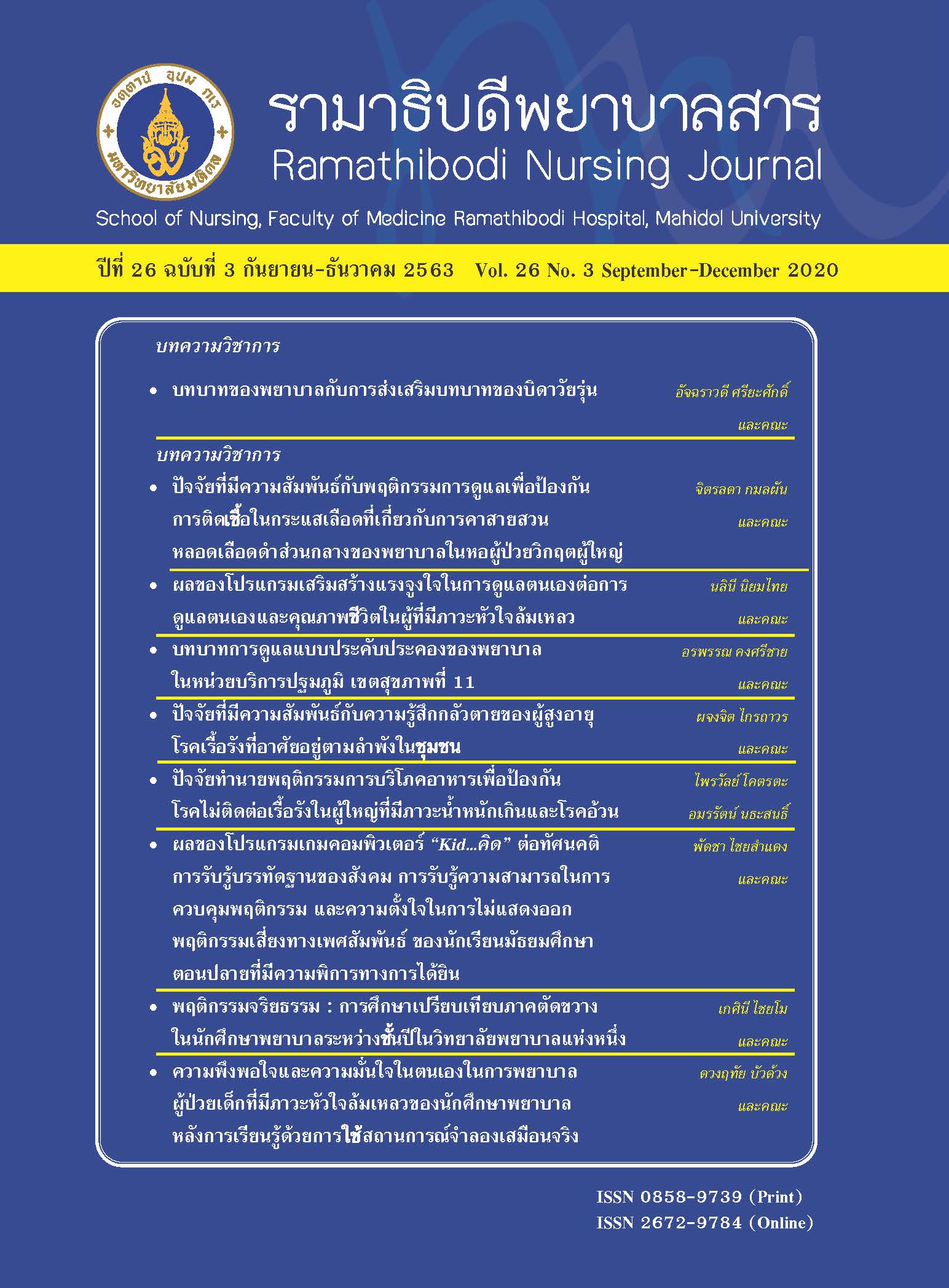
ผลของโปรแกรมเสริมสร้างแรงจูงใจในการดูแลตนเองต่อการดูแลตนเองและคุณภาพชีวิตในผู้ที่มีภาวะหัวใจล้มเหลว
Article Sidebar
Main Article Content
บทคัดย่อ
การวิิจััยครั้งนี้้เป็็นการวิิจััยแบบกึ่่งทดลองกลุ่มเดีียววััดผลก่อนและหลัังการทดลองมีีวัตถุุประสงค์เพื่่อศึึกษาผลของโปรแกรมเสริิมสร้างแรงจููงใจในการดููแลตนเองต่อการดููแลตนเองและคุุณภาพชีีวิิตในผู้ที่่มีีภาวะหััวใจล้มเหลว โดยใช้้กรอบแนวคิิดทฤษฎีีระดัับสถานการณ์์ที่เฉพาะเจาะจงเกี่่ยวกับการดููแลตนเองของผู้ป่วยหััวใจล้มเหลว ร่วมกับการใช้กลยุุทธ์การสััมภาษณ์เพื่่อเสริิมสร้างแรงจููงใจในการเปลี่ยนแปลงพฤติิกรรม กลุ่มตััวอย่างเป็็นผู้ที่่ได้้รัับการวิินิิจฉัยจากแพทย์ว่ามีีภาวะหััวใจล้มเหลวและเข้ารัับการรัักษาโรงพยาบาลรามาธิิบดีีคัดเลืือกคุุณสมบััติิตามเกณฑ์ที่กำหนดจำนวน 29 ราย กลุ่มตััวอย่่างได้รัับโปรแกรมเสริิมสร้้างแรงจููงใจในการดููแลตนเองทัั้งหมด 3 ระยะ ระยะที่่ 1 ส่งเสริิมการรู้จัักตนเอง กระตุ้นให้้เกิิดความตระหนัักของปัญหาสุุขภาพและสร้้างแรงจููงใจ
ในการปรับเปลี่่ยนพฤติิกรรม ระยะที่่ 2 พัฒนาความรู้และทัักษะในการดููแลตนเองในภาวะหััวใจล้มเหลว ในสััปดาห์ที่่ 1 ขณะผู้ป่วยอยู่ในโรงพยาบาล และระยะที่่ 3 ส่งเสริิมการปฏิิบััติิพฤติิกรรมอย่่างต่อเนื่องด้วยการติิดตามทางโทรศััพท์หลัังหน่าย สัปดาห์ละ 1 ครั้ง 4 สัปดาห์ เปิิดช่องทางด่วนติดต่อได้ 24 ชั่่วโมง รวมระยะเวลาดำเนิินโปรแกรม 6 สัปดาห์ การเก็็บข้อมููลดำเนิินการก่อนเข้้าร่ว มโปรแกรมสิ้นสุุดโปรแกรมทัันทีี และสิ้นสุุดโปรแกรม 1 เดืือน ตามลำดับ วิิเคราะห์ข้อมููลโดยใช้้สถิิติิเชิิงพรรณนาและสถิิติิการวิิเคราะห์ความแปรปรวนแบบวััดซ้ำทางเดีียว ผลการวิิจััยพบว่า ภายหลัังเข้าร่วมโปรแกรมกลุ่มตััวอย่างมีีคะแนน เฉลี่ยการดููแลตนเองและคะแนน เฉลี่ยคุุณภาพชีีวิิตหลัังสิ้้นสุุดโปรแกรมทัันทีี หลัังสิ้นสุุดโปรแกรมมาแล้ว 1 เดืือนสููงกว่าก่อนเข้าร่วมโปรแกรมอย่างมีีนัยสำคัญทางสถิิติิ ผลของโปรแกรมเสริิมสร้างแรงจููงใจในการดููแลตนเองก่อให้เกิิดผลลััพธ์ที่ดีี สามารถนำไปใช้เป็็นแนวทางใน
การปรับเปลี่่ยนพฤติิกรรมการดููแลตนเองเพื่่อควบคุุมการเกิิดอาการกำเริิบของโรคเพื่่อส่งเสริิมให้คุุณภาพชีีวิิตดีีขึ้น
คำสำคัญ: หััวใจล้มเหลว โปรแกรมเสริิมสร้างแรงจููงใจ การดููแลตนเอง คุุณภาพชีีวิิต
Article Details
บทความ ข้อมูล เนื้อหา รูปภาพ ฯลฯ ที่ได้รับการตีพิมพ์ในรามาธิบดีพยาบาลสาร ถือเป็นลิขสิทธิ์ของวารสาร หากบุคคลหรือหน่วยงานใดต้องการนำทั้งหมดหรือส่วนหนึ่งส่วนใดไปเผยแพร่หรือเพื่อกระทำการใด ใด จะต้องได้รับอนุญาตเป็นลายลักษณ์อักษรจากรามาธิบดีพยาบาลสารก่อนเท่านั้น
เอกสารอ้างอิง
American Heart Association. About heart failure; 2015[cited 2018 Apr 24]. Available from: https://www.heart.
org/en/health-topics/heart-failure/what-is-heartfailure
Heart Failure Council of Thailand. Heart failure council guideline; 2008 [cited 2018 Jan 14]. Available from:
http://www.thaiheart.org/images/column_129145 4908/CHF Guideline.pdf
Chatterjee NA, Chae CU, Kim E, Moorthy MV, Conen D, Sandhu RK, et al. Modifiable risk factors for incident
heart failure in atrial fibrillation. JACC Heart fail.2017;5(8):552-60.
Korhonen T, Goodwin A, Miesmaa P, Dupuis EA,Kinnunen T. Smoking cessation program with exercise
improves cardiovascular disease biomarkers in sedentary women. J Womens Health (Larchmt). 2011;20(7):1051-
Paul S, Sneed NV. Strategies for behavior change in patients with heart failure. AACN. 2004;13(4):305-13.
Creber RM, Patey M, Lee CS, Kuan A, Jurgens C, Riegel B. Motivational interviewing to improve self-care for
patients with chronic heart failure: MITI-HF randomized controlled trial. Patient Educ Couns. 2016;99(2):256-
Kobkuechaiyapong S. Characteristics of heart failure patients readmitted within 28 days in Saraburi Hospital. J
Prapokklao Hosp Clin Med Educat Center.2013;30(1):35-46. (in Thai)
Toukhsati SR, Driscoll A, Hare DL. Patient selfmanagement in chronic heart failure-establishing
concordance between guidelines and practice. Card Fail Rev. 2015;1(2):128-31.
Damnong N, Deenan A, Kunsongkeit W. Factors related to functional performance of rehospitalized patients with heart failure Journal of Boromarajonani College of Nursing Bangkok; 2015.31(3),74-85. (in Thai)
van der Wal MH, Jaarsma T, van Veldhuisen DJ. Noncompliance in patients with heart failure; how can we
manage it?. Eur J Heart Fail. 2005;7(1):5-17.
Wilson IB, Cleary PD. Linking clinical variables with health-related quality of life: a conceptual model of patient outcomes. JAMA. 1995;273(1):59-65.
Suwanno J, Petsirasaw R, Praseathai P, Chanpradit A,Saisuk W. Self-care among patients with chronic heart
failure. Thai Journal of Nursing and Midwifery Council.2008;23(1):35-47. (in Thai)
Riegel B, Dickson VV, Faulkner KM. The situationspecific theory of heart failure self-care: Revised and
updated. J Cardiovasc Nurs. 2016;31(3):226-35.
Jaarsma T, Cameron J, Riegel B, Stromberg A. Factors related to self-care in heart failure patients according to
the middle-range theory of self-care of chronic illness: a literature update. Curr Heart Fail Rep. 2017;14(2):71-7.
Seearoon L. The effects of an intrinsic motivation program on motivation & acceptance to rehabilitation treatment among drug dependent clients at one treatment center for drug dependence in Pathumthani Province. Thammasat Medical Journal. 2011;11(4):549-56. (in Thai)
Tiansaard J, Kanogsunthornrat N. Motivational interviewing: concept and application in persons with
chronic kidney disease. Ramathibodi Nursing Journal.2016;22(3):223-32. (in Thai)
Jerawatana R, Reutrakul S, Siripitayakunkit A. The effect of advanced practice nurse-led intervention program on outcomes in diabetes patients with complex problems.Ramathibodi Nursing Journal. 2016;22(2):51-68. (in
Thai)
Mabry JL. The effects of motivational interviewing on heart failure self-care during transitional care in an
Appalachian population [dissertation]. Knoxville,University of Tennessee; 2017.
Miller WR, Rollnick S. Motivational interviewing:preparing people to change addictive behavior. New York,
US: The Guilford Press; 1991.
Miller WR, Rollnick S. Motivational interviewing:Preparing people for change, 2nd ed. New York, US: The
Guilford Press; 2003.
Goldberg RJ, Spencer FA, Farmer C, Meyer TE, Pezzella S. Incidence and hospital death rates associated with heart failure: a community-wide perspective. Am J Med.2005;118(7):728-34.
Riegel B, Masterson Creber R, Hill J, Chittams J, Hoke L. Effectiveness of motivational interviewing in decreasing hospital readmission in adults with heart failure and multimorbidity. Clin Nurs Res. 2016;25(4):362-77.
Paradis V, Cossette S, Frasure-Smith N, Heppell S,Guertin MC. The efficacy of a motivational nursing
intervention based on the stages of change on self-care in heart failure patients. J Cardiovasc Nurs. 2010;25(2):130-41.
Prochaska JO, DiClemente CC. Stages and processes of self-change of smoking: toward an integrative model of change. J Consult Clin Psychol. 1983;51(3):390-5.
Krethong P. A causal model of health-related quality of life in Thai heart failure patients [thesis]. Bangkok:
Chulalongkorn University; 2007. (in Thai)
Polit DF, Beck CT. Nursing research: principles and methods. Philadelphia: Lippincott Williams & Wilkins;
Borson S, Scanlan J, Brush M, Vitallano P, Dokmak A.The Mini-Cog: a cognitive “Vital Signs” measure for
dementia screening in multi-lingual elerly. Int J Geriatr Psychiatry. 2000;15:1021–27.
Supaporn T, Rod L, Allan C, Nahathai W, Jane C.Development of the Thai version of Mini-Cog, a brief
cognitive screening test. Geriatr Gerontol Int. 2015;15 (5):594-600. (in Thai)
Riegel B, Lee CS, Dickson VV, Carlson B. An update on the Self-Care of Heart Failure Index. J Cardiovasc Nurs.
;24(6):485-97.
Rector TS, Cohn JN. Assessment of patient outcome with the Minnesota Living with Heart Failure Questionnaire:reliability and validity during a randomized, double-blind,placebo-controlled trial of pimobendan. Pimobendan Multicenter Research Group. Am Heart J. 1992;124(4):1017-25.
Tepsuriyanont S. Quality of life in heart failure patients.Journal of The Royal Thai Army Nurses. 2017;18(1):39-
(in Thai)
Brodie DA, Inoue A, Shaw DG. Motivational interviewing to change quality of life for people with chronic heart
failure: a randomised controlled trial. Int J Nurs Stud.2008;45(4):489-500.
Faller H, Störk S, Schuler M, Schowalter M, Steinbüchel T, Ertl G, et al. Depression and disease severity as
predictors of health-related quality of life in patients with chronic heart failure-a structural equation modeling
approach. J Cardiac Fail. 2009;15(4):286-92.
