
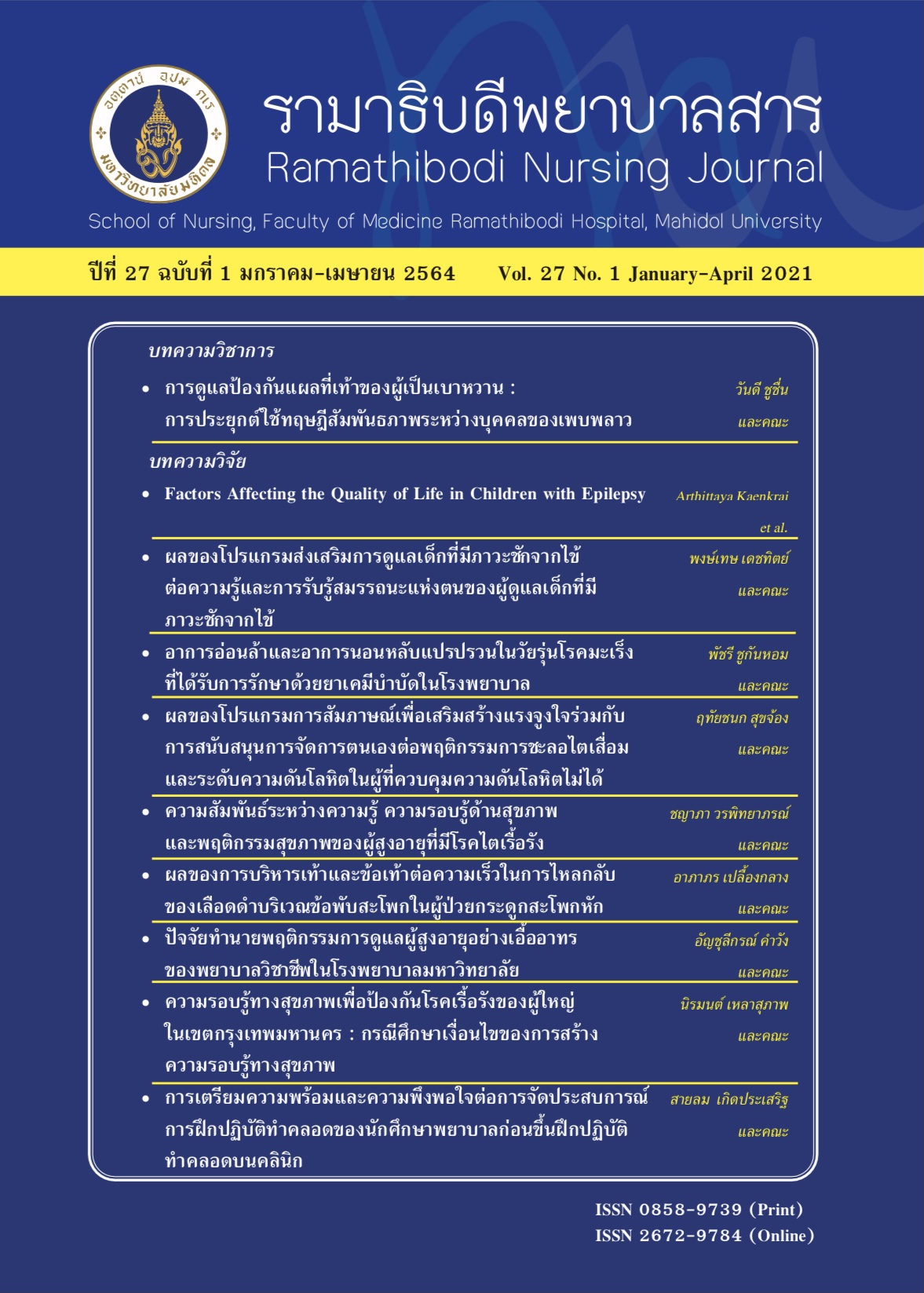
ปัจจัยทำนายพฤติกรรมการดูแลผู้สูงอายุอย่างเอื้ออาทรของพยาบาลวิชาชีพในโรงพยาบาลมหาวิทยาลัย
Article Sidebar
Main Article Content
บทคัดย่อ
การศึกษาเชิงบรรยายครั้งนี้มีวัตถุประสงค์เพื่อศึกษาปัจจัยทำนายพฤติกรรมการดูแลผู้สูงอายุอย่างเอื้ออาทรของพยาบาลวิชาชีพ ในโรงพยาบาลมหาวิทยาลัย โดยใช้แนวคิดทฤษฎีการกระทำด้วยเหตุผลเป็นกรอบแนวคิดในการศึกษา กลุ่มตัวอย่างคือ พยาบาลวิชาชีพจำนวน 150 ราย ที่ปฏิบัติงานในหอผู้ป่วยที่ดูแลผู้สููงอายุุในโรงพยาบาลมหาวิทยาลัยแห่งหนึ่งและได้รับการคัดเลือกโดยการสุ่มแบบช่วงชั้นแบบมีสัดส่วน เก็บข้อมูลในช่วงเดือนเมษายน-มิถุุนายน พ.ศ. 2562 ด้วยวิธีการตอบแบบสอบถามด้วยตนเอง จำนวน 6 ฉบับ เพื่อประเมินข้อมูลส่วนบุคคล ความรู้เบื้องต้นเกี่ยวกับผู้สูงอายุ เจตคติต่อการดูแลผู้สูงอายุ การรับรู้บรรยากาศเอื้ออาทร ความตั้งใจในการดูแล และพฤติกรรมการดูแลผู้สูงอายุุอย่างเอื้ออาทร วิเคราะห์ความสัมพันธ์ของตัวแปรด้วยสถิติสหสัมพันธ์
แบบสเปียร์แมน และวิเคราะห์ความสามารถในการร่วมทำนายพฤติกรรมการดูแลผู้สูงอายุุอย่างเอื้ออาทรด้วยการวิเคราะห์การถดถอยแบบพหุคูณแบบ Enter ผลการศึกษาพบว่าเจตคติต่อการดูแลผู้สูงอายุ การรับรู้บรรยากาศเอื้ออาทร และความตั้งใจในการดูแลมีความสัมพันธ์ทางบวกกับพฤติกรรมการดูแลผู้สูงอายุุอย่างเอื้ออาทร แต่ความรู้เบื้องต้นเกี่ยวกับผู้สูงอายุไม่มีความสัมพันธ์กับพฤติกรรมการดูแลผู้สูงอายุอย่างเอื้ออาทรอย่างมีนัยสำคัญทางสถิติ การรับรู้บรรยากาศเอื้ออาทร ความตั้งใจในการดูแลผู้สูงอายุ เจตคติต่อการดูแลผู้สูงอายุ และความรู้เบื้องต้นเกี่ยวกับผู้สูงอายุ สามารถร่วมกันทำนายพฤติกรรมการดูแลผู้สูงอายุุได้ร้อยละ 32 โดยที่การรับรู้บรรยากาศเอื้ออาทรเป็นตัวแปรทำนายที่มีอิทธิพลมากที่่สุด จากผลการศึกษานี้ควรส่งเสริมการรับรู้ บรรยากาศเอื้ออาทร เจตคติที่ดีต่อการดููแลผู้สููงอายุุ และความตั้งใจในการดูแลผู้สูงอายุ เพื่อให้เกิดพฤติกรรมการดูแลผู้สูงอายุอย่างเอื้้ออาทรของพยาบาลวิชาชีพ
คำสำคัญ : ความตั้งใจในการดูแล พฤติกรรมการดูแลผู้สูงอายุอย่างเอื้ออาทร พยาบาลวิชาชีพ ผู้สูงอายุ แนวคิดทฤษฎีการกระทำด้วยเหตุผล
Article Details
บทความ ข้อมูล เนื้อหา รูปภาพ ฯลฯ ที่ได้รับการตีพิมพ์ในรามาธิบดีพยาบาลสาร ถือเป็นลิขสิทธิ์ของวารสาร หากบุคคลหรือหน่วยงานใดต้องการนำทั้งหมดหรือส่วนหนึ่งส่วนใดไปเผยแพร่หรือเพื่อกระทำการใด ใด จะต้องได้รับอนุญาตเป็นลายลักษณ์อักษรจากรามาธิบดีพยาบาลสารก่อนเท่านั้น
เอกสารอ้างอิง
Assantachai P. Common health problem in elderly and prevention. Bangkok: Union Creation; 2009.
Inouye SK, Studenski S, Tinetti ME, Kuchel GA. Geriatric syndromes: clinical, research and policy implications of acore geriatric concept. J Am Geriatr Soc. 2007; 55(5):780–91.
Ham RJ. Primary care geriatrics: a case-based approach.5th ed. Elsevier Health Sciences; 2007.
Sasat S. Gerontological nursing: common problems and caring guideline. 3rd ed. Bangkok: Active print; 2011.
Jitmontree N, Thongcharoen W, Thanasilp S. Good model of elderly care in family and community in city and
Bangkok. J Nurs Sci. 2011;29(2):67-74.
Wilson LD. The American Association of Colleges of Nursing’s geriatric nursing education consortium. J
Gerontolol Nurs. 2012;36(7):14-7.
Malathum P. Successful aging. Rama Nurs J.2007;13(3):221-31.
Thongcharoen W. Nursing science and arts. 2nd ed.Bangkok: NP Press; 2015.
Leethong-in M, Piyawattanapong S. Predicting factors of age-friendly nursing care behavior by nursing studentsnursing practice subject. Journal of Nursing and Health Care. 2015;33(3): 70-9. (in Thai)
Rerksadayut P. Caring behavior of perioperative nurses and related factors as perceived by perioperative nurse [Thesis]. Songkla: Prince of Songkla University; 2013.
Ajzen I, Fishbein M. Understanding attitudes and predicting social behavior. Englewood Cliffs NJ: Prentice-
Hall; 1980.
McKinlay A, Cowan S. Student nurses’ attitudes towards working with older patients. J Adv Nurs. 2003; 43(3),
-309.
Oyetunde MO, Ojo OO, Ojewale LY. Nurses’ attitude towards the care of the elderly: implications for
gerontological nursing training. J Nurs Educ. 2013;3 (7):150-8.
Faul F, Erdfelder E, Lang AG, Buchner A. G*power 3: a flexible statistical power analysis program for the social,behavior, and biomedicalsciences. Behave ResMethods.2007;39(2): 175-91
Dikken J, Hoogerduijn JG, Oeseburg, B, Venables H,Habes V, Schuurmans MJ, et al. Educating for an aging
society: competencies, knowledge and attitude and how to motivate students. J Adv Nurs. 2016;72(S1);8
Hughes L. Peer group caring interaction scale and organizational climate for caring questionnaire. In: Watson
J, editors. Assessing and measuring caring in nursing and health sciences. 2nd ed. New York: Springer; 2009. p.
-62.
Fishbein M, Ajzen I. Predicting and changing behavior:the reasoned action approach. New York: Psychology
Press; 2010.
Suebwonglee C, Suchewa S, Wongwanich S. Development of a nursing caring behavior assessment instrument using the cognitive interview technique. SDU Res J. 2011;7(2):127-42. (in Thai)
Ko NY, Feng MC, Chiu DY, Wu M H, Feng JY, Pan SM.Applying theory of planned behavior to predict nurses’
intention and volunteering to care for SARS patients in southern Taiwan. Kaohsiung J Med Sci. 2004;20(8):389-98.
Javadi M, Kadkhodaee M, Yaghoubi M, Maroufi M, Shams A. Applying theory of planned behavior in predicting of patient safety behaviors of nurses. Mater Sociomed.2013;25(1):52-5.
Jeong SY, Park HS, Wang HJ, Kim M. Intentions to care for new influenza A (H1N1) patients and influencing
factors: an application of theory of planned behavior. J Korean Assoc Soc Home Care Nurs. 2015;22(1):78-87.
Kim CJ, Yoo HR, Yoo MS, Kwon BE, Hwang KJ.Attitude, beliefs, and intentions to care for SARS patients
among Korean clinical nurses: an application of theory of planned behavior. J Korean Acad Nurs. 2006;36(4):
-603.
De Guzman AB, Jimenez BCB, Jocson KP, Junio AR,Junio DE, Jurado JBN, Justiniano ABF. Filipino nursing
students’ behavioral intentions toward geriatric care: a structural equation model (SEM). Educ Gerontol.
;39(3):138-54.
Hagerling FL. Nurse attitudes toward caring for older
patients with delirium [Dissertation]. Colorado: Colorado
State University, USA; 2015.
