
ปัจจัยที่มีอิทธิพลต่อคุณภาพชีวิตเด็กโรคลมชัก
Article Sidebar
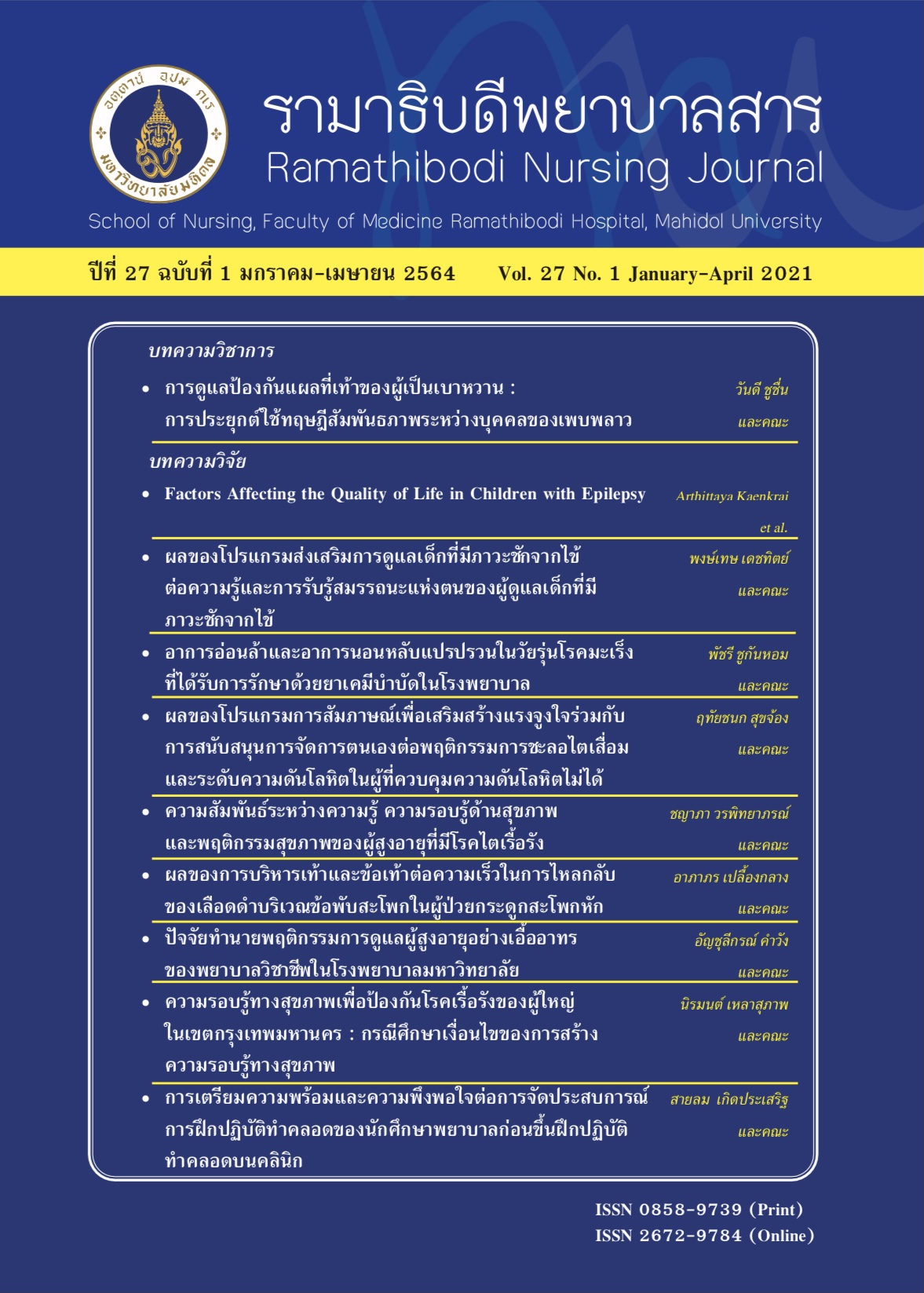
Main Article Content
บทคัดย่อ
คุุณภาพชีวิตเป็นสิ่งที่บ่งบอกถึงผลลัพธ์ทางการรักษาที่สำคัญทางคลินิกโดยเฉพาะอย่างยิ่งในผู้ป่วยเด็กโรคเรื้อรัง การวิจัยครังนี้มีวัตถุุประสงค์เพื่อหาความสัมพันธ์เชิงทำนายปัจจัยที่่มีอิทธิผลต่อคุณภาพชีวิตเด็กโรคลมชัก โดยปัจจัยคัดสรร ได้แก่ ความรุนแรงของโรคลมชักโรคร่วม และการทำหน้าที่ของครอบครัว กลุ่มตัวอย่างคือ ผู้ดูแลหลักของเด็กโรคลมชักช่วงอายุ 4-15 ปี ที่มารับการตรวจรักษาในคลินิกโรคระบบประสาทเด็กทั้งแผนกผู้ป่วยนอกและผู้ป่วยในสถาบันประสาทวิทยาและโรงพยาบาลรามาธิบดีจำนวน 90 ราย โดยเลือกตัวอย่างแบบ เฉพาะเจาะจงตามคุณสมบัติที่กำหนด เก็บรวบรวมข้อมูลระหว่างเดือนมิถุนายน-สิงหาคม พ.ศ. 2562 เครื่องมือที่ใช้ในการเก็บข้อมูลประกอบด้วย แบบบันทึกข้อมูลส่วนบุคคล แบบบันทึกข้อมูลระดับความรุนแรงของโรคลมชัก แบบประเมินการปฏิบัติหน้าที่ของครอบครัว และแบบประเมินคุณภาพชีวิตผู้ป่วยเด็กโรคลมชัก วิเคราะห์ข้อมูลโดยใช้สถิติพรรณนา สัมประสิทธ์สหสัมพันธ์ของเพียร์สันและการวิเคราะห์ความถดถอยเชิงพหุคูณ ผลการศึกษาพบว่าความรุนแรงของโรคลมชัก โรคร่วมและการทำหน้าที่ของครอบครัวสามารถร่วมกันทำนายคุณภาพชีวิตโดยรวมได้ร้อยละ 28.40 ผลการศึกษานี้จะเป็นประโยชน์ สำหรับพยาบาลและบุคลากรทีมสุขภาพในการสนับสนุนการดูแลเด็กโรคลมชักอย่างเหมาะสมและออกแบบโปรแกรมเพื่อส่งเสริมคุุณภาพชีวิตของผู้ป่วยเด็กโรคลมชักต่อไป
คำสำคัญ : ปัจจัยทำนาย คุณภาพชีวิต เด็กโรคลมชัก
Article Details
บทความ ข้อมูล เนื้อหา รูปภาพ ฯลฯ ที่ได้รับการตีพิมพ์ในรามาธิบดีพยาบาลสาร ถือเป็นลิขสิทธิ์ของวารสาร หากบุคคลหรือหน่วยงานใดต้องการนำทั้งหมดหรือส่วนหนึ่งส่วนใดไปเผยแพร่หรือเพื่อกระทำการใด ใด จะต้องได้รับอนุญาตเป็นลายลักษณ์อักษรจากรามาธิบดีพยาบาลสารก่อนเท่านั้น
เอกสารอ้างอิง
Aaberg KM, Gunnes N, Bakken IJ, Søraas CL, Berntsen A, Magnus P, et al. Incidence and prevalence of childhood epilepsy: A nationwide cohort study. Pediatrics. 2017;139(5):e20163908.
Camfield P, Camfield C. Incidence, prevalence and aetiology of seizures and epilepsy in children. Epileptic
Disord. 2015;17(2):117-23.
Russ SA, Larson K, Halfon N. A national profile of childhood epilepsy and seizure disorder. Pediatrics.
;129(2):256-64.
Asawavichienjinda T, Sitthi-Amorn C, Tanyanont W.Prevalence of epilepsy in rural Thailand: a populationbased
study. J Med Assoc Thai. 2002;85(10):1066-73.
Modi AC, Ingerski LM, Rausch JR, Glauser TA. Treatment factors affecting longitudinal quality of life in new onset pediatric epilepsy. J Pediatr Psychol. 2011;36(4):466-75.
Testa MA, Simonson DC. Assessment of quality-of-life outcomes. N Engl J Med. 1996;334(13):835-40.
Cramer JA. Principles of health-related quality of life:assessment in clinical trials. Epilepsia. 2002;43(9):1084-
Goodwin SW, Ferro MA, Speechley KN. Development and assessment of the Quality of Life in Childhood Epilepsy Questionnaire (QOLCE-16). Epilepsia. 2018;59(3):668-78.
Haneef Z, Grant ML, Valencia I, Hobdell EF, KothareSV, Legido A, et al. Correlation between child and parental
perceptions of health-related quality of life in epilepsy using the PedsQL. v4. 0 measurement model. Epileptic
Disord. 2010;12(4):275-82.
Ramsey RR, Loiselle K, Rausch JR, Harrison J, Modi AC.Predictors of trajectories of epilepsy-specific quality of
life among children newly diagnosed with epilepsy.Epilepsy Behav. 2016;57 (Pt A): 202-10.
Schachter SC. Epilepsy quality of life and cost of care.Epilepsy Behav. 2000;1(2):120-7.
Ronen GM, Streiner DL, Rosenbaum P. Health-related quality of life in childhood epilepsy: moving beyond’
seizure control with minimal adverse effects. Health and Quality of life Outcomes. 2003;1(1):36.
Ferro MA. Risk factors for health-related quality of life in children with epilepsy: a meta-analysis. Epilepsia.
;55(11):1722-31.
Mendes TP, Crespo CA, Austin JK. Family cohesion, stigma, and quality of life in dyads of children with epilepsy and their parents. J Pediatr Psychol. 2017;42(6):689-99.
Puka K, Ferro MA, Anderson KK, Speechley KN. Healthrelated quality of life in mothers of children with epilepsy:10 years after diagnosis. Qual Life Res. 2018:969-77.
Lach LM, Ronen GM, Rosenbaum PL, Cunningham C,Boyle MH, Bowman S, et al. Health-related quality of
life in youth with epilepsy: theoretical model for clinicians and researchers. Part I: the role of epilepsy and comorbidity.Qual Life Res. 2006;15(7):1161-71.
Bompori E, Niakas D, Nakou I, Siamopoulou-Mavridou A, Tzoufi MS. Comparative study of the health-related
quality of life of children with epilepsy and their parents.Epilepsy Behav. 2014;41:11-7.
Epstein NB, Baldwin LM, Bishop DS. The McMaster family assessment device. J Marital Fam Ther.
;9(2):171-80.
Sajobi TT, Wang M, Ferro MA, Brobbey A, Goodwin S,Speechley KN, et al. Multivariate trajectories across
multiple domains of health-related quality of life in children with new-onset epilepsy. Epilepsy Behav.
;75:72-8.
Cohen J. A power primer. Psychol Bull. 1992;112(1):155-159.
Austin JK, Dunn DW, Huster GA. Childhood epilepsy and asthma: changes in behavior problems related to gender and change in condition severity. Epilepsia.2000;41(5):615-23.
Räty LK, Söderfeldt BA, Larsson G, Larsson BMW. The relationship between illness severity, sociodemographic
factors, general self-concept, and illness-specific attitude in Swedish adolescents with epilepsy. Seizure.
;13(6):375-82.
Trangkasombat U. Family therapy and family counseling.Bangkok: Family Research and Development Center;
Goodwin SW, Ferro MA, Speechley KN. Measurement equivalence of the short-form Quality of Life in Childhood Epilepsy Questionnaire (QOLCE-16). Epilepsy Behav.2019;90:142-7.
Thrasher C, Grossmann T. Children’s emotion perception in context: the role of caregiver touch and relationship quality. Emotion; 2019.
Cianchetti C, Messina P, Pupillo E, Crichiutti G, Baglietto MG, Veggiotti P, et al. The perceived burden of epilepsy:impact on the quality of life of children and adolescents and their families. Seizure. 2015;24:93-101.
Ferrer F, Vilaseca R, Olmos JG. Positive perceptions and perceived control in families with children with intellectual disabilities: relationship to family quality of life. Qual Quant. 2017;51(2):903-18.
