
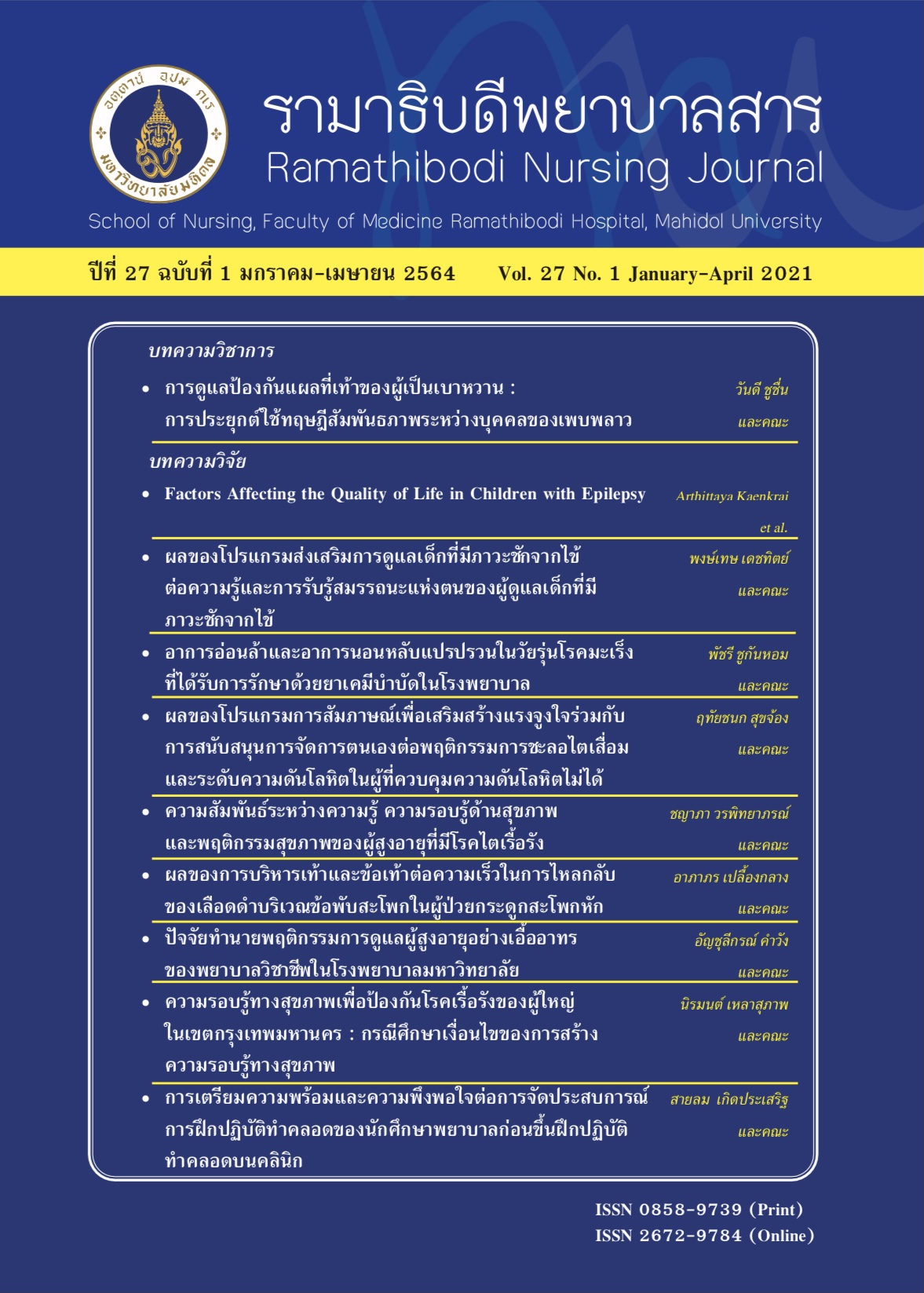
ผลของโปรแกรมส่งเสริมการดูแลเด็กที่มีภาวะชักจากไข้ต่อความรู้และการรับรู้สมรรถนะแห่งตนของผู้ดูแลเด็กที่มีภาวะชักจากไข้
Article Sidebar
Main Article Content
บทคัดย่อ
การศึกษาวิจัยนี้เป็นการวิจัยเชิงทดลอง เปรียบเทียบกลุ่มตัวอย่างแบบสองกลุ่ม วัดผลก่อนและภายหลังการทดลอง เพื่อศึกษาผลของโปรแกรมส่งเสริมการดูแลเด็กที่มีภาวะชักจากไข้ต่อความรู้เกี่ยวกับภาวะชักจากไข้ และการรับรู้สมรรถนะแห่งตนของผู้ดูแลเด็กที่มีภาวะชักจากไข้คัดเลือกกลุ่มตัวอย่างแบบเฉพาะเจาะจงซึ่งเป็นผู้ดูแลหลักของเด็กอายุุ 3 เดือน ถึง 5 ปี ที่มีภาวะชักจากไข้ และเข้ารับการรักษาพยาบาล ณ งานอุุบัติเหตุและฉุกเฉิน จำนวน 34 ราย แบ่งเป็นกลุ่มควบคุมที่ได้รับการพยาบาลตามปกติ และกลุ่มทดลองที่ได้รับโปรแกรมส่งเสริมการดููแลเด็กที่มีภาวะชักจากไข้ร่วมกับการพยาบาลตามปกติ กลุ่มละ 17 ราย ดำเนินการเก็บรวบรวมข้อมููลตั้งแต่เดือนกรกฎาคม 2559 ถึง เดือนเมษายน 2560 ผู้วิจัยได้พัฒนาโปรแกรมฯ และเครื่องมือในการเก็บรวบรวมข้อมููล ภายใต้กรอบทฤษฎีการรับรู้สมรรถนะแห่งตนของแบนดููรา เครื่องมือ ประกอบด้วย แบบบันทึกข้อมููลส่วนบุุคคล แบบสอบถามความรู้เกี่ยวกับภาวะชักจากไข้ และแบบสอบถามการรับรู้สมรรถนะแห่งตนของผู้ดูแลเด็กที่มีภาวะชักจากไข้ วิเคราะห์ข้อมููลด้วยสถิติเชิงบรรยายไคสแควร์ และการทดสอบค่าที ผลการวิจัยพบว่า ภายหลังการทดลอง กลุ่มทดลองมีค่าเฉลี่ยคะแนนความรู้เกี่ยวกับภาวะชักจากไข้ และคะแนนการรับรู้สมรรถนะแห่งตนของผู้ดูแล สูงกว่าค่าเฉลี่ยคะแนนในกลุ่มควบคุมอย่างมีนัยสำคัญทางสถิติ ผลการศึกษาครั้งนี้มีประโยชน์ต่อพยาบาลโดยสามารถนำไปใช้ในการส่งเสริมความรู้และพัฒนาการรับรู้สมรรถนะแห่งตนในผู้ดูแลเด็กที่มี
ภาวะชักจากไข้ที่มารับการรักษาพยาบาลที่งานอุบัติเหตุและฉุกเฉินได้
คำสำคัญ : ผู้ดูแล ภาวะชักจากไข้ โปรแกรมส่งเสริมการดูแลเด็กที่มีภาวะชักจากไข้ ความรู้ การรับรู้สมรรถนะแห่งตน
Article Details
บทความ ข้อมูล เนื้อหา รูปภาพ ฯลฯ ที่ได้รับการตีพิมพ์ในรามาธิบดีพยาบาลสาร ถือเป็นลิขสิทธิ์ของวารสาร หากบุคคลหรือหน่วยงานใดต้องการนำทั้งหมดหรือส่วนหนึ่งส่วนใดไปเผยแพร่หรือเพื่อกระทำการใด ใด จะต้องได้รับอนุญาตเป็นลายลักษณ์อักษรจากรามาธิบดีพยาบาลสารก่อนเท่านั้น
เอกสารอ้างอิง
Chomboon S, Noonin N, Aekwarangkoon S, Kusol K. The effect of discharge education for caregivers on the revisit of children with acute febrile illness at Nakhon Si Thammarat municipality hospital. Kuakarun Journal of
Nursing 2019;26(1):92-106. (in Thai)
Champi C, Gaffney-Yocum PA. Managing febrile seizures in children. Dimens Crit Care Nurs. 2001;20(5):2-7.
Kolahi AA, Tahmooreszadeh S. First febrile convulsion:inquiry about the knowledge, attitudes and concerns of the patient’s mothers. Eur J Pediatr. 2009;168(2):167-71.
Carman KB, Ekici AE, Yimenicioglu S, Yarar C, Arslantas D, Yakut A. The prevalence of febrile seizure and
associated factors among Trukish children. Int J Clin Pediatr. 2014;3(1):1-4.
Chung S. Febrile seizure. Korean J Pediatr.2014;57(9):384-95.
Aruncharoenrat J. The development of clinical nursing practice guideline in support of febrile convulsion care and prevention. [thesis]. Samut Prakan: Huachiew Chalermprakiet University; 2009. (in Thai)
Paul S, Nair J, Hemming J. Complex febrile seizure in children. Nurs. Time. 2011;107(40);15.
Najimi A, Dolatabadi NK, Esmaeili AA, Sharifirad GR.The effect of educational program on knowledge, attitude
and practice of mothers regarding prevention of febrile seizure in children. J Edu Health Promot. 2013;2(26):1-5.
Walsh AM, Edwards HE. Management of childhood fever by parents: literature review. J Adv Nurs. 2006;54
(2):217-27.
Gajaseni N. Relationships among selected basic conditioning factors, child-care agency, and maternal
care-giving behaviors upon febrile children aged 3 months to 6 years. [thesis]. Nakorn Pathom: Mahidol University;2004. (in Thai)
Lamchang S, Sriboonyawattana N, Nuglor T, Lamchang P. Factors related to parental practices for children with febrile convulsion. Nursing Journal. 2015;42(1):166-77. (in Thai)
Pongjaturawit Y, Chaimongkol N. Experiences of mothers in management of their children with fever. Nursing Journal of The Ministry of Public Health 2015;24(3):29-40.(in Thai)
Rkain M, Rkain I, Safi M, Kabiri M, Ahid S, Benjelloun BDS. Knowledge and management of fever among
Moroccan parents. East Mediterr Health J. 2014;20(6):397-402.
Bandura A. Self-efficacy: Toward a unifying theory of behavioral change. Psychol. Rev. 1977; 84(2):191-
Bandura A. Self-efficacy: The exercise of control. New York: W. H. Freeman and Company: 1997.
Prasopkittikun T. Self - efficacy and health behavior. Thai Journal of Nursing Council. 2001;16(3):1-12. (in Thai)
Panturut P. Effect of knowledge and self-efficacy enhancement program on self-efficacy of caregivers of
children with acyanotic congenital heart disease. [thesis].Nakorn Pathom: Mahidol University; 2011. (in Thai)
Iamsupasit S. Theories and techniques in behavior modification. 6th ed. Bangkok: Chulalongkorn University
Press; 2007. (in Thai)
Sumanit S. Effects of self-efficacy promotion on perceived self-efficacy of caregivers participating in care provided to critically ill children. [thesis]. Nakorn Pathom: MahidolUniversity; 2009. (in Thai)
Faul F, Erdfelder E, Lang AG, Buchner A. G*Power 3:A flexible statistical power analysis program for the social,
behavioral, and biomedical sciences. Behav. Res. Methods.2007;39(2):175-191.
Pornmeesri A, Mettraipan P, Jamkrajang N, Boonsanong K. The results of the program to promote the care and protection of children with febrile convulsion, the efficacy of care in reducing the recurrence of febrile convulsion.[cited 2014 December 20]. Available from: http://www.smpkhos.go.th/document/ F193861.pdf
Elbilgahy AA, Aziz RA. Effect of implementing an educational module on improving mothers knowledge,
home management and attitude about febrile convulsion.J Nurs Educ Pract. 2018;8(3):1-11.
Tabassum SR, Parvaiz N. Effectiveness of structured teaching programme on knowledge regarding management of febrile convulsions among mothers of under five children. Int J Innov Res Sci Eng Technol. 2018:4(1):1168-78.
Soundari ES, Kokilavani N, Kumar CS. A study to assess the effectiveness of educational intervention on knowledge and attitude of mothers regarding care of children with convulsion disorder at Melmaruvathur. Asian Journal of Nursing Education and Research. 2014:4(4);457-60.
Khamenkan K, Phunsa S, Poogpan J, Butpool J, Saengkae R. The effect of a program of nurses providing information to parents’ knowledge and satisfaction on caring for hospitalized children. Nursing Journal. 2017:44(2);71-80. (in Thai)
Srichantaranit A, Chungsomprasong P, Vijarnsorn C,Sukthongsa W, Udomponglukana N, Jaturachaidech C.
Comparing the effects of teaching with VCD and teaching with flip chart on knowledge and anxiety of mothers in
caring for children undergoing cardiac catheterization.Nursing Science Journal of Thailand. 2014;32(2):41-
(in Thai)
