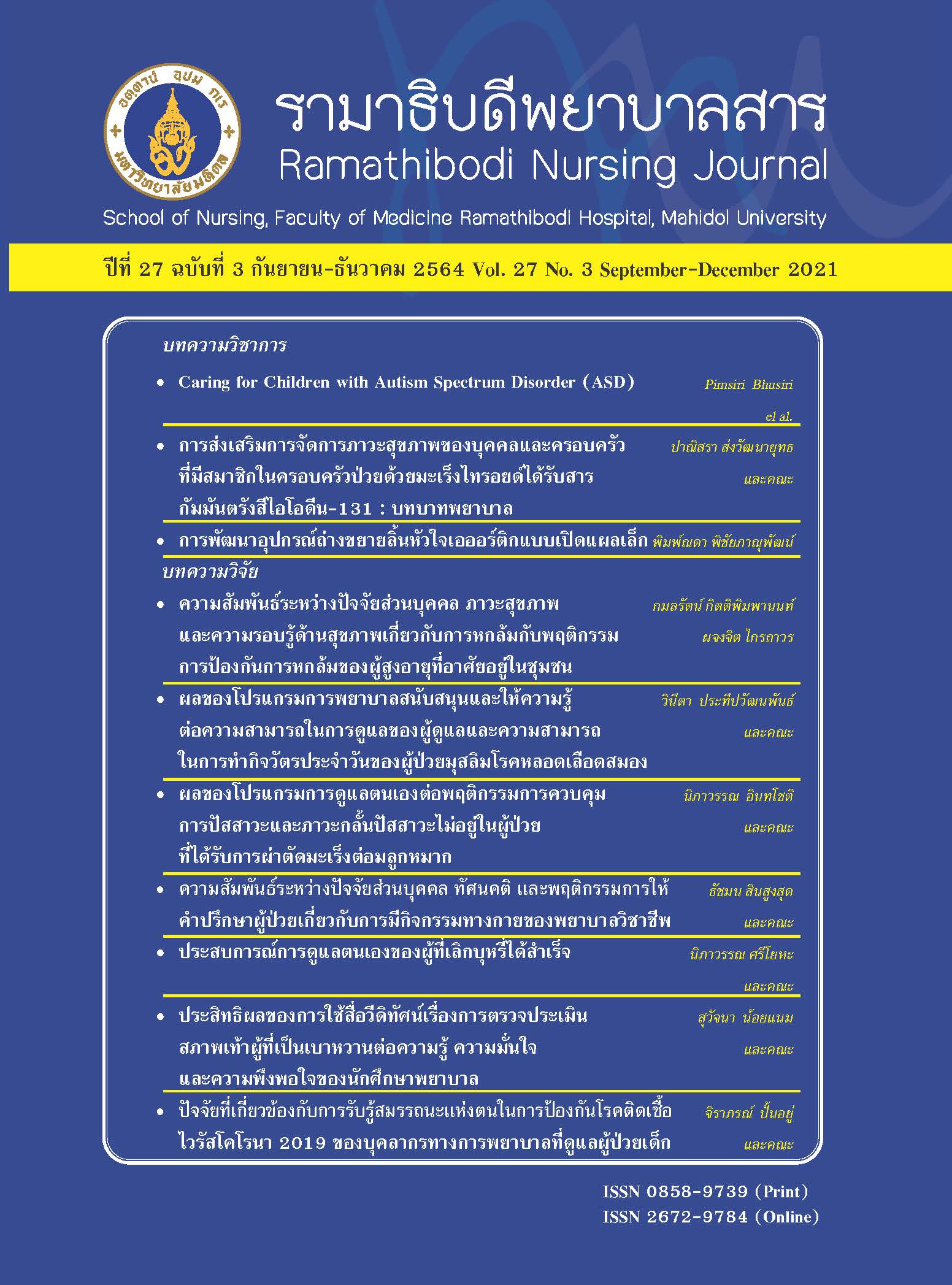
ความสัมพันธ์ระหว่างปัจจัยส่วนบุคคล ทัศนคติ และพฤติกรรมการให้คำปรึกษาผู้ป่วยเกี่ยวกับการมีกิจกรรมทางกายของพยาบาลวิชาชีพ
Article Sidebar
Main Article Content
บทคัดย่อ
การศึกษาครั้งนี้เป็นวิจัยเชิงความสัมพันธ์ เพื่อศึกษาความสัมพันธ์ระหว่างปัจจัยส่วนบุคคล ทัศนคติเกี่ยวกับการมีกิจกรรมทางกายและพฤติกรรมการให้คำปรึกษาผู้ป่วยเกี่ยวกับการมีกิจกรรมทางกายของพยาบาลวิชาชีพ กลุ่มตัวอย่าง คือ พยาบาลวิชาชีพที่ปฏิบัติงานในหน่วยตรวจผู้ป่วยนอก โรงพยาบาลในสังกัดมหาวิทยาลัยแห่งหนึ่ง จำนวน 74 คน เครื่องมือที่ใช้ในการเก็บรวบรวมข้อมูล ประกอบด้วย แบบสอบถามข้อมูลส่วนบุคคล แบบสอบถามทัศนคติเกี่ยวกับการมีกิจกรรมทางกาย และแบบสอบถามพฤติกรรมการให้คำปรึกษาผู้ป่วยเกี่ยวกับการมีกิจกรรมทางกาย วิเคราะห์ข้อมูลโดยใช้สถิติบรรยายและสัมประสิทธิ์สหสัมพันธ์ของเพียร์สัน ผลการวิจัยพบว่า กลุ่มตัวอย่างทั้งหมดเป็นเพศหญิง อายุเฉลี่ย 38.15 ปี ค่ามัะยฐานของประสบการณ์ทำงานเท่ากับ 13 ปี ร้อยละ 50 มีค่าดัชนีมวลกายอยู่ในเกณฑ์ปกติ และร้อยละ 51.40 ไม่มีโรคประจำตัวคะแนนเฉลี่ยทัศนคติเกี่ยวกับการมีกิจกรรมทางกายอยู่ในระดับสูง แต่พบว่าพฤติกรรมการให้คำปรึกษาผู้ป่วยเกี่ยวกับการมีกิจกรรมทางกายตามการรับรู้ของบพยาบาลอยู่ในระดับต่ำ ความถี่ในการออกกำลังกายมีความสัมพันธ์ทางบวกกับพฤติกรรมการให้คำปรึกษาผู้ป่วยเกี่ยวกับการมีกิจกรรมทางกายอย่างมีนัยสำคัญ ส่วนอายุ ประสบกาณ์ทำงาน ดัชนีมวลกาย และทัศนคติ ไม่มีความสัมพันธ์กับพฤติกรรมการให้คำปรึกษาผู้ป่วยเกี่ยวกับการมีกิจกรรมทางกาย ผลวิจัยครั้งนี้เป็นข้อมูลพื้นฐานให้กับผู้ที่เกี่ยวข้องทบทวนขอบเขตภาระงานของพยาบาลให้สอดคล้องกับเป้าหมายของแผนพัฒนาสุขภาพแห่งชาติในการให้คำปรึกษาผู้ป่วยนอกของพยาบาลวิชาชีพเกี่ยวกับการมีกิจกรรมทางกาย และควรสนับสนุนให้บุคลากรเพิ่มระดับการมีกิจกรรมทางกายที่มากขึ้น และตระหนักว่าการมีกิจกรรมทางกายเป็นส่วนหนึ่งของการส่งเสริมสุขภาพและการดูแลรักษาผู้รับบริการ
คำสำคัญ : พฤติกรรมการให้คำปรึกษา การมีกิจกรรมทางกาย ทัศนคติเกี่ยวกับการมีกิจกรรมทางกาย พยาบาลวิชาชีพ
Article Details
บทความ ข้อมูล เนื้อหา รูปภาพ ฯลฯ ที่ได้รับการตีพิมพ์ในรามาธิบดีพยาบาลสาร ถือเป็นลิขสิทธิ์ของวารสาร หากบุคคลหรือหน่วยงานใดต้องการนำทั้งหมดหรือส่วนหนึ่งส่วนใดไปเผยแพร่หรือเพื่อกระทำการใด ใด จะต้องได้รับอนุญาตเป็นลายลักษณ์อักษรจากรามาธิบดีพยาบาลสารก่อนเท่านั้น
เอกสารอ้างอิง
World Health Organization (WHO). Global action plan on physical activity 2018–2030: more active people for
a healthier world; 2018. Available from website: https://www.who.int/publications/i/: item/9789241514187
Strategy and Planning Division Ministry of Public Health 2018; 2018. Available from website: http://bps.moph.
go.th/new_bps/sites/default/files/statistic61%20full.pdf (in Thai)
U.S. Department of Health and Human Services. Physical activity guidelines for Americans 2nded. [cited 2019
October 27]. Available from: https://health.gov/paguidelines/second- edition/pdf/ Physical_Activity_
Guidelines_2nd_edition.pdf
Ribeiro MA, Martins MA, Carvalho CRF. The role of physician counseling in improving adherence to physical
activity among the general population. Sao Paulo Med J.2007;125(2):115-21. doi: 10.1590/s151 31802007000200010.
National Economic and Social Development Board Office of the Prime Minister. The twelfth national economic and social development plan (2017-2021); 2019. Available from website: https://wops.moph.go.th/ops/oic/
data/20161115144754_1_.pdf (in Thai)
Pinto BM, Goldstein MG, Marcus BH. Activity counseling by primary care physicians. Prev Med. 1998;27(4):506-13.
Frank E, Tong E, Lobelo F, Carrera J, Duperly J. Physical activity levels and counseling practices of U.S. medical
students. Med Sci Sports Exe. 2008; 40(3): 413-21.
The promotion of physical activity and health development board. Thailand 2018-2030 national physical activity
plan; 2018. Available from website: http://dopah.anamai moph go.th/wp-content/uploads/2018/07/Physical-
Activity-Plan.pdf (in Thai)
Buchholz SW, Purath J. Physical activity and physical fitness counseling patterns of adult nurse practitioners. J
Am Acad Nurse Pract. 2007;19(2):86-92.
Grimstvedt ME, Der Ananian C, Keller C, Woolf K, Sebren A, Ainsworth B. Nurse practitioner and
physician assistant physical activity counseling knowledge,confidence and practices. Prev Med. 2012;54(5):306-8.
Carroll JK, Fiscella K, Epstein RM, Sanders MR, Williams GC. A 5A’s communication intervention to promote
physical activity in underserved populations. BMC Health Serv Res. 2012;12:374. doi: 10.1186/1472-6963-
-374.
Whitlock EP, Orleans CT, Pender N, Allan J. Evaluating primary care behavioral counseling interventions: an
evidence-based approach. Am J Prev Med. 2002;22:267-84.
Jay M, Schlair S, Caldwell R, et al. From the patient’s perspective: the impact of training on resident physician’s obesity counseling. J Gen Intern Med. 2010;25:415-22.
Utap MS, Tan CPL, Su AT. Effectiveness of a brief intervention for smoking cessation using the 5A model
with self-help materials and using self-help materials alone: a randomized controlled trail. Malays Fam
Physician. 2019;14(2):2-9.
Sirisopon D, Leewanun C, Kuptniratsaikul V. The attitudes and behavior of exercise of residents of Faculty of
Medicine, Siriraj Hospital. ASEAN J Rehabil Med.2011;21(2):50-5. (in Thai)
Lawlor DA. and Hanratty B. The effect of physical activity advice given in routine primary care consultation: a
systematic review. J Public Health Med. 2001;23(3):219-26.
Esposito EM. and Fitzpatrick JJ. Registered nurses’ beliefs of the benefits of exercise, their exercise behavior and their patient teaching regarding exercise. Int. J. Nurs.2011;17:351-6.
Pender NJ, Murdaugh CL, Parson MA. Health promotion in nursing practice. 5thed. California: Prentice-Hall; 2006.
Ajzen I. The theory of planned behavior. Organ Behav Hum Decis Process. 1991;50(2):179-211.
American College of Sports Medicine. ACSM’s guidelines for exercise testing and prescription.9thed. Philadelphia:Two Commerce Square; 2014.
Lin ML, Huang JJ, Chaung HY, Tsai HM, Wang HH.Physical activities and influencing factors among public
health nurses: a cross-sectional study. BMJ.2018;8(4):e019959. doi: 10.1136/bmjopen-2017-019959
Walsh LM, Callaghan HP, Keaver LM. Physical activity knowledge attitudes and behaviors among Irish nursing
students. Int J Health Promot Educ. 2020; 59(3):1-11.doi:10.1080/14635240.2020.1729221
Bowen PG Mankowski RT, Harper SA, Buford TW.Exercise is medicine as a vital sign: challenges and
opportunities. Transl J Am Coll Sports Med. 2019;4(1):1-7.
Barnes PM, Schoenborn CA. Trends in adults receiving a recommendation for exercise or other physical activity from a physician or other health professional. NCHS Data Brief. 2012;(86):1-8.
Pukrittayakamee P, Busssaratid S, Hosiri T, Wannarit K.Use of 5 A’s model for smoking-cessation by residents in Siriraj hospital. Journal of Psychiatric Association of Thailand. 2017;62(2):157-66. (in Thai)
AuYoung M, Linke SE, Pagoto S, Buman MP, Craft LL,Richardson CR, et al. Integrating physical activity in
primary care practice. Am J Med. 2016;129(10): 1022-9. doi: 10.1016/j.amjmed.2016.02.008
Abramson S, Stein J, Schaufele M, Frates E, Rogan S.Personal exercise habits and counseling practices of
primary care physicians: a national survey. Clin J Sport Med. 2000;10(1):40-8. doi: 10.1097/00042752-
-00008
McCarty MC, Hennrikus DJ, Lando HA, Vessey JT.Nurses’ attitudes concerning the delivery of brief cessation
advice to hospitalized smokers. Prev Med. 2001;33(6):674–81. doi: 10.1006/pmed.2001. 0944
Bakhshi S, Sun F, Murrells T, While A. Nurses’ health behaviours and physical activity-related health-promotion practices. Br J Community Nurs. 2015;20(6):289-96.doi: 10.12968/bjcn.2015.20.6.289
