
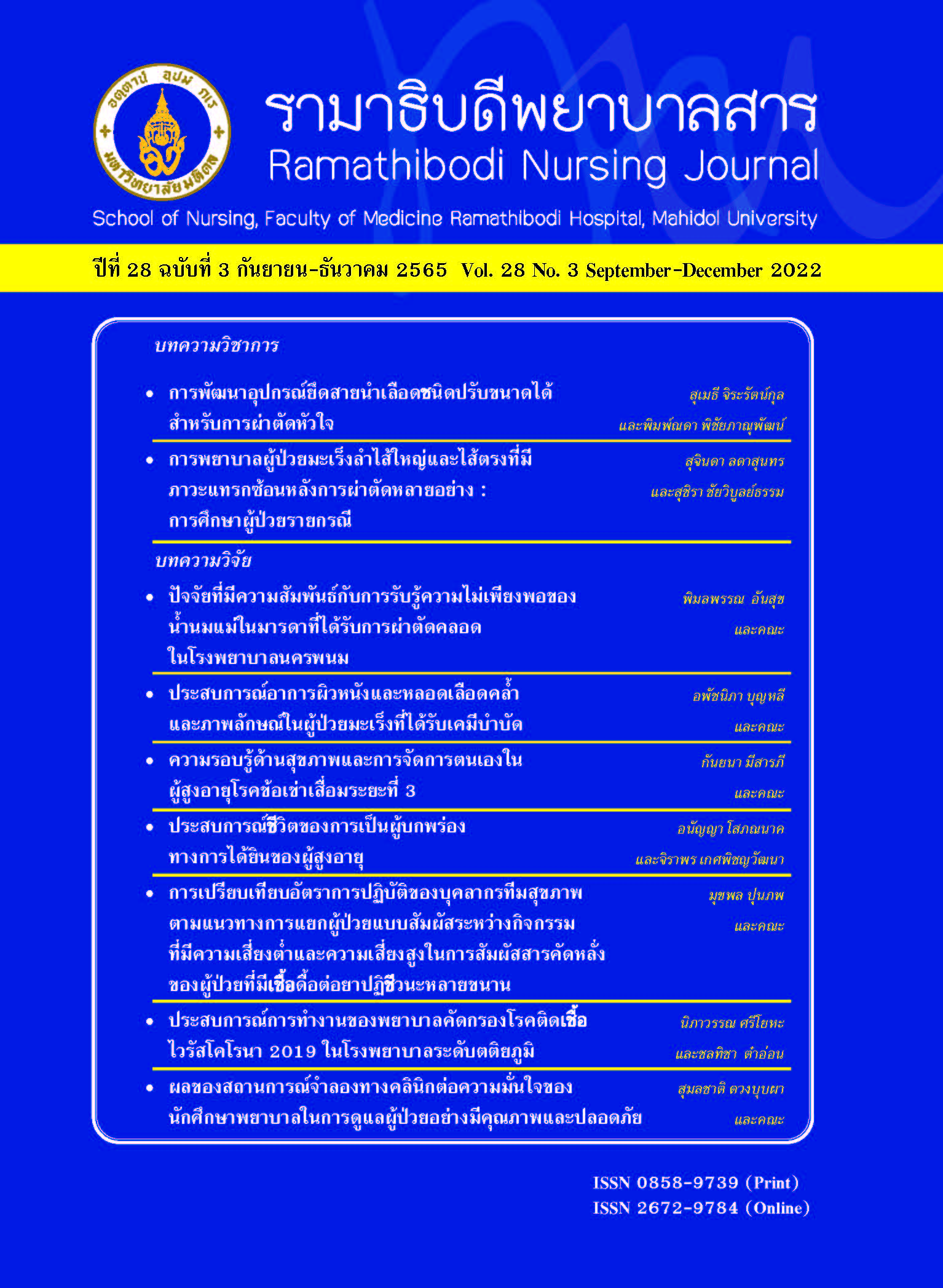
ประสบการณ์อาการผิวหนังและหลอดเลือดคล้ำ และภาพลักษณ์ในผู้ป่วยมะเร็งที่ได้รับเคมีบำบัด
Article Sidebar
Main Article Content
บทคัดย่อ
การวิจัยเชิงบรรยายนี้ มีวัตถุประสงค์เพื่อศึกษาประสบการณ์ของอาการผิวหนังและหลอดเลือดคล้ำ การรับรู้ระดับความรุนแรง การรบกวนการดำเนินชีวิต และภาพลักษณ์ในผู้ป่วยมะเร็งที่ได้รับเคมีบำบัด โดยใช้ทฤษฏีการจัดการอาการเป็นกรอบแนวคิดในการวิจัย กลุ่มตัวอย่างเป็นผู้ป่วยมะเร็งที่ได้รับเคมีบำบัด โรงพยาบาลมหาวิทยาลัยแห่งหนึ่งในกรุงเทพมหานคร จำนวน 80 ราย เครื่องมือ ประกอบด้วย แบบสอบถามข้อมูลส่วนบุคคล แบบประเมินความรุนแรงของอาการผิวหนังและหลอดเลือดคล้ำ แบบสอบถามการรบกวนการดำเนินชีวิต และแบบสอบถามภาพลักษณ์ทางกาย วิเคราะห์ข้อมูลด้วยสถิติบรรยาย ผลการวิจัยพบว่า กลุ่มตัวอย่างมีอายุเฉลี่ย 59.43 ปี กลุ่มตัวอย่างทั้งหมดเป็นมะเร็งชนิดเป็นก้อน และส่วนใหญ่เป็นมะเร็งลำไส้ ร้อยละ 62.50 ระยะที่ 4 ร้อยละ 63.75 ได้รับสูตรเคมีบำบัดที่มี 5-fluorouracil เป็นส่วนประกอบร้อยละ 90 ลักษณะการเกิดอาการผิวหนังและหลอดเลือดคล้ำ มากกว่าครึ่งหนึ่ง
(ร้้อยละ 53.75) เริ่มเป็นรอยดำมีลักษณะอ่อนนิ่มตามแนวหลอดเลือดดำที่ได้รับเคมีบำบัดเกิดบริเวณท้องแขนด้านในร้อยละ 51.25 อาการผิวหนังและหลอดเลือดคล้ำ มีความรุนแรงระดับปานกลาง แต่รบกวนการดำเนินชีวิตในระดับเล็กน้อยถึงน้อยมาก สิ่งที่รบกวนการดำเนินชีวิตมากที่สุด 3 ลำดัับแรก ได้แก่ 1) การมีสีผิวหนังคล้ำตามแนวของหลอดเลือดดำ 2) การมีผลต่อการเลือกเสื้อผ้าที่จะสวมใส่ และ 3) ความรู้สึกอับอายขาดความมั่นใจ ตามลำดับ ผู้ป่วยที่อาการผิวหนังและหลอดเลือดคล้ำมีความรู้สึกพึงพอใจกับภาพลักษณ์ทางกายโดยรวมในระดับมาก ผลการศึกษานี้สามารถใช้เป็นแนวทางให้พยาบาลและทีมสุขภาพในการพัฒนาโปรแกรมการจัดการอาการเพื่อลดผลกระทบของอาการผิวหนังและหลอดเลือดคล้ำในผู้ป่วยมะเร็ง
คำสำคัญ : เคมีบำบัด อาการผิวหนังและหลอดเลือดคล้ำ การรบกวนการดำเนินชีวิต ภาพลักษณ์ทางกาย
Article Details

อนุญาตภายใต้เงื่อนไข Creative Commons Attribution-NonCommercial-NoDerivatives 4.0 International License.
บทความ ข้อมูล เนื้อหา รูปภาพ ฯลฯ ที่ได้รับการตีพิมพ์ในรามาธิบดีพยาบาลสาร ถือเป็นลิขสิทธิ์ของวารสาร หากบุคคลหรือหน่วยงานใดต้องการนำทั้งหมดหรือส่วนหนึ่งส่วนใดไปเผยแพร่หรือเพื่อกระทำการใด ใด จะต้องได้รับอนุญาตเป็นลายลักษณ์อักษรจากรามาธิบดีพยาบาลสารก่อนเท่านั้น
เอกสารอ้างอิง
International Agency for Research on Cancer. Estimated number of new case in 2020, worldwide, both sexes, all age; 2020 [cited 2020 July 22]. Available from World Health Organization Web site: https://gco.iarc.fr/today/online-analysis-pie v=2020&mode=cancer&mode_population=continents&population=900
&populations=900&key=total&sex=0&cancer=39&type=0&statistic=5&prevalence
=0&population_group=0&ages_group%5B%5D=0&ages_group%5B%5D=17&nb_items
=7&group_cancer=1&include_nmsc=1&include_nmsc_other=1&half_pie=0&donut=0
Faculty of Medicine Siriraj Hospital. Faculty of Medicine 4 institutes join forces to present “Correct anti-cancer policy to reduce incidences, reduce disability and death from cancer in Thailand” to consider the agenda of the National Health Assembly; 2019 [cited 2020 July 22].Available from Faculty of Medicine Siriraj Hospital Website: https://www.si.mahidol.ac.th/th/hotnewsdetail.asp?hn_id=2422
Meecharoen W, Kalated T, Nutra K. Quality of life of cancer patients receiving chemotherapy and their family caregivers. Journal of Nursing and Health Care. 2018;36(4):52-61. (in Thai)
Hazelwood DM, Koeck S, Wallner M, Anderson KH,Mayer H. Patients with cancer and family caregivers:management of symptoms caused by cancer or cancer therapy at home. Heilberufe Science. 2012;3(4):149-58. doi: 10.1007/s16024-012-0118-z.
Noori M, Hunter-Ellul L, Kelly B. Serpentine supravenous hyperpigmentation following cisplatin and pemetrexed chemotherapy. Cutis. 2017;99(4):E20-22.
Das A, Kumar D, Mohanty S, Mondal AK, Chowdhury SN, Bandyopadhyay D. Serpentine supravenous hyperpigmentation induced by docetaxel. Indian J Dermatol Venereol Leprol. 2015;81(4):434-6. doi:10.4103/0378-6323.156191.
Lancman G, Steinberg A, Gabrilove J. Serpentine supravenous hyperpigmentation in an HIV Patient Receiving R-CHOP for DLBCL. Int J Hematol Oncol Stem Cell Res. 2018;12(1):1-3.
Lau JF, Dean SM, Rooke TW, Olin JW. Serpentine supravenous hyperpigmentation due to hydroxychl oroquine. Vasc Med. 2016;21(6):558-9. doi:10.1177/1358863X16650276.
Suvirya S, Agrawal A, Parihar A. 5-Fluorouracil-induced bilateral persistent serpentine supravenous hyperpigmented eruption, bilateral mottling of palms and diffuse hyperpigmentation of soles. BMJ Case Rep. 2014 Oct21;2014: bcr2014206793. doi: 10.1136/bcr-2014-206793.
Swathi T, Sucharitha R, Subash. VK, Rao AY, Prakash CSK. Three case reports of 5-fluorouracil induced serpentine supravenous hyperpigmentation. International Journal of Current Pharmaceutical & Clinical Research 2014;4(1):1-3.
Geddes ERC, Cohen PR. Antineoplastic agent-associated serpentine supravenous hyperpigmentation: superficial venous system hyperpigmentation following intravenous chemotherapy. South Med J. 2010; 103(3):231-5. doi:10.1097/SMJ.0b013e3181ce0f5e.
Payne BK. Weapon bias: Split-second decisions and unintended stereotyping. Curr Dir Psychol Sci.2006;15(6):287-91. doi.org/10.1111/j. 1467-8721.2006.00454.
Jamalpur I, Mogili HR, Koratala A. Serpentine supravenous hyperpigmentation. Clin Case Rep. 2017;5(9):1546-7. doi: 10.1002/ccr3.1102.
Aziz N, Faraz M, Sherwani MA, Fatma T, Prasad R.Illuminating the anticancerous efficacy of a new fungal chassis for silver nanoparticle synthesis. Front Chem.2019;7: article 65. doi.org/10.3389/fchem.2019.00065.
Akyurek FT, Sari N, Ugurluoglu C, Kurtipek GS.Serpentine supravenous hyperpigmentation related to carboplatin and vinorelbine chemotherapy: a case report.Dermatol Ther. 2019;32(4):e12981. doi: 10.1111/dth.12981.
Dodd M, Janson S, Facione N, Faucett J, Froelicher ES,Humphreys J, et al. Advancing the science of symptom management. J Adv Nurs. 2001;33(5):668-76. doi:10.1046/j.1365-2648.2001.01697.x.
Humphreys J, Janson S, Donesky DA, Dracup K, Lee KA,Puntillo K, et al. Theory of symptom management. In:Smith MJ & Liehr PR, editors. Middle range theory for nursing.3rded. New York: Springer;2014. p.141-84.
Bender MS, Janson SL, Linda SF, Lee KA. Theory of Symptom Management. In: Smith MJ & Liehr PR, editors.Middle range theory for nursing. 4th ed. New York:Springer ;2018. p.147-178.
Chen SC, Huang CY, Huang BS, Lin CY, Fan KH, Chang JT-C, et al. Factors associated with healthcare professional’s rating of disfigurement and self-perceived body image in female patients with head and neck cancer.Eur J Cancer Care (Engl). 2018;27(2):e12710. doi:10.1111/ecc.12710.
Cheewabantherng C, Roomruangwong C. Body image and its associated factors in patients with breast cancer with mastectomy at King Chulalongkorn Memorial Hospital.Chula Med J 2014 Sep - Oct; 58(5):563–76. (in Thai)
Phummarin N, Oranratanaphan S, Roomruangwong C.Body image and depression among gynecologic cancer patients at King Chulalongkorn Memorial Hospital. Chula Med Bull. 2019 Jan–Feb;1(1):79-92. (in Thai)
Yamane T, Statistics: an introductory analysis. 3rd ed.New York. Harper and Row Publications; 1973.
Aree-Ue S, Youngcharoen P. The 6 cognitive function test-Thai version: psychometric property testing.Ramathibodi Nursing Journal.2020;26(2),188-02.(in Thai)
Hopwood, P., Fletcher, I., Lee, A., & Al Ghazal, S.(2001). A body image scale for use with cancer patients.Eur J Cancer. 2001;37(2),189-97. doi:10.1016/s0959-8049(00)00353-1.
Cheewapoonpol B. Relationships between personal factors,fear of reactions of significant persons, coping strategies,social support, and body image of post mastectomy patients. Master’s thesis, Master of Nursing Science,Faculty of Nursing, Chulalongkorn University; 2004.(in Thai)
Rao R, Balachandran C. Serpentine supravenous pigmentation. A rare vasculo-cutaneous effect induced by systemic 5-fluorouracil. Indian J Dermatol Venereol Leprol. 2010;76(6):714-5. doi: 10.4103/0378-6323.72459.
Hrushesky WJ. Letter: Serpentine supravenous fluorouracil hyperpigmentation. JAMA. 1976;236(2):138 doi:10.1001/jama.1976.03270020012002.
Somasekharan D, Narayanan B. Serpentine supravenous hyperpigmentation–a rare cutaneous manifestation in non-neoplastic conditions. J Skin Sex Transmitted Dis.2019;1: 97-100. doi:10.25259/JSSTD_28_2019.
Thaweethamcharoen T. Sunlight and skin care; 2017.[cited 2021 May 9]. Available from Faculty of Medicine Siriraj Hospital Web site: https://www.si.mahidol.ac.th/th/healthdetail.asp?aid=301
Khantichitr P, Kanogsunthornrat N, Sumdaengrit B.Pruritus, management strategies and outcomes as perceived by persons with cholangiocarcinoma. Journal of Nursing and Health Care. 2013;31(1):34-42. (in Thai)
Kim IR, Cho J, Choi EK, Kwon IG, Sung YH, Lee JE, etal. Perception, attitudes, preparedness and experience of chemotherapy-induced alopecia among breast cancer patients: a qualitative study. Asian Pac J Cancer Prev.2012;13(4):1383-8. doi: 10.7314/apjcp.2012.
4.1383.
Zamel ON, Inocian EP, Alshehry AS, Tumala RB,Patalagsa JG, Alsaleh KA. Quality of life among breast and colon cancer patients before and after first-cycle chemotherapy. Journal of holistic nursing. 2021;39(2):116–25. doi.org/10.1177/0898010 120958859.
