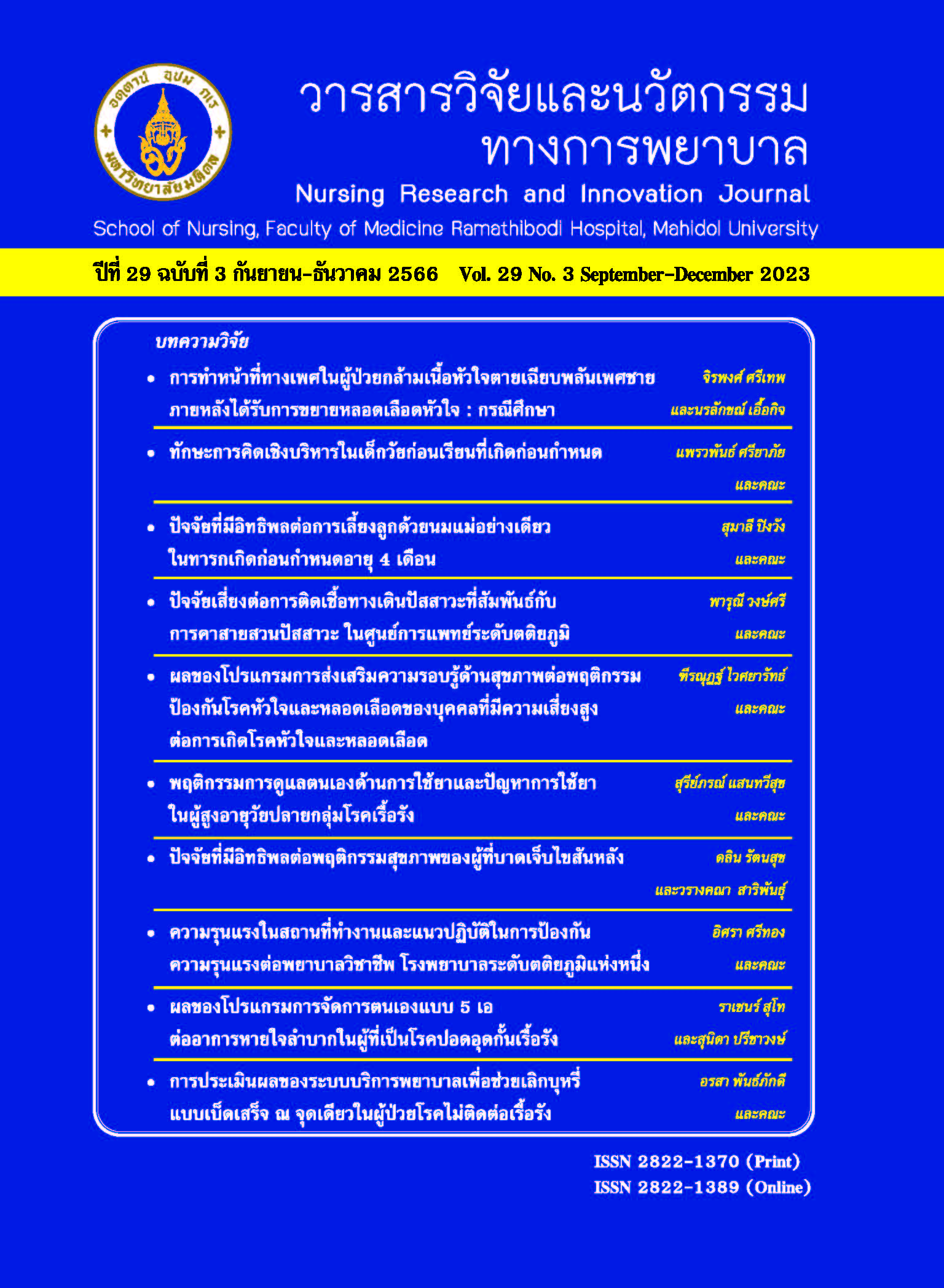
ปัจจัยที่มีอิทธิพลต่อพฤติกรรมสุขภาพของผู้ที่บาดเจ็บไขสันหลัง
Article Sidebar
Main Article Content
บทคัดย่อ
การศึกษาเชิงทำนายครั้งนี้มีวัตถุประสงค์เพื่อศึกษาปัจจัยที่มีอิทธิพลต่อพฤติกรรมสุขภาพของผู้ที่บาดเจ็บไขสันหลังโดยใช้แบบจำลองPRECEDE-PROCEED เป็นกรอบแนวคิดในการศึกษา กลุ่มตัวอย่างคือผู้ที่บาดเจ็บไขสันหลังจำนวน150 รายเลือกกลุ่มตัวอย่างแบบเฉพาะเจาะจงตามเกณฑ์ทำการเก็บรวบรวมข้อมูลโดยใช้แบบสอบถาม 4 ชุด เพื่อประเมินข้อมูลส่วนบุคคล ความรู้สึกมีคุณค่าในตนเอง การสนับสนุนทางสังคม และพฤติกรรมสุขภาพ สถิติที่ใช้ในการวิเคราะห์ข้อมูลคือสถิติเชิงพรรณนาสถิติสหสัมพันธ์และการวิเคราะห์การถดถอยพหุคูณ ผลการศึกษาพบว่าความรู้สึกมีคุณค่าในตนเองและการสนับสนุนทางสังคม มีความสัมพันธ์ทางบวกกับพฤติกรรมสุขภาพของผู้ที่บาดเจ็บไขสันหลังอย่างมีนัยสำคัญทางสถิติแต่อายุและระดับการศึกษาไม่มีความสัมพันธ์กับพฤติกรรมสุขภาพของผู้ที่บาดเจ็บไขสันหลัง การสนับสนุนทางสังคมและความรู้สึกมีคุณค่าในตนเอง สามารถร่วมกันทำนายพฤติกรรมสุขภาพของผู้ที่บาดเจ็บไขสันหลังได้ร้อยละ 23 โดยที่การสนับสนุนทางสังคมเป็นตัวแปรทำนายที่มีอิทธิพลมากที่สุด จากผลการศึกษานี้พยาบาลควรส่งเสริมให้ผู้ป่วยรู้สึกมีคุณค่าในตนเอง และส่งเสริมให้ครอบครัวผู้ดูแลร่วมส่งเสริมให้ผู้ป่วยพฤติกรรมสุขภาพที่ดีอย่างต่อเนื่อง
คำสำคัญ : พฤติกรรมสุขภาพ ความรู้สึกมีคุณค่าในตนเอง การสนับสนุนทางสังคม การบาดเจ็บ
ไขสันหลัง
Article Details

อนุญาตภายใต้เงื่อนไข Creative Commons Attribution-NonCommercial-NoDerivatives 4.0 International License.
บทความ ข้อมูล เนื้อหา รูปภาพ ฯลฯ ที่ได้รับการตีพิมพ์ในรามาธิบดีพยาบาลสาร ถือเป็นลิขสิทธิ์ของวารสาร หากบุคคลหรือหน่วยงานใดต้องการนำทั้งหมดหรือส่วนหนึ่งส่วนใดไปเผยแพร่หรือเพื่อกระทำการใด ใด จะต้องได้รับอนุญาตเป็นลายลักษณ์อักษรจากรามาธิบดีพยาบาลสารก่อนเท่านั้น
เอกสารอ้างอิง
Hyun-Yoon K. Management and rehabilitation of spinal cordinjuries.Singapore:Springer; 2019.
National Spinal CordInjuryStatistical Center. Traumatic spinal cord injury:Fact and figures at a glance; 2022 [cited 2022 December 28]. Available from: https://www.nscisc.uab.edu.
Chinchai P, Wittayanin W. Influence of the home visit program on the functional abilities and quality of life of people with spinal cord injury in Thailand.Asia Pac Disabil Rehabil J. 2008;19(1):50-9.
Rattanasuk D, Khuwatsamrit K. Causal model of psychological empowerment among people with spinal cordInjury in Thailand.Orthop Nurs.2021;40(3):136-43.
KhazaeipourZ,Norouzi-JavidanA,KavehM,Mehrabani FK, Kazazi E, Emami-Razavi S-H. Psychosocial outcomes following spinal cord injury in Iran. J Spinal Cord Med. 2014;37(3):338–45.
Gabbe BJ, Nunn A. Profile and costs of secondary conditions resulting in emergency department presentations and readmission to hospital following traumatic spinal cord injury. Injury. 2016;47(8):1847-55.
Cao Y,DiPiro N,Krause JS.Health factors and spinal cord injury: a prospective study of risk of cause-specific mortality.Spinal Cord. 2019;57(7):594-602.
Green LW, Kreuter MW. Health program planning: an educational and ecological approach. Boston: McGraw-Hill; 2005.
Jang DE,Shin,JH.Self-care performance of middle-aged stroke patients in Korea. Clin Nurs Res. 2019;28(3):263-79.
La Vala SL, Etingen B, Miskevics S. Factors influencing self-care behaviors in persons with spinal cord injuries and disorders. Top Spinal Cord Inj Rehabil. 2016;22(1):27-38.
JaisopaS. The relationships of perceived barriers to action,perceived self-efficacy,perceived social support,personal factors, and health-promoting behaviors among disabled persons in Uttaradit province [Thesis]. Bangkok:Mahidol University; 2004.
Singchangchai S. Factor related to health behaviors of hemiplegia patient Wichian Buri hospital Wichian Buri District,Phetcabun province[Thesis].Bangkok:Kasetsart University; 2013. (in Thai).
Gaska I, Sygit KM, Cipora E, Sygit M, Krakowiak J.Factors determining health behaviours of the 50+population with cardiovascular diseases. Ann Agric Environ Med. 2020;27(1):99-105.
Liu E, Feng Y, Yue Z, Zhang Q, Han T. Differences in the health behaviors of elderly individuals and influencing factors: evidence from the Chinese longitudinal healthy longevity survey. Int J Health Plann Manage. 2019;34(4):1520-32.
Kim SJ, Yoo IY. Health promotion behavior of Chinese international students in Korea including acculturation factors: a structural equation model. Asian Nurs Res.2016;10(1):25-31.
Zou H, Tian Q, Chen Y, Cheng C,Fan X. Coping styles mediate the relationship between self-esteem,health locus of control, and health-promoting behavior in Chinese patients with coronary heart disease. J Cardiovasc Nurs.2017;32(4):331-8.
Mohebi S, Parham M, Sharifirad G, Gharlipour Z,Mohammadbeigi A, Rajati F. Relationship between perceived social support andself-carebehavior intype 2 diabetics:across-sectional study. J Educ HealthPromot.2018;7(48):1-6.
Sari Y, Upoyo AS, Isworo A, Taufik A, Sumeru A,Anandari D, Sutrisna E. Foot self-care behavior and its predictors in diabetic patients in Indonesia. BMC Res Notes. 2020;13(1):1-6.
Polit DF, Beck CT. Nursing research: Principles and method. 7th ed. Philadelphia: Lippincott Williams and Wilkins; 2004.
Mahoney FI, Barthel DW. Rehabilitation of chronically ill patients: The influence of complications on the final goal.South MedJ. 1958;51(5):605-9.
JitapunkulS,KamolratanakulP, EbrahimS. Themeaning of activities of daily living in a Thai elderly population:development of anew index. Age Ageing. 1994;23(2):97-101.
Rosenberg M. Society and the adolescent self-image.Princeton, New Jersey:Princeton University; 1965.
Srimoragot P. Effects of supportive counseling on perceived illness,self-esteem,and moral in cervical cancer patients undergoing radiotherapy [Dissertation].Bangkok:Mahidol University; 1993. (In Thai).
Withatanang P,Saneha C,Pinyopasakul W, Nilanont Y.Factors influencing depression in patients with first ischemic stroke. J NursSci. 2018;36(1):44-56.(in Thai).
SuwannurakS. The relationship of personal factor, self-esteem and social support to depression in high-risk pregnant women in Siriraj Hospital [Thesis]. Bangkok:Mahidol University; 2004.
Kitrungrote L.Severity of side effects,self-esteem,social support, and role adaptation of cervical cancer patients receiving radiation therapy [Thesis]. Bangkok: Mahidol University; 2000.
Hanucharurnkul S.Social support, self-care, and quality of life in cancer patients receiving radiotherapy in Thailand [Dissertation].Michigan:Wayne State University; 1988.
Schaefer C, Coyne JC, Lazarus RS. The health-related functions of social support.J Behav Med.1981;4(4):381-406.
Norbeck JS, Lindsey AM, Carrieri VL. The development of an instrument to measure social support. Nurs Res.1981;30(5):264-9.
Santawaja C. A casual model of psychosocial adjustment in post radiotherapy cervical cancer women [Dissertation].Bangkok: Mahidol University; 2002.
Khuwatsamrit K,HanucharurnkulS,ChyunD,Panpakdee O,ViwatwongkasemC.Social support,self-efficacy,and adherence to self-care requirements in patients with coronary artery disease. Thai Journal of Nursing Research.2006;10(3): 156-64. (in Thai).
Bloemen-VrenckenJHA,Witte LP,PostMWM, Heuvel WJA. Health behavior of persons with spinal cord injury.Spinal Cord. 2007;45(3):243-9.
Mashola MK,Mothabeng DJ.Associations between health behaviour, secondary health conditions and quality of life in people with spinal cord injury. Afr J Disabil. 2019;463(8):1-9.
Walter GP,Seidel W, Giustina RD, Bins-ElyJ, Maurici R, Narciso-Schiavon JL. Prognostic factors in patients with pressure sores in a university hospital in southern Brazil. Acta Ortop Bras. 2017;25(6): 243-7.
Kalomo, EN, Shamrova D, Jun J, Lightfoot EB, Mgori N, Kalb A. Psychosocial factors affecting self-esteem among youth living with human immunodeficiency virus(HIV) in Namibia. Afr J Soc Work. 2021;11(5):273-82.
Curvis W,SimpsonJ,HampsonN.Factors associated with self-esteem following acquired brain injury in adults: A systematic review. Neuropsychol Rehabil. 2018;28(1):142-83
