
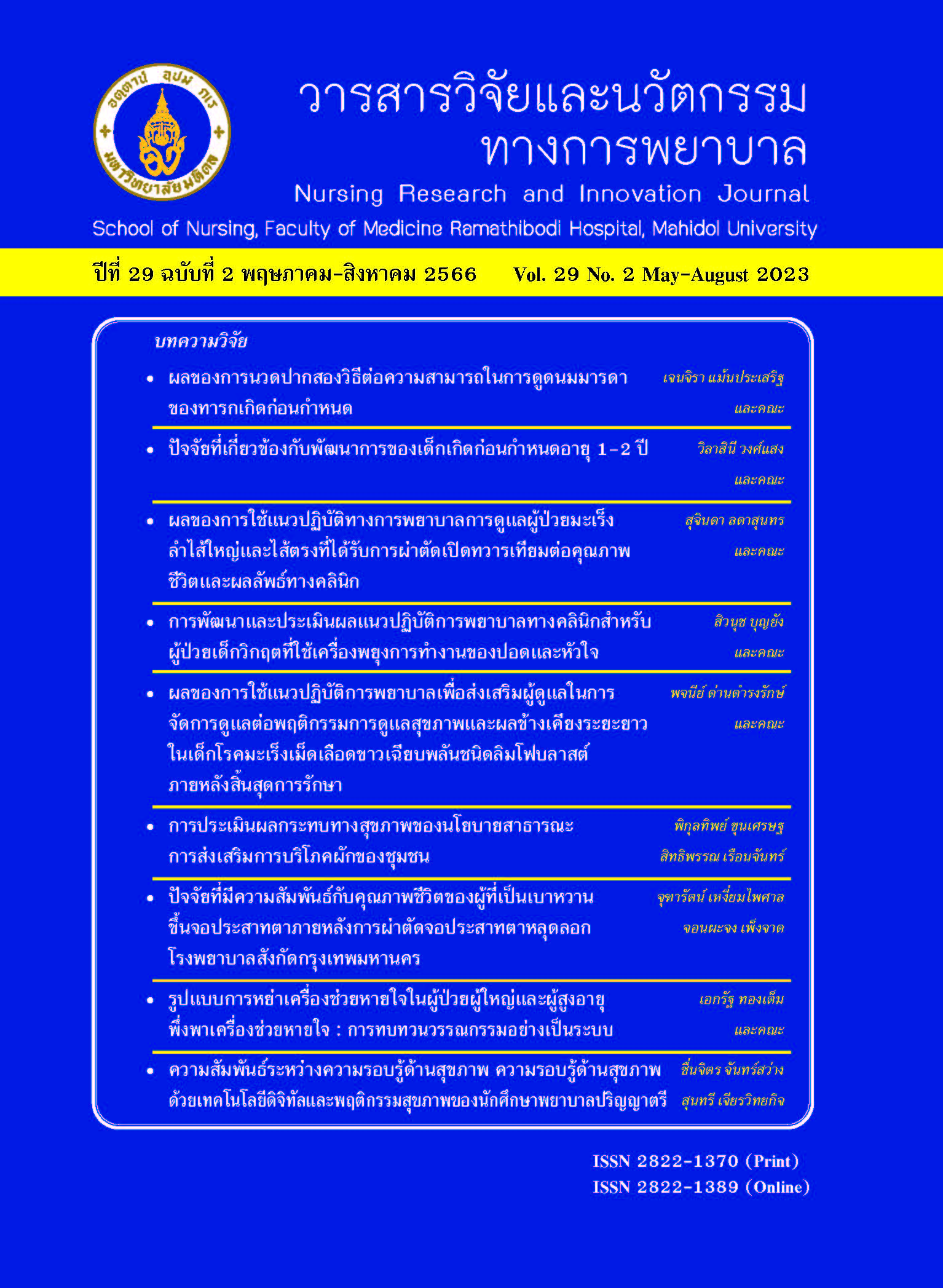
การพัฒนาและประเมินผลแนวปฏิบัติการพยาบาลทางคลินิกสำหรับผู้ป่วยเด็กวิกฤตที่ใช้เครื่องพยุงการทำงานของปอดและหัวใจ
Article Sidebar
Main Article Content
บทคัดย่อ
การศึกษานี้เป็นการพัฒนาและประเมินผลแนวปฏบัติการพยาบาลทางคลินิกสำหรับผู้ป่วยเด็กวิกฤตที่ใช้เครื่องพยุงการทำงานของปอดและหัวใจ เพื่อป้องกันภาวะแทรกซ้อนตลอดจนสามารถประเมินภาวะการเปลี่ยนแปลงต่าง ๆ ที่ อาจเกิดขึ้น เพื่อให้ผู้ป่วยได้รับการรักษาพยาบาลอย่างทันท่วงที การศึกษานี้ใช้กรอบแนวคิดการพัฒนาคุุณภาพการบริการของโดนาบีเดียนร่วมกับแนวคิดด้านพยาธิสรีรวิทยา ในการพัฒนาแนวปฏิบัติโดยใช้หลักฐานเชิงประจักษ์ ซึ่งมีงานวิจัยและบทความวิชาการทั้งหมด 31 เรื่อง แนวปฏิบัติมี 3 ระยะ คื อ 1) การดููแลระยะก่อนการใส่เครื่องพยุงการทำงานของปอดและหัวใจ 2) การดููแลขณะใช้เครื่องพยุงการทำงานของปอดและหัวใจ และ 3) การดููแลระยะหลังการถอดเครื่องพยุงการทำงานของปอดและหัวใจ แนวปฏิบัตินี้ได้รับการตรวจสอบความตรงและความถููกต้องเชิงเนื้อหาจากผู้ทรงคุุณวุุฒิ การนำแนวปฏิบัติไปใช้กับผู้ป่วยเด็กวิกฤตที่ ใช้เครื่องพยุงการทำงานของปอดและหัวใจ จำนวน 8 ราย ส่วนใหญ่ได้รับการรักษาด้วยเครื่องพยุงการทำงานของหัวใจและปอด (venoarterial extracorporeal membrane oxygenation หรือVA ECMO) ร้ อยละ 75 จำนวนวันนอนเฉลี่ยในหอผู้ป่วยวิกฤตเท่ากับ 11.75 วัน ภาวะแทรกซ้อนที่พบมากที่สุุดคือ ภาวะเลือดออก แต่เมื่อพยาบาลมีการประเมินและติดตามอย่างใกล้ชิดตามแนวปฏบัติที่พัฒนาขึ้น ทำให้ผู้ป่วยได้รับการรักษาพยาบาลอย่างทันท่วงที่ พบว่าผู้ป่วยทุุกรายปลอดภัยจากภาวะแทรกซ้อน รองลงมาคือ ภาวะมีลิ่มเลือดในวงจรบริวณด้านหน้าปอดเทียมพยาบาลตรวจสอบค่าแรงดันบริเวณด้านหน้าและด้านหลังของปอดเทียม และตรวจสอบลิ่มเลือดในวงจร ผู้ป่วยได้รับการดููแลอย่างใกล้ชิดจึงไม่เกิดอันตรายต่อ ผู้ป่วยสำหรับความเป็นไปได้ในการนำแนวปฏิบัติไปใช้จากพยาบาล 32 ราย พบว่า ความเป็นไปได้ในการนำแนวปฏิบััติการพยาบาลไปใช้อยู่ในระดับมากถึงมากที่สุุด ความพึงพอใจของพยาบาลในการนำแนวปฏิบัติไปใช้อยู่ในระดับมากถึงมากที่สุดการศึกษาครั้งนี้มีข้อเสนอแนะว่าพยาบาลที่ดููแลผู้ป่วยเด็ก วิกฤิตที่ใช้เครื่องพยุง การทำงานของปอดและหัวใจ ควรมีการติดตามผลลัพธ์ของการใช้แนวปฏิบัติในระยะยาว เพื่อติดตามความเป็นไปได้ของการนำแนวปฏิบัติไปใช้ป ระโยชน์ของแนวปฏิบัติเพื่อความปลอดภัยของผู้ป่วย
คำสำคัญ: แนวปฏิบัติการพยาบาลทางคลินิก ผู้ป่วยเด็กวิกฤต เครื่องพยุ งการทำงานของปอดและหัวใจ
Article Details

อนุญาตภายใต้เงื่อนไข Creative Commons Attribution-NonCommercial-NoDerivatives 4.0 International License.
บทความ ข้อมูล เนื้อหา รูปภาพ ฯลฯ ที่ได้รับการตีพิมพ์ในรามาธิบดีพยาบาลสาร ถือเป็นลิขสิทธิ์ของวารสาร หากบุคคลหรือหน่วยงานใดต้องการนำทั้งหมดหรือส่วนหนึ่งส่วนใดไปเผยแพร่หรือเพื่อกระทำการใด ใด จะต้องได้รับอนุญาตเป็นลายลักษณ์อักษรจากรามาธิบดีพยาบาลสารก่อนเท่านั้น
เอกสารอ้างอิง
Ruangnapa K. Treatment with extracorporeal membrane oxygenation in pediatric patients with acute respiratory failure. In Bhurayanontachai R, Ruangnapa K, editors.Textbook caring patient use extracorporeal membrane oxygenation. Bangkok: Sahamit Pattana Printing; 2018.p. 225-40. (in Thai)
Schwartz SM, Schmidt A. Medical and nursing care of the child on mechanical circulatory support. Pediatr Crit Care Med. 2013;14(5):43-50.
Lertbunrian R, Kositset A. Use extracorporeal membrane oxygenation (ECMO). In Kositset A, Preutthipan A,Limrangsikul A, Khogkhatithum C, Pandee U, Lertbunrian R, editors. Pediatric critical care. Bangkok: Wandee Printing; 2013. p. 661-70. (in Thai)
Connor ON, Smith JR. An innovative ECMO staffing model to reduce harm. J Perinat Neonatal Nurs.2018;32(3):204-5.
Kosaiyawat S. The national children’s day: development and importance to human resource development. Journal of Education and Social Development. 2008;4:1-17.(in Thai)
Cherian S. Trends in extracorporeal membrane oxygenation (ECMO) nursing. 2015 [cited 2019 May 6]. Available from: https://www.researchgate.net/publication/ 314216150_Trends_in_Extracorporeal_membrane_oxygenation ECMO_ nursing.
Mossadegh C, Combes A. (Eds.). Nursing care and ECMO (13th ed). Cham: Springer; 2017.
Eden A, Purkiss C, Cork G, Baddeley A, Morri, K, Carey L, et al. In-patient physiotherapy for adults on venovenous extracorporeal membrane oxygenation -United Kingdom ECMO physiotherapy network: a consensus agreement for best practice. J Intensive Care Soc.
;18(3):212-20.
Calhoun, A. ECMO: Nursing care of adult patients on ECMO. Crit Care Nurs Q. 2018;41(4):394-8.
Supachutikul A. Patient safety goals: SIMPLE.Accreditation is an Educational Process. Nonthaburi:Famous and successful ; 2018. (in Thai)
Pornsirirat T, Thongyu S. Nursing care of patients with acute respiratory failure using extracorporeal membrane oxygenation. Siriraj Medical Bulletin. 2016;9:44-50.(in Thai)
Zangrillo A, Landoni G, Biondi-Zoccai G, Greco M,Greco T, Frati G, et al. A meta-analysis of complications and mortality of extracorporeal membrane oxygenation.Crit Care Resusc. 2013;15(3):172-8.
Courtwright SE, Mastro KA, Preuster C, Dardashti N,McGill S, Madelon M, Johnson D. Reducing hospitalacquired pressure ulcers using bundle methodology in pediatric and neonatal patients receiving extracorporeal membrane oxygenation therapy: An integrative review and call to action. J Spec Pediatr Nurs. 2017;22(4):1-14.
Biffi S, Di Bella S, Scaravilli V, Peri AM, Grasselli G,Alagna L, et al. Infections during extracorporeal membrane oxygenation: epidemiology, risk factors, pathogenesis and prevention.Int J Antimicrob Agents. 2017;50(1):9-16.
Schwartz SM, Schmidt A. Medical and nursing care of the child on mechanical circulatory support. Pediatr Crit Care Med. 2013;14(5):43-50.
Carpenter JL, Yu YR, Cass DL, Olutoye OO, Thomas JA, Burgman C, et al. Use of venovenous ECMO for neonatal and pediatric ECMO: a decade of experience at a tertiary children’s hospital. Pediatr Surg Int. 2018;34(3):263-8.
Hanson SJ, Jaber B, Bembea MM, Loftis LL, Spinella PC, Zhang L, et al. Venovenous versus venoarterial extracorporeal membranous oxygenation in inotrope dependent pediatric patients with respiratory failure.ASAIO J. 2021;67(4):457-62.
Fernando SM, Qureshi D, Tanuseputro P, Dhanani S,Guerguerian AM, Shemie SD, et al. Long-term survival and costs following extracorporeal membrane oxygenation in critically ill children -a population-based cohort study.Crit Care. 2020;24(1):1-11.
Alshammari MA, Vellolikalam C, Alfeeli S. Nurses’perception of their role in extracorporeal membrane oxygenation care: a qualitative assessment. Nurs Crit Care.2020;27(2):251–7.
Botsch A, Protain E, Smith AR, Szilagyi R. Nursing implications in the ECMO patient. 2019 [cited 2021 May28]. Available from: http://dx.doi.org/10.5772/intechopen.85982.
Cherian S.Trends in extracorporeal membrane oxygenation (ECMO) nursing. 2015 [cited 2019 May 6]. Available
from: https://www.researchgate.net/publication/ 314216150_Trends_in_Extracorporeal_membrane_oxygenation ECMO_ nursing.
Liao MT, Tsai IJ, Lin FH, Tseng LJ, Huang SC, Chen YS, et al. Risk factors for in-hospital mortality and acute kidney injury in neonatal-pediatric patients receiving extracorporeal membrane oxygenation. J Formos Med Assoc. 2021;120(9):1758-67.
Bergeron A, Holifield L. Extracorporeal membrane oxygenation: The nurse’s role in patient care nursing. Nurs Crit Care. 2020;15(3):6-14.
Hamed A, Alinier G, Hassan IF. The ECMO specialist’s role in troubleshooting ECMO emergencies. Egypt J Crit Care Med. 2018;6(3):91–3.
Fouilloux V, Gran C, Guervilly C, Breaud J, Louali FE,Rostini P. Impact of education and training course for ECMO patients based on high-fidelity simulation: a pilot study dedicated to ICU nurses. Perfusion. 2019;34(1):29–34.
