
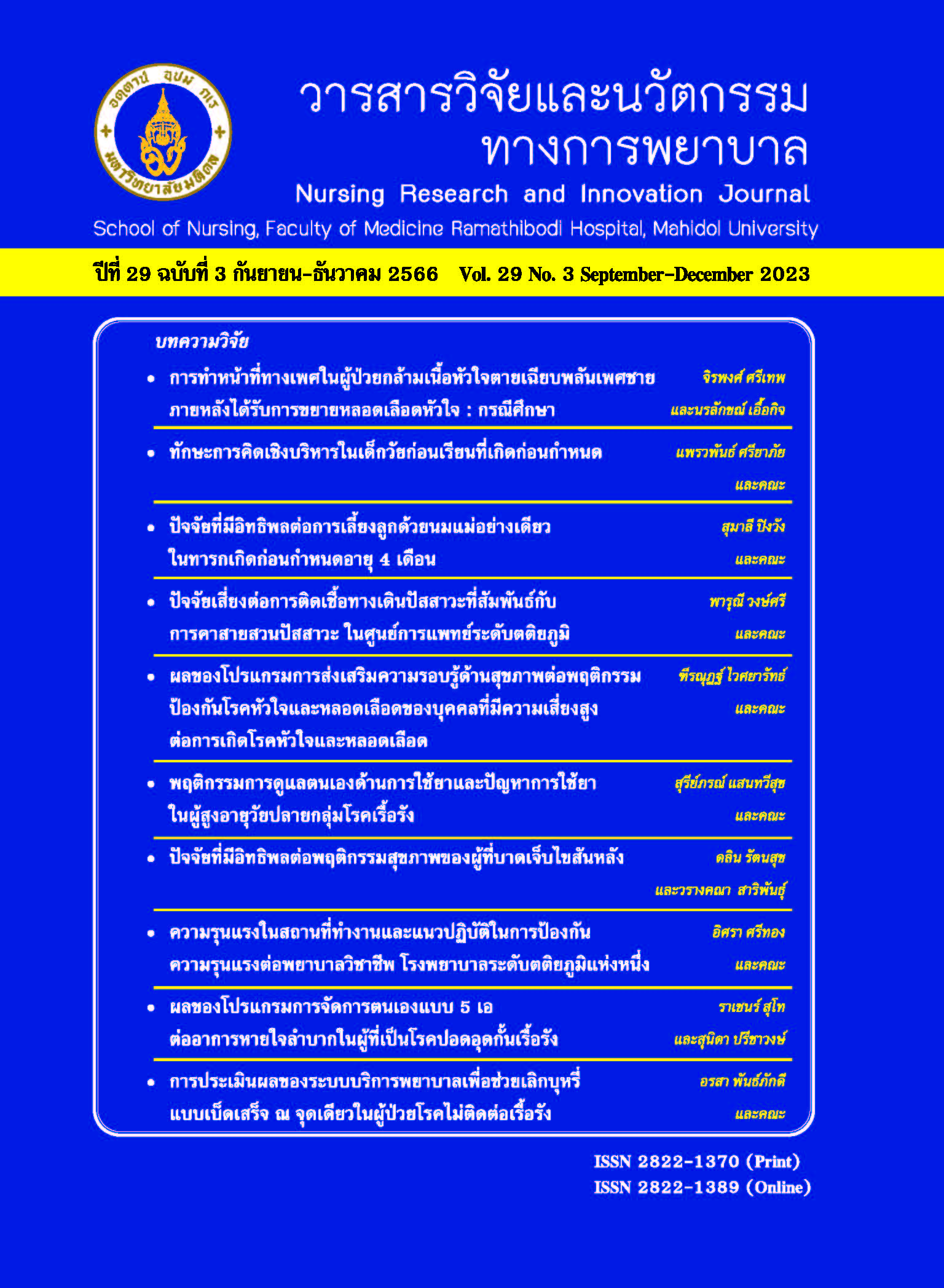
ผลของโปรแกรมการส่งเสริมความรอบรู้ด้านสุขภาพต่อพฤติกรรมป้องกันโรคหัวใจและหลอดเลือดของบุคคลที่มีความเสี่ยงสูงต่อการเกิดโรคหัวใจและหลอดเลือด
Article Sidebar
Main Article Content
บทคัดย่อ
การวิจัยกึ่งทดลองนี้มีวัตถุประสงค์เพื่อศึกษาผลของโปรแกรมการส่งเสริมความรอบรู้ด้านสุขภาพต่อพฤติกรรมป้องกันโรคหัวใจและหลอดเลือดของบุคคุลที่มีความเสี่ยงสูงต่อการเกิดโรคหัวใจและหลอดเลือด กลุ่มตัวอย่าง คือ บุคคลที่มีความเสี่ยงสูงต่อการเกิดโรคหัวใจและหลอดเลือดจำนวน 62 ราย แบ่งเป็นกลุ่มควบคุมและกลุ่มทดลองกลุ่มละ 31 ราย คัดเลือกกลุ่มตัวอย่างแบบเฉพาะเจาะจง โดยกลุ่มทดลองได้รับการพยาบาลตามปกติร่วมกับโปรแกรมการส่งเสริมความรอบรู้ด้านสุขภาพเป็น ระยะเวลา 8 สัปดาห์กลุ่มควบคุมได้รับการพยาบาลตามปกติโปรแกรมการส่งเสริมความรอบรู้ด้านสุขภาพพัฒนาขึ้นโดยการประยุกต์แนวคิดความรอบรู้ด้านสุขภาพของนัทบีม เครื่องมือที่ใช้ในการเก็บข้อมูล ได้แก่ แบบสอบถามข้อมูลส่วนบุคคลแบบสอบถามพฤติกรรมการป้องกันโรคหัวใจและหลอดเลือด และแบบวัดความรอบรู้ด้านสุขภาพ
วิเคราะห์ข้อมูลโดยสถิติบรรยาย สถิติทดสอบทีคู่ และสถิติที่อิสระ ผลการวิจัยพบว่า หลังการทดลองคะแนนเฉลี่ยพฤติกรรมป้องกันโรคหัวใจและหลอดเลือดของกลุ่มที่ได้รับโปรแกรมการส่งเสริมความรอบรู้ด้านสุขภาพสูงกว่าก่อนได้รับโปรแกรม และสูงกว่ากลุ่มควบคุม อย่างมีนัยสำคัญทางสถิติผลการวิจัยครั้งนี้แสดงให้เห็นว่าโปรแกรมการส่งเสริมความรอบรู้ด้านสุขภาพส่งผลให้เกิดพฤติกรรมป้องกันโรคหัวใจและหลอดเลือดในทางที่ดีขึ้น สามารถนำไปใช้ แนวทางในการปฏิบัติการพยาบาลเพื่อป้องกันโรคหัวใจและหลอดเลือดในบุคคลที่มีความเสี่ยงสูงในการเกิดโรคหัวใจและหลอดเลือดต่อไป
คำสำคัญ :พฤติกรรมป้องกันโรคหัวใจและหลอดเลือด ความรอบรู้ด้านสุขภาพ ความเสี่ยงสูงต่อการเกิดโรคหัวใจและหลอดเลือด
Article Details

อนุญาตภายใต้เงื่อนไข Creative Commons Attribution-NonCommercial-NoDerivatives 4.0 International License.
บทความ ข้อมูล เนื้อหา รูปภาพ ฯลฯ ที่ได้รับการตีพิมพ์ในรามาธิบดีพยาบาลสาร ถือเป็นลิขสิทธิ์ของวารสาร หากบุคคลหรือหน่วยงานใดต้องการนำทั้งหมดหรือส่วนหนึ่งส่วนใดไปเผยแพร่หรือเพื่อกระทำการใด ใด จะต้องได้รับอนุญาตเป็นลายลักษณ์อักษรจากรามาธิบดีพยาบาลสารก่อนเท่านั้น
เอกสารอ้างอิง
American Heart Association. 2022 Heart disease&Stroke statistical update fact sheet global burden of disease. [cited 2023 January 6]. Available from: https://professional.heart.org/-/media/PHD-Files-2/ScienceNews/2/2022-Heart-and-Stroke-Stat-Update/2022-
Stat-Update-factsheet-GIobal-Burden-of-Disease.pdf
Bureau of Non-Communicable Diseases, Department of Disease Control,Ministry of Public Health.Coronary heart disease situation.[cited 2023 January 6].Available from:http://www.thaincd.com /2016/mission/documentsdetail.php?id=14480&tid=32&gid=1-020
Strategy and planning division, Office of the Permanent Secretary, Ministry of Public Health. Mortality rate of coronary heart disease patients. [cited 2023 January 6]Available from: http://healthkpi.moph.go.th/kpi/kpilist/view/?id=45
Ministry of Public Health. Health Data Center (HDC).[cited 2020 October 25]. Available from: https:// hdcservice.moph.go.th/hdc/main/index.php
Bureau of Non-Communicable Diseases. Department of Disease Control, Ministry ofPublic Health. World heart day campaign messages. [cited 2020May 22].Available from: http://thaincd.com/document/file/download/knowledge/WorldHeartDaycampaignmessages_61.pdf
American Heart Association. 2019ACC/AHA guideline on the primary prevention of cardiovascular disease. [cited 2020 June 2]. Available from https://www.acc.org/latest-in-cardiology/ten-points-to-remember/2019/03/07/16/00/2019-acc-aha-guideline-on-primary-prevention-gl-prevention
Chaiwong N,BonkhonthodP.Predicting factors preventive behaviors for coronary heart disease among persons at risk to disease. Journal of Nursing and Health Care.2019;37(2):6-15. (in Thai)
Bureau of Non-Communicable Diseases. Department of Disease Control, Ministry of Public Health. Risk assessment and management guide to cardiovascular disease. Bangkok: Agricultural Cooperative Association of Thailand; 2014.
Bureau of Non-Communicable Diseases. Department of Disease Control, Ministry of Public Health. Non-communicable disease division annual report fiscal year 2020. [cited 2023 January 6]. Available from https://www.iccp portal.org/system/files/plans/Thailand%20 National%20NCD%20plan% 202017-2021.pdf
World Health Organization. Health literacy. [cited 2020 June 10].Availablefrom: https://iris.who.int/bitstream/ handle/10665/364206/9789240055391-eng.pdf?sequence=1
Nutbeam D. Health literacy as a public health goal: a challenge for contemporary health education and communication strategies into the 21st century. Health Promotion International. 2000;15:259-67.
Cho YI, Lee,SY, Arozullah, AM, Crittenden K. Effects of health literacy on health status and health service utilization amongst the elderly. Soc Sci Med. 2008;66:1809-16.
WanprasertS,MoolsartS,Jantacumma N.The effectiveness of a health literacy developmental program in a pre-hypertension group with overweight. Journal of Nursing,Public Health, and Education. 2019;20(2):92-104.(in Thai)
Bureau of Non-Communicable Diseases, Department of Disease Control,Ministry of PublicHealth.Guidelines for
assessment of cardiovascular risk. [cited 2020 May 22].Available from: https://www.ahajournals.org/doi/ full/10.1161/01.cir.0000437741.48606.98
Arahung R. The effects of health literacy enhancement program on hypertensive prevention behavior of pre-hypertension risk group at a community in Nakhon Pathom province [thesis]. Nakhon Pathom: Christian University;2018. (in Thai)
Intarakamhang A. Creating and developing of Thailand health literacy scales. [cited 2023October 21].Available from:http://bsris.swu.ac.th/upload/268335.pdf
Punyathanachaikhul K. The effectiveness of a health literacy developmental program in hypertension patients risking to chronic kidney disease. Nursing Public Health and Education Journal. 2020;21(1):41-54. (in Thai)
Kanejima Y,Shimogai T, KitamuraM, Ishihara K, Izawa K. Impact of health literacy in patients with cardiovascular diseases: a systematic review and meta-analysis.Patient Educ Couns. 2022;105(7):1793-800.
Tangdomrongsin N,PowwattanaA,Auemaneekul N. The effect of motivation formation program with mobile technology for health to prevent cardiovascular disease in high risk group. Journal of Health and Nursing Research.2020;36(2):122-39. (in Thai)
LinS,ChenI,YuW,LeeS,TsaiT.Effect of a community-based participatory health literacy program on health behaviors and health empowerment among community-dwelling older adults:a quasi experimental study. Geriatr Nurs. 2019;40(5):494-501.
