
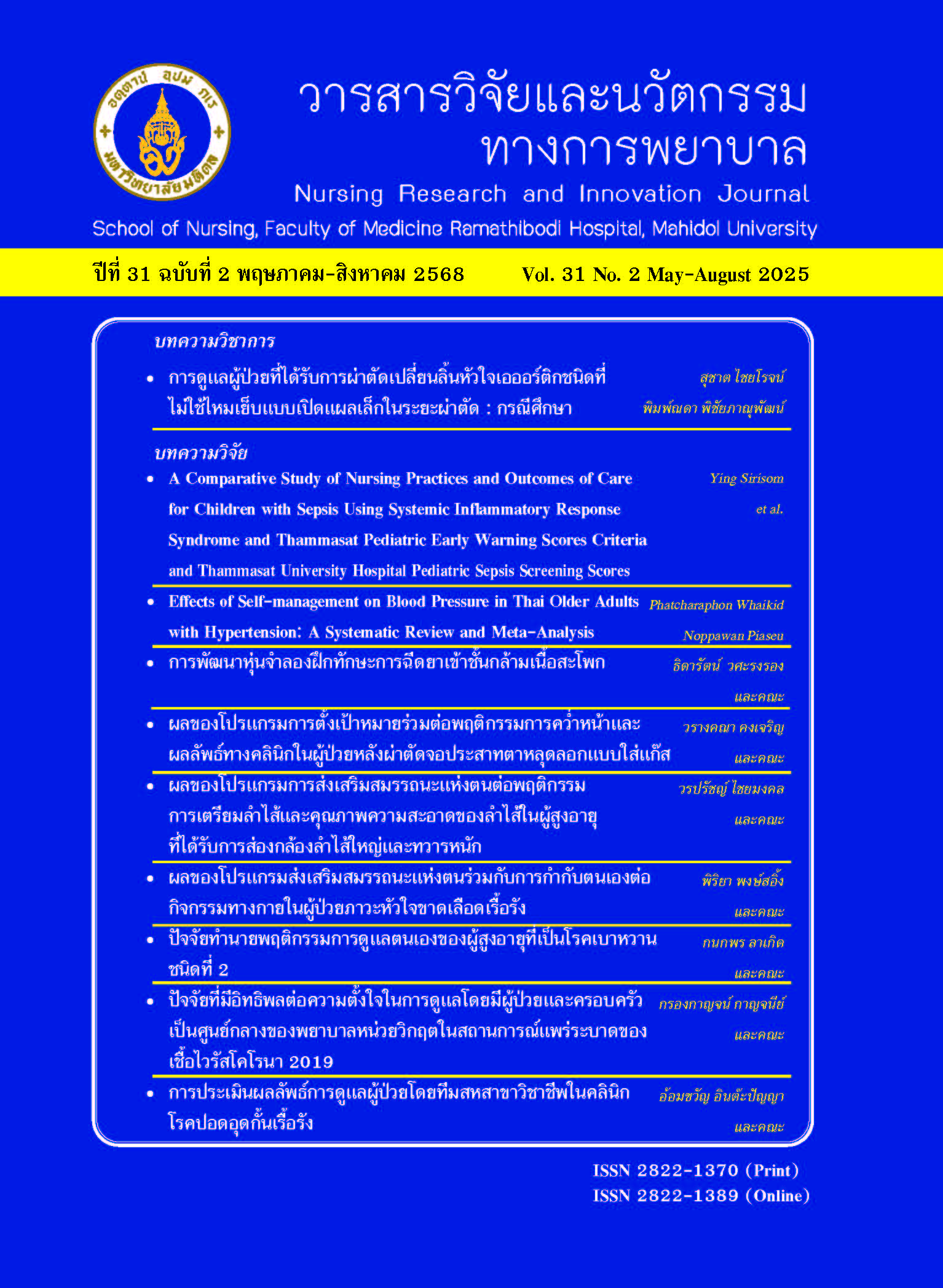
ปัจจัยที่มีอิทธิพลต่อความตั้งใจในการดูแลโดยมีผู้ป่วยและครอบครัวเป็นศูนย์กลางของพยาบาลหน่วยวิกฤตในสถานการณ์แพร่ระบาดของเชื้อไวรัสโคโรนา 2019
Article Sidebar
Main Article Content
บทคัดย่อ
การดูแลโดยมีผู้ป่วยและครอบครัวเป็นศูนย์กลาง (patient and family-centered care: PFCC) เป็นแนวคิดการดูแลที่มีพื้นฐานมาจากการร่วมมือกันระหว่างผู้ป่วย ครอบครัว และทีมสุขภาพ เพื่อทำให้การดูแลรักษาเกิดประโยชน์สูงสุด ประกอบด้วยแนวคิดหลักที่สำคัญ 4 ด้าน ได้แก่ 1) การมีศักดิ์ศรีและความเคารพ 2) การแบ่งปันข้อมูล 3) การมีส่วนร่วม และ 4) การประสานความร่วมมือ ปัจจุบันการดูแลแบบ PFCC ถูกนำไปใช้ในผู้ป่วยกลุ่มต่าง ๆ อย่างแพร่หลาย และทำให้เกิดผลลัพธ์ทางคลินิกที่ดีทั้งต่อผู้ป่วย ครอบครัว และทีมสุขภาพ อย่างไรก็ตาม การดูแลแบบ PFCC ในผู้ป่วยวิกฤตเป็นสิ่งที่ท้าทาย เนื่องจากระบบการดูแลรักษาผู้ป่วยวิกฤตได้รับการออกแบบให้ใช้เทคโนโลยีต่าง ๆ เป็นเครื่องมือในการรักษาและติดตามผล นอกจากนี้อุปสรรคในดูแลแบบ PFCC ในผู้ป่วยวิกฤต อาจเกิดจากตัวผู้ป่วยและครอบครัว สภาพแวดล้อมในหอผู้ป่วยวิกฤต และจากทีมสุขภาพได้ พยาบาลหน่วยวิกฤตที่ดูแลผู้ป่วยอย่างใกล้ชิดตลอด 24 ชั่วโมง จึงมีบทบาทสำคัญในการดูแลแบบ PFCC อย่างไรก็ตาม ในช่วงสถานการณ์แพร่ระบาดของโรคติดเชื้อโคโรนาไวรัส 2019 หรือโควิด-19 ทำให้เกิดข้อจำกัดในการมีปฏิสัมพันธ์ และการสื่อสารระหว่างผู้ป่วย ครอบครัว และพยาบาลหน่วยวิกฤต รวมทั้งพยาบาลวิกฤตไม่ได้รับการเตรียมพร้อมต่อสถานการณ์นี้ แนวปฏิบัติป้องกันการแพร่กระจายโรคโควิด-19 ภาระงานที่เพิ่มขึ้น ความเหนื่อยล้า ความเครียด และความกังวลต่อการติดโรคโควิด-19 อาจส่งผลต่อความตั้งใจของพยาบาลวิกฤตต่อการดูแลแบบ PFCC ได้ ดังนั้น การทำความเข้าใจถึงปัจจัยที่มีผลต่อความตั้งใจในการดูแลแบบ PFCC ของพยาบาลหน่วยวิกฤตจึงเป็นสิ่งสำคัญ ทฤษฎีพฤติกรรมตามแผน (Theory of Planned Behavior: TPB) เป็นทฤษฎีที่ใช้กันอย่างแพร่หลายในการศึกษาปัจจัยที่มีผลต่อพฤติกรรมของบุคคล จากทฤษฎีพฤติกรรมตามแผน ความตั้งใจของบุคคลในการแสดงพฤติกรรมนั้น ทำนายได้จากปัจจัยสำคัญ 3 ด้าน ได้แก่ 1) ทัศนคติที่มีต่อพฤติกรรม (attitude toward the behavior) 2) การคล้อยตามกลุ่มอ้างอิง (subjective norm) และ3) การรับรู้ความสามารถในการควบคุมพฤติกรรม (perceived behavioral control) ดังนั้น การใช้กรอบแนวคิดจากทฤษฎีพฤติกรรมตามแผน เพื่อศึกษาปัจจัยที่มีผลต่อความตั้งใจในการดูแลแบบ PFCC ของพยาบาลหน่วยวิกฤตในช่วงสถานการณ์แพร่ระบาดของโรคติดเชื้อโควิด-19 จะส่งเสริมให้เข้าใจพฤติกรรมการดูแลผู้ป่วยของพยาบาลหน่วยวิกฤตและส่งเสริมคุณภาพการดูแลและความปลอดภัยให้ผู้ป่วย
การวิจัยนี้มีวัตถุประสงค์ เพื่อศึกษาปัจจัยทำนายความตั้งใจในการดูแลแบบ PFCC ของพยาบาลหน่วยวิกฤตในสถานการณ์แพร่ระบาดของเชื้อไวรัสโควิด-19 ได้แก่ ระดับการศึกษา ประสบการณ์การทำงานในหอผู้ป่วยวิกฤต ทัศนคติ การคล้อยตามกลุ่มอ้างอิง และการรับรู้ความสามารถในการดูแลแบบ PFCC การวิจัยนี้เป็นการวิจัยแบบความสัมพันธ์เชิงทำนาย โดยใช้กรอบแนวคิดการดูแลแบบ PFCC แนวคิดพฤติกรรมตามแผน และ คุณลักษณะของพยาบาล กลุ่มตัวอย่างเป็นพยาบาลหน่วยวิกฤต 124 คน ที่ปฏิบัติงานในหอผู้ป่วยวิกฤต 8 แห่ง ที่โรงพยาบาลจุฬาลงกรณ์ สภากาชาดไทย คัดเลือกกลุ่มตัวอย่างแบบเจาะจง ตามเกณฑ์คือ เป็นพยาบาลระดับปฏิบัติการ และมีประสบการณ์การทำงานในหอผู้ป่วยวิกฤตอย่างน้อย 6 เดือน เครื่องมือประกอบด้วย แบบสอบถาม 5ชุด ได้แก่ 1) แบบสอบถามข้อมูลส่วนบุคคล 2) แบบสอบถามทัศนคติต่อการดูแลแบบ PFCC 3) แบบสอบถามการคล้อยตามกลุ่มอ้างอิงในการดูแลแบบ PFCC 4) แบบสอบถามการรับรู้ความสามารถในการดูแลแบบ PFCC และ 5) แบบสอบถามความตั้งใจในการดูแลแบบ PFCC วิเคราะห์ข้อมูลโดยใช้สถิติเชิงพรรณนา และสถิติการถดถอยพหุคูณแบบ Enter
ผลการวิจัย พบว่า ระดับการศึกษา ประสบการณ์การทำงานในหอผู้ป่วยวิกฤต ทัศนคติ การคล้อยตามกลุ่มอ้างอิง และการรับรู้ความสามารถในการดูแลแบบ PFCC สามารถร่วมกันทำนายความตั้งใจในการดูแลแบบ PFCC ของพยาบาลหน่วยวิกฤตได้อย่างมีนัยสำคัญทางสถิติ (F = 7.849, p < .01) ร้อยละ 25 โดยที่การรับรู้ความสามารถในการดูแลแบบ PFCC (β = .314, p = .002) การคล้อยตามกลุ่มอ้างอิง (β = .223, p = .015) และระดับการศึกษา (β = .175, p = .038) เป็นตัวแปรที่มีอิทธิพลอย่างมีนัยสำคัญทางสถิติต่อความตั้งใจในการดูแลแบบPFCC ของพยาบาลหน่วยวิกฤต จากผลการศึกษาครั้งนี้ ผู้บริหารทางการพยาบาลควรจัดการอบรมการดูแลแบบ PFCC เพื่อส่งเสริมความเข้าใจ และทัศนคติที่ดีแก่พยาบาลหน่วยวิกฤต รวมทั้งจัดระบบสนับสนุนการสื่อสารและความร่วมมือระหว่างผู้ป่วย ครอบครัว และทีมสุขภาพ เช่น ห้องประชุม และทีมที่ปรึกษาให้แก่ผู้ป่วยและครอบครัว
คำสำคัญ : การแพร่ระบาดของเชื้อไวรัสโคโรนา 2019 พยาบาลหน่วยวิกฤต ความตั้งใจ การดูแลโดยมีผู้ป่วยและครอบครัวเป็นศูนย์กลาง
Article Details

อนุญาตภายใต้เงื่อนไข Creative Commons Attribution-NonCommercial-NoDerivatives 4.0 International License.
บทความ ข้อมูล เนื้อหา รูปภาพ ฯลฯ ที่ได้รับการตีพิมพ์ในรามาธิบดีพยาบาลสาร ถือเป็นลิขสิทธิ์ของวารสาร หากบุคคลหรือหน่วยงานใดต้องการนำทั้งหมดหรือส่วนหนึ่งส่วนใดไปเผยแพร่หรือเพื่อกระทำการใด ใด จะต้องได้รับอนุญาตเป็นลายลักษณ์อักษรจากรามาธิบดีพยาบาลสารก่อนเท่านั้น
เอกสารอ้างอิง
Suvarnabhumi K. Patient-centered care. The Thai Journal of Primary Care and Family Medicine. 2011;3(1):38-44.(in Thai)
Deepika SR, Rahman J. Patient and family centered care:practices in pediatrics. Int J Nurs Educ. 2020;12(4):43-7.
Institute of Medicine (US) Committee on Quality of Health Care in America. Crossing the Quality Chasm: A New Health System for the 21st Century. Washington (DC):National Academies Press (US); 2001;323(7322):1192.
The Healthcare Accreditation Institute. Hospital and healthcare service standards, 5thed. Nonthaburi: Healthcare Accreditation Institute (Public Organization); 2023.
Institute for patient- and family-centered care. Advancing the practice of patient- and family-centered care in hospitals how to get started. Bethesda; 2017.
National Institute for Emergency Medicine. Emergency medicine indicator. [Internet]. Nonthaburi: National Institute for Emergency Medicine; 2019 [cited 2020 Dec12]. Available from: https://ws.niems.go.th/KPI57/2557/kpireportcontinue01.aspx
Kozub E, Scheler S, Necoechea G, OByrne N. Improving nurse satisfaction with open visitation in an adult intensive care unit. Crit Care Nurs Q. 2017;40(2):144-54.
Mol MM, Boeter TG, Verharen L, Kompanje EJ, Bakker J, Nijkamp MD. Patient-and family-centred care in the intensive care unit: a challenge in the daily practice of healthcare professionals. J Clin Nurs. 2017;26(19-20):3212-23.
Montenegro P, Farias-Reyes D, Galiano-Gálvez MA,Quiroga-Toledo N. Restricted/unrestricted visits to adult patients in the intensive care unit. Aquichan. 2016;16(3):358.
Goldfarb MJ, Bibas L, Bartlett V, Jones H, Khan N.Outcomes of patient- and family-centered care interventions in the ICU: a systematic review and meta-analysis. Crit Care Med. 2017;45(10):1751-61.
Secunda KE, Kruser JM. Patient-centered and family-centered care in the intensive care unit. Clin Chest Med.2022;43(3):539-50.
Kiwanuka F, Shayan SJ, Tolulope AA. Barriers to patient and family-centred care in adult intensive care units: a systematic review. Nurs Open. 2019;6(3):676-84.
Division of Communicable Diseases. Academic development group of emerging infectious diseases coronavirus disease situation 2019 (COVID-19) public health measurement of problems in prevention and control diseases in travelers [internet]. [cited 2021 Oct 25].
Available from: https://ddc.moph.go.th/uploads/ files/2017420210820025238.pdf. (in Thai)
Krewulak KD, Jaworska N, Lee L, St Louis J, Dmitrieva O, Leia MP, et al. Impact of restricted family presence during the COVID-19 pandemic on critically ill patients,families, and critical care clinicians: a qualitative systematic review. BMC Health Serv Res. 2024;24
(1):936.
Department of Medical Services, Ministry of Public Health.Guidelines for the management of critically ill patients during the COVID-19 outbreak. [internet]. [cited 2025 April 30]. Available from: https://dmsic.moph.go.th/index/detail/8194 (in Thai)
Alaloul F, Alomari K, Al Qadire M, Al-Dwaikat T. Public knowledge, attitude, practices, and level of anxiety toward the COVID-19 pandemic among people living in Oman.Nurs Forum. 2021;56(3):596-603.
Ajzen I. The theory of planned behavior. Organ Behav Hum Decis Process. 1991;50:179-211.
Glanz K, Rimer BK, Viswanath K. Health behavior theory,research, and practice. 5thed. Sanfancisco: Jossey-Bass; 2015.
Khamwang A, Malathum P, Jianvitayakij S. Predictive factors for elderly care behavior by professional nurses in university hospitals. Ramathibodi Nursing Journal.2562;27:108-21. (in Thai).
Malcolm O, Nelson A, Modeste NN, Gavaza P. Factors influencing implementation of personalized prevention plans among annual wellness visit patients using the theory of planned behavior: A quantitative study. Res Social Adm Pharm. 2021;17:1636-44.
Cheng J, Cui J, Yu W, Kang H, Tian Y, Jiang X. Factors influencing nurses’ behavioral intention toward caring for COVID-19 patients on mechanical ventilation: a cross-sectional study. PLoS One. 2021;16(11):e0259658.
Hwang A, Kim D. Factors influencing nurses’ intent to provide care involved in coronavirus disease 2019: theory of planned behaviour perspectives. J Clin Nurs.2024;33(1):333-43. doi: 10.1111/jocn.16468.
Ma Y, Cui N, Li X, et al. Predicting critical care nurses’intention to use physical restraints in intubated patients: a structural equation model. J Nurs Manag. 2023;2023:3286312.
Hebeshy, Mona I. Attitude, subjective norms, perceived behavioral control, and intention of Egyptian of Egyptian nurses towards prevention of deep vein thrombosis among critically ill patients in intensive care units. [internet].2018 [cited 2025 April 30]. Available from: http://rave.ohiolink.edu/etdc/view?acc_num=kent1524226281287546
Rostami F, Syed Hassan ST, Yaghmaei F. Applying theory of planned behavior to develop family-centered care,2015-2016. Iran J Public Health. 2018;47:460-1.
Lee J, Kang SJ. Factors influencingnurses’ intention to care for patients with emerging infectious diseases:Application of the theory of planned behavior. Nurs Health Sci. 2020;22:82–90.
Thaiatwithi T, Champamoon A. Factors influencing patient-centered care as perceived by professional nurses at Srinagarind hospital, Khon Kaen University. Srinagarind Medical Journal. 2562;34:198-204. (in Thai)
Auttharos T, Apaijirarat J, Soonsawat J. Study of nurses’perceptions and practices in family-centered care. Report of the Pediatric Nursing Association of Thailand. 2006.Contract No. 9749922212. Thai Red Cross College of Nursing. (in Thai)
Kramulroj N, Natithonsombat K, Khlantamniem K. Factors predicting of nursing practice in family-centered cared community nurse practitioners. Huachiew Chalermprakiet University Journal.2018;21:13-27. (in Thai)
Choi S. Factors affecting to the person-centered care among critical care nurses. J Korean Crit Care Nurs.2020;13:36-44.
Somjainuek J, Prasobkittikun T, Srichantanit A. Predictive factors of pediatric nurses’ practice in family-centered care.Journal of Nursing Science. 2017;34:70-9. (in Thai)
Strategy and Planning Division, Office of the Permanent Secretary, Ministry of Public Health. Plan and measures for managing the COVID-19 situation toward endemic transition. [Internet]. 2565 [cited 2025 April 30].Available from: http://bps.moph.go.th. (in Thai)
Aboumatar H. Three reasons to focus on patient and family engagement during the COVID-19 pandemic. Qual Manag Health Care. 2020;29(3):176-7.
Faul F, Erdfelder E, Lang AG, Buchner A. G*Power 3: a flexible statistical power analysis program for the social,behavioral, and biomedical sciences. Behav Res Methods.2007;39(2):175-191.
Bruce B, Letourneau N, Ritchie J, Larocque S, Dennis C,Elliott MR. A multisite study of health professionals’perceptions and practices of family-centered care. J Fam Nurs. 2002;8:408-29.307
Thato R. Nursing research: concepts to applications. 4thed. Bangkok: Chulalongkorn University Press; 2018.(in Thai)
Shubayr MA, Mashyakhy M, Agili DEA, Albar N, Quadri MF. Factors associated with infection-control behavior of dental health–care workers during the covid-19 pandemic:A cross-sectional study applying the theory of planned behavior.J Multidiscip Healthc. 2020;13:1527-35.
Sripankaew K. The relationship between attitudes,subjective norms, perceived behavioral control, and nurses’ intentions to assess postoperative pain [Doctoral dissertation]. Bangkok: Chulalongkorn University; 2006.(in Thai)
