
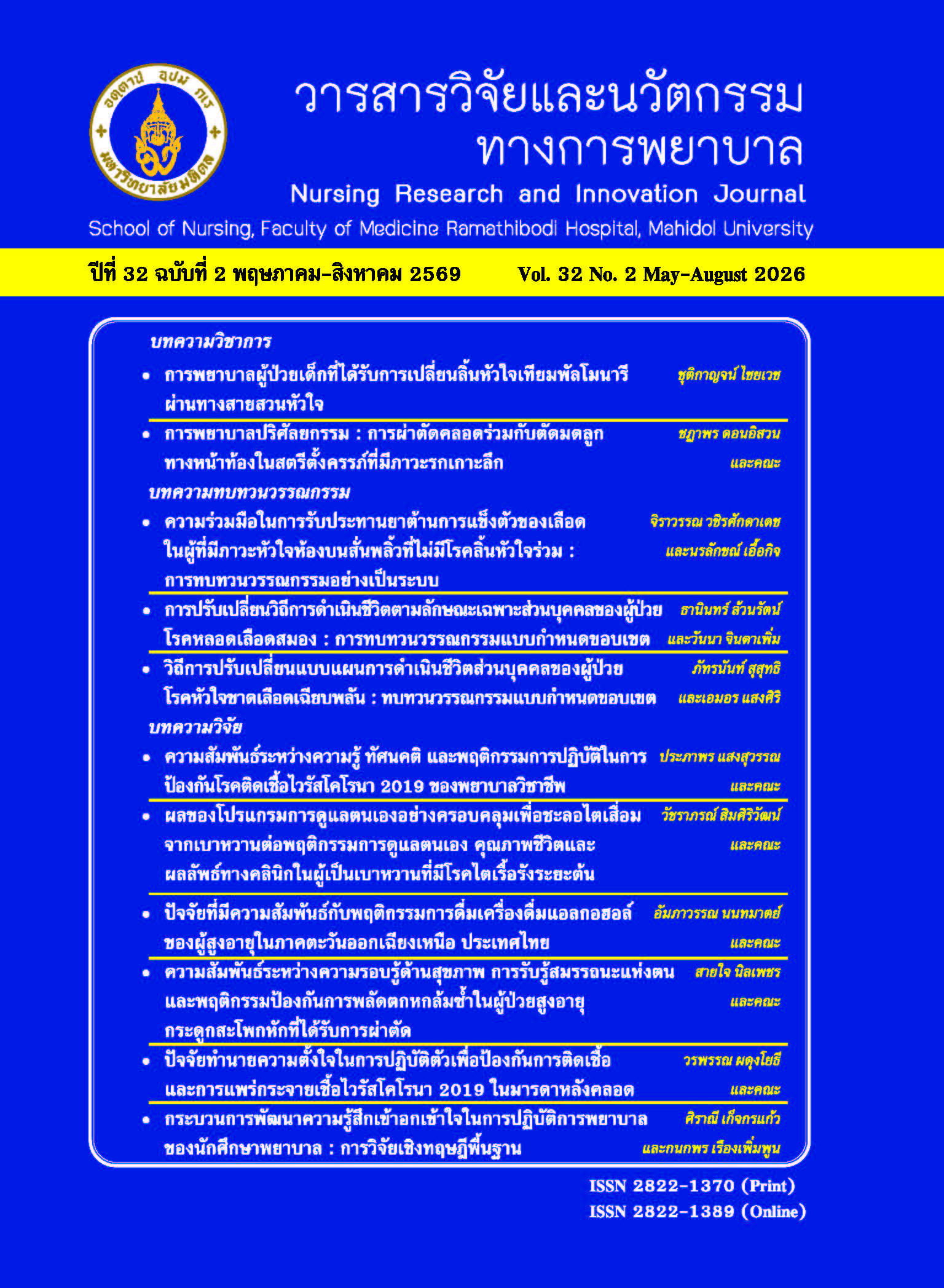
ความสัมพันธ์ระหว่างความรอบรู้ด้านสุขภาพ การรับรู้สมรรถนะแห่งตน และพฤติกรรมป้องกันการพลัดตกหกล้มซ้ำในผู้ป่วยสูงอายุกระดูกสะโพกหักที่ได้รับการผ่าตัด
Article Sidebar
Main Article Content
บทคัดย่อ
การหกล้มในผู้สูงอายุเป็นปัญหาสำคัญที่ส่งผลกระทบต่อคุณภาพชีวิตของผู้สูงอายุ ในกลุ่มผู้สูงอายุที่เคยประสบเหตุหกล้มกระดูกสะโพกหักและต้องเข้ารับการรักษาในโรงพยาบาลด้วยการผ่าตัดกระดูกสะโพก หลังผ่าตัดผู้สูงอายุกระดูกหักส่วนใหญ่เกิดการสูญเสียความสามารถในการเคลื่อนไหว ความสามารถในการปฏิบัติกิจวัตรประจำวัน รวมถึง ผู้สูงอายุมีการใช้ทรัพยากรด้านสุขภาพที่เพิ่มขึ้น เช่น การเข้ารับการรักษาในโรงพยาบาล การฟื้นฟูสุขภาพ การติดตามการรักษาอย่างต่อเนื่อง และค่าใช้จ่ายด้านสุขภาพที่สูงขึ้น โดยเฉพาะในระยะ 2 สัปดาห์แรกหลังการผ่าตัด ผู้สูงอายุมีข้อจำกัดด้านการเคลื่อนไหวอย่างมาก เนื่องจากยังมีการบาดเจ็บของเนื้อเยื่อและกระดูก ช่วงหลังผ่าตัด ผู้สูงอายุมักเกิดความเสี่ยงต่อการเกิดการหกล้มซ้ำสูง การป้องกันการหกล้มอย่างมีประสิทธิภาพต้องใช้แนวทางที่หลากหลายโดยเฉพาะอย่างยิ่ง ความรอบรู้ด้านสุขภาพเกี่ยวกับการป้องกันการหกล้ม และการรับรู้สมรรถนะแห่งตนด้านการป้องกันการหกล้ม ซึ่งเป็นปัจจัยสำคัญที่ส่งผลต่อพฤติกรรมการป้องกันการหกล้มซ้ำ ทั้งนี้ ความรอบรู้ด้านสุขภาพช่วยให้ผู้สูงอายุสามารถเข้าถึง เข้าใจ ประเมิน และประยุกต์ใช้ข้อมูลด้านสุขภาพเพื่อการตัดสินใจในการป้องกันการหกล้มได้อย่างเหมาะสม อย่างไรก็ตามปัจจัยเหล่านี้ยังไม่ได้รับการศึกษาในกลุ่มผู้ป่วยกระดูกสะโพกหักภายหลังการผ่าตัด 2 สัปดาห์ ซึ่งการฟื้นหายจากการผ่าตัดยังไม่คงที่ เสี่ยงต่อการเกิดการล้มซ้ำ ดังนั้น การศึกษาปัจจัยดังกล่าวในระยะฟื้นตัวช่วงต้นจึงอาจเป็นข้อมูลสำคัญในการพัฒนารูปแบบการพยาบาลเพื่อป้องกันการหกล้มในผู้สูงอายุภายหลังการผ่าตัดกระดูกสะโพก
การวิจัยนี้เป็นการวิจัยเชิงพรรณนาแบบสหสัมพันธ์ มีวัตถุประสงค์เพื่อศึกษาความสัมพันธ์ระหว่างความรอบรู้ด้านสุขภาพเกี่ยวกับการป้องกันการหกล้ม การรับรู้สมรรถนะแห่งตนด้านการป้องกันการหกล้ม และพฤติกรรมป้องกันการพลัดตกหกล้มซ้ำในผู้ป่วยสูงอายุกระดูกสะโพกหัก ที่ได้รับการผ่าตัดและมาตรวจติดตามหลังผ่าตัดที่หน่วยตรวจผู้ป่วยนอกออร์โธปิดิกส์ จำนวน 76 ราย ผลการศึกษาคาดว่าจะเป็นข้อมูลเชิงประจักษ์เพื่อใช้พัฒนาแผนการให้การพยาบาล เพื่อการส่งเสริมพฤติกรรมการป้องกันการหกล้มแก่ผู้สูงอายุกระดูกสะโพกหัก ก่อนจำหน่ายจากโรงพยาบาลอย่างเหมาะสม ใช้รูปแบบการวิจัยเชิงพรรณนาแบบสหสัมพันธ์ คัดเลือกกลุ่มตัวอย่างด้วยวิธีเฉพาะเจาะจงตามเกณฑ์คัดเข้า ประกอบด้วย (1) อายุ 60 ปีขึ้นไป (2) มีกระดูกสะโพกหักจากการหกล้ม (3) สามารถสื่อสารและเข้าใจภาษาไทย (4) ไม่มีภาวะพร่องการรู้คิด โดยคัดเลือกผู้เข้าร่วมวิจัยจากผู้ที่มาตรวจติดตามตามนัดภายหลังการจำหน่ายจากโรงพยาบาลในระยะฟื้นตัวช่วงต้น เครื่องมือที่ใช้ในการเก็บรวบรวมข้อมูลประกอบด้วย แบบสอบถามข้อมูลส่วนบุคคลและข้อมูลด้านสุขภาพ แบบประเมินความรอบรู้ด้านสุขภาพเกี่ยวกับการป้องกันการหกล้มในผู้สูงอายุ แบบประเมินการรับรู้สมรรถนะแห่งตนด้านการป้องกันการหกล้ม และแบบประเมินพฤติกรรมการป้องกันการหกล้ม วิเคราะห์ข้อมูลโดยใช้สถิติบรรยาย และสถิติสหสัมพันธ์ของสเปียร์แมน
ผลการศึกษาพบว่า กลุ่มตัวอย่างส่วนใหญ่เป็นเพศหญิง มีอายุเฉลี่ย 78.63 ปี ส่วนใหญ่เป็นการหกล้มและกระดูกสะโพกหักครั้งแรก และไม่มีประวัติการหกล้มมาก่อนหน้านี้ ภายหลังการผ่าตัด 2 สัปดาห์ ผู้สูงอายุจำนวนมากยังคงมีข้อจำกัดด้านการเคลื่อนไหว และต้องได้รับความช่วยเหลือในการเคลื่อนย้ายหรือการทำกิจวัตรประจำวัน คะแนนเฉลี่ยของพฤติกรรมการป้องกันการหกล้มซ้ำสูงกว่าค่ากลางของคะแนนพฤติกรรมป้องกันการหกล้มซ้ำ แสดงให้เห็นว่าผู้เข้าร่วมมีพฤติกรรมการป้องกันการหกล้มซ้ำในระดับปานกลางถึงสูง ความรอบรู้ด้านสุขภาพเกี่ยวกับการป้องกันการหกล้มมีความสัมพันธ์ทางบวกกับการรับรู้สมรรถนะแห่งตนด้านการป้องกันการหกล้ม (r = .31, p < .05) และพฤติกรรมการป้องกันการหกล้มซ้ำ (r = .34, p < .05) อย่างมีนัยสำคัญทางสถิติ แต่การรับรู้สมรรถนะแห่งตนด้านการป้องกันการหกล้มไม่มีความสัมพันธ์กับพฤติกรรมการป้องกันการหกล้มซ้ำ (r = .20, p > .05) ผลการศึกษานี้แสดงถึงความสำคัญของความรอบรู้ด้านสุขภาพเกี่ยวกับการป้องกันการหกล้ม กับพฤติกรรมการป้องกันการหกล้มในกลุ่มผู้สูงอายุที่อยู่ในระยะฟื้นตัวหลังการผ่าตัดกระดูกสะโพก โดยผู้ที่มีความรอบรู้ด้านสุขภาพเกี่ยวกับการป้องกันการหกล้มในระดับสูงมีแนวโน้มที่จะมีการรับรู้สมรรถนะแห่งตนด้านการป้องกันการหกล้มสูงขึ้น และแสดงพฤติกรรมป้องกันการหกล้มมาก ผลการวิจัยนี้สามารถนำไปใช้เป็นแนวทางให้บุคลากรทางการพยาบาลและทีมสหสาขาวิชาชีพควรพัฒนาโปรแกรมส่งเสริมความรอบรู้ด้านสุขภาพ อันจะนำไปสู่การเสริมสร้างพฤติกรรมการป้องกันการหกล้มในผู้สูงอายุ โดยเฉพาะในระยะหลังผ่าตัด เพื่อช่วยลดความเสี่ยงการหกล้มซ้ำ
คำสำคัญ : หกล้ม ความรอบรู้ด้านสุขภาพ การผ่าตัดกระดูกสะโพก ผู้สูงอายุ พฤติกรรมป้องกันการพลัดตกหกล้มซ้ำ การรับรู้สมรรถนะแห่งตน
Article Details

อนุญาตภายใต้เงื่อนไข Creative Commons Attribution-NonCommercial-NoDerivatives 4.0 International License.
บทความ ข้อมูล เนื้อหา รูปภาพ ฯลฯ ที่ได้รับการตีพิมพ์ในรามาธิบดีพยาบาลสาร ถือเป็นลิขสิทธิ์ของวารสาร หากบุคคลหรือหน่วยงานใดต้องการนำทั้งหมดหรือส่วนหนึ่งส่วนใดไปเผยแพร่หรือเพื่อกระทำการใด ใด จะต้องได้รับอนุญาตเป็นลายลักษณ์อักษรจากรามาธิบดีพยาบาลสารก่อนเท่านั้น
เอกสารอ้างอิง
Moreland B, Kakara R, Henry A. Trends in nonfatal falls and fall-related injuries among adults aged 65 and older– United States, 2012–2018. MMWR Morb Mortal Wkly Rep. 2020;69(27):875–81. doi:10.15585/mmwr.mm6927a5.
Moreland B, Legha J, Thomas K, Burns ER. Hip fracture-related emergency department visits, hospitalizations, and deaths by mechanism of injury among adults aged 65 and older, United States 2019. J Aging Health. 2023;35(5–6):345–55. doi:10.1177/ 08982643221132450.
Kostseekiaw T, Jaisue D. The development of falls prevention model for elderly by participation of community partnership networks. Journal of Khon Kaen Provincial Health Office. 2022;4(2):254-69. (in Thai)
Saenwa S, Wattanaburanon A, Maharachpong N. Effect of fall prevention program based on health belief model and social support on fall prevention behaviors among the elderly in Kochan district, Chonburi Province. Research and Development Health System Journal. 2022;15(2):214 –27. (in Thai)
Saiphraraj T, Saiyasalee S, Saengprajuk N. Discrepancies in the provision of emergency medical services for fall among the elderly in Thailand. Journal of Emergency Medical Services of Thailand. 2022;2(1):58-65. (in Thai)
Vilawarn J, Laokhompruttajan J, Laokhompruttajan T,Boonnao Y, Pattarin Boonserm. The effect of a socio-cultural program for promoting quality of life and depression prevention in the elderly, Na Fai subdistrict,Mueang Chaiyaphum district, Chaiyaphum Province.Research and Development Health System Journal.2022;15(1):181-95. (in Thai)
The World Health Organization regional office for Europe (WHO/Europe).[Internet]. Copenhagen: WHO/Europe ; 2012. Policies and priority interventions for healthy ageing;2012 [cited 2023 Oct 3]; p.1-11. Available from:https:// www.euro.who.int/__data /assets/pdf_file/0006/161637/WHD- Policies-and-Priority-Interventions-for-Healthy-Ageing.pdf
Lee SH, Yu S. Effectiveness of multifactorial interventions in preventing falls among older adults in the community:A systematic review and meta-analysis. Int J Nurs Stud.2020;106: 1-22. doi:10.1016/j.ijnurstu. 2020.103564.
Ambrose AF, Paul G, Hausdorff JM. Risk factors for falls among older adults: a review of the literature. Maturitas.2013;75(1):51–61. doi:10.1016/j.maturitas.2013.02.009.
Ganz DA, Bao Y, Shekelle PG, Rubenstein LZ. Will my patient fall? JAMA. 2007;297(1):77–86. doi:10.1001/jama.297.1.77.
Guirguis-Blake JM, Perdue LA, Coppola EL, Bean SI.Interventions to prevent falls in older adults: updated evidence report and systematic review for the US Preventive Services Task Force. JAMA. 2024;332(1) :58–69. doi:10.1001/jama.2024.4166.
Harris E. Systematic review: What works to prevent falls for older people. JAMA. 2023;329(14):1142. doi: 10.1001/jama.2023.4001.
Pillay J, Gaudet LA, Saba S, Vandermeer B, Ashiq AR,Wingert A, et al. Falls prevention interventions for community-dwelling older adults: systematic review and meta-analysis of benefits, harms, and patient values and preferences. Syst Rev. 2024;13(1):289. doi:10.1186/s13643-024-02681-3.
Nutbeam D. The evolving concept of health literacy. Soc Sci Med. 2008;67(12):2072-8. doi: 10.1016/j.socscimed.2008.09.050.
Mackert M, Champlin S, Holton A, Muñnoz I, Damasio M. Health literacy and health information technology adoption: the potential for a new digital divide. J Med Internet Res. 2016;18(10):e264. doi: 10.2196/jmir.6349.
Magnani JW, Mujahid MS, Aronow HD, et al.Health literacy and cardiovascular disease:Fundamental relevance to primary and secondary prevention:A scientific statement from the American Heart Association.Circulation.2018;138(2):e48–74. doi : 10.1161/CIR. 0000000000000579.
Sarapun A, Sirisopon N, Kainaka P, Onsiri S, Outayanik B, Threrawachjareanchai S, Sukomol N. Factors related to a fall prevention behaviors of elderly. Journal of The Royal Thai Army Nurses. 2017; 18(Supplement): 215-22.(in Thai)
Bandura A. Self-efficacy: The exercise of control. New York: Freeman; 1997.
Yao M, Yang YT, Yang YW, Ye Q, Chen QT, Lin T.Fall prevention self-management behavior and associated factors among community-dwelling older adults in China:a cross-sectional study. Nurs Commun. 2025;9:e2025021. doi:10.53388/IN2025021.
Powell LE, Myers AM. The activities-specific balance confidence (ABC) scale. J Gerontol A Biol Sci Med Sci.1995;50(1): 28-34. doi: 10.1093/gerona/50a.1.m28.
Li F, Harmer P, Fisher KJ, McAuley E. Tai Chi and self-rated quality of life and physical health: a randomized controlled trial. J Am Geriatr Soc. 2004;52(3):381–389. doi:10.1111/j.15325415.2004.52255.x.
Paasche-Orlow MK, Wolf MS. The causal pathways linking health literacy to health outcomes. Am J Health Behav. 2007;31(Suppl 1): S19–26. doi:10.5555/ajhb.2007.31.supp.S19.
Yardley L, Donovan-Hall M, Francis K, Todd C. Attitudes and beliefs that predict older people’s intention to undertake strength and balance training. J Gerontol B Psychol Sci Soc Sci. 2007;62(2):P119–P125. doi:10.1093/geronb/62.2.P119.
Aree-Ue S, Youngcharoen P. The 6 item cognitive function test Thai version: psychometric property testing.Ramathibodi Nursing Journal. 2020;26(2):188-202.(in Thai)
Hongkrajok H, Pathumarak N, Masingboon K. Influences of health literacy, perceived self efficacy, and patient-health care provider communication on self-care behaviors among patients with primary hypertension. Royal Thai Navy Medical Journal. 2016;43(2):39-54. (in Thai)
Kareesun K, Malathum P. Sutti N. Relationships among health literacy, knowledge about hypertension control,and health behavior in older persons with hypertension.Ramathibodi Nursing Journal. 2019;25(3):280-95.(in Thai)
Khampisut J. Health literacy and health promotion behaviors of students in Naresuan University. Journal of Education Measurement Mahasarakham University.2017;24(1):67-78. (in Thai)
Bujang MA, Baharum N. Sample size guideline for correlation analysis. World J Soc Sci Res. 2016;3(1):37-46. doi: 10.22158/ wjssr. v3n1p37.
Faul F, Erdfelder E, Buchner A, Lang AG. Statistical power analyses using G*Power 3.1: Tests for correlation and regression analyses. Behav Res Methods. 2009;41(4):1149-60. doi: 10.3758/BRM.41.4.1149.
Cohen J. A power primer. Psychol Bull. 1992,112(1):155–59. doi: 10.1037/0033-2909.112.1.155.
Brooke P, Bullock R. Validation of a 6 item cognitive impairment test with a view to primary care usage. Int J Geriatr Psychiatry. 1999;14(11):936-40.
Kittipimpanon K, Kraithaworn P. Association between personal factors, health status, and health literacy about falling, with fall prevention behaviors among older adults living in the community. Ramathibodi Nursing Journal.2021;27(3):331-42. (in Thai)
Nanthapaiboon K, Wannapakhe J, Viriyatarakij N,Boonsinsukh R. Assessment of internal consistency and convergent validity of the Activities-specific Balance Confidence (ABC) Scale Thai Version. Thai Pharmaceutical and Health Science Journal. 2018;13(1):1-7. (in Thai)
Luewanit C, Tantiboonchai N. Falls risk among the members of the Phuket elderly club. PKRU SciTech Journal. 2017;1(2):1-11. (in Thai)
Balalavi M, Huang HC, Tsai TF, Su FL, Subeq YM.Applying Taiwanese indigenous health literacy for designing an elders’ prevention fall course: a statistical analysis and deep learning approach. J Supercomput. 2021;77:2355-82. doi:10.1007 / s11227-020-03358-z.
Romero SS, Scortegagna HM, Doring M. Functional health literacy level and behavior in the health of the elderly. Texto Contexto Enferm. 2019;27:e5230017.doi: 10.1590/0104- 07072018005230017.
Tamsat A, Aree-Ue S, Leelacharas S. Fear of falling and functional ability in older adults undergoing hip surgery.Journal of The Police Nurse. 2015;7(1):64-82. (in Thai)
McGilton KS, Heath H, Chu CH, Boström AM, Mueller C, Boscart VM, et al. Moving the agenda forward: a person-centered framework in long-term care. Int J Older People Nurs. 2012;7(4):303- 9. doi: 10.1111/opn.12010.
Saengthon N, Aree-Ue S, Youngcharoen P,Kawinwonggowit V. Pain, Physical Activity, and Quality of Life among Older Adults with Knee and Hip Conditions:A Comparative Study. Ramathibodi Nursing Journal.2018;25(1):74-86. (in Thai)
Pongaumpai P, Hoontrakulm S, Roojanavech S. The effect of family empowerment program on fall prevention capabilities of the elderly. Royal Thai Navy Medical Journal. 2018;45(2):311-27. (in Thai)
Hadjistavropoulos T, Carleton RN, Delbaere K, Barden J, Zwakhalen S, Fitzgerald B, et al. The relationship of fear of falling and balance confidence with balance and dual tasking performance. Psychol Aging. 2012;27(1):1-13. doi: 10.1037/a0024054.
Gillespie LD, Robertson MC, Gillespie WJ, Sherrington C, Gates S, Clemson LM, et al. Interventions for preventing falls in older people living in the community.Cochrane Database Syst Rev. 2012;(9):CD007146. doi:10.1002/14651858.CD007146.pub3.
