
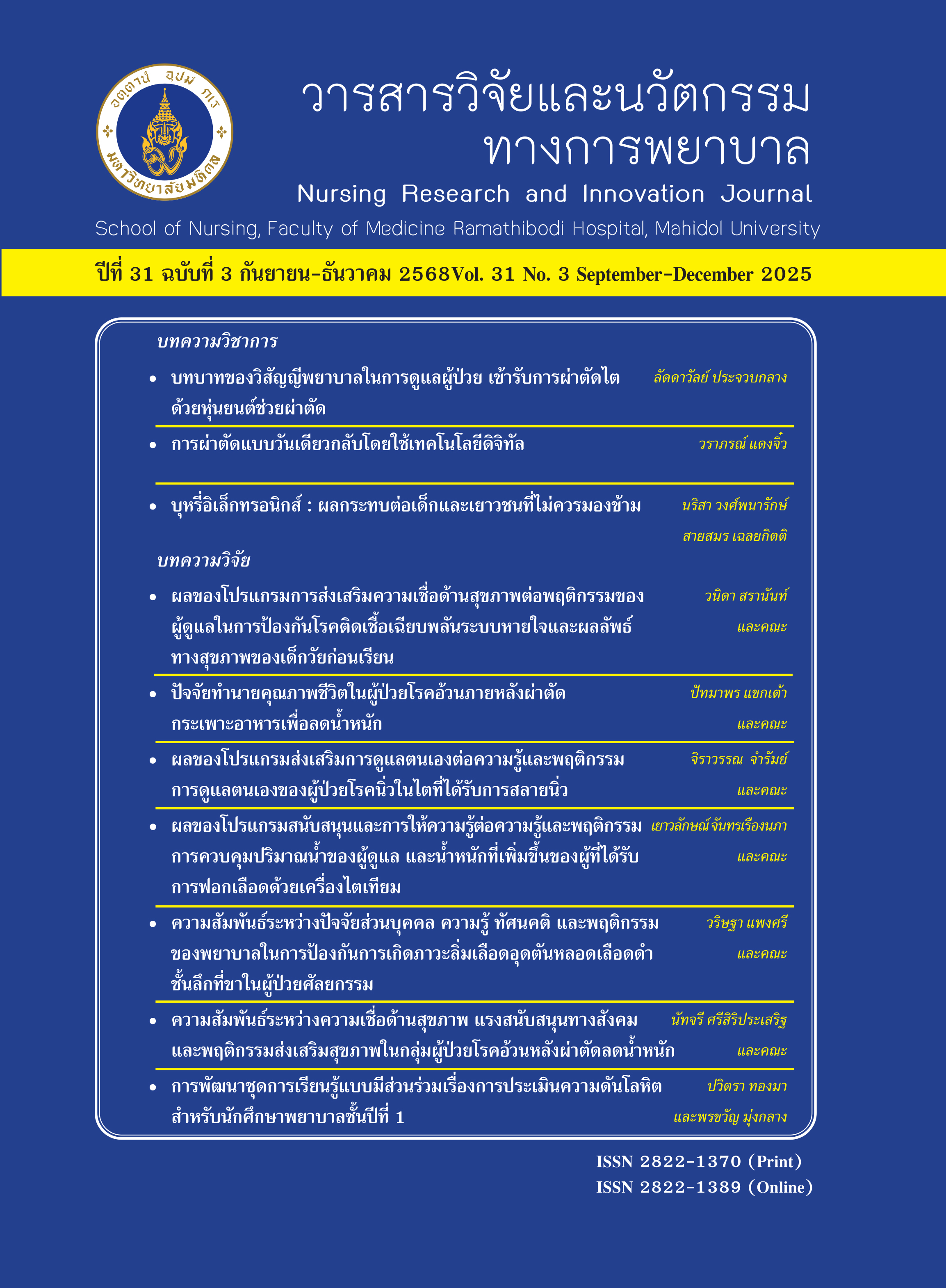
ปัจจัยทำนายคุณภาพชีวิตในผู้ป่วยโรคอ้วนภายหลังผ่าตัดกระเพาะอาหารเพื่อลดน้ำหนัก
Article Sidebar
Main Article Content
บทคัดย่อ
โรคอ้วนเป็นปัญหาสาธารณสุขระดับโลกที่ก่อให้เกิดการเปลี่ยนแปลงทางพยาธิสรีรวิทยา ซึ่งส่งผลกระทบต่อความสามารถในการเคลื่อนไหว การดำเนินชีวิตประจำวัน คุณภาพการนอนหลับ และคุณภาพชีวิตโดยรวมของบุคคล การสะสมของเนื้อเยื่อไขมันในปริมาณมากในผู้ป่วยโรคอ้วนยังเพิ่มความเสี่ยงต่อการเกิดอุบัติเหตุ โดยเฉพาะอุบัติเหตุทางยานยนต์ ซึ่งส่งผลต่อประสิทธิภาพการทำงานและจำกัดโอกาสในการประกอบอาชีพ ด้วยแนวโน้มของโรคอ้วนที่เพิ่มขึ้นอย่างต่อเนื่องทั่วโลก การรักษาที่มีประสิทธิภาพจึงมีความสำคัญอย่างยิ่ง การผ่าตัดกระเพาะอาหารเพื่อลดน้ำหนัก เป็นแนวทางการรักษามาตรฐานที่มีประสิทธิผลสำหรับผู้ป่วยโรคอ้วนรุนแรง โดยเฉพาะผู้ที่มีค่าดัชนีมวลกาย≥ 40 กก./ตรม. ซึ่งไม่เพียงช่วยลดน้ำหนักส่วนเกินได้อย่างมีประสิทธิภาพ
แต่ยังสามารถควบคุมรวมทั้งรักษาโรคร่วมที่เกี่ยวข้องกับโรคอ้วนได้
นอกจากนี้ยังมีส่วนช่วยปรับปรุงภาพลักษณ์ทางร่างกาย เสริมสร้างความมั่นใจในตนเอง และยกระดับคุณภาพชีวิตของผู้ป่วยได้อย่างมีนัยสำคัญ ปัจจัยสำคัญที่ส่งผลต่อคุณภาพชีวิตหลังการผ่าตัด ได้แก่ การลดลงของน้ำหนักส่วนเกินเทียบกับน้ำหนักมาตรฐาน ภาวะซึมเศร้า ความสามารถในการทำหน้าที่ด้านร่างกาย และการได้รับการสนับสนุนทางสังคม
การศึกษานี้เป็นการวิจัยแบบสหสัมพันธ์เชิงทำนาย มีวัตถุประสงค์เพื่อศึกษาปัจจัยที่มีอิทธิพลต่อคุณภาพชีวิตของผู้ป่วยโรคอ้วนภายหลังผ่าตัดกระเพาะอาหารเพื่อลดน้ำหนัก โดยประยุกต์ใช้กรอบแนวคิดคุณภาพชีวิตด้านสุขภาพของ Wilson และ Cleary ซึ่งผสานองค์ประกอบทางชีวภาพและจิตวิทยาเข้าด้วยกัน เพื่อให้เกิดความเข้าใจที่ครอบคลุมเกี่ยวกับปัจจัยที่มีอิทธิพลต่อความเป็นอยู่ที่ดีของผู้ป่วย
การเลือกกลุ่มตัวอย่างใช้วิธีการเลือกแบบเจาะจง โดยพิจารณาจากเกณฑ์การคัดเข้าที่กำหนดไว้ ได้แก่ เป็นผู้ที่มีอายุตั้งแต่ 18 ปีขึ้นไป ทั้งเพศชายและเพศหญิง ได้รับการวินิจฉัยจากแพทย์ว่าเป็นโรคอ้วนและได้รับการรักษาด้วยการผ่าตัดกระเพาะอาหารเพื่อลดน้ำหนักด้วยวิธี Laparoscopic Sleeve Gastrectomy หรือ Roux-en-Y Gastric Bypass มาแล้วไม่น้อยกว่า 6 เดือนก่อนเข้าร่วมการศึกษา ไม่ได้รับการวินิจฉัยว่าเป็นโรคมะเร็ง โรคไต ภาวะหัวใจล้มเหลว และโรคหลอดเลือดสมอง ไม่มีความผิดปกติเกี่ยวกับการมองเห็นและการได้ยิน หรือประสาทสัมผัสอื่น ๆ ผู้เข้าร่วมทุกคนต้องสามารถสื่อสารและเข้าใจภาษาไทยได้เป็นอย่างดี รวมทั้งยินยอมและเต็มใจให้ความร่วมมือในการวิจัยเครื่องมือที่ใช้ในการเก็บรวบรวมข้อมูลประกอบด้วยแบบสอบถามจำนวน 5 ชุด ได้แก่ แบบสอบถามข้อมูลส่วนบุคคลและข้อมูลด้านสุขภาพ แบบประเมินภาวะซึมเศร้า แบบสอบถามการทำหน้าที่ด้านร่างกายแบบสอบ ถามการสนับสนุนทางสังคม และแบบสอบถามคุณภาพชีวิตของผู้ป่วยโรคอ้วน การวิเคราะห์ข้อมูลใช้สถิติเชิงพรรณนา ได้แก่ ค่าเฉลี่ย และ ส่วนเบี่ยงเบนมาตรฐาน เพื่อสรุปลักษณะทั่วไปของกลุ่มตัวอย่าง
และใช้การวิเคราะห์ถดถอยพหุคูณแบบลำดับขั้น เพื่อระบุปัจจัยทำนายคุณภาพชีวิตอย่างมีนัยสำคัญ
ผลการวิจัยพบว่า กลุ่มตัวอย่างมีคุณภาพชีวิตโดยรวมอยู่ในระดับดี (Mean = 53.30, SD = 26.17)โดยมีการลดลงของน้ำหนักส่วนเกินเทียบกับน้ำหนักมาตรฐานภายหลังการผ่าตัดกระเพาะอาหารเฉลี่ยร้อยละ 58.42 (SD = 17.63) แสดงถึงการลดลงของน้ำหนักส่วนเกินอย่างมีนัยสำคัญ ในด้านสุขภาพจิต โดยรวมไม่พบภาวะซึมเศร้า (Mean = 11.40, SD = 8.76) การสนับสนุนทางสังคมอยู่ในระดับดี (Mean = 3.55,SD = 0.54) แสดงให้เห็นว่าผู้ป่วยส่วนใหญ่สามารถเข้าถึงความสัมพันธ์ระหว่างบุคคลที่ให้การสนับสนุนหลังการผ่าตัด ผลการวิเคราะห์ถดถอยแบบลำดับขั้น พบว่า ภาวะซึมเศร้าและการทำหน้าที่ด้านร่างกายสามารถร่วมกันทำนายคุณภาพชีวิตหลังผ่าตัดได้อย่างมีนัยสำคัญทาง
สถิติ โดยสามารถร่วมกันอธิบายความแปรปรวนของคุณภาพชีวิตได้ร้อยละ 25.40 (R² = .25, F = 6.37, p < .001) ทั้งนี้ ภาวะซึมเศร้าเป็นตัวทำนายที่มีอิทธิพลมากที่สุด (β = -0.38, p =< .001)รองลงมาคือการทำหน้าที่ด้านร่างกาย (β = 0.36, p = .002)
การศึกษาครั้งนี้มีความสำคัญต่อบุคลากรทางการแพทย์และผู้กำหนดนโยบายในการดูแลผู้ป่วยหลังการผ่าตัดกระเพาะอาหารเพื่อลดน้ำหนัก โดยควรให้ความสำคัญกับการคัดกรองและจัดการภาวะซึมเศร้าอย่างสม่ำเสมอ เนื่องจากความทุกข์ทางจิตใจที่ไม่ได้รับการรักษาอาจส่งผลกระทบเชิงลบต่อประสิทธิผลของการลดน้ำหนักจากการผ่าตัดอย่างมีนัยสำคัญ นอกจากนี้ ควรส่งเสริมโปรแกรมฟื้นฟูสมรรถภาพทางกายและเสริมสร้างความสามารถในการพึ่งพาตนเอง สามารถช่วยเพิ่มผลลัพธ์ของการรักษาในระยะยาวได้อย่างมีประสิทธิภาพ อีกทั้งควรให้ความสำคัญกับการเสริมสร้างระบบการสนับสนุนทางสังคม เนื่องจากปฏิสัมพันธ์เชิงบวกระหว่างบุคคลมีส่วนช่วยในการเสริมสร้างความยืดหยุ่นทางอารมณ์ และส่งเสริมการเปลี่ยนแปลงพฤติกรรมสุขภาพอย่างยั่งยืน ในท้ายที่สุดการคงไว้ซึ่งน้ำหนักตัวที่ลดลงอย่างเหมาะสม การส่งเสริมคุณค่าในตนเอง และการสร้างภาพลักษณ์ทางร่างกายเชิงบวก ถือเป็นองค์ประกอบสำคัญที่นำไปสู่การยกระดับคุณภาพชีวิตของผู้ป่วยอย่างยั่งยืนภายหลังการผ่าตัดกระเพาะอาหารเพื่อลดน้ำหนัก
คำสำคัญ : การผ่าตัดกระเพาะอาหารเพื่อลดน้ำหนัก ผู้ป่วยโรคอ้วน คุณภาพชีวิต
Article Details

อนุญาตภายใต้เงื่อนไข Creative Commons Attribution-NonCommercial-NoDerivatives 4.0 International License.
บทความ ข้อมูล เนื้อหา รูปภาพ ฯลฯ ที่ได้รับการตีพิมพ์ในรามาธิบดีพยาบาลสาร ถือเป็นลิขสิทธิ์ของวารสาร หากบุคคลหรือหน่วยงานใดต้องการนำทั้งหมดหรือส่วนหนึ่งส่วนใดไปเผยแพร่หรือเพื่อกระทำการใด ใด จะต้องได้รับอนุญาตเป็นลายลักษณ์อักษรจากรามาธิบดีพยาบาลสารก่อนเท่านั้น
เอกสารอ้างอิง
World Health Organization. Obesity and overweight; 2018 [cited 2020 Aug 8]. Available from World Health Organization Web site: https://www.who.int/news-room/fact-sheets/detail/obesity-and-overweight
Martínez Y, Ruiz-López MD, Giménez R, Pérez de la Cruz AJ, Orduña R. Does bariatric surgery improve the patient’s quality of life? Nutr Hosp. 2010;25(6):925-30. doi: 10.3305/nh.2010.25.6.4632
Thomson L, Sheehan KA, Meaney C, Wnuk S, Hawa R, Sockalingam S. Prospective study of psychiatric illness as a predictor of weight loss and health related quality of life one year after bariatric surgery. J Psychosom Res. 2016;86:7-12. doi: 10.1016/j.jpsychores. 2016.04.008
Peterhänsel C, Nagl M, Wagner B, Dietrich A, Kersting A. Predictors of changes in health-related quality of life 6 and 12 months after a bariatric procedure. Obes Surg. 2017;27(8):2120-8. doi: 10.1007/s11695-017-2617-6
Ansari S, Haboubi H, Haboubi N. Adult obesity complications: challenges and clinical impact. Ther Adv Endocrinol Metab. 2020;11:2042018820934955. doi: 10.1177/2042018820934955
Techagumpuch A, Pantanakul S, Chansaenroj P, Boonyagard N, Wittayapairoch J, Poonthananiwatkul T, et al. Thai society for metabolic and bariatric surgery consensus guideline on bariatric surgery for the treatment of obese patient in Thailand. J Med Assoc Thai. 2020;103(3):300-7.
Nickel F, Schmidt L, Bruckner T, Büchler MW, Müller-Stich BP, Fischer L. Influence of bariatric surgery on quality of life, body image, and general self-efficacy within 6 and 24 months-a prospective cohort study. Surg Obes Relat Dis. 2017;13(2):313-9. doi: 10.1016 / j.soard.2016.08.017
World Health Organization. WHOQOL: measuring quality of life; 2012 [cited 2020 Jan 15]. Available from World Health Organization Web site: https://www.who.int/toolkits/whoqol.
Major P, Matłok M, Pędziwiatr M, Migaczewski M, Budzyński P, Stanek M, et al. Quality of life after bariatric surgery. Obes Surg. 2015;25(9):1703-10. doi: 10.1007/s11695-015-1601-2
Sarwer DB, Wadden TA, Moore RH, Eisenberg MH, Raper SE, Williams NN. Changes in quality of life and body image after gastric bypass surgery. Surg Obes Relat Dis. 2010;6(6):608-14. doi: 10.1016/j.soard.2010.07.015
Mechanick JI, Apovian C, Brethauer S, Garvey WT, Joffe AM, Kim J, et al. Clinical practice guidelines for the perioperative nutrition, metabolic, and nonsurgical support of patients undergoing bariatric procedures - 2019 update: cosponsored by American Association of Clinical Endocrinologists/American College of Endocrinology, The Obesity Society, American Society for Metabolic & Bariatric Surgery, Obesity Medicine Association, and American Society of Anesthesiologists. Surg Obes Relat Dis. 2020;16(2):175-247. doi: 10.1016 / j.soard. 2019.10.025
Sarwer DB, Wadden TA, Fabricatore AN. Psychosocial and behavioral aspects of bariatric surgery. Obes Res. 2005;13(4):639-48. doi: 10.1038/oby.2005.71
Jawara D, Alagoz E, Lauer KV, Voils CI, Funk LM Exploring social support dynamics after bariatric surgery: insights from patients and providers. J Surg Res. 2024;299:1-8. doi: 10.1016/j.jss.2024.03.047
Wilson IB, Cleary PD. Linking clinical variables with health-related quality of life. A conceptual model of patient outcomes. Jama. 1995;273(1):59-65.
Kolotkin RL, Davidson LE, Crosby RD, Hunt SC, Adams TD. Six-year changes in health-related quality of life in gastric bypass patients versus obese comparison groups. Surg Obes Relat Dis. 2012;8(5):625-33. doi: 10.1016/j.soard. 2012. 01.011
Tae B, Pelaggi ER, Moreira JG, Waisberg J, de Matos LL, D’Elia G. Impact of bariatric surgery on depression and anxiety symptons, bulimic behaviors and quality of life. Rev Col Bras Cir. 2014;41(3):155-60. doi: 10.1590/s0100-69912014000300004
Brunault P, Frammery J, Couet C, Delbachian I, Bourbao-Tournois C, Objois M, et al. Predictors of changes in physical, psychosocial, sexual quality of life, and comfort with food after obesity surgery: a 12-month follow-up study. Qual Life Res. 2015;24(2):493-501. doi: 10.1007/s11136-014-0775-8
Steele T, Cuthbertson DJ, Wilding JP. Impact of bariatric surgery on physical functioning in obese adults. Obes Rev. 2015;16(3):248-58. doi: 10.1111/obr.12247
Monteiro F, Ponce DAN, Silva H, Pitta F, Carrilho AJF. Physical function, quality of life, and energy expenditure during activities of daily living in obese, post-bariatric surgery, and healthy subjects. Obes Surg. 2017;27(8):2138-44. doi: 10.1007/s11695-017-2619-4
Conceição EM, Fernandes M, de Lourdes M, Pinto-Bastos A, Vaz AR, Ramalho S. Perceived social support before and after bariatric surgery: association with depression, problematic eating behaviors, and weight outcomes. Eat Weight Disord. 2020;25(3):679-92. doi: 10.1007/s40519-019-00671-2
Torrente-Sánchez MJ, Ferrer-Márquez M, Estébanez-Ferrero B, Jiménez-Lasserrotte MDM, Ruiz-Muelle A, Ventura-Miranda MI, et al. Social support for people with morbid obesity in a bariatric surgery programme: a qualitative descriptive study. Int J Environ Res Public Health. 2021;18(12):1-14. doi: 10.3390/ijerph18126530
Pereira MG, Faria S, Lopes H. Quality of life one year after bariatric surgery: the moderator role of spirituality. Obes Surg. 2019;29(4):1207-15. doi: 10.1007/s11695-018-03669-4
Tyrrell J, Mulugeta A, Wood AR, Zhou A, Beaumont RN, Tuke MA, et al. Using genetics to understand the causal influence of higher BMI on depression. Int J Epidemiol. 2019;48(3):834-48. doi: 10.1093/ije/dyy223
Faul F, Erdfelder E, Buchner A, Lang AG. Statistical power analyses using G*Power 3.1: tests for correlation and regression analyses. Behav Res Methods. 2009;41(4):1149-60. doi: 10.3758/BRM.41.4.1149
Radloff LS. The CES-D scale: a self-report depression scale for research in the general population. Appl Psychol Meas. 1977;1(3):385-401. doi: 10.1177/01466216 7700100306
Worapongsathorn T, Pandee W, Triamchaisri S. Validity of the centre for epidemiologic studies depression scale (CES-D) [in Thai]. J Clin Psychol. 1990;21(2):25-45.
Karnofsky DA, Abelmann WH, Craver LF, Burchenal JH. The use of the nitrogen mustards in the palliative treatment of carcinoma. With particular reference to bronchogenic carcinoma. Cancer. 1948;1(4):634-56.
Arsanok A. Selected factors related to quality of life in adult patient with brain tumor. [thesis]. Bangkok: Chulalongkorn University; 2006.
Schaefer C, Coyne JC, Lazarus RS. The health-related functions of social support. J Behav Med. 1981;4(4):381-406. doi: 10.1007/ BF00846149
Hanucharurnkul S. Social support, self-care, and quality of life cancer patients receiving radiation in Thailand. [dissertation]. Detroit: Wayne State University; 1988.
Patrick DL, Bushnell DM, Rothman M. Performance of two self-report measures for evaluating obesity and weight loss. Obes Res. 2004;12(1):48-57. doi: 10.1038/oby.2004.8
Patrick DL, Bushnell DM. Obesity-specific patient reported outcomes: obesity and weight loss quality of life (OWLQOL) and weight-related symptoms measure (WRSM). User’s Manual and Scoring Diskette for United States Version. Seattle, Washington: Universityof Washington; 2004.
Greene ME, Grieco A, Evans-Labok K, Ko CY, Hutter MM. First report of outcomes from the patient-reported outcome measures program in the metabolic and bariatric surgery accreditation quality improvement program. Surg Obes Relat Dis. 2024;20(2):173-83. doi: 10.1016/j.soard.2023.09.010
Slurink IAL, Nyklíček I, Kint R, Tak D, Schiffer AA, Langenhoff B, et al. Longitudinal trajectories and psychological predictors of weight loss and quality of life until 3 years after metabolic and bariatric surgery. J Psychosom Res. 2024;178:111590. doi: 10.1016/j.jpsy chores. 2024.111590
Arhi CS, Dudley R, Moussa O, Ardissino M, Scholtz S, Purkayastha S. The complex association between bariatric surgery and depression: a national nested-control study. Obes Surg. 2021;31(5):1994-2001. doi: 10.1007/s11695-020-05201-z
Wongrukmit S, Sumritpradit P, Nakawiro D, Putadechakum S, Rodphech V, Kuichanuan T, et al. Association between depression, weight loss, and quality of life 2 years after bariatric surgery. Clin Nutr ESPEN. 2023;58:552. doi: 10.1016/j.clnesp.2023.09.372
Alowaid MI. Impact of physical functioning on quality of life post laparoscopic sleeve gastrectomy. Int J Novel Res Healthc Nurs. 2022;9(3):93-100. doi: 10.5281/zenodo.7124364
Adil MT, Jain V, Rashid F, Al-Taan O, Whitelaw D, Jambulingam P. Meta-analysis of the effect of bariatric surgery on physical function. Br J Surg. 2018;105(9):1107-18. doi: 10.1002/bjs.10880
Janik MR, Rogula T, Bielecka I, Kwiatkowski A, Paśnik K. Quality of life and bariatric surgery: cross-sectional study and analysis of factors influencing outcome. Obes Surg. 2016;26(12):2849-55. doi: 10.1007/s11695-016-2220-2
Soares C, Pinho AC, Sousa HS, da Costa EL, Preto J. Health-related quality of life 6 years after bariatric surgery: factors influencing outcome. Porto Biomed J. 2022;7(3):e163. doi: 10.1097/j.pbj.000000000 0000163
