
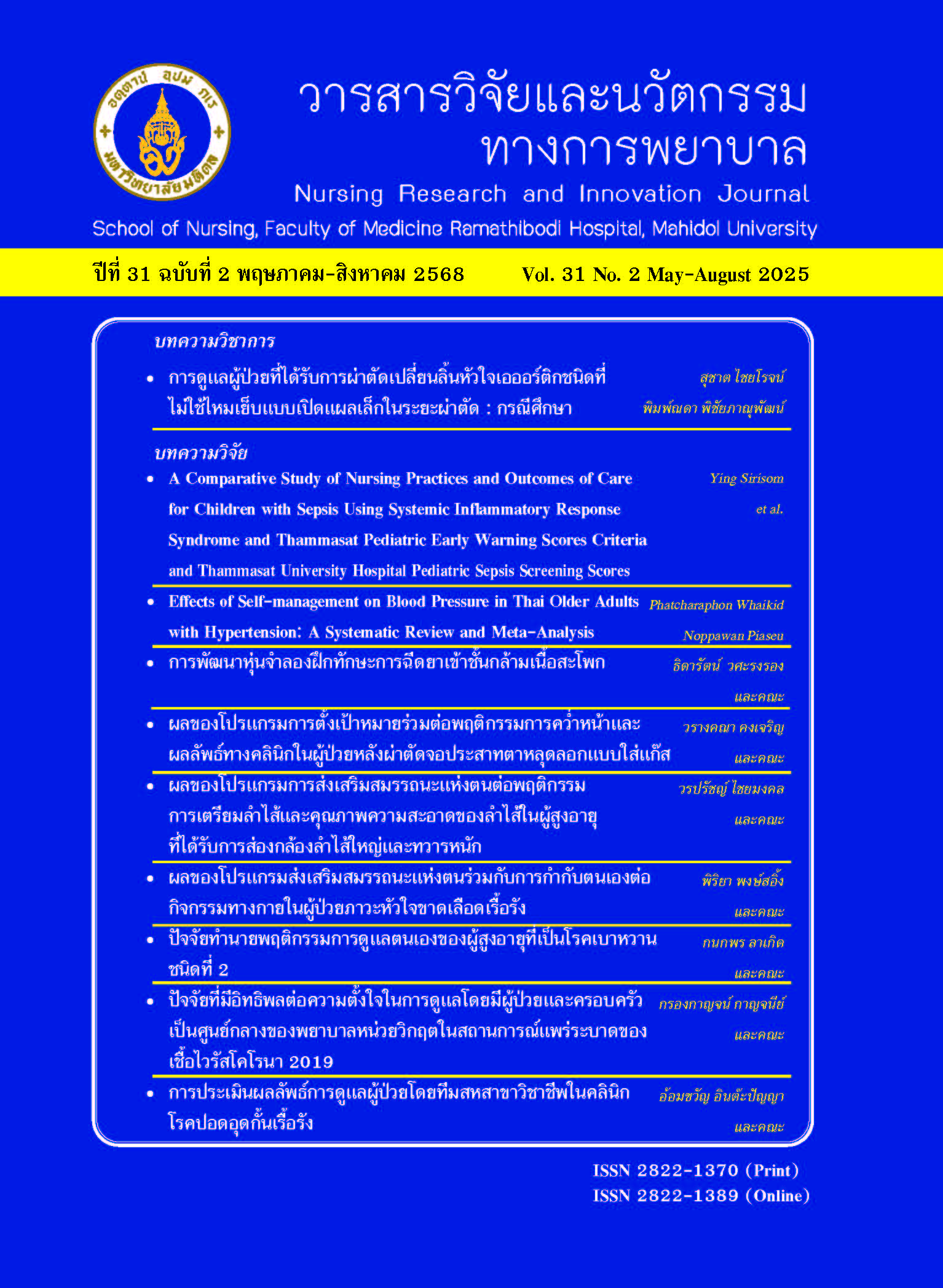
การประเมินผลลัพธ์การดูแลผู้ป่วยโดยทีมสหสาขาวิชาชีพในคลินิกโรคปอดอุดกั้นเรื้อรัง
Article Sidebar
Main Article Content
บทคัดย่อ
โรคปอดอุดกั้นเรื้อรังเป็นปัญหาสุขภาพและเป็นสาเหตุการตายที่สำคัญทั้งในประเทศไทยและทั่วโลก มีการดำเนินของโรคอย่างต่อเนื่องและมีการฟื้นกลับไม่เต็มที่ ส่งผลต่อการทำหน้าที่ของร่างกายและคุณภาพชีวิตของผู้ป่วย แนวทางในการดูแลรักษาผู้ป่วยโรคปอดอุดกั้นเรื้อรังมุ่งเน้นการช่วยลดอาการเหนื่อยหอบและลดความเสี่ยงในการเกิดอาการกำเริบ ซึ่งมีความต้องการการดูแลหลายด้าน จึงต้องการการดูแลจากทีมสหสาขาวิชาชีพ เพื่อช่วยส่งเสริมผลลัพธ์ผู้ป่วยและคุณภาพการดูแล การศึกษาที่ผ่านมาพบว่าการดูแลผู้ป่วยโรคปอดอุดกั้นเรื้อรังโดยทีมสหสาขาวิชาชีพช่วยให้ผลลัพธ์ทางคลินิกดีขึ้น แต่การประเมินผลลัพธ์อาจไม่ครอบคลุมที่จะสะท้อนถึงคุณภาพการดูแลที่ได้รับจากทีมสหสาขาวิชาชีพ จากแนวคิดการประเมินคุณภาพการให้บริการของโดนาบีเดียนด้านผลลัพธ์ ซึ่งเป็นการประเมินการเปลี่ยนแปลงที่เกิดขึ้นกับผู้ป่วยอันเป็นผลมาจากผู้ให้บริการ ประกอบด้วยการประเมินการเปลี่ยนแปลงภาวะสุขภาพ ความรู้ พฤติกรรม และความพึงพอใจในการดูแลที่ได้รับ อย่างไรก็ตาม ยังไม่พบการศึกษาถึงการประเมินพฤติกรรมการดูแลตนเองของผู้ป่วยโรคปอดอุดกั้นเรื้อรังที่เป็นผลลัพธ์จากการดูแลโดยทีมสหสาขาวิชาชีพ ซึ่งพฤติกรรมการดูแลตนเองที่ดีสามารถส่งผลต่อผลลัพธ์ของผู้ป่วยได้ ดังนั้นการประเมินผลลัพธ์การดูแลผู้ป่วยโรคปอดอุดกั้นเรื้อรังโดยทีมสหสาขาวิชาชีพ จึงควรประเมินให้ครอบคลุมด้านต่าง ๆ เพื่อช่วยสะท้อนคุณภาพการดูแลได้ชัดเจนมากขึ้น
การวิจัยเชิงบรรยายครั้งนี้ มีวัตถุประสงค์เพื่อศึกษาผลลัพธ์การดูแลผู้ป่วยโรคปอดอุดกั้นเรื้อรังโดยทีมสหสาขาวิชาชีพ ได้แก่ พฤติกรรมการดูแลตนเอง อาการหายใจลำบาก ความสามารถในการทำกิจกรรม คุณภาพชีวิต และความพึงพอใจของผู้ป่วยในการรับบริการ โดยใช้กรอบแนวคิดการประเมินคุณภาพการให้บริการของโดนาบีเดียน กลุ่มตัวอย่างคือผู้ป่วยโรคปอดอุดกั้นเรื้อรังที่ได้รับการดูแลโดยทีมสหสาขาวิชาชีพในคลินิกโรคปอดอุดกั้นเรื้อรัง โรงพยาบาลตติยภูมิแห่งหนึ่ง คัดเลือกกลุ่มตัวอย่างแบบเฉพาะเจาะจง ระหว่างเดือนมีนาคม ถึง มิถุนายน พ.ศ. 2565 จำนวน 87 คน ตามเกณฑ์คัดเข้าคือ 1) อายุ 40 ปี ขึ้นไป 2) เข้ารับการรักษาในคลินิกโรคปอดอุดกั้นเรื้อรังเป็นระยะเวลาอย่างน้อย 1 ปี 3) มาตรวจติดตามการรักษาสม่ำเสมอ อย่างน้อยร้อยละ 80 ของจำนวนครั้งที่แพทย์นัดตรวจติดตามใน 1 ปีที่ผ่านมา 4) สามารถสื่อสารและเข้าใจภาษาไทยได้ 5) ยินดีเข้าร่วมงานวิจัยโดยลงนามในแบบฟอร์มยินยอมเป็นลายลักษณ์อักษร 6) กรณีที่กลุ่มตัวอย่างอายุ 60 ปี ขึ้นไป ต้องไม่มีความบกพร่องทางการรู้คิด โดยผ่านการประเมินสมรรถภาพการรู้คิด 6 ข้อได้คะแนนน้อยกว่า 8 คะแนนจาก 28 คะแนน เก็บรวบรวมข้อมูลด้วย แบบสอบถามข้อมูลทั่วไปและข้อมูลสุขภาพของผู้ป่วย แบบประเมินอาการหายใจลำบาก แบบประเมินความสามารถในการทำกิจกรรม แบบสอบถามพฤติกรรมการดูแลตนเองของผู้ป่วยโรคปอดอุดกั้นเรื้อรัง แบบสอบถามคุณภาพชีวิต และแบบสอบถามความพึงพอใจของผู้ใช้บริการต่อการบริการที่ได้รับ วิเคราะห์ข้อมูลด้วยสถิติเชิงพรรณนา
ผลการวิจัยพบว่า กลุ่มตัวอย่างส่วนใหญ่เป็นเพศชาย มีอายุเฉลี่ย 64.49 ปี (SD = 10.72) ได้รับการวินิจฉัยโรคปอดอุดกั้นเรื้อรังในช่วงเวลา 1-15 ปี มีระดับความรุนแรงของโรคอยู่ในระดับปานกลาง (GOLD stage 2) และเป็นโรคปอดอุดกั้นเรื้อรัง กลุ่ม A ส่วนใหญ่ได้รับการรักษาด้วยยาสูดพ่นแบบผสมมากที่สุด กลุ่มตัวอย่างร้อยละ 49.43 มีอาการกำเริบตั้งแต่ 1 ครั้งขึ้นไปในหนึ่งปี มีกลุ่มตัวอย่างร้อยละ 14.94 ที่ต้องได้รับการรักษาตัวในโรงพยาบาลจากอาการกำเริบของโรค ส่วนผลลัพธ์ของผู้ป่วยพบว่า กลุ่มตัวอย่างมีคะแนนเฉลี่ยพฤติกรรมการดูแลตนเองโดยรวมค่อนข้างสูงเท่ากับ 104.97 คะแนน (SD = 9.14) จากคะแนนเต็ม 124 คะแนน โดยมีคะแนนเฉลี่ยพฤติกรรมด้านการใช้ยาถูกต้องสูงที่สุด ส่วนใหญ่มีอาการหายใจลำบากระดับ 0 (ร้อยละ 37.93) รองลงมา มีอาการหายใจลำบากระดับ 1 (ร้อยละ 33.33) และมีความสามารถในการทำกิจกรรมตั้งแต่ 3 METs ขึ้นไป (ร้อยละ 93.10) มีคะแนนเฉลี่ยคุณภาพชีวิตโดยรวมค่อนข้างสูง คะแนนเฉลี่ย 79.08 คะแนน (SD = 9.10) จากคะแนนเต็ม 100 คะแนน และมีคะแนนเฉลี่ยความพึงพอใจในการบริการค่อนข้างสูงเท่ากับ 72.79 คะแนน (SD = 1.95) จากคะแนนเต็ม 75 คะแนน ส่วนใหญ่มีความพึงพอใจระดับมากที่สุด ในเรื่อง “การให้เกียรติและยอมรับนับถือความเป็นคน” รองลงมาคือ “การให้เวลาในการพูดคุยเกี่ยวกับปัญหา” และ “การติดตามปัญหาอย่างต่อเนื่อง” ผลการศึกษาในครั้งนี้ แสดงให้เห็นว่าผลลัพธ์ผู้ป่วยที่ดีสะท้อนถึงการที่หน่วยงานมีโครงสร้างที่ดี มีการจัดตั้งคลินิกโรคปอดอุดกั้นเรื้อรังที่เป็นระบบ และมีกระบวนการในการดูแลผู้ป่วยโดยทีมสหสาขาวิชาชีพที่ดี ดังนั้นควรสนับสนุนในการจัดตั้งระบบการดูแลผู้ป่วยโรคปอดอุดกั้นเรื้อรังโดยทีมสหสาขาวิชาชีพ เพื่อส่งเสริมคุณภาพการดูแลและเพิ่มผลลัพธ์ของผู้ป่วยอย่างครอบคลุม
คำสำคัญ : โรคปอดอุดกั้นเรื้อรัง การดูแลแบบสหสาขาวิชาชีพ ทีมสหสาขาวิชาชีพ ผลลัพธ์ของผู้ป่วย
Article Details

อนุญาตภายใต้เงื่อนไข Creative Commons Attribution-NonCommercial-NoDerivatives 4.0 International License.
บทความ ข้อมูล เนื้อหา รูปภาพ ฯลฯ ที่ได้รับการตีพิมพ์ในรามาธิบดีพยาบาลสาร ถือเป็นลิขสิทธิ์ของวารสาร หากบุคคลหรือหน่วยงานใดต้องการนำทั้งหมดหรือส่วนหนึ่งส่วนใดไปเผยแพร่หรือเพื่อกระทำการใด ใด จะต้องได้รับอนุญาตเป็นลายลักษณ์อักษรจากรามาธิบดีพยาบาลสารก่อนเท่านั้น
เอกสารอ้างอิง
World Health Organization. Chronic Obstructive Pulmonary Disease (COPD); 2024 [cited 2024 May10]. Available from: https:// www.who.int/ news-room/fact-sheets/detail/chronic-obstructive-pulmonarydisease-%28copd%29 utm_source=chatgpt.com
Department of Disease Control. Report on health status screening and survey: Non-communicable diseases via Smart Aor Sor Mor Application; 2023 [cited 2025 May10]. Available from: https://ddc.moph.go.th/uploads/publish/1541120240306043816.pdf
Global Initiative for Chronic Obstructive Lung Disease.Global strategy for the prevention, diagnosis and management of chronic obstructive pulmonary disease:2024 report; 2024 [cited 2024 May 9]. Available from:https://goldcopd.org/2024-gold-report/
Thoracic Society of Thailand under Royal Patronage.Guidelines for the diagnosis and treatment of chronic obstructive pulmonary disease 2022. Bangkok: Pappim Press; 2022.
Jo YS. Long-term outcome of chronic obstructive pulmonary disease: a review. Tuberc Respir Dis (Seoul).2022;85(4):289-301. doi:10.4046/trd.2022.0074.
Hurst JR, Skolnik N, Hansen GJ, Anzueto A, Donaldson GC, Dransfield MT, et al. Understanding the impact of chronic obstructive pulmonary disease exacerbations on patient health and quality of life. Eur J Intern Med.2020;73:1-6. doi:10.1016/j.ejim.2019.12.014.
Quaderi SA, Hurst JR. The unmet global burden of COPD.Glob Health Epidemiol Genom. 2018;3:e4. doi:10.1017/gheg.2018.1.
Sumner J, Bundele A, Shankar R, Chong LS, Kowitlawakul Y, Mukhopadhyay A. Living with COPD: understanding patient experiences through the lens of photovoice. BMC Pulm Med. 2023;23(1):433. doi:10.1186/s12890-023-02738-4.
Global Initiative for Chronic Obstructive Lung Disease.Global strategy for the prevention, diagnosis and management of chronic obstructive pulmonary disease:2025 report; 2025 [cited 2025 May 10]. Available from:https://goldcopd.org/2025-gold-report/
Young M, Villgran V, Ledgerwood C, Schmetzer A,Cheema T. Developing a multidisciplinary approach to the COPD care pathway. Crit Care Nurs Q. 2021;44(1):121-7.doi:10.1097/cnq.0000000000000345.
Bouton C, Journeaux M, Jourdain M, Angibaud M, Huon JF, Rat C. Interprofessional collaboration in primary care:what effect on patient health? a systematic literature review. BMC Prim Care. 2023;24(1):253. doi:10.1186/s12875-023-02189-0.
World Health Organization. A vision for primary health care in the 21st century: towards universal health coverage and the Sustainable Development Goals [Internet]. Geneva:WHO; 2018 [cited 2024 Jun 13]. Available from: https://iris.who.int/ handle/ 10665/328065
Modthong W. Effects of developing service behaviors of outpatient staff at Buriram Hospital. Journal of Nurses Association of Thailand Northern Office.2012;30(2):140-6. (in Thai)
Panjapornpon K, Tanont S. Clinical outcomes of multidisciplinary care in chronic obstructive pulmonary disease patients at the Central Chest Institute of Thailand.Journal of the Medical Association of Thailand. 2012;95 Suppl 8:S24-30. (in Thai)
Rojanawipart J. The effects of a treatment program for complex chronic obstructive pulmonary disease patients at Thawangpha Hospital, Nan Province. Lampang Medical Journal. 2016;37(2):33-45. (in Thai)
Traiphopsakul W. Outcomes of multidisciplinary team care at the chronic obstructive pulmonary disease clinic, Lerdsin Hospital, Bangkok. Journal of The Department of Medical Services. 2018;43(2):63-6. (in Thai)
Donabedian A. An introduction to quality assurance in health care. Oxford: Oxford University Press; 2003.
Sinthupaeng P, Nawsuwan K. Self-care behaviors of patients with chronic obstructive pulmonary disease in Namom Hospital, Songkhla Province. Thai Journal of Public Health and Health Sciences. 2021;4(2):205-18.(in Thai)
Long H, Howells K, Peters S, Blakemore A. Does health coaching improve health-related quality of life and reduce hospital admissions in people with chronic obstructive pulmonary disease? a systematic review and meta-analysis.Br J Health Psychol. 2019;24(3):515-46.doi:10.1111/bjhp.12366.
Chai YH, Yang H, Huang GP, Wu T, Dong Y. Nursing outcomes and risk factors of patients with chronic obstructive pulmonary disease after discharge. Int J Chron Obstruct Pulmon Dis. 2021;16:2911-6. doi:10.2147/copd.S321375.
Pongmesa T. Outcomes reported by patients with chronic obstructive pulmonary disease. In: Kaewomtawong T,editor. Diagnosis and treatment of chronic obstructive pulmonary disease. Nonthaburi: Health Work; 2016.p.91-105.
Yamane T. Statistics: An introductory analysis. 3rd ed.New York: Harper and Row; 1973.
Brooke P, Bullock R. Validation of a 6 item cognitive impairment test with a view to primary care usage. Int J Geriatr Psychiatry. 1999;14(11):936-40.
Areeue S, Youngcharoen P. The Thai version of the 6-item cognitive impairment test: Psychometric properties.Ramathibodi Nursing Journal. 2020;26(2):188-99.(in Thai)
Thoracic Society of Thailand. Health Service Practice Guideline of COPD in 2010. Bangkok: The National Health Security Office of Thailand; 2010. p.7-28.
Surveillance for respiratory hazards in the occupational setting [American Thoracic Society]. Am Rev Respir Dis.1982;126(5):952-6.
Myers J, Do D, Herbert W, Ribisl P, Froelicher VF. A nomogram to predict exercise capacity from a specific activity questionnaire and clinical data. Am J Cardiol.1994;73(8):591-6. doi:10.1016/0002-9149(94)90340-9.
Chunjapo P. Effect of walking exercise program on functional capacity among persons with heart failure [Thesis]. Chiang Mai: Chiang Mai University; 2004.(in Thai)
Voravichienwong S, Siripittayakunkit A, Kanoksunthornrat N. Effects of a self-care promotion program on knowledge and self-care behavior in patients with chronic obstructive pulmonary disease experiencing recurrent acute exacerbations. Journal of The Royal Thai Army Nurses.2021;25(2):148-65. (in Thai)
Pimraksa N. The effects of a self-care promotion program on self-care behavior, dyspnea, and pulmonary function in patients with chronic obstructive pulmonary disease [Thesis]. Khon Kaen: Kaen University; 2007. (in Thai)
Hanucharoenkul S, Punpakdee O, Intarasombat P,Nantachaiyaphan P, Patiprajuk S, Namchantra R, et al.Efficiency and cost-effectiveness of advanced practice nurses in the Thai healthcare system. Bangkok:Jutthong; 2011.
Duangbubpha S, Hanucharoenkul S, Pookboonmee R,Orathai P, Kiatboonsri C. Chronic care model implementation and outcomes among patients with COPD in care teams with and without advanced practice nurses.Pac Rim Int J Nurs Res Thail. 2013;17(2):102-16.
Suwisith N, Hanucharoenkul S. Development of a patient satisfaction questionnaire for nursing services. Ramathibodi Medical Journal. 2011;17(2):264-77. (in Thai)
Vauterin D, Van Vaerenbergh F, Grymonprez M,Vanoverschelde A, Lahousse L. Medication adherence to inhalation therapy and the risk of COPD exacerbations: a systematic review with meta-analysis. BMJ Open Respir Res. 2024;11(1). doi:10.1136/bmjresp-2023-001964.
Harnphadungkit K. 6-Minute walk test. Journal of Thai Rehabilitation Medicine. 2014;24(1):1-4. (in Thai)
Phusiri S. The relationship between six-minute walk distance and hospitalization risk due to exacerbation of chronic obstructive pulmonary disease over one year at Trang Hospital. Journal of Thai Rehabilitation Medicine.2019;29(3):94-8. (in Thai)
Sawang O, Homhuan N. Development of a care model for patients with chronic obstructive pulmonary disease.Nakhonphanom Hospital Journal. 2019;6(2):59-71.(in Thai)
Intasri C, Tanvatanakul V. Expectation and satisfactions of clients on the service system of outpatient departments in one public hospital of Chachoengsao Province. Research and Development Health System Journal. 2020;15(3):128-41. (in Thai)
