
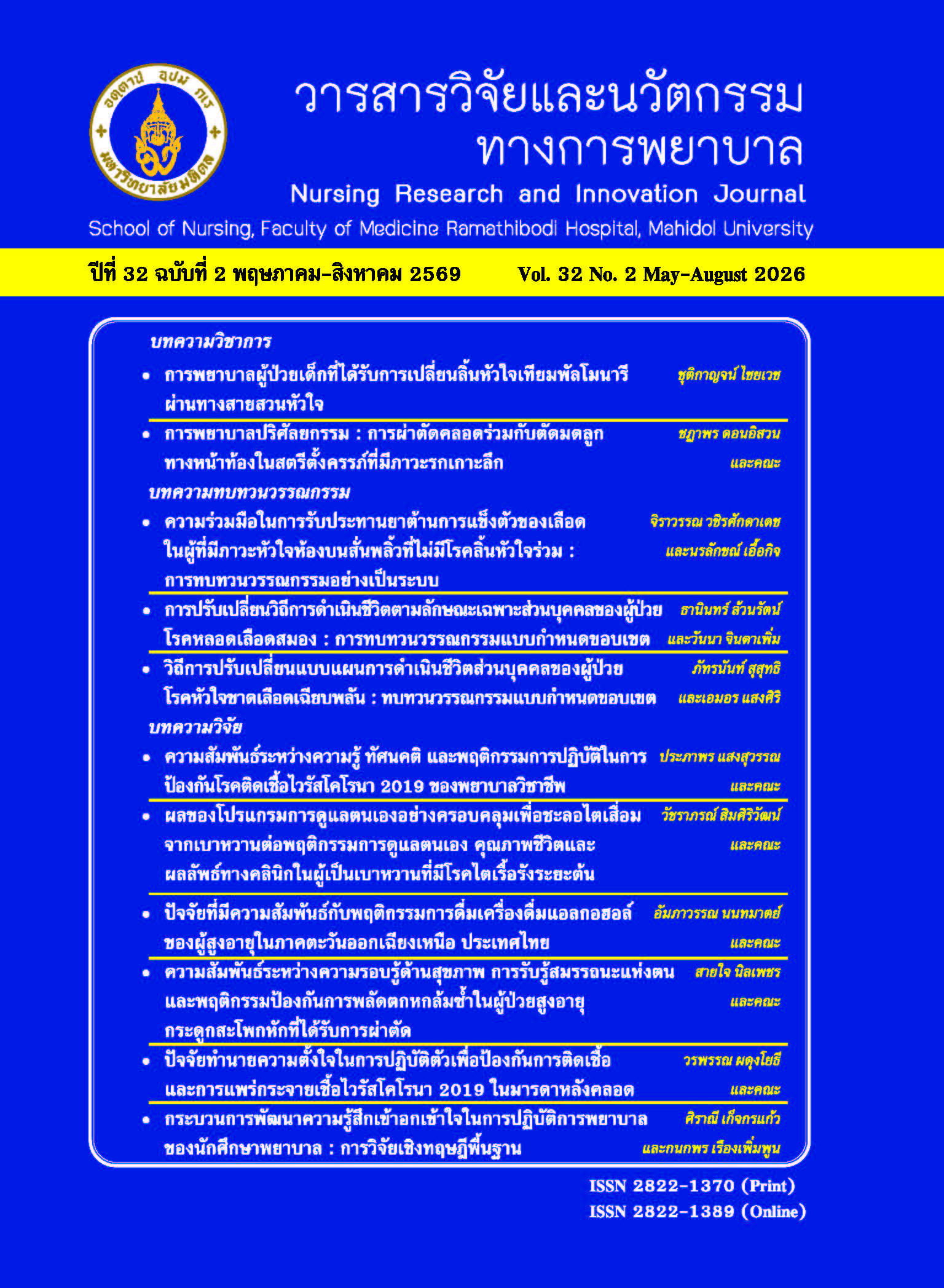
the ผลของโปรแกรมการดูแลตนเองอย่างครอบคลุมเพื่อชะลอไตเสื่อมจากเบาหวานต่อพฤติกรรมการดูแลตนเอง คุณภาพชีวิต และผลลัพธ์ทางคลินิกในผู้เป็นเบาหวานที่มีโรคไตเรื้อรังระยะต้น
Article Sidebar
Main Article Content
บทคัดย่อ
โรคเบาหวานเป็นปัญหาสุขภาพสำคัญที่มีแนวโน้มเพิ่มขึ้นอย่างต่อเนื่อง และส่งผลกระทบต่อสุขภาพ คุณภาพชีวิต และระบบสุขภาพ โดยเฉพาะจากภาวะแทรกซ้อนและความจำเป็นในการดูแลอย่างต่อเนื่อง ดังนั้น การพัฒนาระบบบริการที่มีคุณภาพและเชื่อมโยงการดูแลอย่างไร้รอยต่อระหว่างโรงพยาบาลและเครือข่ายบริการสุขภาพ จึงมีความสำคัญต่อการยกระดับผลลัพธ์การดูแลผู้ป่วยเบาหวาน การที่ผู้เป็นเบาหวานไม่สามารถควบคุมระดับน้ำตาลในเลือดให้อยู่ในเกณฑ์ที่เหมาะสมได้ มีโอกาสเกิดภาวะแทรกซ้อนที่หลอดเลือดขนาดใหญ่และหลอดเลือดขนาดเล็กโดยเฉพาะหลอดเลือดขนาดเล็ก ตามอวัยวะต่าง ๆ ของร่างกาย เช่น หลอเลือดเล็กที่จอตา หลอดเลือดเล็กส่วนปลาย และหลอดเลือดที่ต่อมหมวกไตเสื่อมลง การศึกษาที่ผ่านมา พบว่า ค่าน้ำตาลเฉลี่ยสะสมที่เพิ่มขึ้นทุก 1 เปอร์เซ็นต์จากค่าเป้าหมาย จะเพิ่มความเสี่ยงต่อการเกิดภาวะแทรกซ้อนที่หลอดเลือดขนาดเล็ก ร้อยละ 25 โดยภาวะแทรกซ้อนหลอดเลือดขนาดเล็กที่ไต เป็นสาเหตุของการเกิดโรคไตเรื้อรังจากเบาหวานมากที่สุด และเป็นสาเหตุที่ทำให้ผู้ป่วยโรคไตเรื้อรังระยะสุดท้ายต้องเข้ารับการบำบัดทดแทนไตสูง ดังนั้น หากผู้เป็นเบาหวานสามารถดูแลตนเองได้อย่างถูกต้องจะสามารถชะลอการเกิดไตเสื่อม และมีคุณภาพชีวิตที่ดีได้
การวิจัยนี้เป็นวิจัยเชิงทดลอง แบบสุ่มและมีกลุ่มควบคุมเปรียบเทียบผลระหว่างกลุ่มทดลองและกลุ่มควบคุมโดยผู้ปฏิบัติการพยาบาลขั้นสูงมีวัตถุประสงค์เพื่อศึกษาผลของโปรแกรมการดูแลตนเองอย่างครอบคลุมเพื่อชะลอไตเสื่อมจากเบาหวานต่อผลลัพธ์ด้านผู้ป่วย ใช้กรอบแนวคิดความพร่องในการดูแลตนเองของโอเร็มร่วมกับเทคนิคสัมภาษณ์เพื่อสร้างแรงจูงใจกระตุ้นให้เกิดการปรับเปลี่ยนพฤติกรรมภายใต้มาตรฐานการดูแลผู้เป็นเบาหวานอย่างครอบคลุมเพื่อชะลอการเสื่อมของไต และหลักฐานเชิงประจักษ์ในกลุ่มผู้เป็นเบาหวานที่มีไตเรื้อรังระยะ 1- 3a จำนวน 68 ราย สุ่มเข้ากลุ่มทดลองและกลุ่มควบคุม กลุ่มละ 34 ราย
กลุ่มทดลองเข้าร่วมโปรแกรมจำนวน 12 สัปดาห์ แบ่งเป็น 2 ระยะ โดยระยะที่ 1 ระยะพิจารณาและตัดสินใจเพื่อเตรียมพร้อมเข้าสู่การปฏิบัติ เริ่มจากการสร้างสัมพันธภาพ การประเมินภาวะสุขภาพ และประเมินขั้นความพร้อมในการปรับเปลี่ยนพฤติกรรม และความสามารถในการตอบสนองความต้องการการดูแลตนเองทั้งหมด ผู้วิจัยใช้กลยุทธ์สัมภาษณ์เพื่อสร้างแรงจูงใจ โดยใช้คำถามปลายเปิด การสะท้อนกลับ การชื่นชม การสรุปความ กระตุ้นให้ผู้เป็นเบาหวานพูด ถึงคำพูดที่มุ่งสู่การเปลี่ยนแปลง (self-statement message ) ระบบการพยาบาลแบบให้ความรู้ ฝึกทักษะและสนับสนุนความสามารถในการดูแลตนเองครอบคลุมการดูแลผู้เป็นเบาหวานที่มีภาวะแทรกซ้อนทางไต ให้เพิ่มเพื่อนรูปแบบไลน์แอพพลิเคชั่นปรึกษาตลอด 24 ชั่วโมง เพื่อปรึกษาสุขภาพและกระตุ้นแรงจูงใจในการดูแลตนเองต่อเนื่อง และส่งไฟล์วีดิโอ เรื่อง “ชุดความรู้โรคเบาหวานที่มีภาวะแทรกซ้อนทางไต” ให้เรียนรู้ด้วยตนเอง ในสัปดาห์ที่ 1 หลังร่วมโปรแกรม ระยะที่ 2 การลงมือปฏิบัติและผลของการปฏิบัติ ติดตามการดูแลตนเองที่บ้านทางแอพพลิเคชั่นไลน์ สนทนาแบบวีดีโอและเสียง เพื่อติดตาม กระตุ้น ให้คำปรึกษา และเสริมสร้างแรงจูงใจในการปรับเปลี่ยนพฤติกรรมต่อเนื่องทุก 2 สัปดาห์ กลุ่มควบคุมได้รับการดูแลตามปกติ ระยะเวลารวมในโปรแกรม 12 สัปดาห์ เก็บรวบรวมข้อมูลโดยใช้แบบสอบถามพฤติกรรมการดูแลตนเองและแบบสอบถามคุณภาพชีวิต ผลลัพธ์ทางคลินิก ได้แก่ น้ำตาลเฉลี่ยสะสม ความดันโลหิต โปรตีนอัลบูมินในปัสสาวะ อัตราการกรองของไต วิเคราะห์ข้อมูลด้วยสถิติพรรณา การทดสอบค่าทีแบบอิสระ Wilcoxon signed rank test และ Mann-Whitney U test
ผลการศึกษา ภายหลังเข้าร่วมโปรแกรมครบ 12 สัปดาห์ พบว่า กลุ่มทดลองมีค่าเฉลี่ยคะแนนพฤติกรรมการดูแลตนเองสูงกว่าก่อนร่วมโปรแกรมและสูงกว่ากลุ่มควบคุมอย่างมีนัยสำคัญทางสถิติ
(t = 13.51, p < .001) คุณภาพชีวิตสูงกว่าก่อนร่วมโปรแกรมและสูงกว่ากลุ่มควบคุมอย่างมีนัยสำคัญทางสถิติ (z = -4.02, p < .001) อัตราการกรองของไตสูงกว่าก่อนร่วมโปรแกรมและสูงกว่ากลุ่มควบคุมอย่างมีนัยสำคัญทางสถิติ (t = 3.26, p =.002) และพบว่า ค่าน้ำตาลเฉลี่ยสะสมต่ำกว่าก่อนร่วมโปรแกรมและต่ำกว่ากลุ่มควบคุมอย่างมีนัยสำคัญทางสถิติ (t = -6.65, p < .001) ความดันโลหิตขณะหัวใจบีบตัวต่ำกว่าก่อนร่วมโปรแกรมและต่ำกว่ากลุ่มควบคุมอย่างมีนัยสำคัญทางสถิติ (t = -4.04, p < .001) ความดันโลหิตขณะหัวใจขณะคลายตัวต่ำกว่าก่อนร่วมโปรแกรมและต่ำกว่ากลุ่มควบคุมอย่างมีนัยสำคัญทางสถิติ (t = -3.32, p <.001) นอกจากนี้ ค่าโปรตีนอัลบูมินในปัสสาวะต่ำกว่าก่อนร่วมโปรแกรมและต่ำกว่ากลุ่มควบคุมอย่างมีนัยสำคัญทางสถิติ (t = -2.26, p = .02) ผลการวิจัยนี้ ชี้ให้เห็นว่า พยาบาลผู้ปฏิบัติการพยาบาลขั้นสูงที่ดูแลผู้เป็นเบาหวานหรือผู้ให้ความรู้เกี่ยวกับโรคเบาหวานควรนำโปรแกรมการดูแลตนเองอย่างครอบคลุมเพื่อชะลอไตเสื่อมไปใช้ในผู้เป็นเบาหวานที่มีโรคไตเรื้อรังระยะต้นต่อไป
คำสำคัญ : ผลลัพธ์ทางคลินิก การดูแลอย่างครอบคลุม โรคเบาหวานโรคไตเรื้อรังระยะต้น การสัมภาษณ์เพื่อสร้างแรงจูงใจ
Article Details

อนุญาตภายใต้เงื่อนไข Creative Commons Attribution-NonCommercial-NoDerivatives 4.0 International License.
บทความ ข้อมูล เนื้อหา รูปภาพ ฯลฯ ที่ได้รับการตีพิมพ์ในรามาธิบดีพยาบาลสาร ถือเป็นลิขสิทธิ์ของวารสาร หากบุคคลหรือหน่วยงานใดต้องการนำทั้งหมดหรือส่วนหนึ่งส่วนใดไปเผยแพร่หรือเพื่อกระทำการใด ใด จะต้องได้รับอนุญาตเป็นลายลักษณ์อักษรจากรามาธิบดีพยาบาลสารก่อนเท่านั้น
เอกสารอ้างอิง
International Diabetes Federation. Diabetes Atlas, 10ᵗʰ ed. 2021 [cited 2023 Apr 18]. Available from: https://idf.org/ about-diabetes/ diabetes-facts-figures/
Ekphalakorn W, Phakcharoen N, Sathiennopakao W.Survey report on Thai population health: 6th National Health Examination Survey 2019–2020. Bangkok:Aksorn Graphic & Design; 2020. (in Thai)
Daroh S, & Saesa N la. Factors associated with poor glycemic control in type 2 diabetes patients in Bannang Sata district, Yala province. Thammasat Chalermprakiat Hospital Journal. 2019;4(3):27–30. (in Thai)
Pajun T, Suwanpan K, Anarat B, Thalakorn N. Factors associated with glycemic control in type 2 diabetic patients in Tha Bo district, Nong Khai province. Regional Health Center Journal 9. 2022;16:285–98. (in Thai)
Fufueang W, Anuwatnonthekhet A. Factors associated with poor control of glycated blood sugar in type 2 diabetic patients in Doi Luang district, Chiang Rai, Thailand.Journal of Nursing and Therapeutic Care. 2019;11(2):42-51.(in Thai)
Puttarak U, Bureerach S. Factors associated with glycemic control in type 2 diabetic patients at Kangpla sub-district health promoting hospital, Loei province. In: The 34ᵗʰ National Graduate Conference; 2022. p.989–1000.(in Thai)
Fekadu G, Bula K, Bayisa G, Turi E, Tolossa T, Kasaye HK. Challenges and factors associated with poor glycemic control among type 2 diabetes mellitus patients at Nekemte referral hospital, Western Ethiopia. J Multidiscip Healthc.2019;12:963–74. doi:10.2147/ JMDH. S232691.
Diabetes Association of Thailand. Clinical practice guidelines for diabetes 2017, 3ʳᵈ ed. Pathum Thani:Romyen Media; 2017. (in Thai)
Helou, Talhouedec, Shaha & Zanchi. The impact of a multidisciplinary selfcare management program on quality of life, selfcare, adherence to antihypertensive therapy,glycemic control, and renal function in diabetic kidney disease: a crossover study protocol. BMC Nephrol.2016;17(1):88-98. doi:10.1186/s12882-016-0279-6.
Dong L, Li J, Lian Y, Tang ZX, Zen Z, Yu P, Li Y.Longterm intensive lifestyle intervention promotes improvement of stage III diabetic nephropathy. Med Sci Monit. 2019;25:3061–8. doi:10.12659/MSM.913512.
UK Prospective Diabetes Study (UKPDS) Group.Intensive bloodglucose control with sulphonylureas or insulin compared with conventional treatment and risk of complications in patients with type 2 diabetes (UKPDS33). Lancet. 1998;352(9131):837–53. PMID: 9742976.
Kidney Association of Thailand. Clinical practice guidelines for chronic kidney disease management prior to renal replacement therapy 2022 (updated). Bangkok:Srimuang Printing; 2022. (in Thai)
Vijitsunthornkul K. Epidemiology and review of chronic kidney disease prevention measures. Nonthaburi: Ministry of Public Health; 2022. (in Thai)
Rossing P, Caramori ML, Chan JC, Heerspink HJ, Hurst C, Khunti K, et al. KDIGO 2022 clinical practice guideline for diabetes management in chronic kidney disease. Kidney Int. 2022 ;102 (5 Suppl) :S1-27. doi:10.1016/j.kint.2022.06.008.
HuayanayEspinoza IE, GuerraCastañon F, ReyesDiaz M,LazoPorras M, de la CruzLuque C, Herrera DA, et al.Quality of life and self-efficacy in type 2 diabetes patients in a Peruvian public hospital. Medwave. 2021;21:e8133.
Letta S, Aga F, Assebe Yadeta T, Geda B, Dessie Y.Selfcare practices and correlates among type 2 diabetes patients in Eastern Ethiopia: a hospitalbased crosssectional study. SAGE Open Med. 2022;7:1–8. doi:10.1177/20503121221107337.
Abedini MR, Bijari B, Miri Z, Shakhs Emampour F,Abbasi A. The quality of life of patients with type 2 diabetes using EQ5D5L in Birjand. Health Qual Life Outcomes. 2020;18(1):1–9. doi:10.1186/s12955-020-1277-8.
Shahabi N, Kolivand M, Salari N, Abbasi P. The effect of telenursing training based on familycentered empowerment pattern on diet regimen compliance in type 2 diabetes mellitus patients: a randomized clinical trial.BMC Endocr Disord. 2022;22(1):1–8. doi:10.1186/s 12902-022-00953-4.
Molavynejad S, Miladinia M, Jahangiri M. A randomized trial comparing video telecare education vs. inperson education on dietary regimen compliance in type 2 diabetes mellitus patients: support for clinical telehealth providers.BMC Endocr Disord. 2022;22(1):1–10. doi:10.1186/s12902-022-01032-4.
Jiamjariyaporn T, Ingsathit A, Tungsanga K, Banchuin C, Vipattawat K, Kanchanakorn S, et al. Effectiveness of integrated care on delaying chronic kidney disease progression in rural Thai communities (ESCORT study):rationale and design [NCT01978951]. BMC Nephrol.2014;15:(1):1471-2369. doi:10.1186/1471-2369-15-99.
Wichit, N., Mnatzaganian, G.,Courtney, M., Schulz, P.,& Johnson, M.Randomized controlled trial of a family-oriented self-management program to improve self-efficacy glycemic control and quality of life among Thai individuals with type 2 diabetes.Diabetes Research and Clinical Practice. 2017;123:37-48. doi:10.1016/j.diabres.2016.11.013.
American Diabetes Association. Standards of Medical Care in Diabetes 2022. (2022). Diabetes Care. 2022;54(1): s244-s53. doi:10.2337/cd22-as01.
Jirawatthana R, Riwtrakul Pratheungtham S,Siripittayakunchit A. Outcomes of advanced practice nurse-led selfcare program for complex diabetic patients.Ramathibodi Nursing Journal. 2018;24(1):51–68. (in Thai)
Tiensaard J, Kanogsunthornrat N, Kitiyakora C. Effect of motivational interviewingbased counseling and education program on health behaviors and clinical outcomes in predialysis CKD patients. Thai Journal of Nursing and Midwifery Practice. 2018;2(5):19–38. (in Thai)
Singprasert R, Chailimpmontree R, Kanoksunthornrat N.Effect of behaviorchange program combined with motivational interviewing before renal replacement therapy by advanced practice nurse.Master’s thesis in Adult & Gerontological Nursing,Ramathibodi School of Nursing, Mahidol University; 2017. (in Thai)
Sirindhorn Hospital Statistics. Statistics of diabetes patients at Sirindhorn Hospital. Academic and Planning Division,Sirindhorn Hospital, Medical Department, Bangkok;2021. (in Thai)
Orem ED, Taylor SG, Renpenning KM. Nursing: Concepts of Practice, 6ᵗʰ ed. St. Louis: Mosby; 2001.
Miller WR, Rollnick S. Motivational interviewing: helping people change, 3ʳᵈ ed. New York: Guilford; 2013.
Hinkhao C, Hanprasithkham K, Jiaravithayakit S. Effect of selfmanagement plus motivational interviewing to slow diabetic kidney disease: effects on selfmanagement behaviors and clinical outcomes in type 2 diabetes with stage 3 CKD. Journal of Phrapokklao Nursing College,Chanthaburi. 2019;30(2):185–202. (in Thai)
Polit DF, Beck CT. Nursing research: Principles and methods. Lippincott Williams & Wilkins; 2004.
Brooke P, Bullock R. Validation of 6 item cognitive impairment test for primary care usage. Int J Geriatr Psychiatry. 1999;14(11):936–40. PMID: 10556864.
Areuea S, Yangcharoen P. Thai version of the 6 item cognitive impairment test: psychometric properties.Ramathibodi Nursing Journal. 2020;26(2):188–202.(in Thai)
Davies MJ, Aroda VR, Collins BS, Gabbay RA, GreenJ, Maruthur NM, Rosas SE, Del Prato S, Mathieu C, Mingrone G, Rossing P. Management of hyperglycaemia in type 2 diabetes, 2022. A consensus report by the American Diabetes Association (ADA) and the European Association for the Study of Diabetes (EASD).Diabetologia. 2022;65(12):1925-66. doi:10.1007/s00125-022-05787-2.
Keerattiyutawong P. (2005). The effectiveness of a self-care management program for patients with type 2 diabetes
on knowledge, self-care activities, quality of life, and HbA1c levels [dissertation]. Bangkok: Mahidol University; 2005.
Azar FE, Solhi M, Nejhaddadgar N, Amani F. The effect of intervention using the PRECEDE- PROCEED model based on quality of life in diabetic patients. Electron Physician. 2017; 9(8):5024-30. doi:10.19082/5024.
Srisathitnaragool B. Research methodology in nursing (5th ed.). Bangkok: U & I Inter Media; 2000. (in Thai)
Bunrod K. Factor associations for changing stage in chronic kidney disease, Chaiya Hospital, SuratThani. Medical Journal. 2019;33(3): 367–78. (in Thai)
Lyu QY, Huang JW, Li YX, Chen QL, Yu XX, Yang QH. Effects of nurseled webbased transitional care program on glycemic control and quality of life posthospital discharge in type 2 diabetes patients: a randomized controlled trial. Int J Nurs Stud. 2021;119:103929.doi: 10.1016/j.ijnurstu.2021.103929.
