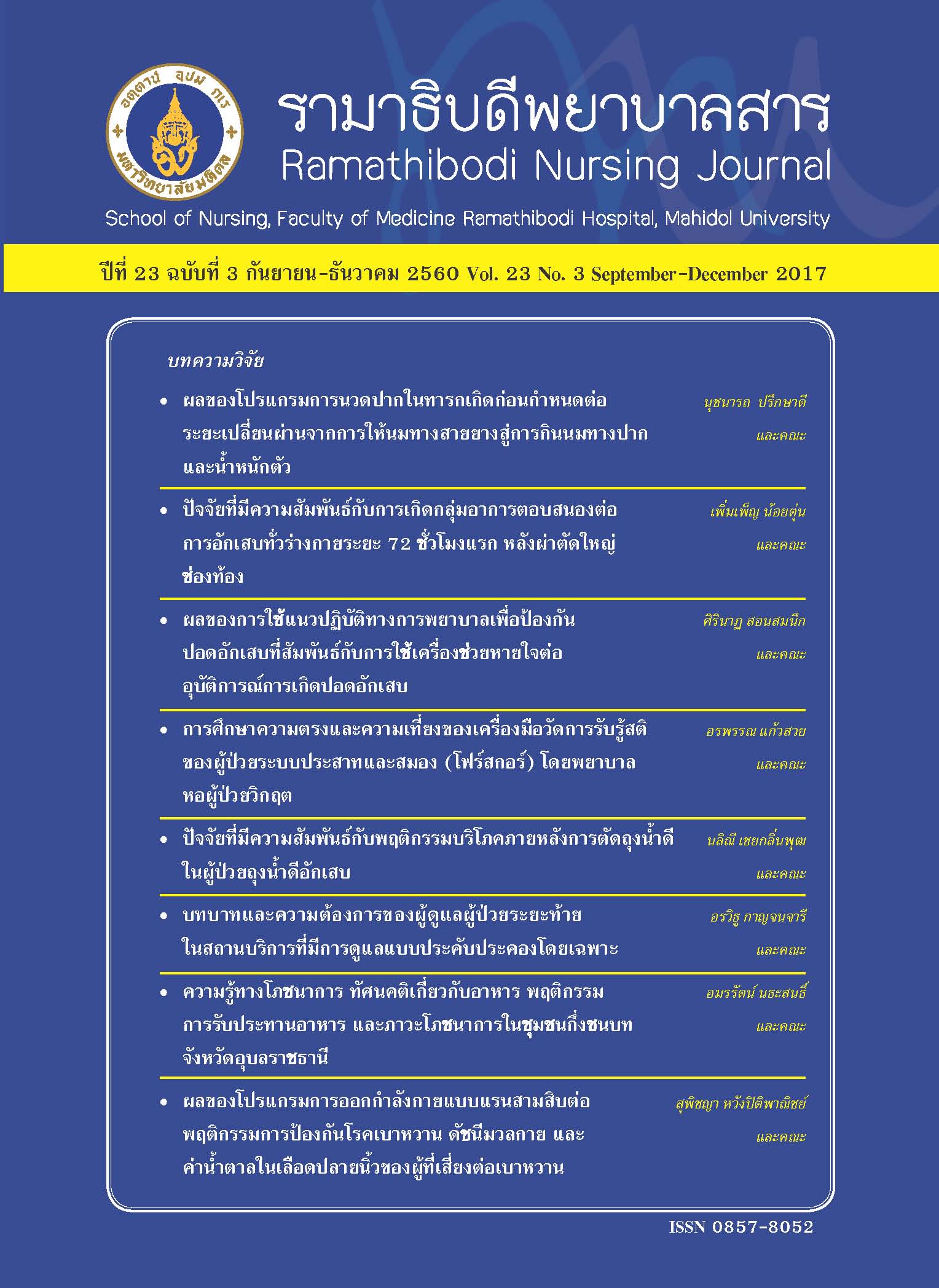
ความรู้ทางโภชนาการ ทัศนคติเกี่ยวกับอาหาร พฤติกรรมการรับประทานอาหารและภาวะโภชนาการในชุมชนกึ่งชนบทจังหวัดอุบลราชธานี
Article Sidebar
Main Article Content
บทคัดย่อ
บทคัดย่อ:
การศึกษาครั้งนี้เป็นการวิจัยเชิงสำรวจเพื่อศึกษาความรู้ทางโภชนาการ ทัศนคติเกี่ยวกับอาหาร พฤติกรรมการรับประทานอาหาร และภาวะโภชนาการของประชาชนในชุมชนกึ่งชนบท กลุ่มตัวอย่างเป็นประชาชนหมู่บ้านแห่งหนึ่งในอำเภอวารินชำราบ จังหวัดอุบลราชธานี จำนวน 200 ราย เก็บรวบรวมข้อมูลโดยใช้แบบสอบถามและการประเมินภาวะโภชนาการ วิเคราะห์ข้อมูลด้วยสถิติบรรยายและสัมประสิทธิ์สหสัมพันธ์ของสเปียร์แมน ผลการศึกษาพบว่า ตัวอย่างมีคะแนนเฉลี่ยความรู้ทางโภชนาการ ทัศนคติเกี่ยวกับอาหาร และพฤติกรรมการรับประทานอาหารคิดเป็นร้อยละ 59.16, 66.83, และ 62.77 ของคะแนนรวม ตามลำดับ โดยพบว่า มีคะแนนเฉลี่ยของความรู้ ทัศนคติ และพฤติกรรมที่ไม่เหมาะสมในการรับประทานอาหารที่มีไขมันมากที่สุดเมื่อเปรียบเทียบกับอาหารประเภทอื่น ตัวอย่างร้อยละ 43 มีดัชนีมวลกายอยู่ในเกณฑ์ปกติ ร้อยละ 22.50, 13, และ 7.50 มีภาวะโภชนาการเกิน อ้วน และต่ำกว่าเกณฑ์ ตามลำดับ อย่างไรก็ตาม ค่าเฉลี่ยดัชนีมวลกาย (22.18±2.76 กก./ม2) และเส้นรอบเอว (78.01±7.86 ซม.) อยู่ในเกณฑ์ปกติ ส่วนใหญ่ (ร้อยละ 81.50) มีสัดส่วนของเส้นรอบเอวต่อสะโพกอยู่ในเกณฑ์มากกว่าปกติ โดยมีค่าเฉลี่ยเท่ากับ 0.87±.05 ผลการวิเคราะห์ความสัมพันธ์พบว่า พฤติกรรมการรับประทานอาหารมีความสัมพันธ์ทางลบอย่างมีนัยสำคัญทางสถิติกับภาวะโภชนาการ (ดัชนีมวลกาย) ของประชาชน อายุมีความสัมพันธ์ทางบวกกับพฤติกรรมการรับประทานอาหาร ระดับการศึกษามีความสัมพันธ์ทางบวกกับความรู้ทางโภชนาการและรายได้ของครอบครัวต่อเดือน ผลการศึกษาสามารถนำมาใช้เป็นแนวทางในการพัฒนาโปรแกรมสร้างเสริมสุขภาพด้านโภชนาการโดยการให้ความรู้ทางโภชนาการและสร้างแรงจูงใจในการปรับเปลี่ยนพฤติกรรมการรับประทานอาหารให้เหมาะสม
คำสำคัญ: ความรู้ทางโภชนาการ ทัศนคติเกี่ยวกับอาหาร พฤติกรรมการรับประทานอาหาร ภาวะโภชนาการ ชุมชุนกึ่งชนบท
Article Details
บทความ ข้อมูล เนื้อหา รูปภาพ ฯลฯ ที่ได้รับการตีพิมพ์ในรามาธิบดีพยาบาลสาร ถือเป็นลิขสิทธิ์ของวารสาร หากบุคคลหรือหน่วยงานใดต้องการนำทั้งหมดหรือส่วนหนึ่งส่วนใดไปเผยแพร่หรือเพื่อกระทำการใด ใด จะต้องได้รับอนุญาตเป็นลายลักษณ์อักษรจากรามาธิบดีพยาบาลสารก่อนเท่านั้น
เอกสารอ้างอิง
2. Natason A, Sehaphan N, Pinthong P. The effect of health information media toward nutritional knowledge, attitude toward food, food behavior, and nutritional status in semi-rural community.Full text 2013.UbonRatchathani. (in Thai)
3. Piaseu N, Tatsanachantatanee D, Kittipoom S, Putwatana P. Nutrition knowledge, attitude toward food, food behavior, and nutrition status among nursing students. Rama Nurs J. 2009;15(1):48-59.(in Thai)
4. MusikthongJ, Sriyuktasuth A, Kongkar R, Sangwichaipat N. Nutrition knowledge, attitude toward food, food consumption behavior, and nutrition status in nursing students, Mahidol University. J Nurs Sci. 2009;28(3):41-9. (in Thai)
5. Chapha M. Nutritional knowledge, attitude toward food, food consumption behavior, and nutritional status in Air Force student nurses. Journal of the Police Nurse. 2014; 6(2):144-57. (in Thai)
6. Mullaney MI, Corish CA, Loxley A. Exploring the nutrition and lifestyle knowledge, attitudes, and behavior of student home economics teachers: baseline finding -from a 4-years longitudinal study.Int J Consum Stud.2008;32:314-22.
7. Nilmanat K, Naka K, Kong-in W, Sai-jew A, Chailungka P, Boonphadh P. Nutritional conditions of elderly people in the three Southernmost border provinces. Thai J Nurs. 2013;28: 75-84. (in Thai)
8. Chumkaew K, Rungsayatorn S. Knowledge, attitude, and food consumption behavior of the elderly in Songkhla province.Kasetsart Journal of Social Sciences. 2014;35(1): 16-29. (in Thai)
9. Saleepan S, Sinawat S, Damapong S. Dietary intake of Thais in the fifth National Nutrition Survey of Thailand.Journal of the Nutrition Association of Thailand. 2009;44(3):91-101. (in Thai)
10. Suparp S. Social and cultural Thailand: family values, religious traditions. Bangkok: Thai Watana Panich; 2000. (in Thai)
11. Murray RB, Zentner PJ. Nursing assessment and health promotion: Strategies through the life span. (5thed.). Norwalk: CT: Appleton & Lange; 1993.
12. Polit DF, Beck CT. Nursing research: principle and methods. (9thed.). Philadelphia: J.B. Lippincott; 2012.
13. Choo V.WHO reassesses appropriate body-mass index for Asian populations. The Lancet. 2002;360:235.
14. World Health Organization. Physical status: The use and interpretation of anthropometry. Technical Report Series, 854.Geneva, Switzerland: World Health Organization; 1995.
15. Ferketich S. Focus on psychometrics internal consistency estimates of reliability. Res Nurs Health. 1990;13: 437-40.
16. Tanaree W. Food choice behavior of the people in Saluang-Keeleake, Mae Rim district, Chiang Mai province.Full text 2012. Chiang Mai. (in Thai)
17. Pender NJ. Health promotion in nursing practice. (3rded.). New York: Appleton & Lange; 1996.
18. Polsiri A. Knowledge, attitudes, and behaviors about food consumption of Ramkhamhaeng University undergraduate students.Ramkhamhaeng Research Journal of Humanities and Social Science. 2008;11(1):49-60. (in Thai)
19. Lutz CA, Mazur EE, Litch NA. Nutrition and diet therapy. Philadelphia: F.A. Davis; 2015.
