
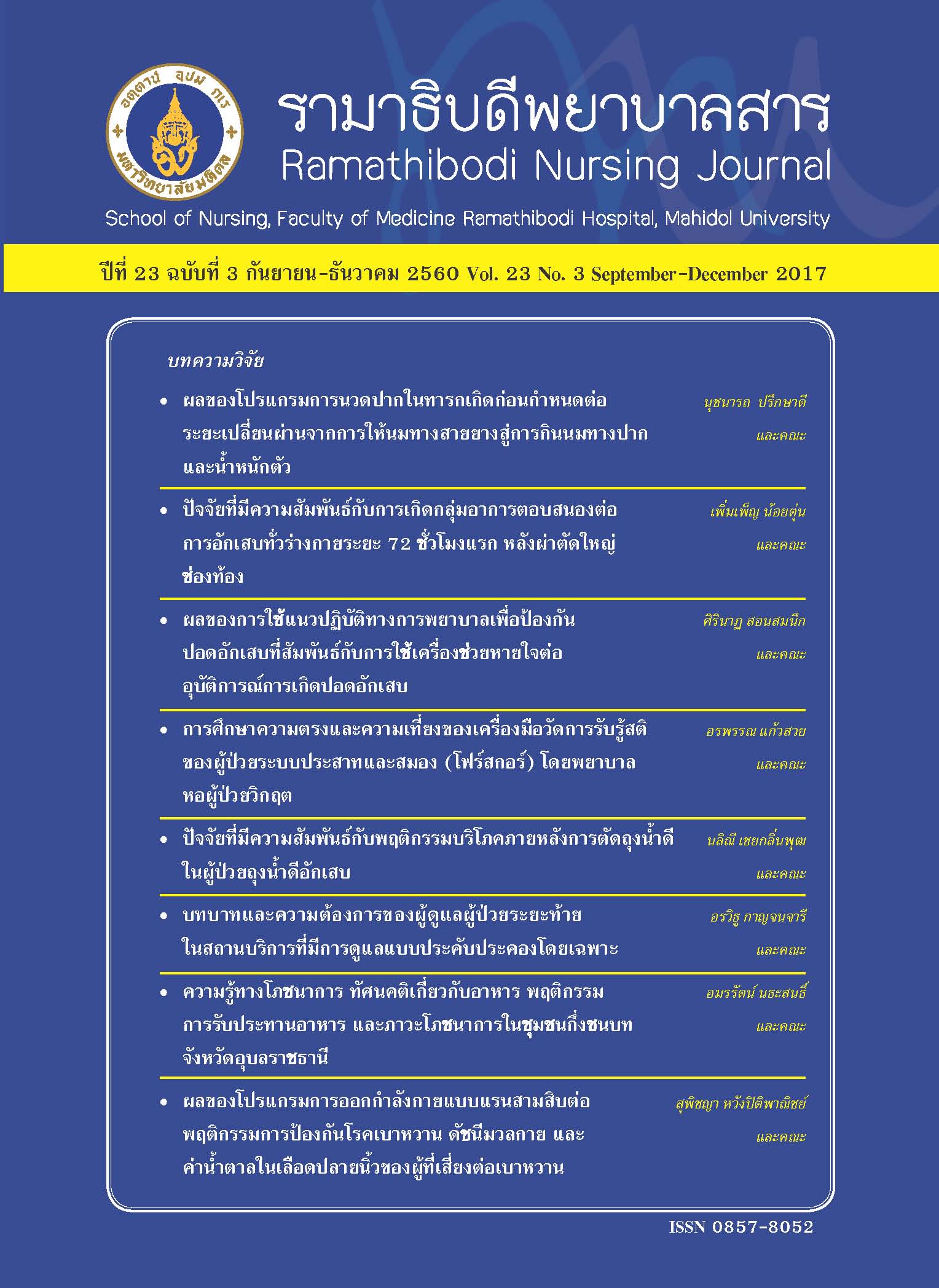
ปัจจัยที่มีความสัมพันธ์กับการเกิดกลุ่มอาการตอบสนองต่อการอักเสบทั่วร่างกายระยะ 72 ชั่วโมงแรก หลังผ่าตัดใหญ่ช่องท้อง
Article Sidebar
Main Article Content
บทคัดย่อ
บทคัดย่อ
การวิจัยครั้งนี้เป็นการศึกษาเชิงพรรณนามีวัตถุประสงค์เพื่อศึกษาปัจจัยที่มีความ สัมพันธ์กับการเกิดกลุ่มอาการตอบสนองต่อการอักเสบทั่วร่างกาย ระยะ 72 ชั่วโมงแรกหลังผ่าตัดใหญ่ช่องท้อง กลุ่มตัวอย่าง 102 ราย เป็นผู้ป่วยที่เข้ารับการรักษาด้วยการผ่าตัดใหญ่ช่องท้องที่มีคุณสมบัติตามเกณฑ์ที่กำหนด เก็บข้อมูลระหว่างเดือนมกราคมถึงเดือนพฤศจิกายน พ.ศ. 2559 เครื่องมือที่ใช้ในการวิจัยประกอบด้วย 1) แบบบันทึกข้อมูลทั่วไปของผู้ป่วย 2) แบบประเมินสภาพร่างกายผู้ป่วยก่อนผ่าตัด 3) แบบประเมินภาวะโภชนาการก่อนผ่าตัด 4) แบบประเมินความวิตกกังวลก่อนผ่าตัด 5) แบบประเมินสภาพผู้ป่วยระหว่างผ่าตัด 6) แบบบันทึกการเกิดกลุ่มอาการตอบสนองต่อการอักเสบทั่วร่างกาย และ 7) แบบบันทึกการเกิดภาวะแทรกซ้อนหลังผ่าตัด วิเคราะห์ข้อมูลโดยใช้สถิติเชิงพรรณนาและสถิติสหสัมพันธ์ของสเปียร์แมน ผลการศึกษาพบว่ากลุ่มตัวอย่างเป็นเพศชาย ร้อยละ 56.90 อายุเฉลี่ย 61.47 ปี (SD = 13.25) ได้รับการผ่าตัดทางเดินอาหาร ร้อยละ 55.90การผ่าตัดตับ ม้าม และทางเดินน้ำดี ร้อยละ 44.10 การเกิดกลุ่มอาการตอบสนองต่อการอักเสบทั่วร่างกายคิดเป็นร้อยละ 55.90, 44.10, และ 40.20 ในระยะ 24, 48, และ 72 ชั่วโมงหลังผ่าตัดใหญ่ช่องท้อง ตามลำดับ สภาพร่างกายผู้ป่วยก่อนผ่าตัดและสภาพผู้ป่วยระหว่างผ่าตัด มีความสัมพันธ์กับการเกิดกลุ่มอาการตอบสนองต่อการอักเสบทั่วร่างกายในระยะ 72 ชั่วโมงหลังผ่าตัด อย่างมีนัยสำคัญทางสถิติ พยาบาลและทีมสุขภาพสามารถนำผลการศึกษาครั้งนี้ไปใช้ในการพัฒนาคุณภาพการพยาบาลทางคลินิกในการดูแลผู้ป่วยผ่าตัดใหญ่ช่องท้อง การติดตามประเมินกลุ่มอาการตอบสนองต่อการอักเสบทั่วร่างกาย และปัจจัยที่เกี่ยวข้อง ตั้งแต่ระยะก่อนผ่าตัด ระหว่างผ่าตัด และหลังผ่าตัดเพื่อการเฝ้าระวังและป้องกันการเกิดภาวะแทรกซ้อนหลังผ่าตัดที่คุกคามต่อชีวิต
คำสำคัญ: กลุ่มอาการตอบสนองต่อการอักเสบทั่วร่างกาย ภาวะโภชนาการ ความวิตกกังวล สภาพ ผู้ป่วยระหว่างผ่าตัด ผ่าตัดใหญ่ช่องท้อง
Article Details
บทความ ข้อมูล เนื้อหา รูปภาพ ฯลฯ ที่ได้รับการตีพิมพ์ในรามาธิบดีพยาบาลสาร ถือเป็นลิขสิทธิ์ของวารสาร หากบุคคลหรือหน่วยงานใดต้องการนำทั้งหมดหรือส่วนหนึ่งส่วนใดไปเผยแพร่หรือเพื่อกระทำการใด ใด จะต้องได้รับอนุญาตเป็นลายลักษณ์อักษรจากรามาธิบดีพยาบาลสารก่อนเท่านั้น
เอกสารอ้างอิง
2. Buttenschoen K, Fathimani K, Buttenschoen DC. Effect of major abdominal surgery on the host immune response to infection. CurrOpin Infect Dis. 2010;23(3): 259-67.
3. Farinas-Alvarez C, Farinas MC, Fernandez-Masarraza C, Llorca J, Casanova D, Delgado-Rodriguez M. Analysis of risk factor for nosocomial sepsis in surgical patients [abstract]. BJS [Internet].2002;87(8) [cited 2014 October 20]. Available from: http://onlinelibrary.wiley.com/doi/10.1046/j.1365-2168.2000.01466. x/abstract
4. Toft P, Tønnesen E. The systemic inflammatory response to anesthesia and surgery. Current Anesthesia & Critical Care. 2008;19:349-53.
5. Haga Y, Beppu T, Doi K, Nozawa F, Mugita N, Ikei S, et al. Systemic inflammatory response syndrome and organ dysfunction following gastrointestinal surgery. Crit Care Med. 1997;25(12):1994-2000.
6. Talmor M, Hydo L, Barie PS. Relationship of systemic inflammatory response syndrome to organ dysfunction, length of stay, and mortality in critical surgical illness. Arch Surg. 1999;134:81-7.
7. Singh S, Singh P, Singh G. Systemic inflammatory response syndrome outcome in surgical patients. Indian J Surg. 2009;71(4):206-9.
8. Ferraris VA, Ballert EQ, Mahan A. The relationship between intraoperative blood transfusion and postoperative systemic inflammatory response syndrome. Am J Surgery. 2013; 205:457-65.
9. Tønnesen H, Nielsen PR, Lauritzen JB, Møller AM. Smoking and alcohol intervention before surgery: evidence for best practice. Br J Anaesth. 2009;102(3):297-306.
10. Punjasawadwong Y, Hintong, T. The Thai anesthesia incidents study (THAI Study) of anesthetic adverse events and risk factors for preventive strategies. Multicenter collaboration research in Thailand; 2005.(in Thai)
11. Jakobson T, Karjagin J, Vipp L, Padar M, Parik AH, Starkopf L, et al. Postoperative complications and mortality after major gastrointestinal surgery. MEDICINA [Internet]. 2014;50 [cited 2015 Jan 25]. Available from http://www.sciencedirect.com/science/article/pii/S101 0660X14000196
12. Kulpho Y, Thosingha O, Danidutsadeekul S, & Kongsayareepong S. Predictive factors for systemic inflammatory response syndromes during the first 24 post-operative hours in abdominal surgery patients. Thai Journal of Nursing Council. 2014;29(1):5-14.(in Thai)
13. Panoi A, Kasemmongkol J. Prevalence of preoperative malnutrition in major abdominal surgery patients. Royal Thai Army Medical Journal. 2004;57(2):69-76.(in Thai)
14. Krisanabud P, Thosingha O, Danaidutsadeekul S, Iramaneerat C. Factors associated with recovery among patients undergoing non-traumatic general abdominal surgery within one week. Thai Journal of Nursing Council. 2012;27(1);39-48. (in Thai)
15. Putwatana P, Reodecha P, Sirapo-ngam Y, Lertsithichai P, Sumboonnanonda K. Nutrition screening tools and the prediction of postoperative infectious and wound complications: comparison of methods in presence of risk adjustment. Nutrition. 2004;21:691-7.(in Thai)
16. Zhou W, Xu X, Yan J, &Mou Y. Nutritional risk is still a clinical predictor of postoperative outcomes in laparoscopic abdominal surgery. SurgEndosc. 2013;8:27.
17. Hassen TA, Pearson S, Cowled PA, Fitridge RA. Preoperative nutritional status predicts the severity of the systemic inflammatory response syndrome (SIRS) following major vascular surgery. Eur J Vas EndovascSurg [Internet]. 2007;33:696-702.doi:10.1016/j.ejvs.20 06.12.006
18. Yusamran M,Sripontan P. Percieved anxiety level and it’s causes in the pre-operative patients at Mahasarakam hospital. J SciTechnol MSU. 2014;418-28.(in Thai)
19. Maes M, Song C, Lin A, De Jongh R, GastelAV, Kenis G, et al. The effects of psychological stress on human: increased production of pro-inflammatory cytokines and Th1-like response in stress-induced anxiety [abstract]. Cytokine[Internet]. 1998;10(4) [cited 2015 Feb 19]. Available from http://www.sciencedirect.com/science/article/pii/S1043466697902908
20. Nathens A, Maier R. Shock and resuscitation. In; Norton J, Barie P, Bollinger RR, Chang A, Lowry S, Mulvihill S, Pass H, Thompson R (Eds). Surgery. Springer New York; 2008, p. 305-321
21. Haynes AB, Regenbogen SE, Weiser TG, Lipsitz SR, Dziekan G, Berry WR, et al. Surgical outcome measurement for a global patient population: validation of the Surgical Apgar Score in 8 countries. Surgery. 2011;149(4):519-24.
22. Rogenbogen SE, Bordeianou L, Hutter MM, Gawande A. The intraoperative surgical apgar score predicts postdischarge complications after colon and rectal resection. Surgery. 2010;148:559-66.
23. Faul F, Erdfelder E, Lang AG, Buchner A. G*Power 3.0.10 [Internet]. 2008 (cited 2013 Jan 4). Available from http://www.brothersoft.com/gpower-405573.html
24. Burns N, Grove S. The practice of nursing research: conduct, critique, and utilization. 4thed. Philadelphia, Pennsylvania, USA: W.B. Saunders; 2001.
25. American Society of Anesthesiologists. ASA physical status classification system (last approved by the ASA House of Delegates on October 15, 2014) [Internet]. 2014 [cited 2014Dec 14]. Available from http://www.asahq.org/~/media/Sites/ASAHQ/Files/Public/Resources/standards-guidelines/asa-physical-status-classification-system.pdf
26. Fuller JK, Anesthesia. In Fuller JK. Surgical technology principles and practice. 4th ed. Missouri: Elsevier Saunders 2005;215-43.
27. Buzby GP, Knox LS, Crospy LO, Eisenberg JM, Hakenson CM, Mcneal GE et al. Study protocol: a randomized clinical trialof total parenteral nutrition in malnourished surgical patients. Am J ClinNutr.1988;47:366-81.
28. William WK Zung. A rating instrument for anxiety disorders. Psychosomatics. 1971;12(6):371-9.
29. Thammaraksa S. The effect of biofeedback training and autogenic training programs towards anxiety levels of patients who are facing with anxiety. [thesis]. PathumThani: Thammasat University; 2008. (in Thai)
30. Gawande AA, Kwaan MR, Regenbogen SE, Lipsitz SA, Zinner MJ. An apgar score for surgery. American College of Surgeons, 2007;204(2):201-8.
31. American College of Chest Physicians/Society of Critical Care Medicine Consensus Conference. definitions for sepsis and organ failure and guidelines for the use of innovative therapies in sepsis. Crit Care Med .1992;20(6): 864-74.
32. Plevkova J. Systemic inflammatory response syndrome. [Internet]. 2011[cited 2014 October 7]. Available from http://www.documbase.com/goto/40866574-d70c 75b3c48230a1b749cea02e361b6f/ Systemic-inflammatory-response-syndrome-2011.pdf
33. Tschoeke SK, Hellmuth M, Hostmann A, Ertel W, OberholZer A. The early second hit in trauma management augments the pro-inflammatory immune response to multiple injuries. J Trauma. 2007;62(6):1396-1404.
34. Oh CA, Kim DH, Oh SJ, Choi MG, Noh JH, Sohn TS, et al. Nutrition risk index as a predictor of postoperative wound complications after gastrectomy. World J Gastroenterol. 2012;18(7):673-8.
35. Thieme RD, Cutchma G, Chieferdecker MM, Campos ACL. Nutritional risk index is predictor of postoperative complications in operations of digestive system or abdominal wall?. ABCD: Arq Bras Cir Dig [Internet]. 2013;26(4) [cited 2015 Jan 17]. Available from http://www.scielo.br/scielo.php?pid=S0102-67202013000400007&script=sci_arttext&tlng=en
