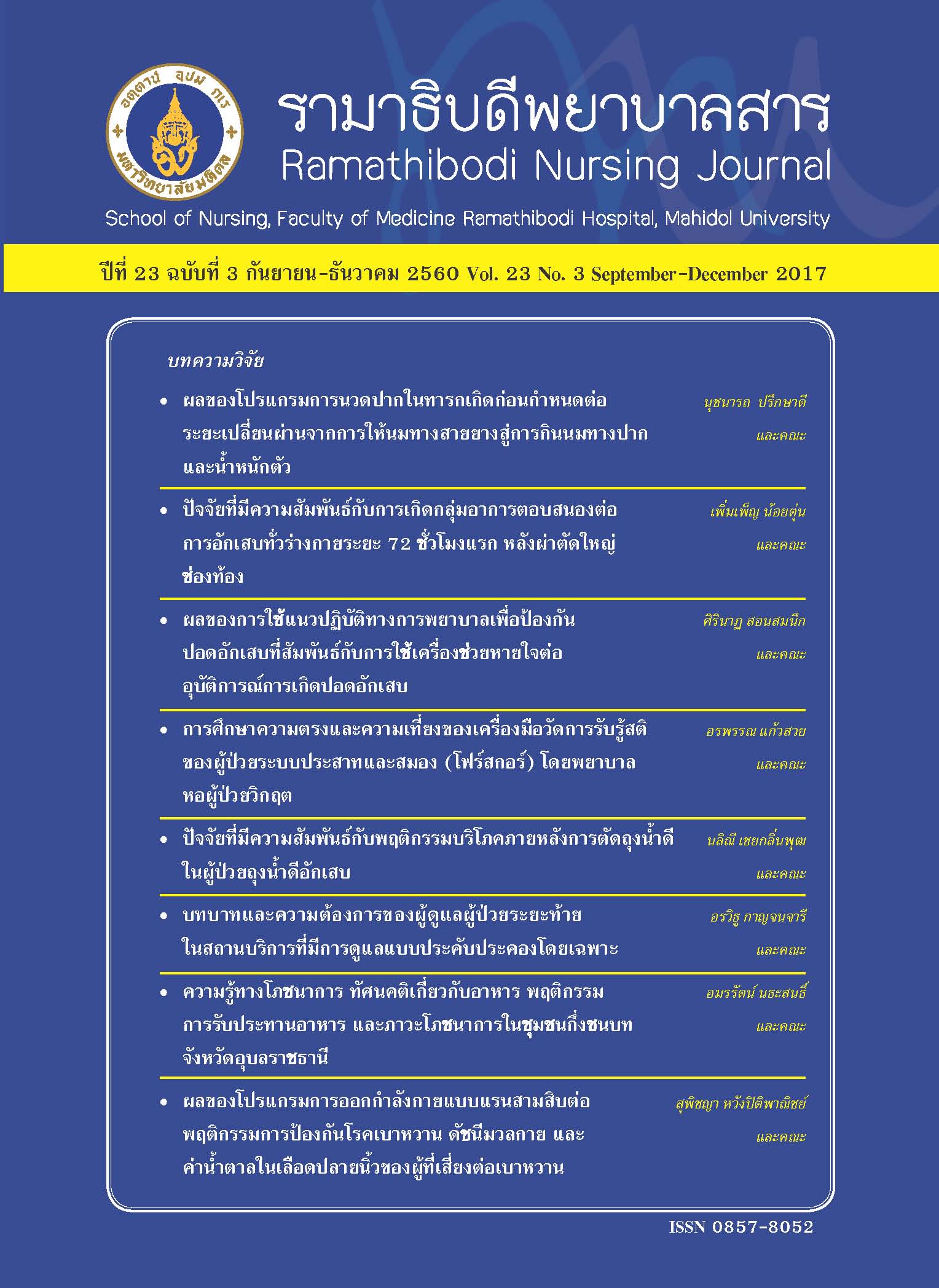
ปัจจัยที่มีความสัมพันธ์กับพฤติกรรมบริโภคภายหลังการตัดถุงน้ำดีในผู้ป่วยถุงน้ำดีอักเสบ
Article Sidebar
Main Article Content
บทคัดย่อ
การศึกษาครั้งนี้เป็นการวิจัยเชิงพรรณนาเพื่อหาความสัมพันธ์ระหว่าง อายุ เพศ การรับรู้ความเจ็บป่วยอาการภายหลังตัดถุงน้ำดี และความรู้เรื่องอาหารเฉพาะโรคกับพฤติกรรมบริโภคภายหลังการตัดถุงน้ำดีโดยใช้ทฤษฏีการเปลี่ยนผ่านของเมลิสเป็นกรอบแนวคิดในการศึกษา กลุ่มตัวอย่างคือ ผู้ป่วยถุงน้ำดีอักเสบที่ได้รับการผ่าตัดตัดถุงน้ำดีแบบส่องกล้องหรือผ่าตัดทางหน้าท้อง ซึ่งเข้ารับการรักษา ณ แผนกศัลยกรรมในโรงพยาบาลระดับตติยภูมิ 2 แห่ง ในจังหวัดชลบุรี จำนวน 82 ราย คัดเลือกกลุ่มตัวอย่างตามคุณสมบัติที่กำหนด เก็บรวบรวมข้อมูลระหว่างเดือนกรกฎาคม ถึง ธันวาคม พ.ศ. 2559 เครื่องมือที่ใช้ในการวิจัย ประกอบด้วย แบบสอบถามข้อมูลส่วนบุคคล แบบสอบถามการรับรู้ความเจ็บป่วย แบบสัมภาษณ์อาการภายหลังตัดถุงน้ำดี แบบสัมภาษณ์พฤติกรรมบริโภคภายหลังตัดถุงน้ำดี และแบบสัมภาษณ์ความรู้เรื่องอาหารเฉพาะโรค วิเคราะห์ข้อมูลด้วยสถิติพรรณนา สถิติสัมประสิทธิ์สหสัมพันธ์พอยท์ไบซีเรียล และสัมประสิทธิ์สหสัมพันธ์แบบเพียร์สัน ผลการวิจัยพบว่า กลุ่มตัวอย่างเป็นเพศหญิง ร้อยละ 75.60 มีอายุเฉลี่ย 42.79 ปี (SD = 12.43) ร้อยละ 76.83 ของผู้ป่วยที่ได้รับการตัดถุงน้ำดียังมีอาการภายหลังการตัดถุงน้ำดีในระดับน้อย มีการรับรู้ความเจ็บป่วยด้านลบในระดับปานกลาง มีความรู้เรื่องอาหารเฉพาะโรคอยู่ในระดับสูง และมีพฤติกรรมบริโภคภายหลังการตัดถุงน้ำดีในระดับดี ผลการวิเคราะห์ความสัมพันธ์ พบว่า เพศหญิงมีพฤติกรรมบริโภคภายหลังการตัดถุงน้ำดี ดีกว่าเพศชาย ส่วนอายุ การรับรู้ความเจ็บป่วย และความรู้เรื่องอาหารเฉพาะโรคมีความสัมพันธ์ทางบวกกับพฤติกรรมบริโภคภายหลังการตัดถุงน้ำดีอย่างมีนัยสำคัญทางสถิติ ส่วนอาการภายหลังการตัดถุงน้ำดีมีความสัมพันธ์ทางลบกับพฤติกรรมบริโภคภายหลังการตัดถุงน้ำดีอย่างมีนัยสำคัญทางสถิติ ผลการศึกษาครั้งนี้ สามารถน�าไปใช้ในการพัฒนาคุณภาพการดูแลผู้ที่ได้รับการตัดถุงน้ำดี เพื่อลดผลกระทบของอาการภายหลังการตัดถุงน้ำดี โดยพยาบาลควรมีการติดตามอาการภายหลังการตัดถุงน้ำดีและพฤติกรรมบริโภคภายหลังการตัดถุงน้ำดี เพื่อส่งเสริมให้ผู้ป่วยมีพฤติกรรมบริโภคที่เหมาะสม
คำสำคัญ: พฤติกรรมบริโภคภายหลังตัดถุงน้ำดี การรับรู้ความเจ็บป่วย อาการภายหลังตัดถุงน้ำดี ความรู้เรื่องอาหารเฉพาะโรค ผู้ป่วยถุงน้ำดีอักเสบ
Article Details
บทความ ข้อมูล เนื้อหา รูปภาพ ฯลฯ ที่ได้รับการตีพิมพ์ในรามาธิบดีพยาบาลสาร ถือเป็นลิขสิทธิ์ของวารสาร หากบุคคลหรือหน่วยงานใดต้องการนำทั้งหมดหรือส่วนหนึ่งส่วนใดไปเผยแพร่หรือเพื่อกระทำการใด ใด จะต้องได้รับอนุญาตเป็นลายลักษณ์อักษรจากรามาธิบดีพยาบาลสารก่อนเท่านั้น
เอกสารอ้างอิง
2. Ministry of Public Health.Number of patients classified by cause of 75 diseases from the public health department of the Ministry of Public Health [Internet]. 2014 (cited 2015 Oct 10). Available from: http://service.nso. go.th/nso/nsopublish/BaseStat/tables /00000_Whole%20Kingdom/in-45-54.xls (in Thai)
3. Pradhan SB, Joshi MR, Vaidya A. Prevalence of different types of gallstone in the patients with cholelithiasis at Kathmandu Medical College, Nepal. KUMJ. 2009;7(3):268-71.
4. Social Security Office [SSO]. SSO revealed top 10 diseases that pay the most expensive treatment [Internet]. 2013 (cited 2015Jan23). Available from: http://www.hfocus.org/content/2013/07/3980 (in Thai)
5. Meekasem K. Studying the behavior consumption fast foods of working people in Bangkok. [Thesis] Bangkok: Bangkok University; 2011. (in Thai)
6. National Institute for Health and Care Excellence [NICE]. Costing statement: gallstone disease implementing the NICE guideline on gallstone disease [Internet]. 2014 (cited 2015 Jan23). Available from: https://www.nice.org.uk/guidance/cg188/resources/cg188-gallstone-disease-costing-statement2
7. Jensen SW. Postcholecystectomy syndrome [Internet]. 2015 (cited 2015 Nov 20). Available from: http://emedicinemedscape.com/article/192761-overview#a5
8. Mertens MC, Roukema JA, Scholtes VPW, Vries J. Trait anxiety predicts outcome 6weeks after cholecystectomy a prospective follow-up study. Ann Behav Med. 2011; 41:264-9.
9. Jaunoo SS, Mohandas S, Almond LM. Postcholecystectomy syndrome (PCS). Int J Surg. 2010;8:15-7.
10. Shojaiefard A, Esmaeilzadeh M, Ghafouri A, Mehrabi A. Various techniques for the surgical treatment of common bile duct stones: a meta review. Gastroenterol Res Pract.2009;2009:1-12. doi:10.1155/2009/840208
11. Chumkaew K. Knowledge, attitude, and food consumption behavior of the elderly in Songkhla Province. Kasetsart Journal. 2013;35:16-29.
12. Meleis AI. Transitions theory: Middle range and situation specific theories in nursing research and practice. New York: Springer; 2010.
13. Nanthasin N. Factors affecting consumer’s consumption behavior and loyalty toward health food in Bangkok metropolis. Journal of Cultural Approach. 2015;16(29): 1-16.(in Thai)
14. Mithkasem S. Factors affecting on selfcare behavior with essential hypertensionpatients in Police General Hospital. [Thesis] Chiang Mai: Chiang Mai University; 2003. (in Thai)
15. Mankhong P. Relationshipsbetweenillness representation, hardiness, social support, and health behaviors of persons with metabolicsyndrome. [Thesis] Chonburi: Burapa University; 2014. (in Thai)
16. Masoumi SJ, Mehrabani D, Moradi F, Zare N, Firouzi MF, Mazloom Z. Theprevalence of dyspepsia symptoms and its correlation with the quality of life among Qashqai Turkish migrating nomads in Fars Province, Southern Iran. Pak J Med Sci. 2015;31(2):325-30.
17. SawangsapK. Factors predicting food consumption behaviors of persons with dyslipidemia. [Thesis] Chonburi: Burapa University; 2013. (in Thai)
18. Tamhankar AP, Mazari F, Olubaniyi J, Everitt N, Ravi K. Postoperative symptoms, after-care, and return to routine activity after laparoscopic cholecystectomy. JSLS. 2010;14:484-9.
19. Down SK, Nicolic M, Abdulkarim H, Skelton N, Harris AN, Koak Y. Lowninety-dayre-admission rates after emergency and elective laparoscopic cholecystectomy in a district general hospital. Ann R Coll Surg Engl. 2010; 92:307-10.
20. Faul F, Erdfelder E, Lang AG, Buchner A. G*Power 3.1.9.2. [Internet]. 2010 (cited 2015 Nov 20). Available from: http://gpower.software.informer.com/3.1/
21. Burns N, Grove S. The practice of nursing research: Appraisal, synthesis, and generation of evidence. 7th ed. St. Louis: W. B. Saunders; 2013.
22. JirawatkulA. Statistics for health science research. Nonthaburi: Office of the Permanent Secretary, Ministry of Public Health; 2007. (in Thai)
23. Moss-Morris R, Weinman J, Petrie KJ, Horne R, Cameron LD, Buick D.Therevised illness perception questionnaire (IPQ-R). Psychology and Health. 2002;17(1):1-16.
24. Sriprasong S, Hanucharurnkul S, Panpukdee O, Krittayaphong R, Pongthavornkamol K, Vorapongsathorn T. Functional status model: an empirical test among discharged acute myocardial infarction patients.Thai J Nurs Res. 2009;13(4):268-84.(in Thai)
25. Bloom BS. Learning of mastery. Evaluation Comment. 1968;1(2):29-62.
26. Abraham S, Rivero HG, Erlikh IV, Griffith LF, Kondamudi VK. Surgical and nonsurgical management of gallstones. Am Fam Physician. 2014;89(10):795-802.
27. Gharde P, Muntode P, Wagh D, Swarnkar M, Gode DS, Yeola M, et al. A study of abdominal symptoms and their outcome after cholecystectomy: original article. Int J Surg. 2013;30(3):1-5.
28. Katavic SS, Tanackovic SF, Badurina B. Illness perception and information behavior of patients with rare chronic diseases. Information Research. 2016;21(1):1-7.
29. Yacoub J. Diet after a cholecystectomy [Internet]. 2014 (cited 2015Nov20). Available from: http://www.livestrong. com/ article/162697-diet-after-a-cholecys tectomy
30. Nangyaem A. Determinants of eating behavior of hypertensive patients. Journal of Nursing Science Chulalongkorn University. 2007;19(3):84-96.(in Thai)
31. Barak F, Falahi E, Keshteli AH, Yazdannik A, Esmaillzadeh A. Adherence to the dietary approaches to stop hypertension (DASH) diet in relation to obesity among Iranian female nurses. Public Health Nutr. 2015;18(4):705-12.
32. Broadbent E, Petrie KJ, Main J, Weinman J. The brief illness perception questionnaire. J Psychosom Res. 2006;60: 631-7.
33. Seetisan P. Factors associated with selfcare behaviors among uncontrolled hypertension patients in Dokkhamtai Hospital, Dokkhamtai District, Phayao Province. Lanna Public Health Journal. 2013;9(2):120-36. (in Thai)
34. Khodarahmi M, Azadbakht L. Dietary fat intake and functional dyspepsia. Adv Biomed Res. 2016; 5(76):1-6.
35. Sangalee M. The effect of education program for diet modification on knowledge of self care, perceived self care abilities and clinical parameters in patients undergoing hemodialysis. [Thesis] Nakhon Pathom: Mahidol; 2007.(in Thai)
