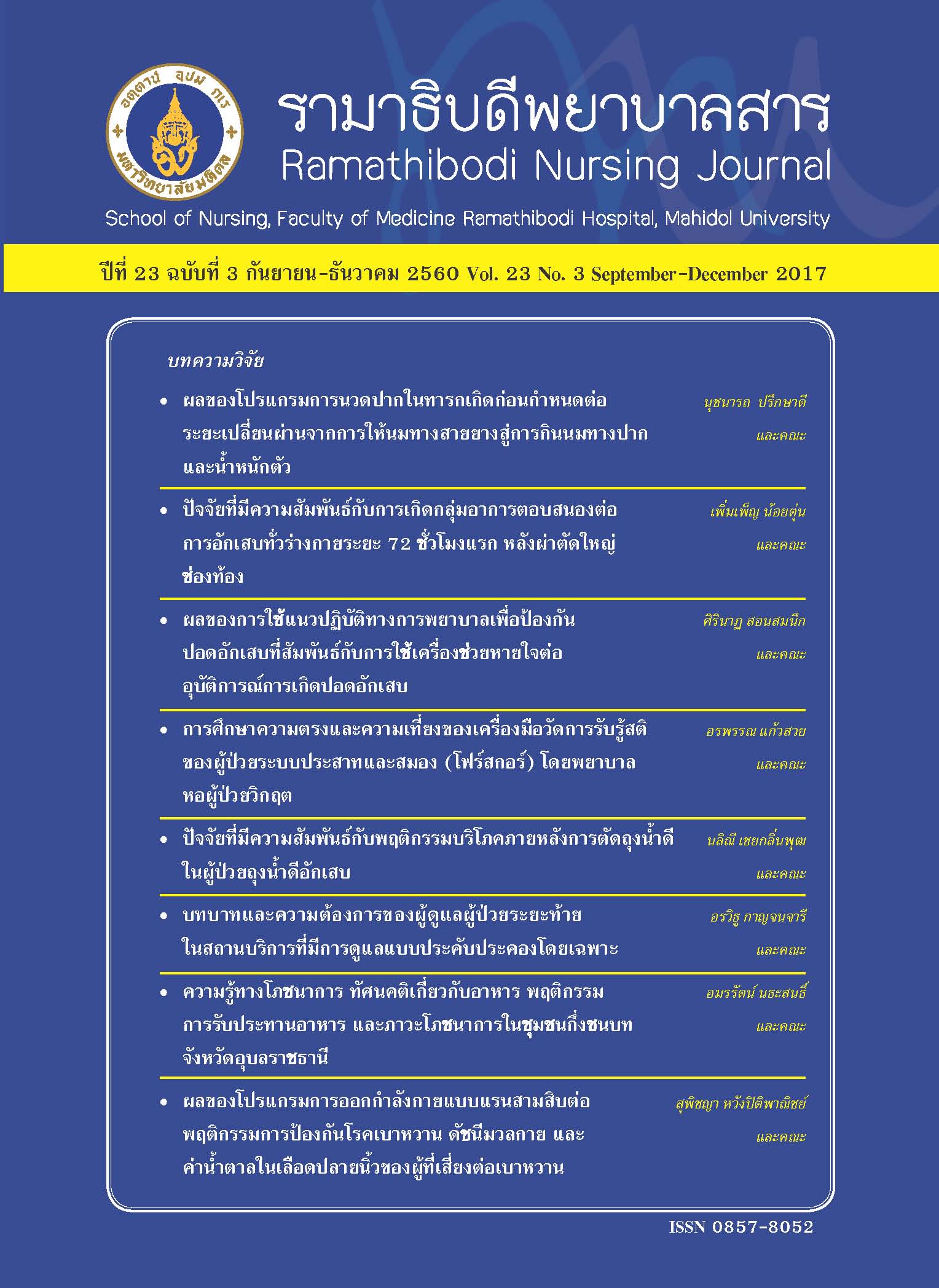
บทบาทและความต้องการของผู้ดูแลผู้ป่วยระยะท้ายในสถานบริการที่มีการดูแลแบบประคับประคองโดยเฉพาะ
Article Sidebar
Main Article Content
บทคัดย่อ
บทคัดย่อ: การศึกษาเชิงคุณภาพนี้มีวัตถุประสงค์เพื่อศึกษาบทบาทและความต้องการของผู้ดูแลผู้ป่วยระยะท้ายในสถานบริการที่มีการดูแลแบบประคับประคองโดยเฉพาะ คัดเลือกผู้ดูแลหลักทั้งหญิงและชายที่อายุ 20 ปีขึ้นไป ดูแลช่วยเหลือผู้ป่วยระยะท้ายก่อนและระหว่างมารับบริการที่โรงพยาบาลมหาวชิราลงกรณธัญบุรี จำนวน 9 ราย เก็บรวบรวมข้อมูลจากการสนทนากลุ่มจำนวน 2 กลุ่ม กลุ่มละ 4-5 ราย และสัมภาษณ์เดี่ยว 4 ราย โดยใช้แบบสอบถามและแนวทางการสัมภาษณ์บทบาทและความต้องการของผู้ดูแลผู้ป่วยระยะท้าย วิเคราะห์ข้อมูลเชิงเนื้อหา ผลการศึกษาพบว่าบทบาทของผู้ดูแลผู้ป่วยระยะท้ายประกอบด้วย 3 บทบาท ได้แก่ 1) การดูแลผู้ป่วยโดยตรงด้านร่างกาย จิตใจ สังคม และจิตวิญญาณ 2) การเตรียมพร้อมสำหรับการดูแลระยะท้าย และ 3) การปรับตัวและการดูแลตนเอง ส่วนความต้องการของผู้ดูแลผู้ป่วยในระยะท้าย ประกอบด้วย 4 ประเด็น ได้แก่ 1) ความต้องการข้อมูลในการจัดการดูแลผู้ป่วยระยะท้าย 2) ความต้องการประสานงานเพื่อเข้าถึงบริการระยะท้าย 3) ความต้องการให้บุคลากรของสถานบริการช่วยดูแลผู้ป่วยระยะท้ายแทนตนเองเมื่อจำเป็น และ 4) ความต้องการความช่วยเหลือด้านการเงิน ข้อค้นพบนี้สามารถนำไปใช้เป็นข้อมูลพื้นฐานในการออกแบบแนวทางในการให้ความช่วยเหลือผู้ดูแลผู้ป่วยระยะท้ายที่เข้ารับบริการในสถานบริการที่มีการดูแลแบบประคับประคองโดยเฉพาะ
คำสำคัญ: ผู้ดูแล ผู้ป่วยระยะท้าย บทบาท ความต้องการ การดูแลแบบประคับประคอง
Article Details
บทความ ข้อมูล เนื้อหา รูปภาพ ฯลฯ ที่ได้รับการตีพิมพ์ในรามาธิบดีพยาบาลสาร ถือเป็นลิขสิทธิ์ของวารสาร หากบุคคลหรือหน่วยงานใดต้องการนำทั้งหมดหรือส่วนหนึ่งส่วนใดไปเผยแพร่หรือเพื่อกระทำการใด ใด จะต้องได้รับอนุญาตเป็นลายลักษณ์อักษรจากรามาธิบดีพยาบาลสารก่อนเท่านั้น
เอกสารอ้างอิง
2. Sirapo-ngam Y. Family caregiver’s life for chronic illness patients. Academic conference: caring for the family caregiver of chronic patients. Bangkok: Ramathibodi School of Nursing, Faculty of Medicine Ramathibodi Hospital, Mahidol University; 2012. p.16-20. (in Thai)
3. Davis LL. Building a science of caring for caregivers. FCH. 1992;15(2):1-9.
4. Glajchen M. The emerging role and needs of family caregivers in cancer care. J Support Oncol. 2004; 2(2):145-55.
5. Levitan LL. Oncology pain and symptom management in primary care. In: Buttaro T M, Trybulski J, Polgar-Bailey P, Sandberg-Cook J, editor. Primary care: a collaborative practice. 5th ed. Elsevier Health Sciences; 2016. p.1335-45.
6. Waeteh S, Nilmanal K, Songwathana P. Caregivers’ experience in providing care for muslim patients with terminal AIDS. TJNC. 2009; 24(4):95-109. (in Thai)
7. Hasson F, Kernohan WG, McLaughlin M, Waldron M, McLaughlin D, Chambers H, et al. An exploration into the palliative and end-of-life experiences of carers of people with Parkinson’s disease. Palliat Med. 2010;24(7):731-6.
8. Somanusorn S, Hatthakit U, Nilmanat, K. Caring for a relative at the end of life to die peacefully in the Thai Buddhist culture. The Journal of Faculty of Nursing Burapha University. 2011;19(2):28-41. (in Thai)
9. Jo S, Brazil K, Lohfeld L, Willison K. Caregiving at the end of life: perspectives from spousal caregivers and care recipients. Palliat Support Care. 2007;5(1):11-7.
10. Given BA, Given CW, Sherwood PR. Family and caregiver needs over the course of the cancer trajectory. J Support Oncol. 2012;10(2):57-64.
11. Hasson F, Spence A, Waldron M, Kernohan G, McLaughlin D, Watson B, et al. Experiences and needs of bereaved carers during palliative and end-of-life care for people with chronic obstructive pulmonary disease. J Palliat Med. 2009;25(3):157-63.
12. Mangan PA, Taylor KL, Yabroff KR, Fleming DA, Ingham JM. Caregiving near the end of life: Unmet needs and potential solutions. Palliat Support Care. 2005;1(3):247-59.
13. Wong MS, Chan SWC. The experiences of Chinese family members of terminally ill patients–a qualitative study. J Clin Nurs. 2007;16(12):2357-64.
14. Abernethy A, Burns C, Wheeler J, Currow D. Defining distinct caregiver subpopulations by intensity of end-of-life care provided. Palliat Med. 2009;23(1):66-79.
