
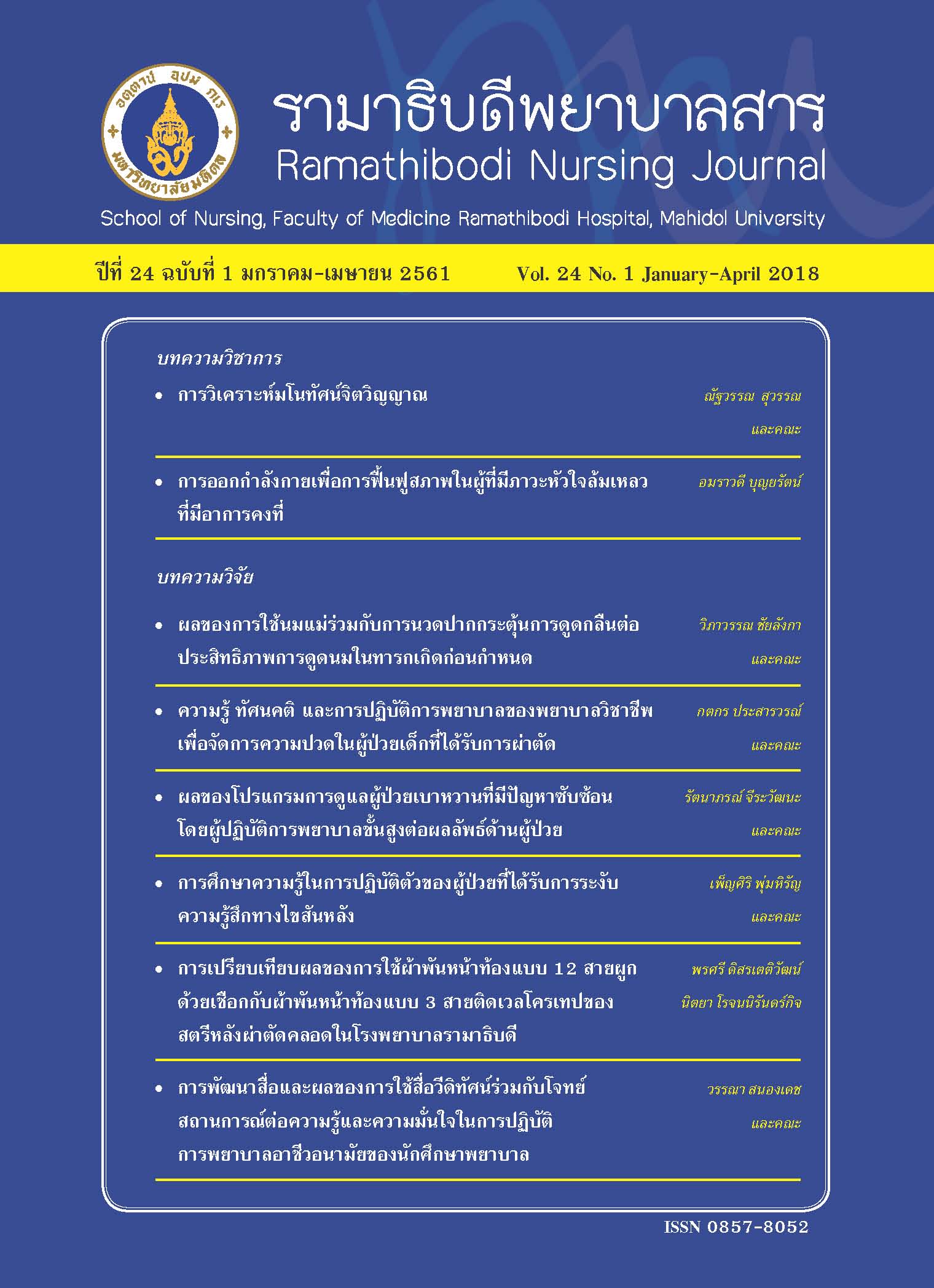
ผลของโปรแกรมการดูแลผู้ป่วยเบาหวานที่มีปัญหาซับซ้อนโดยผู้ปฏิบัติการพยาบาลขั้นสูงต่อผลลัพธ์ด้านผู้ป่วย
Article Sidebar
Main Article Content
บทคัดย่อ
การวิจัยนี้เป็นการวิจัยกึ่งทดลองศึกษาแบบกลุ่มเดียววัดซ้ำ มีวัตถุประสงค์เพื่อศึกษาผลของโปรแกรมการดูแลผู้ป่วยเบาหวานที่มีปัญหาซับซ้อนโดยผู้ปฏิบัติการพยาบาลขั้นสูง (APN) ต่อผลลัพธ์ด้านผู้ป่วยกรอบแนวคิดครั้งนี้ใช้ทฤษฎีการดูแลตนเองของโอเร็ม ร่วมกับการใช้เทคนิคการสัมภาษณ์เพื่อสร้างแรงจงู ใจในการปรับเปลี่ยนพฤตกิ รรมและหลกั ฐานเชิงประจักษ์ ผู้เข้าร่วมวิจัย
เป็นผู้ป่วยเบาหวานที่มีปัญหาซับซ้อนเข้ารักษาในโรงพยาบาลรามาธิบดี จำนวน 30 ราย เลือกกลุ่มตัวอย่างตัวอย่างแบบเฉพาะเจาะจงตามเกณฑ์คัดเข้า ผู้เข้าร่วมวิจัยได้รับโปรแกรม 3 ระยะเป็นเวลา 10 สัปดาห์ในสัปดาหท์ ี่ 1 มีกิจกรรมระยะที่ 1 และระยะที่ 2 ดังนี้ ระยะที่ 1 ส่งเสริมการร้จู ักตนเองและสร้างแรงจูงใจโดย APN ให้ผู้เข้าร่วมวิจัยประเมินภาวะสุขภาพกระตุ้นสร้างแรงจูงใจในการดูแลตนเองระยะที่ 2ตั้งเป้าหมายและวางแผนร่วมกัน ให้ความรู้ในการดูแลเบาหวาน ฝึกทักษะและพัฒนาทักษะในการดูแล
ตนเอง สร้างสิ่งแวดล้อม และสร้างแรงจูงใจรวมจำนวน 3 ครั้งและในสัปดาห์ที่ 2 ดำเนินกิจกรรมระยะที่ 3 สนับสนุนการดูแลต่อเนื่อง โดยติดตามทางโทรศัพท์ทุก 2 สัปดาห์ รวมทั้งสิ้น 5 ครั้งและเปิดช่องทางสายด่วน APN 24ชั่วโมง เก็บข้อมูลพฤติกรรมการดูแลตนเอง คุณภาพชีวิต และค่าน้ำตาลเฉลี่ยสะสมในเลือด ก่อนและหลังสิ้นสุดโปรแกรม 2 สัปดาห์ เก็บข้อมูลความร้เู กี่ยวกับเบาหวาน 3 ครั้ง คือ ก่อนและหลังให้ความรู้ทุกด้านและหลังสิ้นสุดโปรแกรม 2 สัปดาห์ วิเคราะห์ข้อมูลโดยใช้สถิติเชิงบรรยาย
การทดสอบทีและสถิติความแปรปรวนแบบวัดซ้ำของฟรีดแมนผลการวิจัยพบว่า ผู้เข้าร่วมวิจัยมีอายุ ระหว่าง 19 ถึง 87 ปี มีค่าเฉลี่ยคะแนนความรู้ พฤติกรรมการดูแลตนเอง และคุณภาพชีวิตสูงกว่าก่อนได้รับโปรแกรมอย่างมีนัยสำคัญทางสถิติ และมีค่าเฉลี่ยน้ำตาลสะสมเฉลี่ยลดลงจาก 11.43% เป็น 7.29% หลังสิ้นสุดโปรแกรม งานวิจัยนี้แสดงถึงประสิทธิภาพของโปรแกรมการดูแลผู้ป่วยเบาหวานที่มีปัญหาซับซ้อนโดยผู้ปฏิบัติการพยาบาลขั้นสูงอย่างต่อเนื่องต่อผลลัพธ์ที่ดีด้านผู้ป่วย ดังนั้น จึงควร
นำโปรแกรมนี้ลงสู่การปฏิบัติแก่ผู้ป่วยเบาหวานที่ไม่สามารถคุมระดับน้ำตาลในเลือดได้และมีปัญหาซับซ้อนให้มีคุณภาพชีวิตที่ดี
คำสำคัญ: โปรแกรมดูแลผู้ป่วยเบาหวานที่มีปัญหาซับซ้อน ผู้ปฏิบัติการพยาบาลขั้นสูงพฤติกรรมการดูแลตนเอง น้ำตาลเฉลี่ยสะสมในเลือด คุณภาพชีวิต
Article Details
บทความ ข้อมูล เนื้อหา รูปภาพ ฯลฯ ที่ได้รับการตีพิมพ์ในรามาธิบดีพยาบาลสาร ถือเป็นลิขสิทธิ์ของวารสาร หากบุคคลหรือหน่วยงานใดต้องการนำทั้งหมดหรือส่วนหนึ่งส่วนใดไปเผยแพร่หรือเพื่อกระทำการใด ใด จะต้องได้รับอนุญาตเป็นลายลักษณ์อักษรจากรามาธิบดีพยาบาลสารก่อนเท่านั้น
เอกสารอ้างอิง
outcomes. Globalization and Health. 2013;9:11.
2. Diabetes Association of Thailand. Clinical practice guideline for diabetes 2014. Bangkok: Aroonkarnpim;
2014. (in Thai)
3. National Health Security Officeof Thailand. The report of person with type 2 diabetes care and hypertension in
hospitals under the jurisdiction of the Ministry of Public Health and hospitals under the Bangkok metropolitan
administration: DMHT. Bangkok: National Health Security Office; 2012. (in Thai)
4. American Diabetes Association: ADA. Standards of medical care in diabetes 2015. Diabetes Care. 2015;
38(1):1-89.
5. Anderbro T, Gonder-Frederick L, Bolinder J, Lins PE, Wredling R, Moberg E, et al. Fear of hypoglycemia:
Relationship to hypoglycemic risk and psychological factors. Acta Diabetol. 2015; 52(3):581-9.
6. Di Battista AM, Hart TA, Greco L, Gloizer J. Type 1 diabetes among adolescents: reduced diabetes self-care
caused by social fear and fear of hypoglycemia. Diabetes Educ. 2009;35(3):465-75.
7. Siripitayakunkit A, Hanucharurnkul, S., Melkus, G. D.E., Vorapongsathorn, T., Rattarasarn, C., & Arpanantikul,
M. Factors contributing to integrating lifestyle in Thai women with type 2 diabetes. Pac Rim Int J Nurs Res Thai.
2008;12(3):166-78.
8. Gulabani M, John M, Isaac R. Knowledge of diabetes, its treatment and complications amongst diabetic patients in
a tertiary care hospital. IJCM. 2008;33(3):204
9. Beliard R, Muzykovsky K, Vincent III W, Shah B, Davanos E. Perceptions, barriers, and knowledge of inpatient glycemic control: a survey of health care workers. J Pharm Policy Pract. 2016;29(4):348-54.
10. Rawdaree P. The impact of diabetes on health and illness. In: Nitiyanant W, Wannasang S, Deerochana- wong C,
editors. Diabetes situation in Thailand 2007. Bangkok: Diabetes Association of Thailand; 2007. (in Thai)
11. McNamara JP, Reid AM, Freedland AR, Righi SE, Geffken GR. Contributing factors to poor adherence and
glycemic control in pediatric type 1 diabetes: facilitating a move toward telehealth. Type 1 Diabetes-Complications,
Pathogenesis, and Alternative Treatments: InTech; 2011.
12. Wint Y, Duff E, McFarlane-Anderson N, O’Connor A, Bailey E, Wright-Pascoe R. Knowledge, motivation and
barriers to diabetes control in adults in Jamaica. West Indian Medical Journal. 2006;55(5):330-3.
13. Reutrakul S, Deerochanawong C. Diabetes in Thailand: status and policy. Curr Diab Rep. 2016;16(3):28.
14. Ramathibodi Hospital Statistical Database. Evidence of diabetic patients at Ramathibodi Hospital. Bangkok: Faculty
of Medicine Ramathibodi Hospital; 2015. (in Thai)
15. Jerawatana R. Clinical pathway of hospitalized diabetic patients: discharge planning and telehealth by APN. Annual
report 2014. Bangkok: Concept Medicus; 2014. (in Thai)
16. Likitratcharoen S. Meta-analysis of educative-supportive intervention research for diabetic patients in Thailand
[thesis]. Nakhon Pathom: Mahidol University; 2000.
17. Norris SL, Engelgau MM, Narayan KM. Effectiveness of self-management training in type 2 diabetes: A systematic
review of randomized controlled trials. Diabetes Care. 2001;24(3):561-87.
18. Keeratiyutawong P. Hanucharurnkul S. A long term follow-up of the effectiveness of a self-management program in persons with type 2 diabetes. Rama Nurs J. 2010;22(3):293-308. (in Thai)
19. Evans MM. Evidence-based practice protocol to improve glucose control in individuals with type 2 diabetes mellitus.
MedSurg Nursing. 2010;19(6):317.
20. Wexler DJ, Beauharnais CC, Regan S, Nathan DM, Cagliero E, Larkin ME. Impact of inpatient diabetes management, education, and improved discharge transition on glycemic control 12 months after discharge. Diabetes Res Clin Prac. 2012;98(2):249-56.
21. Hamric AB, Hanson, C. M., Tracy, M. F., & O’Grady, E. T. Advanced practice nursing an integrative approach. 5th ed. United States of America: Deborah Lee Vogel; 2009.
22. Hanucharurnkul S. Collaboration among nursing faculties and advanced practice nurses: The professional success.
Thai Journal of Nursing and Midwifery Practice. 2015; 2(2):5-16.(in Thai)
23. Orem DE, Taylor SG, Renpenning KM. Nursing: concepts of practice. 6th ed. St. Louis: Mosby; 2001.
24. Miller WR, Rollnick S. Motivational interviewing helping people change. New York: The Guilford Press; 2013.
25. The Royal College of Medicine of Thailand. Evidence-Based Medicine & Clinical Practice Guideline. The Royal College of Medicine of Thailand.2001;18(6): 36-47. (inThai)
26. Chen SM, Creedy D, Lin HS, Wollin J. Effects of motivational interviewing intervention on self-management,
psychological and glycemic outcomes in type 2 diabetes: a randomized controlled trial. IJNS. 2012;49(6):637-44.
27. Gucciardi E, Chan VW, Manuel L, Sidani S. A systematic literature review of diabetes self-management education
features to improve diabetes education in women of Black African/Caribbean and Hispanic/Latin American ethnicity.
Patient Educ Couns. 2013;92(2):235-45.
28. Beck RS, Daughtridge R, Sloane PD. Physician-patient communication in the primary care office: A systematic
review. J Am Board Fam Pract. 2002;15(1):25-38.
29. Wong FKY, Mok MPH, Chan T, Tsang MW. Nurse follow-up of patients with diabetes: randomized controlled
trial. J Adv Nurs. 2005;50(4):391-402.
30. Luecha Y, Lerdmaleewong M, LauhachindaY, Seesuwan W, Putwatana P, Thanooruk R. Nursing research. 6th ed.
Bangkok: SiamPrinting. 1997. (in Thai)
31. Pfeiffer E. A Short Portable Mental Status Questionnaire for the Assessment of Organic Brain Deficit in Elderly
Patients†. Journal of the American Geriatrics Society. 1975;23(10):433-41.
32. Intarasombat P, Sirapo-ngam Y, Chansirikarn S, Yamvong C, Mahakayanun S. Effects of patient and families participation in health care on functional outcome, well-being, complications, length of stay in elderly patients, and patient and family satisfaction with care. Rama Nur J. 1996;2(2):30-48. (in Thai)
33. Department of Medicine. Improving the quality of life of person with diabetes in Ramathibodi Hospital project.
Bangkok: Judthong; 2011. (in Thai)
34. Accu-Chek. Evaluation report: Accu-Chek® performa test strips with advanced chemistry; 2016 [cited 2016
July 21]. Avilable from: https://www.accu-chek.ch.
35. Keeratiyutawong P. A self-management program for improving knowledge, self-care activities, quality of life, and glycosylated HbAIc in Thais with type 2 diabetes mellitus. [dissertation]. Bankok: Mahidol University; 2005. (in Thai)
36. Little RR. Glycated hemoglobin standardization--National Glycohemoglobin Standardization Program (NGSP)
perspective. Clinical Chemistry and Laboratory Medicine. 2003;41(9):1191-8.
37. American Diabetes Association: ADA. Standards of medical care in diabetes 2016. Diabetes Care. 2016;
37(S1):S14-80.
38. Himathongkam T, Tantayotai V, Bunnag P, Deerochanawong C, Nakasatien S. Situation analysis and literature review on diabetes mellitus and high blood sugar. Ministry of Public Health. 2004.(in Thai)
39. Stratton IM, Adler AI, Neil HA, Matthews DR, Manley SE, Cull CA, et al. Association of glycaemia with macrovascular and microvascular complications of type 2 diabetes (UKPDS 35): prospective observational study.
BMJ (Clinical research ed). 2000;321(7258):405-12.
