
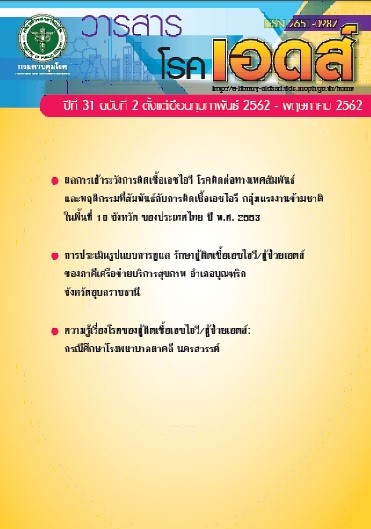
Effective Surveillance for HIV Infection. Sexually Transmitted Diseases and Behavior Associated with HIV Infection among Migrant Worker in 10 Provinces of Thailand, 2010
DOI:
https://doi.org/10.14456/taj.2019.6Keywords:
Integrated Biological and Behavioral Surveillance (IBBS), HIV, STI, migrant workersAbstract
The Integrated Biological and Behavioral Surveillance (IBBS) was performed among migrant workers whose age were 15 years old or more, with or without registration, from 3 countries i.e. Myanmar, Laos and Cambodia, who had been residing in Thailand for 6 months or longer, in 10 selected provinces, in 5 occupational types including fishery, continuous fishery, construction workers, agriculturist, and factory workers. The survey was conducted in 2010. The objectives were to study HIV and Sexually Transmitted Infection (STI) prevalence rates and to assess behaviors associated to HIV infection. HIV and syphilis infection, other STI infections and behavior data were derived from blood test, urine test, and interviewing using a questionnaire. There were 3,001 subjects enrolled to the study. Of these, 52.3% were female and 47.7% were male. The average age was 29.1±8.8 years old. 60.2% of the subjects were from Myanmar, and 20% were equally from Laos and Cambodia. During the last 6 months before the interviewing, 618 subjects (34.2%) out of the respondents to this question (N=1,809) reported to have at least one symptom of STI. The percentages of type of sex partner (N=2,119) in their last sex-act was with husband/wife for 86.2% [among this group (N=1,814) reported using condom for 6.8%, and not using a condom for 93.2%]; with commercial sex workers for 6.7% [among this group (N=113) reported using a condom for 78.8%, and not using a condom for 21.2%]; with boy or girl friend/lover for 5.3% [among this group (N=142) reported using a condom for 36.6%, and not using a condom for 63.4%]; with other man/woman who is not a lover for 1.2% [among this group (N=23) reported using a condom for 47.8%, and not using a condom for 52.2%]; and with others for 0.6% [among this group (N=4) reported using a condom for 50.%, and not using a condom for 50.0%]. HIV, Chlamydia trachomatis, Neisseria gonorrhea and Syphilis infection rates were 1.3, 0.93, 0.87 and 0.59% respectively. The other problems found form the study included limited access to health care services for example out of the studied subjects (N=3,001), 40.1% got health insurance card while the rest did not hold such card resulted into limited access to HIV testing. In addition, migrant workers had low level of knowledge related to HIV and AIDS. It is recommended that there should be attempts to promote access to health care services and communication, including to provide knowledge of HIV and STI to migrant workers in an intensive way, with an emphasis on the correct measure to prevent HIV infection. The role of migrant health volunteer or migrant health worker should be strengthened, including the role to disseminate knowledge and coordination for migrant workers to access to health care.Downloads
Download data is not yet available.
References
1. United Nations General Assembly Special Session on HIV/AIDS., data.unaids.org/pub/.../080813_gr08_prev1549_1990_2007_en.xls. [Internet]. [cited 2018 September 20]. Available from http://www.unaids.org/docu-ments/20101123_2010_hiv_prevalence_map_em.pdf)
2. United Nations General Assembly Special Session on HIV/AIDS. Monitoring the Declaration of Commitment on HIV/AIDS GUIDELINES ON CONSTRUCTION OFCORE INDICATORS 2008 Reporting. [Internet]. 2008 [cited 2018 Sep 20]. Available from https://www.unaids.org/sites/default/files/media_asset/jc1318_core_indicators_manual_en_0.pdf
3. กรมการจัดหางาน สำนักบริหารแรงงานต่าวด้าว กระทรวงแรงงาน. การบริหารจัดการการทำงานของคนต่างด้าว สรุปปี 2553.[อินเตอร์เน็ต]. 2553 [สืบค้นเมื่อวันที่ 21 พ.ย. 2561] แหล่งข้อูล: http://wp.doe.go.th/sites/default/files/statistic/8/sy2553.pdf
4. วิพุธ พูลเจริญ,ปิติพร จันทรทัต ณ อยุธยา, วิภา ภาวนาภรณ์, วรัญญา เตียวสกุล, ชวลิต ตันตินิมิตกุล. วิวัฒนาการควบคุมโรคเอดส์ในประเทศไทย: แบบอย่างของการพัฒนาแนวคิดส่งเสริมสุขภาพ. พิมพ์ครั้งที่ 1. นนทบุรี: โครงการสำนักพิมพ์ สถาบันวิจัยสาธารณสุข; 2542.
5. อภิชาติ จำรัสฤทธิรงค์, วาทินี บุญชลักษี. การวิจัยประเมินผลกระทบโครงการส่งเสริมการป้องกันเอดส์ในแรงงานข้ามชาติ ประเทศไทย (โครงการฟ้ามิตร) ปี 2551. พิมพ์ครั้งที่ 1. นครปฐม: สถาบันวิจัยประชากรและสังคม มหาวิทยาลัยมหิดล; 2552.
2. United Nations General Assembly Special Session on HIV/AIDS. Monitoring the Declaration of Commitment on HIV/AIDS GUIDELINES ON CONSTRUCTION OFCORE INDICATORS 2008 Reporting. [Internet]. 2008 [cited 2018 Sep 20]. Available from https://www.unaids.org/sites/default/files/media_asset/jc1318_core_indicators_manual_en_0.pdf
3. กรมการจัดหางาน สำนักบริหารแรงงานต่าวด้าว กระทรวงแรงงาน. การบริหารจัดการการทำงานของคนต่างด้าว สรุปปี 2553.[อินเตอร์เน็ต]. 2553 [สืบค้นเมื่อวันที่ 21 พ.ย. 2561] แหล่งข้อูล: http://wp.doe.go.th/sites/default/files/statistic/8/sy2553.pdf
4. วิพุธ พูลเจริญ,ปิติพร จันทรทัต ณ อยุธยา, วิภา ภาวนาภรณ์, วรัญญา เตียวสกุล, ชวลิต ตันตินิมิตกุล. วิวัฒนาการควบคุมโรคเอดส์ในประเทศไทย: แบบอย่างของการพัฒนาแนวคิดส่งเสริมสุขภาพ. พิมพ์ครั้งที่ 1. นนทบุรี: โครงการสำนักพิมพ์ สถาบันวิจัยสาธารณสุข; 2542.
5. อภิชาติ จำรัสฤทธิรงค์, วาทินี บุญชลักษี. การวิจัยประเมินผลกระทบโครงการส่งเสริมการป้องกันเอดส์ในแรงงานข้ามชาติ ประเทศไทย (โครงการฟ้ามิตร) ปี 2551. พิมพ์ครั้งที่ 1. นครปฐม: สถาบันวิจัยประชากรและสังคม มหาวิทยาลัยมหิดล; 2552.
Downloads
Published
2021-09-17
How to Cite
1.
Poonkasorn S, Thanaisawanyangkoon S. Effective Surveillance for HIV Infection. Sexually Transmitted Diseases and Behavior Associated with HIV Infection among Migrant Worker in 10 Provinces of Thailand, 2010. Thai AIDS Journal [internet]. 2021 Sep. 17 [cited 2026 Sep. 30];31(2):55-69. available from: https://he02.tci-thaijo.org/index.php/ThaiAIDSJournal/article/view/253693
Issue
Section
Report of operation

