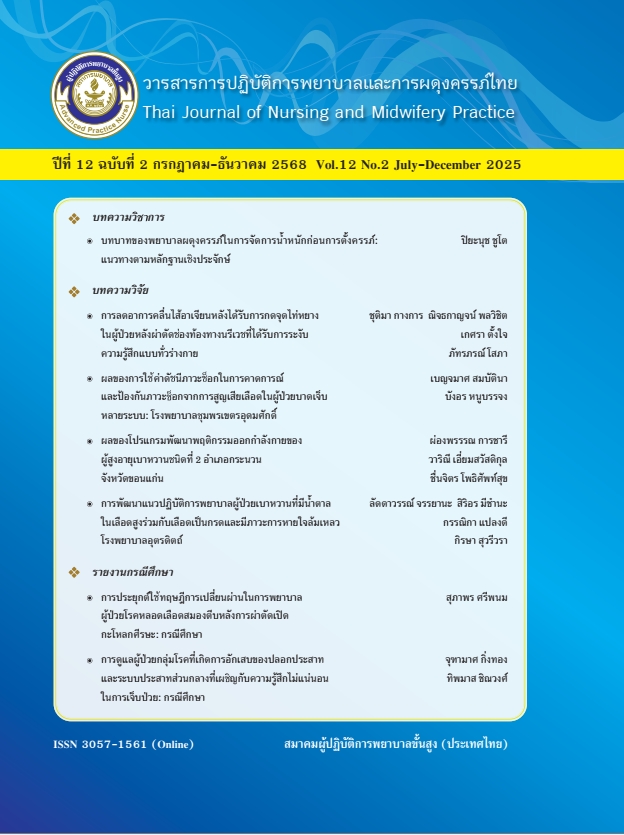
Utilizing Shock Index for Prediction and Prevention of Hypovolemic Shock in Multiple Trauma Patients at Chumphon Khet Udomsakdi Hospital
Article Sidebar
Main Article Content
Abstract
Abstract: This quasi-experimental one-group pre-posttest study aimed to examine the effects of using the Shock Index (SI) to predict and prevent hypovolemic shock among multiple trauma patients from traffic accidents at Chumphon Khet Udomsakdi Hospital. The study included two participant groups: 32 registered nurses and 35 multiple trauma patients admitted to the surgical intensive care unit and the trauma and neurosurgical wards, all of whom met the inclusion criteria during the study period. The intervention comprised education and hands-on training of the nurses in the use and application of the Shock Index. The research instruments consisted of a demographic questionnaire for nurses, a knowledge and practice test on the use of the Shock Index, a practice assessment form, a satisfaction evaluation questionnaire, and the severity of hypovolemic shock report. Data were analyzed using descriptive statistics (percentage, mean, and standard deviation) and paired t-test to compare pre- and post-intervention outcomes. The results revealed that nurses’ mean scores for knowledge and practical skills significantly improved after receiving the education and hands-on training (p < .05). When comparing the severity of hypovolemic shock within the first 24 hours of admission, application of the Shock Index enabled earlier detection of blood loss–related shock, resulting in a statistically significant reduction in shock severity levels (p < .05). All participants rated their satisfaction with the use of the Shock Index at a high level. The findings suggest that the Shock Index can be effectively utilized for early prediction and prevention of hypovolemic shock. Future studies should include a larger sample group of patients with high risk or critical illness in other units.
Downloads
Article Details

This work is licensed under a Creative Commons Attribution-NonCommercial-NoDerivatives 4.0 International License.
References
Taghavi S, Asari R. Hypovolemic shock. StatPearls [Internet]. 2023 [cited 2023 Dec 30]. Available from: https://www.ncbi.nlm.nih.gov/books/NBK513297
Ciechanowicz D, Samojto N, Koztowski C, et al. Incidence and etiology of mortality in polytrauma patients: An analysis of material from Multitrauma Centre of the University Teaching Hospital No. 1 in Szczecin, over a period of 3 years (2017–2019). Pol J Surg. 2020; 92(4): 1-6.
World Health Organization. Road traffic deaths and injuries in Thailand: The global status report on road safety [Internet]. 2018 [cited 2023 Dec 30]. Available from: https://cdn.who.int/media/docs/default-source/thailand/roadsafety/overview-en-final-25-7-19.pdf?sfvrsn=f9d7a862_2
Department of injury prevention and control, Department of disease control. Road traffic accidents: Injury surveillance system 2018-2023 [Internet]. Nonthaburi: Ministry of Public Health; 2023 [cited 2023 Dec 9]. Available from: https://dip.ddc.moph.go.th/new
Cook A, Davies R, Cook A, et al. Hemothorax: A review of the literature. Clin Pulm Med. 2020 Jan;27(1):1-8.
Wikipedia contributors. Hemothorax [Internet]. Wikipedia. 2025 Aug 9 [cited 2025 Aug 9]. Available from: https://en.wikipedia.org/wiki/Hemothorax
Klarhofer M, Gunther D, Haberthur C, et al. Wearable microwave instrument can detect and monitor traumatic internal bleeding in humans. Sci Rep. 2021; 11: 12345.
Lewis SL, Bucher L, Heitkemper MM, et al. Medical-surgical nursing: Assessment and management of clinical problems. 11th ed. St. Louis: Elsevier; 2020.
Nakapakshin J, Samranati M, Techaudomdej J. Development and evaluation of clinical practice guidelines for the management of hypovolemic shock in critically ill patients. Thai J Nurs Pract. 2023; 10(1): 120-39. Thai.
Surgical Intensive Care Unit, Chumphon Khet Udomsakdi Hospital. Nursing performance report: Specialized nursing competency and application of shock index, 2022. Chumphon: Chumphon Khet Udomsakdi Hospital; 2023. (Internal document). Thai.
Trauma and Neurosurgical Ward, Chumphon Khet Udomsakdi Hospital. Nursing performance report: Specialized nursing competency and application of shock index, 2022. Chumphon: Chumphon Khet Udomsakdi Hospital 2023. (Internal document); Thai.
Hasasrisri N, Chanruangwanitch W, Tosing O, et al. Predictive factors of shock in patients receiving care in the emergency department. J Nurs. 2019; 34(3): 60-75. Thai.
Dai G, Lu X, Xu F, et al. Early mortality risk in acute trauma patients: Predictive value of injury severity score, trauma index, and different types of shock indices. J Clin Med. 2022; 11(11): 1-8.
Melnyk BM, Fineout-Overholt E. Evidence-based practice in nursing & healthcare: a guide to best practice. 5th ed. Philadelphia: Wolters Kluwer; 2023.
Anderson LW, Krathwohl DR, editors. A taxonomy for learning, teaching, and assessing: a revision of Bloom’s taxonomy of educational objectives. New York: Longman; 2001.
Allgower M, Buri C. Shock index. Dtsch Med Wochenschr. 1967; 92: 1947–50.
Krongdai U. Traumatic shock [Internet]. 2019 [cited 2025 Jun 28]. Available from: http://www.slideshare.net/krongdai/traumatic-shock
American College of Surgeons. ATLS: Advanced trauma life support: student course manual. 11th ed. Chicago (IL): American College of Surgeons; 2021.
Kinsman L, Cooper S, Champion R, et al. The impact of web-based and face-to-face simulation education programs on nurses’ response to patient deterioration: a multi-site interrupted time series study. Nurse Educ Today. 2021; 102: 104939.
Chung JYS, Li WHC, Tan ACW, et al. Efficacy of a blended learning programme in enhancing communication skill competence and self-efficacy of nursing students in clinical handovers: a randomized controlled trial. BMC Med Educ. 2022; 22: 275.
Kim J, Park JH, Shin S. Effectiveness of simulation-based nursing education depending on fidelity: a meta-analysis. BMC Med Educ. 2022; 22: 244.
Lavoie P, Pepin J, Cossette S. Contribution of a reflective learning model to nursing students’ clinical judgment development: a quasi-experimental study. Nurse Educ Today. 2021; 97: 104705.
Marcinowicz L, Owlasiuk A, Slusarska B. Mentoring in nursing: a systematic review of mentoring programs and their effectiveness. Nurse Educ Today. 2023; 125: 105684.
Lien RY, Cheng CG, Hung SH, et al. The effect of the knowledge, skills, and attitudes from nurse training using in situ simulation in an intensive care unit. healthcare. 2023; 11(21): 2851.
Ren Q, Chen F, Zhang H, et al. Effects of a standardized patient-based simulation in anaphylactic shock management for new graduate nurses. BMC Nursing. 2022; 21: 209.
Nakapaksin J, Somrarnyart M, Tachaudomdach C. Development and Evaluation of Clinical Nursing Practice Guidelines Implementation for Hypovolemic Shock Management Among Critically Ill Patients. Thai J Nurs Midwif Pract. 2023; 10(1): 120 39
Klangpraphan W, Pearkao C. Effect of Using Nursing Model Web Application for Patients with Chest and Abdominal Trauma Having Emergency Severity Index Levels I and II with Shock on Selected Outcomes. J Res Nursing-Midwif Health Sci. 2022; 43(1): 1 11.
Kang HY, Kim HR. Impact of blended learning on learning outcomes in the public healthcare education course: a review of flipped classroom with team-based learning. BMC Medical Education. 2021; 21: 78.
Lee J, Kim S, Park J. Effects of simulation-based education on clinical decision-making and critical thinking in nursing students: A systematic review and meta-analysis. Nurse Educ Today. 2022; 109: 105236.
Sedgwick P, Greenwood N. Understanding the Hawthorne effect. BMJ. 2020; 371: m3932.
