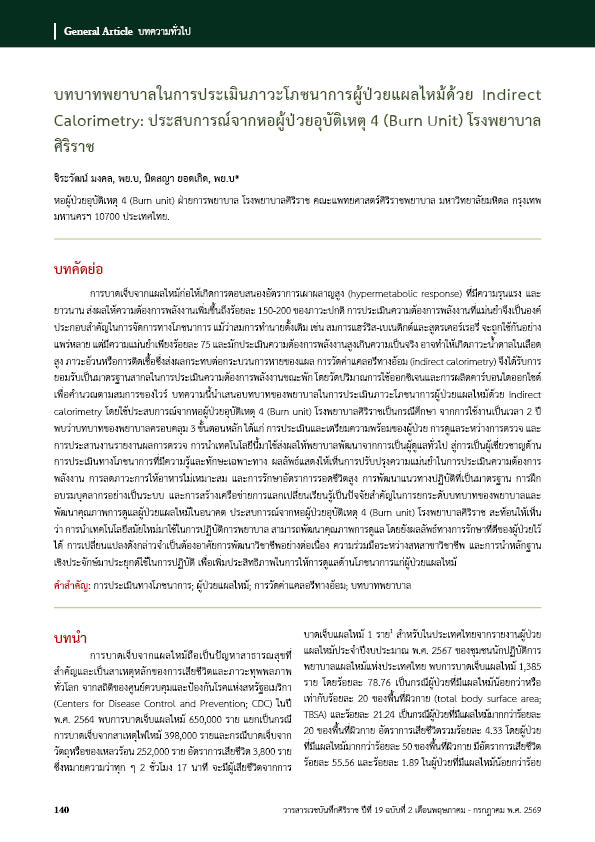
The Role of Nurses in Nutritional Assessment of Burn Patients Using Indirect Calorimetry: Experience from Trauma Ward 4 (Burn Unit) Siriraj Hospital
Article Sidebar
Main Article Content
Abstract
Burn injuries induce a severe and prolonged hypermetabolic response, resulting in energy requirements increased by 150 – 200% above normal levels. Accurate energy requirement assessment is, therefore, a critical component of nutritional
management. Although traditional predictive equations such as the Harris-Benedict equation and Curreri formula are widely used, they demonstrate only 75% and often overestimate energy requirements. This overestimation may lead to hyperglycemia, obesity, or infection, which can negatively impact the wound healing process. Indirect calorimetry has been recognized as the gold standard for assessing resting energy expenditure by measuring oxygen consumption and carbon dioxide production to calculate energy needs using the Weir equation. This article presents the nursing roles in the nutritional assessment of burn patients using indirect calorimetry, utilizing a two-year experience from Trauma Ward 4 (Burn Unit) at Siriraj Hospital as a case study. The nursing roles encompass three main phases: patient assessment and preparation, care during measurement procedures, and coordination of result reporting. Implementing this technology has transformed nurses from general caregivers to specialized experts in nutritional assessment with specific knowledge and skills. Results demonstrate improved accuracy in energy requirement assessment, reduced inappropriate feeding
practices, and maintenance of a high survival rate. The development of standardized practice guidelines, systematic personnel training, and the establishment of knowledge-sharing networks are essential factors for advancing nursing roles and enhancing the quality of burn patient care in the future. The experience from Siriraj Hospital's Burn Unit illustrates how modern technology integration can elevate nursing practice while maintaining excellence in patient outcomes. This transformation requires continuous professional development, interdisciplinary collaboration, and evidence-based practice implementation to optimize nutritional care delivery for burn patients.
Article Details

This work is licensed under a Creative Commons Attribution-NonCommercial-NoDerivatives 4.0 International License.




References
American Burn Association. (2024). Burn incidence fact sheet [Fact sheet]. https://ameriburn.org/resources/burn-incidence-fact-sheet/
ชุมชนนักปฏิบัติการพยาบาลผู้ป่วยแผลไหม้แห่งประเทศไทย. รายงานผู้ป่วยแผลไหม้ประจำปีงบประมาณ 2567. Thai J Burn and Wound Healing. 2025;9(1):2-6.
Williams, F. N., & Herndon, D. N. Metabolic and endocrine considerations after burn injury. Clin Plastic Surg. 2017;44(3):541-553.
Profile and Factors Influencing Resting Energy Expenditure in Adult Burn Patients. Burns & Trauma. 2020;8:1-10.
Wang Y, Jiang J, Liu M, Liu H, Shen T, Yang J, et al. Estimates of resting energy expenditure using predictive equations in adults with severe burns: a systematic review and meta-analysis. JPEN J Parenter Enteral Nutr. 2024;48:267-274.
Clark A, Imran J, Madni T, Wolf SE. Nutrition and metabolism in burn patients. Burns Trauma. 2017;5:11.
De Waele E, van Zanten ARH. Routine use of indirect calorimetry in critically ill patients: pros and cons. Crit Care. 2022;26:123.
Singer P, Blaser AR, Berger MM, Alhazzani W, Calder PC, Casaer MP, et al. ESPEN guideline on clinical nutrition in the intensive care unit. Clin Nutr. 2019;38:48-79.
Oshima T, Berger MM, De Waele E, Guttormsen AB, Heidegger CP, Hiesmayr M, et al. Indirect calorimetry in nutritional therapy. A position paper by the ICALIC study group. Clin Nutr. 2017;36:651-662.
Watanabe S, Izumino H, Takatani Y, Tsutsumi R, Suzuki T, Tatsumi H, et al. Effects of Energy Delivery Guided by Indirect Calorimetry in Critically Ill Patients: A Systematic Review and Meta-Analysis. Nutrients. 2024;16:1452.
Occhiali E, Bernard B, Fraboulet M, Achamrah N,
Clavier T. An evaluation of intensive care nurses' performance of indirect calorimetry measurements. Nurs Crit Care. 2024;29:307-312.
Van Den Berg GH, Huisman-de Waal G, Vermeulen H, Kruseman AC. Factors influencing the delivery of nutritional care by nurses for hospitalised medical patients with malnutrition; a qualitative study. J Clin Nurs. 2023;32:2487-2498.
Van Den Berg GH, Huisman-de Waal G, Vermeulen H, Kruseman AC. Factors influencing the delivery of nutritional care by nurses for hospitalised medical patients with malnutrition; a qualitative study. J Clin Nurs. 2023;32:2487-2498.
McClave SA, Taylor BE, Martindale RG, Warren MM, Johnson DR, Braunschweig C, et al. Guidelines for the provision and assessment of nutrition support therapy in adult critically ill patients. JPEN J Parenter Enteral Nutr. 2016;40:159-211.
Stanojcic M, Abdullahi A, Rehou S, Parousis A, Jeschke MG. Pathophysiological Response to Burn Injury in Adults. Ann Surg. 2018;267:576-584.
Jeschke, M. G., et al. Pathophysiological response to burn injury in adults. Ann Surg. 2018;267(3):576-585.
Abdullahi A, Jeschke MG. Taming the Flames: Targeting White Adipose Tissue Browning in Hypermetabolic Conditions. Endocr Rev. 2017;38:538-549.
Knuth CM, Ricciuti Z, Barayan D, Rehou S, Jeschke MG. Mapping the Hypermetabolic Response in Burn Patients. J Burn Care Res. 2022;43:S30.
Porter C, Tompkins RG, Finnerty CC, Sidossis LS, Suman OE, Herndon DN. The metabolic stress response to burn trauma: current understanding and therapies. Lancet. 2016;388:1417-1426.
Achamrah N, Delsoglio M, De Waele E, Berger MM, Pichard C. Indirect calorimetry: the 6 main issues. Clin Nutr. 2021;40:4-14.
Uhl S, Aerts O, Bouzit N, Klingler E, Genton L, Pichard C. Hospital malnutrition: It was, is now, and will remain a problem. Clin Nutr. 2021;40:4090-4101.
Roberts S, Chaboyer W, Hopper Z, Marshall AP. Using technology to promote patient engagement in nutrition care: A feasibility study. Nutrients. 2021;13:314.
Richards DA, Hilli A, Pentecost C, Goodwin VA, Frost J. Fundamental nursing care: A systematic review of the evidence on the effect of nursing care interventions for nutrition, elimination, mobility and hygiene. J Clin Nurs. 2018;27:2179-2188.
Xi P, Kaifa W, Yong Z, Hong Y, Chao W, Lijuan S, et al. Establishment and Assessment of New Formulas for Energy Consumption Estimation in Adult Burn Patients. PLoS ONE. 2014;9(10):e110409.
