สถานการณ์การจัดการศึกษาเพื่อส่งเสริมความเข้าใจพัฒนาการวัยรุ่นเชิงบวก ของนักเรียนระดับมัธยมศึกษาตอนต้น โรงเรียนแม่ลาน้อยดรุณสิกข์ จังหวัดแม่ฮ่องสอน
คำสำคัญ:
พัฒนาการวัยรุ่นเชิงบวก, การจัดการศึกษา, สุขภาวะบทคัดย่อ
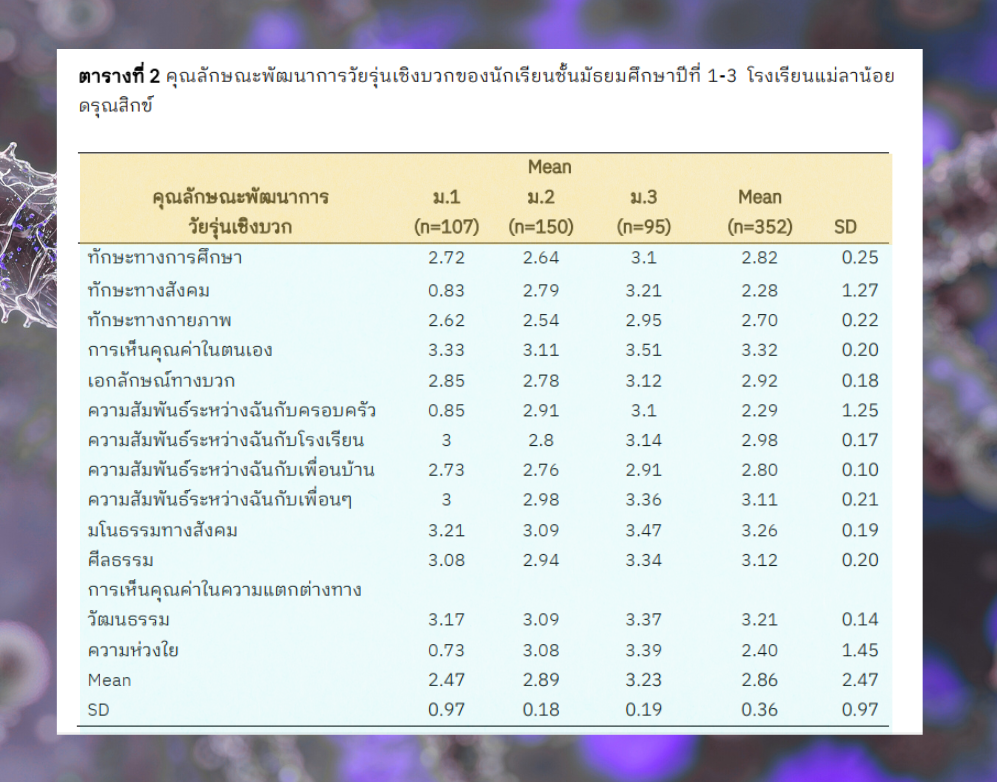
การวิจัยนี้ครั้งนี้เป็นการวิจัยแบบผสมผสานทั้งเชิงปริมาณและเชิงคุณภาพ มีวัตถุประสงค์เพื่อศึกษาสถานการณ์ที่เกี่ยวข้องกับการจัดการศึกษาเพื่อส่งเสริมความเข้าใจพัฒนาการวัยรุ่นเชิงบวก ระดับมัธยมศึกษาตอนต้น โรงเรียนแม่ลาน้อยดรุณสิกข์ จังหวัดแม่ฮ่องสอน การวิจัยเชิงปริมาณมีกลุ่มตัวอย่างคือ นักเรียน ม.1–ม.3 จำนวน 352 คน ส่วนการวิจัยเชิงคุณภาพมีผู้ให้ข้อมูลสำคัญได้แก่ ครู ผู้บริหาร ผู้ปกครอง และนักเรียน สำหรับข้อมูลเชิงปริมาณใช้สถิติเชิงพรรณนาได้แก่ ค่าเฉลี่ยเลขคณิต ส่วนเบี่ยงเบนมาตรฐาน ความถี่ และร้อยละ การวิเคราะห์ข้อมูลเชิงคุณภาพใช้การวิเคราะห์เนื้อหา ผลการวิจัยเชิงปริมาณพบว่าภาพรวมของพัฒนาการวัยรุ่นมีค่าคะแนนเฉลี่ยรวมของพัฒนาการวัยรุ่นเชิงบวกเพิ่มขึ้นตามระดับชั้น ม.1: เฉลี่ย 2.47 ม.2: เฉลี่ย 2.89 ม.3: เฉลี่ย 3.23 ผลการวิจัยเชิงคุณภาพพบว่า (1) โรงเรียนมีศักยภาพในการจัดกิจกรรมที่ส่งเสริมพัฒนาการของนักเรียนทุกมิติ โดยเฉพาะการใช้กิจกรรมท้องถิ่นและสร้างความสัมพันธ์กับชุมชน (2) รูปแบบ “7C–Maela Youth Positive Development Model” ที่ประกอบด้วย 7 องค์ประกอบ ได้แก่ Competence, Confidence, Connection, Character, Caring, Contribution และ Critical Consciousness สามารถประยุกต์กับบริบทและกิจกรรมในโรงเรียนได้อย่างเหมาะสม (3) ผลการประเมินรูปแบบพบว่า นักเรียนมีพัฒนาการเชิงบวกเพิ่มขึ้นในทุกองค์ประกอบ โดยเฉพาะความสามารถในการเรียนรู้ การสื่อสาร และการคิดเชิงวิพากษ์
เอกสารอ้างอิง
Bowers, E. P., Larson, L. R., & Parry, B. J. (2021). Nature as an ecological asset for positive youth development: Empirical evidence from rural communities. Frontiers in Psychology, 12 (688574): 1-15. https://doi.org/10.3389/fpsyg.2021.688574
Bronfenbrenner, U. (1979). The ecology of human development: Experiments by nature and design. Harvard University Press.
Camire, M., Newman, T. J., Bean, C., & Strachan, L. (2021). Reimagining positive youth development and life skills in sport through a social justice lens. Journal of Applied Sport Psychology 34 (6): 1058-1076. https://doi.org/10.1080/10413200.2021.1958954
Catalano, R. F., Berglund, M. L., Ryan, J. A. M., Lonczak, H. S., & Hawkins, J. D. (2004). Positive youth development in the United States: Research findings on evaluations of positive youth development programs. The Annals of the American Academy of Political and Social Science, 591(1): 98-124. https://doi.org/10.1177/0002716203260102
Domitrovich, C. E., Durlak, J. A., Staley, K. C., & Weissberg, R. P. (2017). Soocial-Emotional Competence: An Essential Factor for Promoting Positive Adjustment and Reducing Risk in School Children. Child Development, 88(2), 408-416.
Eccles, J. S., & Gootman, J. A. (2002). Community programs to promote youth development. National Academies Press. Retrieved 5, 2025 from https://nap.nationalacademies.org/catalog/10022/community-programs-to-promote-youth-development
Gomez-Baya, D., Reis, M., & Gaspar de Matos, M. (2019). Positive youth development, thriving and social engagement: An analysis of gender differences in Spanish youth. Scandinavian Journal of Psychology, 60(6): 559-568. https://doi.org/10.1111/sjop.12577
Gonzalez, M., Kokozos, M., Byrd, C. M., & McKee, K. E. (2020). Critical positive youth development: A framework for centering critical consciousness. Journal of Youth Development, 15(6): 24-43. https://doi.org/10.5195/jyd.2020.859
Gonzalez, M., Williams, C., & Guerra, F. (2024). Relational developmental systems in youth development. Journal of Adolescent Research, 39(1), 1-8.
Jacobs, J. M., Lawson, M., Ivy, V. N., & Richards, K. A. R. (2017). Enhancing the transfer of life skills from sport-based youth development programs to school, family, and community settings. Journal of Amateur Sport, 3(3): 20-43. https://doi.org//10.17161/jas.v3i3.6514
Kozina, A., Gmez-Baya, D., Gaspar de Matos, M., Tom, G., & Wiium, N. (2021). The association between the 5Cs and anxiety-insights from three countries: Portugal, Slovenia, and Spain. Frontiers in Psychology, 12(668049): 1-11. https://doi.org/10.3389/fpsyg.2021.668049
Krejcie, R. V. & Morgan, D. W. (1970). Determining Sample Size for Research Activities. Educational and Psychological Measurement, 30, 607-610.
Lerner, R. M., Almerigi, J. B., Theokas, C., & Lerner, J. V. (2005). Positive youth development a view of the issues. The Journal of Early Adolescence, 25(1): 10-16. https://doi.org/10.1177/0272431604273211
Lerner, R. M., Lerner, J. V., Almerigi, J. B., Theokas, C., Phelps, E., Gestsdottir, S., et al. (2005). Positive youth development, participation in community youth development programs, and community contributions of fifth-grade adolescents: Findings from the first wave of the 4-H study of positive youth development. The Journal of Early Adolescent, 25(1): 17-71. https://doi.org/10.1177/0272431604272461
Overton, W. F. (2024). Relational developmental systems and human development. In R. M. Lerner (Ed.). Handbook of child psychology and developmental science (8th ed., Vol.1, pp. 101-128). Wiley.
Pereira, T., & Freire, T. (2021). Positive youth development in the context of climate change: A systematic review. Frontiers in Psychology, 12(786119): 1-13. https://doi.org/10.3389/fpsyg.2021.786119
Qi, S., Hua, F., Zhou, Z., & Shek, D. T. L. (2020). Trends of positive youth development publications (1995–2020): A scientometric review. Applied Research in Quality of Life, 17(1): 421-446. https://doi.org/10.1007/s11482-020-09878-3
Roth, J. L., & Brooks-Gunn, J. (2003). What exactly is a youth development program? Answers from research and practice. Applied Developmental Science, 7(2): 94-111. https://doi.org/10.1207/S1532480XADS0702_6
Rovinelli, R. J., & Hambleton, R. K. (1977). On the use of content specialists in the assessment of criterion-referenced test item validity. Dutch Journal of Educational Research, 2(2), 49-60.
Shek, D. T. L. (2020). Chinese adolescent research under COVID-19. Journal of Adolescent Health, 67(6): 733-734. https://doi.org/10.1016/j.jadohealth.2020.09.011
Shek, D. T. L., & Chai, W. (2020). The impact of positive youth development attributes and life satisfaction on academic well-being: A longitudinal mediation study. Frontiers in Psychology, 11(2126): 1-14. https://doi.org/10.3389/fpsyg.2020.02126
Shek, D. T. L., Dou, D., Zhu, X., & Chai, W. (2019). Positive youth development: current perspectives. Adolescent Health, Medicine and Therapeutics, 10: 131-141. https://doi.org/10.2147/AHMT.S179946
Shek, D. T. L., Leung, K. H., Dou, D., & Zhu, X. (2022). Family functioning and adolescent Delingquency in Mainland China: positive youth development attributes as a mediator. Frontiers in Psychiatry, 13(883439): 1-14. https://doi.org/10.3389/fpsyg.2022.883439
Shek, D. T. L., Zhao, L., Dou, D., Zhu, X., & Xiao, C. (2021). The impact of positive youth development attributes on posttraumatic stress disorder symptoms among Chinese adolescents under covid-19. Journal of Adolescent Health, 68(4): 676-682. https://doi.org/10.1016/j.jadohealth.2021.01.011
Tagtow, A, Herman, D., & Cunningham-Sabo, L. (2022). Next-generation solutions to address adaptive challenges in dietetics practice: The I+PSE conceptual framework for action. Journal of the Academy of Nutrition and Dietetics, 122(1): 15-24. https://doi.org/10.1016/jand.2021.01.018
Wiium, N., & Dimitrova, R. (2019). Positive youth development across cultures: Introduction to the special issue. Child youth Care Forum, 48(2): 147-153. https://doi.org/10.1007/s10566-019-09488-7
Wong, A. H., Pacella-LaBarbara, M. L., Ray, J. M., Ranney, M. L., & Chang, B. P. (2020). Healing the healer: Protecting emergency health care workers’ mental health during COVID-19. Annals of Emergency Medicine, 76(4): 379-384.https://doi.org/10.1016/j.annemergmed.2020.04.041
Yoshikawa, H., Wuermli, A. J., Britto, P. R., Dreyer, B., Leckman, J. F.,Lye, S. J., et al. (2020). Effects of the global COVID-19 pandemic on early childhood development: Short- and long-term risks and mitigating program and policy actions. The Journal of Pediatrics, 223: 188-193. https://doi.org/10.1016/jpeds.2020.05.020
Zhou, Z., Shek, D. T. L., & Zhu, X. (2020). The importance of positive youth development attributes to life satisfaction and hopelessness in mainland Chinese adolescents.Frontiers in Psychology, 11(553313): 1-18. https://doi.org/10.3389/fpsyg.2020.553313
ดาวน์โหลด
เผยแพร่แล้ว
รูปแบบการอ้างอิง
ฉบับ
ประเภทบทความ
สัญญาอนุญาต
ลิขสิทธิ์ (c) 2025 วารสารสาธารณสุขและวิทยาศาสตร์สุขภาพ

อนุญาตภายใต้เงื่อนไข Creative Commons Attribution-NonCommercial-NoDerivatives 4.0 International License.
บทความทุกบทความที่ได้รับการตีพิมพ์ถือเป็นลิขสิทธิ์ของ วารสารสาธารณสุข