The Situation of Educational Management for Promoting Understanding and Positive Youth Development Among Lower Secondary Students at Maelanoi Daroonsik School, Mae Hong Son Province
Keywords:
Positive Youth Development, Educational Management, Rural School ContextAbstract
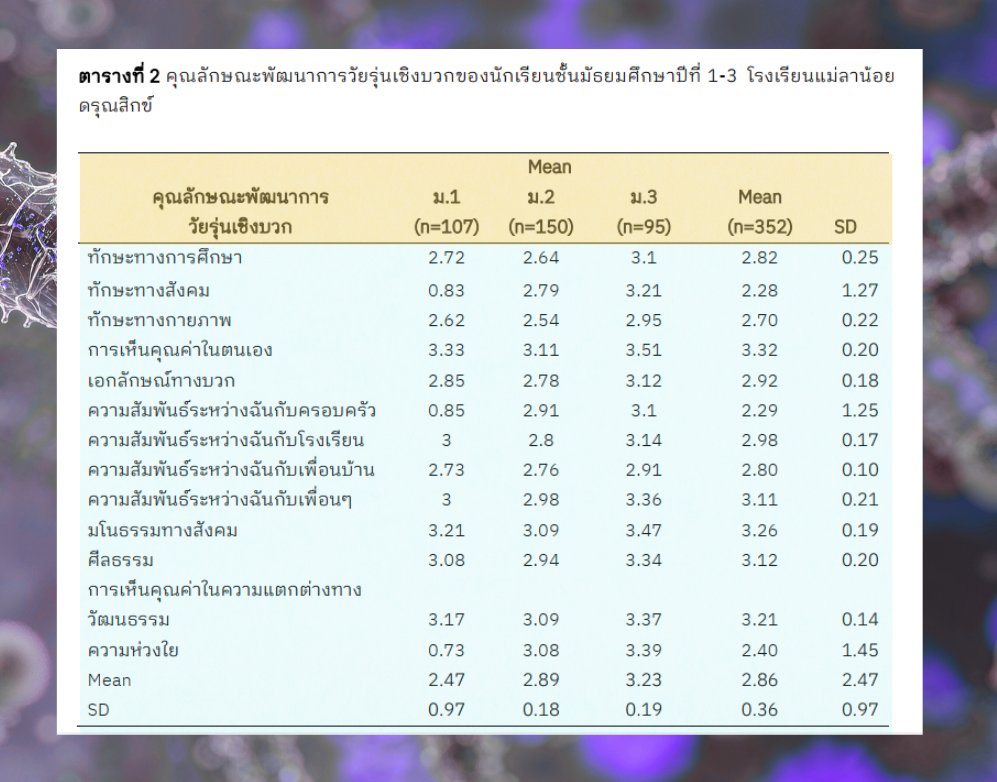
This research is mixed-method research, both quantitative and qualitative, to study the situation related to educational management to promote understanding of positive adolescent development at the lower secondary level, Maelanoi Daroonsik School, Mae Hong Son Province. The quantitative research had a sample group of 352 students in grades 1–3. The qualitative study had key informants, including teachers, administrators, parents, and students. Quantitative statistics were used, including arithmetic mean, standard deviation, frequency, and percentage. The qualitative data analysis used content analysis. The quantitative research results found that the overall picture of adolescent development had an average score of positive adolescent development that increased according to grade level. M.1: average 2.47, M.2: average 2.89, M.3: average 3.23. The qualitative research results found that (1) schools have the potential to organize activities that promote student development in the dimensions, especially by using local activities and building relationships with the community. (2) The “7C–Maela Youth Positive Development Model,” which consists of 7 components: Competence, Confidence, Connection, Character, Caring, Contribution, and Critical Consciousness, can be appropriately applied to school contexts and activities. (3) The results of the evaluation of the model found that students had positive development in all components, especially learning abilities, communication, and critical thinking.
References
Bowers, E. P., Larson, L. R., & Parry, B. J. (2021). Nature as an ecological asset for positive youth development: Empirical evidence from rural communities. Frontiers in Psychology, 12 (688574): 1-15. https://doi.org/10.3389/fpsyg.2021.688574
Bronfenbrenner, U. (1979). The ecology of human development: Experiments by nature and design. Harvard University Press.
Camire, M., Newman, T. J., Bean, C., & Strachan, L. (2021). Reimagining positive youth development and life skills in sport through a social justice lens. Journal of Applied Sport Psychology 34 (6): 1058-1076. https://doi.org/10.1080/10413200.2021.1958954
Catalano, R. F., Berglund, M. L., Ryan, J. A. M., Lonczak, H. S., & Hawkins, J. D. (2004). Positive youth development in the United States: Research findings on evaluations of positive youth development programs. The Annals of the American Academy of Political and Social Science, 591(1): 98-124. https://doi.org/10.1177/0002716203260102
Domitrovich, C. E., Durlak, J. A., Staley, K. C., & Weissberg, R. P. (2017). Soocial-Emotional Competence: An Essential Factor for Promoting Positive Adjustment and Reducing Risk in School Children. Child Development, 88(2), 408-416.
Eccles, J. S., & Gootman, J. A. (2002). Community programs to promote youth development. National Academies Press. Retrieved 5, 2025 from https://nap.nationalacademies.org/catalog/10022/community-programs-to-promote-youth-development
Gomez-Baya, D., Reis, M., & Gaspar de Matos, M. (2019). Positive youth development, thriving and social engagement: An analysis of gender differences in Spanish youth. Scandinavian Journal of Psychology, 60(6): 559-568. https://doi.org/10.1111/sjop.12577
Gonzalez, M., Kokozos, M., Byrd, C. M., & McKee, K. E. (2020). Critical positive youth development: A framework for centering critical consciousness. Journal of Youth Development, 15(6): 24-43. https://doi.org/10.5195/jyd.2020.859
Gonzalez, M., Williams, C., & Guerra, F. (2024). Relational developmental systems in youth development. Journal of Adolescent Research, 39(1), 1-8.
Jacobs, J. M., Lawson, M., Ivy, V. N., & Richards, K. A. R. (2017). Enhancing the transfer of life skills from sport-based youth development programs to school, family, and community settings. Journal of Amateur Sport, 3(3): 20-43. https://doi.org//10.17161/jas.v3i3.6514
Kozina, A., Gmez-Baya, D., Gaspar de Matos, M., Tom, G., & Wiium, N. (2021). The association between the 5Cs and anxiety-insights from three countries: Portugal, Slovenia, and Spain. Frontiers in Psychology, 12(668049): 1-11. https://doi.org/10.3389/fpsyg.2021.668049
Krejcie, R. V. & Morgan, D. W. (1970). Determining Sample Size for Research Activities. Educational and Psychological Measurement, 30, 607-610.
Lerner, R. M., Almerigi, J. B., Theokas, C., & Lerner, J. V. (2005). Positive youth development a view of the issues. The Journal of Early Adolescence, 25(1): 10-16. https://doi.org/10.1177/0272431604273211
Lerner, R. M., Lerner, J. V., Almerigi, J. B., Theokas, C., Phelps, E., Gestsdottir, S., et al. (2005). Positive youth development, participation in community youth development programs, and community contributions of fifth-grade adolescents: Findings from the first wave of the 4-H study of positive youth development. The Journal of Early Adolescent, 25(1): 17-71. https://doi.org/10.1177/0272431604272461
Overton, W. F. (2024). Relational developmental systems and human development. In R. M. Lerner (Ed.). Handbook of child psychology and developmental science (8th ed., Vol.1, pp. 101-128). Wiley.
Pereira, T., & Freire, T. (2021). Positive youth development in the context of climate change: A systematic review. Frontiers in Psychology, 12(786119): 1-13. https://doi.org/10.3389/fpsyg.2021.786119
Qi, S., Hua, F., Zhou, Z., & Shek, D. T. L. (2020). Trends of positive youth development publications (1995–2020): A scientometric review. Applied Research in Quality of Life, 17(1): 421-446. https://doi.org/10.1007/s11482-020-09878-3
Roth, J. L., & Brooks-Gunn, J. (2003). What exactly is a youth development program? Answers from research and practice. Applied Developmental Science, 7(2): 94-111. https://doi.org/10.1207/S1532480XADS0702_6
Rovinelli, R. J., & Hambleton, R. K. (1977). On the use of content specialists in the assessment of criterion-referenced test item validity. Dutch Journal of Educational Research, 2(2), 49-60.
Shek, D. T. L. (2020). Chinese adolescent research under COVID-19. Journal of Adolescent Health, 67(6): 733-734. https://doi.org/10.1016/j.jadohealth.2020.09.011
Shek, D. T. L., & Chai, W. (2020). The impact of positive youth development attributes and life satisfaction on academic well-being: A longitudinal mediation study. Frontiers in Psychology, 11(2126): 1-14. https://doi.org/10.3389/fpsyg.2020.02126
Shek, D. T. L., Dou, D., Zhu, X., & Chai, W. (2019). Positive youth development: current perspectives. Adolescent Health, Medicine and Therapeutics, 10: 131-141. https://doi.org/10.2147/AHMT.S179946
Shek, D. T. L., Leung, K. H., Dou, D., & Zhu, X. (2022). Family functioning and adolescent Delingquency in Mainland China: positive youth development attributes as a mediator. Frontiers in Psychiatry, 13(883439): 1-14. https://doi.org/10.3389/fpsyg.2022.883439
Shek, D. T. L., Zhao, L., Dou, D., Zhu, X., & Xiao, C. (2021). The impact of positive youth development attributes on posttraumatic stress disorder symptoms among Chinese adolescents under covid-19. Journal of Adolescent Health, 68(4): 676-682. https://doi.org/10.1016/j.jadohealth.2021.01.011
Tagtow, A, Herman, D., & Cunningham-Sabo, L. (2022). Next-generation solutions to address adaptive challenges in dietetics practice: The I+PSE conceptual framework for action. Journal of the Academy of Nutrition and Dietetics, 122(1): 15-24. https://doi.org/10.1016/jand.2021.01.018
Wiium, N., & Dimitrova, R. (2019). Positive youth development across cultures: Introduction to the special issue. Child youth Care Forum, 48(2): 147-153. https://doi.org/10.1007/s10566-019-09488-7
Wong, A. H., Pacella-LaBarbara, M. L., Ray, J. M., Ranney, M. L., & Chang, B. P. (2020). Healing the healer: Protecting emergency health care workers’ mental health during COVID-19. Annals of Emergency Medicine, 76(4): 379-384.https://doi.org/10.1016/j.annemergmed.2020.04.041
Yoshikawa, H., Wuermli, A. J., Britto, P. R., Dreyer, B., Leckman, J. F.,Lye, S. J., et al. (2020). Effects of the global COVID-19 pandemic on early childhood development: Short- and long-term risks and mitigating program and policy actions. The Journal of Pediatrics, 223: 188-193. https://doi.org/10.1016/jpeds.2020.05.020
Zhou, Z., Shek, D. T. L., & Zhu, X. (2020). The importance of positive youth development attributes to life satisfaction and hopelessness in mainland Chinese adolescents.Frontiers in Psychology, 11(553313): 1-18. https://doi.org/10.3389/fpsyg.2020.553313
Downloads
Published
How to Cite
Issue
Section
License
Copyright (c) 2025 Thai Journal of Public Health and Health Sciences

This work is licensed under a Creative Commons Attribution-NonCommercial-NoDerivatives 4.0 International License.
บทความทุกบทความที่ได้รับการตีพิมพ์ถือเป็นลิขสิทธิ์ของ วารสารสาธารณสุข