ความสัมพันธ์ระหว่างการทำหน้าที่ของครอบครัวและสถานะการเลิกสูบบุหรี่ของผู้ที่มีหรือเคยมีประวัติติดบุหรี่ในกองตรวจโรคผู้ป่วยนอก โรงพยาบาลพระมงกุฎเกล้า
คำสำคัญ:
การเลิกสูบบุหรี่, การทำงานของครอบครัว, ทัศนคติของครอบครัว, ปัจจัยทางสังคมประชากร, การแก้ปัญหาและบทบาทในครอบครัวบทคัดย่อ
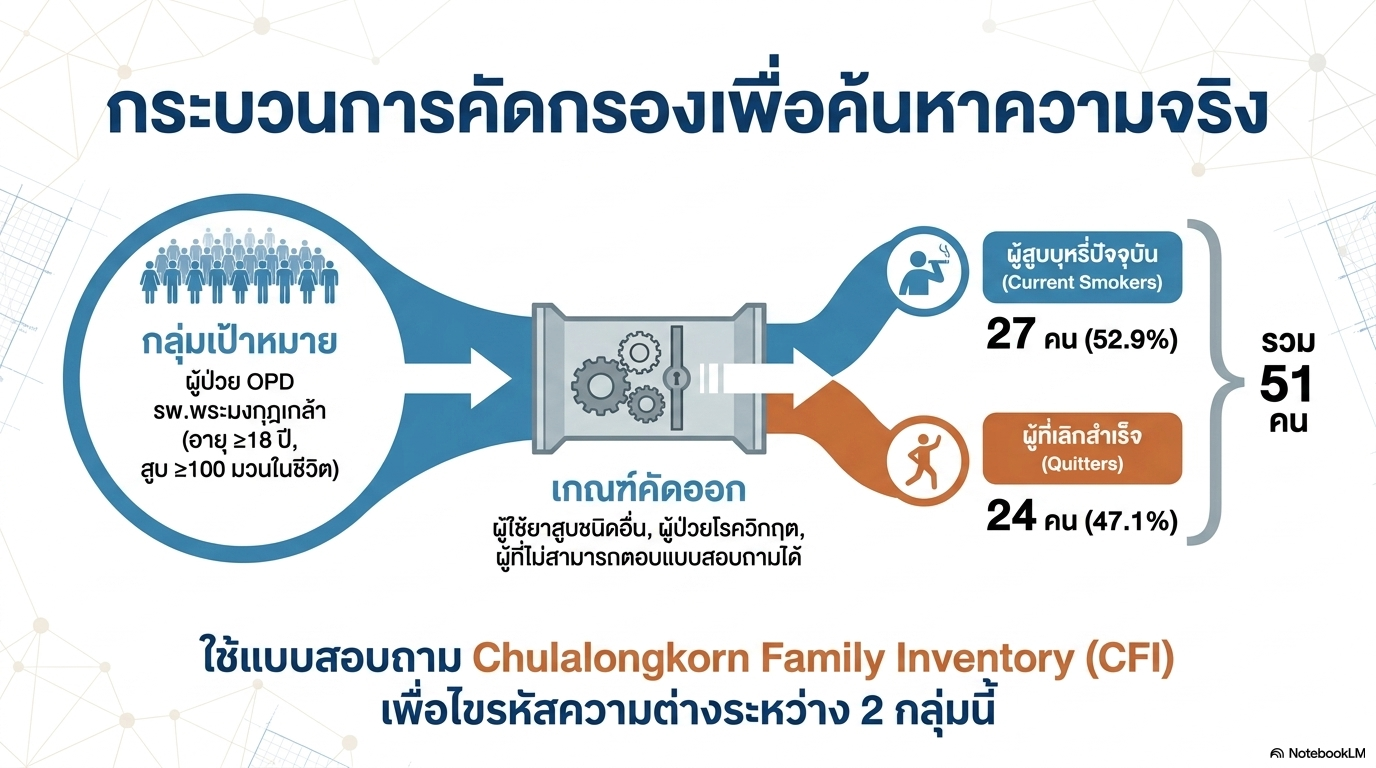
การวิจัยครั้งนี้เป็นการศึกษาแบบภาคตัดขวาง มีวัตถุประสงค์เพื่อประเมินความสัมพันธ์ระหว่างการทำหน้าที่ของครอบครัวและสถานะการเลิกสูบบุหรี่ของผู้ที่มีหรือเคยมีประวัติติดบุหรี่ในกองตรวจโรคผู้ป่วยนอก โรงพยาบาลพระมงกุฎเกล้า รวมถึงสำรวจความแตกต่างด้านลักษณะการสูบบุหรี่และทัศนคติของครอบครัวต่อการสูบบุหรี่ระหว่างผู้ที่ยังสูบบุหรี่อยู่และเลิกสูบบุหรี่ได้สำเร็จแล้ว กลุ่มตัวอย่างประกอบด้วยผู้เข้าร่วม 51 คน ได้แก่ ผู้สูบบุหรี่ปัจจุบัน 27 คน และผู้เลิกบุหรี่แล้ว 24 คน (เลิกนานแล้ว 19 คน เลิกไม่นาน 5 คน) การเก็บข้อมูลใช้แบบสอบถามโครงสร้างซึ่งรวบรวมข้อมูลด้านสังคมประชากร ประวัติการสูบบุหรี่ ทัศนคติของครอบครัว และการทำงานของครอบครัวโดยใช้แบบสอบถาม Chulalongkorn Family Inventory (CFI) การวิเคราะห์ข้อมูลใช้สถิติ Chi-square สำหรับตัวแปรเชิงกลุ่ม และ Mann–Whitney U test สำหรับตัวแปรเชิงปริมาณ พร้อมด้วยการวิเคราะห์ถดถอยโลจิสติกเพื่อประเมินความสัมพันธ์ระหว่างคะแนน CFI และสถานะการเลิกบุหรี่
ผลการศึกษาพบว่า ผู้เลิกบุหรี่มีอายุมากกว่า แต่งงานมากกว่า มีการศึกษาสูงกว่า และมักทำงานนอกภาครัฐมากกว่าผู้สูบบุหรี่ (p < 0.05) ขณะที่ไม่พบความแตกต่างอย่างมีนัยสำคัญในด้านลักษณะการสูบบุหรี่และทัศนคติของครอบครัวต่อการสูบ คะแนนรวม CFI อยู่ในระดับดี (มัธยฐาน 108, IQR 101–118) โดยผู้เลิกบุหรี่มีคะแนนด้านการแก้ปัญหา (20 เทียบกับ 17, p = 0.021) และบทบาท (11 เทียบกับ 10, p = 0.014) สูงกว่าอย่างมีนัยสำคัญ การวิเคราะห์ถดถอยโลจิสติกพบว่าโอกาสเลิกบุหรี่เพิ่มขึ้นต่อการเพิ่มขึ้น 1 คะแนนในด้านการแก้ปัญหา (OR 1.27, 95% CI 1.037–1.556, p = 0.021) และด้านบทบาท (OR 1.748, 95% CI 1.121–2.724, p = 0.014) สรุปได้ว่า อายุ การสมรส ระดับการศึกษา อาชีพ รวมถึงการทำงานของครอบครัวที่ดีโดยเฉพาะด้านการแก้ปัญหาและบทบาท มีส่วนสำคัญต่อความสำเร็จในการเลิกบุหรี่ และควรนำมาพิจารณาในการออกแบบโปรแกรมช่วยเลิกบุหรี่
เอกสารอ้างอิง
Adler, L., Abu Arar, S., Yehoshua, I., Cohen, B., Hermoni Alon, S., Shahar, A. et al (2023). Smoking cessation—better together: A retrospective cohort study. Tobacco Induced Diseases, 21,64. doi:10.18332/tid/162367
Alves, J., Perelman, J., Ramos, E., & Kunst, A. E. (2022). Intergenerational transmission of parental smoking: When are offspring most vulnerable? European Journal of Public Health, 32(5), 741–746. doi:10.1093/eurpub/ckac065
Cho, G. H., Jang, Y. S., Shin, J., Nam, C.-M., & Park, E.-C. (2023). Association between having a meal together with family and smoking: A cross-sectional nationwide survey. BMC Public Health, 23(1), 17155. doi:10.1186/s12889-023-17155-9
Effendi, D. E., Ardani, I., Handayani, S., Agustiya, R. I., Nugroho, A. P., Oktriyanto, O., Yulianto, A. (2024). Factors associated with quitting smoking among males: Findings from the Indonesian National Health Survey. Clinical Epidemiology and Global Health, 28, 101672. doi:10.1016/j.cegh.2024.101672
Faseru, B., Richter, K. P., Scheuermann, T. S., & Park, E. W. (2018). Enhancing partner support to improve smoking cessation. Cochrane Database of Systematic Reviews, 2018(8), CD002928. doi:10.1002/14651858.CD002928.pub4
Flay, B. R. (1999). Understanding environmental, situational and intrapersonal risk and protective factors for youth tobacco use: The theory of triadic influence. Nicotine & Tobacco Research, 1(Suppl 1), S111–S114. doi:10.1080/14622299050011911
Guo, Y., Liu, D.-Y., Wang, Y.-J., Huang, M.-J., Jiang, N., Hou, Q., Sun, X.-Y. (2023). Family functioning and nicotine dependence among smoking fathers: A cross-sectional study. BMC Public Health, 23, 658. doi:10.1186/s12889-023-15475-4
Klinsophon, T., Janwantanakul, P., & Thaveeratitham, P. (2017). Reliability of the Thai version of the Fagerstrom Test for Nicotine Dependence (FTND). Journal of the Medical Association of Thailand, 100(10), 1130–1134.
Komonpaisarn, T. (2022). Economic cost of tobacco smoking and secondhand smoke exposure at home in Thailand. Tobacco Control, 31(6), 714–722. doi:10.1136/tobaccocontrol-2020-056147
Lin, H., Li, M., Chen, M., Liu, Y., Lin, Y., Liu, Z., et al. (2021). The association of workplace smoke-free policies on individual smoking and quitting-related behaviours. BMC Public Health, 21, 2308. doi:10.1186/s12889-021-12395-z
Lowenstein, C., Dow, W. H., & White, J. S. (2020). Peer effects in smoking cessation: An instrumental variables analysis of a worksite intervention in Thailand. SSM - Population Health, 12, 100659. doi:10.1016/j.ssmph.2020.100659
Nagawa, C. S., Pbert, L., Wang, B., Cutrona, S. L., Davis, M., Lemon, S. C., et al. (2022). Association between family or peer views towards tobacco use and past 30-day smoking cessation among adults with mental health problems. Preventive Medicine Reports, 28, 101886. doi:10.1016/j.pmedr.2022.101886
Parwatha, N. W., Lesmana, C. B. J., Aryani, L. N. A., Westa, W., Lely, S., Diniari, N. K. S. (2020). Association between family function and cigarette addiction in high school students. Journal of Clinical and Cultural Psychiatry, 1(1), 9–13.
Prochaska, J. O. (1984). Systems of psychotherapy: A transtheoretical analysis (2nd ed.). Pacific Grove, CA: Brooks/Cole.
Ruokolainen, O., Harkanen, T., Lahti, J., Haukkala, A., Heliovaara, M., Rahkonen, O. (2021). Association between educational level and smoking cessation in an 11-year follow-up study of a national health survey. Scandinavian Journal of Public Health, 49, 951–960. doi:10.1177/1403494821993721
Sornpaisarn, B., Parvez, N., Chatakan, W., Thitiprasert, W., Precha, P., Kongsakol, R., et al (2022). Methods and factors influencing successful smoking cessation in Thailand: A case-control study among smokers at the community level. Tobacco Induced Diseases, 20, 67. doi:10.18332/tid/150345
Thailand National Statistical Office. (2025). The 2024 survey on smoking and drinking situation of population [PDF]. Bangkok, Thailand: National Statistical Office, Ministry of Digital Economy and Society. Retrieved July 18, 2025 from https://www.nso.go.th/nsoweb/storage/survey_detail/2025/20250401100215_15169.pdf
Tobacco Control Research and Knowledge Management Center. (2023, August 11). Burden of disease attributable to risk factors in Thailand 2019. Bangkok, Thailand: Faculty of Medicine, Ramathibodi Hospital, Mahidol University. Retrieved July 20, 2025, from https://www.trc.or.th/en/burden-of-disease-attributable-to-risk-factors-in-thailand-2019
Trangkasombat, U. (2001). Family therapy and family counseling. Bangkok, Thailand: Family Research and Development Center.
Whitton, S. W., McLeish, A. C., Godfrey, L. M., James-Kangal, N., & Rhoades, G. K. (2020). Partner-assisted smoking cessation treatment: A randomized clinical trial. Substance Use & Misuse, 55, 1–9.
Xia, Y., Gong, Y., Wang, H., Li, S., Mao, F. (2022). Family function impacts relapse tendency in substance use disorder: Mediated through self-esteem and resilience. Frontiers in Psychiatry, 13, 815118. doi:10.3389/fpsyt.2022.815118
ดาวน์โหลด
เผยแพร่แล้ว
รูปแบบการอ้างอิง
ฉบับ
ประเภทบทความ
สัญญาอนุญาต
ลิขสิทธิ์ (c) 2026 วารสารสาธารณสุขและวิทยาศาสตร์สุขภาพ

อนุญาตภายใต้เงื่อนไข Creative Commons Attribution-NonCommercial-NoDerivatives 4.0 International License.
บทความทุกบทความที่ได้รับการตีพิมพ์ถือเป็นลิขสิทธิ์ของ วารสารสาธารณสุข