Association Between Family Functioning and Smoking Cessation Status among Smokers in Outpatient Department, Phramongkutklao Hospital
Keywords:
Smoking cessation, Family functioning, Family attitudes, Sociodemographic factors, Problem solving and family rolesAbstract
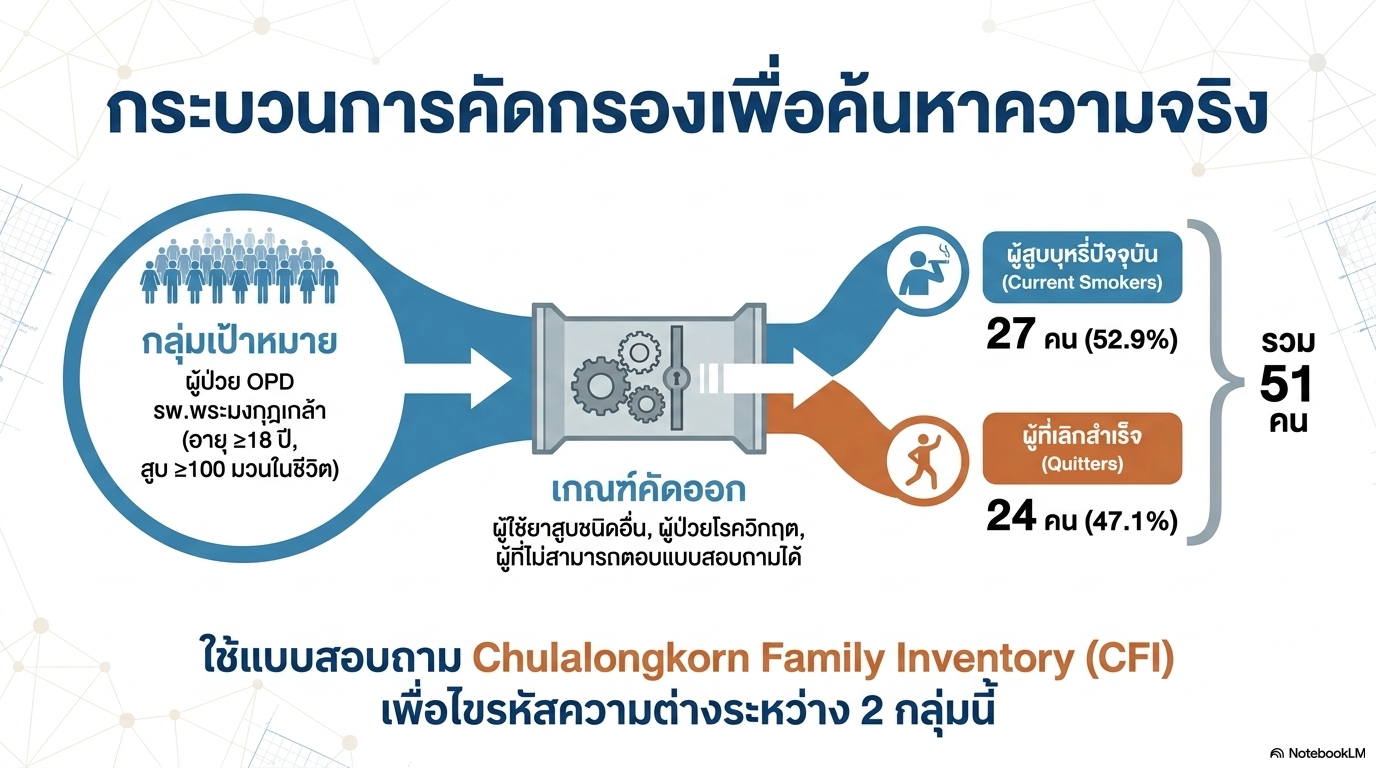
This cross-sectional study compared family functioning between current smokers and individuals who had successfully quit, and explored differences in smoking characteristics and perceived family attitudes toward smoking. Fifty-one participants were enrolled: 27 current smokers and 24 quitters (19 remote, 5 recent). Sociodemographic data, smoking history, family attitudes, and family functioning (Chulalongkorn Family Inventory [CFI]) were collected via structured questionnaire. Categorical variables were analyzed with Chi-square tests, continuous variables with Mann–Whitney U tests, and logistic regression was used to assess associations between CFI scores and smoking cessation status.
Quitters were significantly older, more often married, more highly educated, and more likely to work outside the government sector than current smokers (all p < 0.05). Smoking-related characteristics and perceived family attitudes toward smoking did not differ significantly between groups. Overall family functioning was good (median total CFI 108, IQR 101–118). Quitters had higher CFI Problem Solving scores (20 [18–21] vs 17 [15–20], p = 0.021) and Role scores (11 [10–11] vs 10 [8–11], p = 0.014). Logistic regression indicated increased odds of quitting per one-point increase in Problem Solving (OR 1.27, 95% CI 1.037–1.556, p = 0.021) and Role (OR 1.748, 95% CI 1.121–2.724, p = 0.014). These findings suggest that older age, being married, higher education, non-government employment, and stronger family functioning—particularly in problem solving and role performance—are associated with successful smoking cessation and may inform the design of cessation programs.
References
Adler, L., Abu Arar, S., Yehoshua, I., Cohen, B., Hermoni Alon, S., Shahar, A. et al (2023). Smoking cessation—better together: A retrospective cohort study. Tobacco Induced Diseases, 21,64. doi:10.18332/tid/162367
Alves, J., Perelman, J., Ramos, E., & Kunst, A. E. (2022). Intergenerational transmission of parental smoking: When are offspring most vulnerable? European Journal of Public Health, 32(5), 741–746. doi:10.1093/eurpub/ckac065
Cho, G. H., Jang, Y. S., Shin, J., Nam, C.-M., & Park, E.-C. (2023). Association between having a meal together with family and smoking: A cross-sectional nationwide survey. BMC Public Health, 23(1), 17155. doi:10.1186/s12889-023-17155-9
Effendi, D. E., Ardani, I., Handayani, S., Agustiya, R. I., Nugroho, A. P., Oktriyanto, O., Yulianto, A. (2024). Factors associated with quitting smoking among males: Findings from the Indonesian National Health Survey. Clinical Epidemiology and Global Health, 28, 101672. doi:10.1016/j.cegh.2024.101672
Faseru, B., Richter, K. P., Scheuermann, T. S., & Park, E. W. (2018). Enhancing partner support to improve smoking cessation. Cochrane Database of Systematic Reviews, 2018(8), CD002928. doi:10.1002/14651858.CD002928.pub4
Flay, B. R. (1999). Understanding environmental, situational and intrapersonal risk and protective factors for youth tobacco use: The theory of triadic influence. Nicotine & Tobacco Research, 1(Suppl 1), S111–S114. doi:10.1080/14622299050011911
Guo, Y., Liu, D.-Y., Wang, Y.-J., Huang, M.-J., Jiang, N., Hou, Q., Sun, X.-Y. (2023). Family functioning and nicotine dependence among smoking fathers: A cross-sectional study. BMC Public Health, 23, 658. doi:10.1186/s12889-023-15475-4
Klinsophon, T., Janwantanakul, P., & Thaveeratitham, P. (2017). Reliability of the Thai version of the Fagerstrom Test for Nicotine Dependence (FTND). Journal of the Medical Association of Thailand, 100(10), 1130–1134.
Komonpaisarn, T. (2022). Economic cost of tobacco smoking and secondhand smoke exposure at home in Thailand. Tobacco Control, 31(6), 714–722. doi:10.1136/tobaccocontrol-2020-056147
Lin, H., Li, M., Chen, M., Liu, Y., Lin, Y., Liu, Z., et al. (2021). The association of workplace smoke-free policies on individual smoking and quitting-related behaviours. BMC Public Health, 21, 2308. doi:10.1186/s12889-021-12395-z
Lowenstein, C., Dow, W. H., & White, J. S. (2020). Peer effects in smoking cessation: An instrumental variables analysis of a worksite intervention in Thailand. SSM - Population Health, 12, 100659. doi:10.1016/j.ssmph.2020.100659
Nagawa, C. S., Pbert, L., Wang, B., Cutrona, S. L., Davis, M., Lemon, S. C., et al. (2022). Association between family or peer views towards tobacco use and past 30-day smoking cessation among adults with mental health problems. Preventive Medicine Reports, 28, 101886. doi:10.1016/j.pmedr.2022.101886
Parwatha, N. W., Lesmana, C. B. J., Aryani, L. N. A., Westa, W., Lely, S., Diniari, N. K. S. (2020). Association between family function and cigarette addiction in high school students. Journal of Clinical and Cultural Psychiatry, 1(1), 9–13.
Prochaska, J. O. (1984). Systems of psychotherapy: A transtheoretical analysis (2nd ed.). Pacific Grove, CA: Brooks/Cole.
Ruokolainen, O., Harkanen, T., Lahti, J., Haukkala, A., Heliovaara, M., Rahkonen, O. (2021). Association between educational level and smoking cessation in an 11-year follow-up study of a national health survey. Scandinavian Journal of Public Health, 49, 951–960. doi:10.1177/1403494821993721
Sornpaisarn, B., Parvez, N., Chatakan, W., Thitiprasert, W., Precha, P., Kongsakol, R., et al (2022). Methods and factors influencing successful smoking cessation in Thailand: A case-control study among smokers at the community level. Tobacco Induced Diseases, 20, 67. doi:10.18332/tid/150345
Thailand National Statistical Office. (2025). The 2024 survey on smoking and drinking situation of population [PDF]. Bangkok, Thailand: National Statistical Office, Ministry of Digital Economy and Society. Retrieved July 18, 2025 from https://www.nso.go.th/nsoweb/storage/survey_detail/2025/20250401100215_15169.pdf
Tobacco Control Research and Knowledge Management Center. (2023, August 11). Burden of disease attributable to risk factors in Thailand 2019. Bangkok, Thailand: Faculty of Medicine, Ramathibodi Hospital, Mahidol University. Retrieved July 20, 2025, from https://www.trc.or.th/en/burden-of-disease-attributable-to-risk-factors-in-thailand-2019
Trangkasombat, U. (2001). Family therapy and family counseling. Bangkok, Thailand: Family Research and Development Center.
Whitton, S. W., McLeish, A. C., Godfrey, L. M., James-Kangal, N., & Rhoades, G. K. (2020). Partner-assisted smoking cessation treatment: A randomized clinical trial. Substance Use & Misuse, 55, 1–9.
Xia, Y., Gong, Y., Wang, H., Li, S., Mao, F. (2022). Family function impacts relapse tendency in substance use disorder: Mediated through self-esteem and resilience. Frontiers in Psychiatry, 13, 815118. doi:10.3389/fpsyt.2022.815118
Downloads
Published
How to Cite
Issue
Section
License
Copyright (c) 2026 Thai Journal of Public Health and Health Sciences

This work is licensed under a Creative Commons Attribution-NonCommercial-NoDerivatives 4.0 International License.
บทความทุกบทความที่ได้รับการตีพิมพ์ถือเป็นลิขสิทธิ์ของ วารสารสาธารณสุข