การพัฒนาระบบการดูแลแผลเท้าเบาหวานในผู้ป่วยโรคเบาหวาน อำเภอประทาย จังหวัดนครราชสีมา
คำสำคัญ:
การวิจัยเชิงปฏิบัติการ, แผลเท้าเบาหวาน, ระบบบริการสุขภาพ , การดูแลต่อเนื่อง, การป้องกันบทคัดย่อ
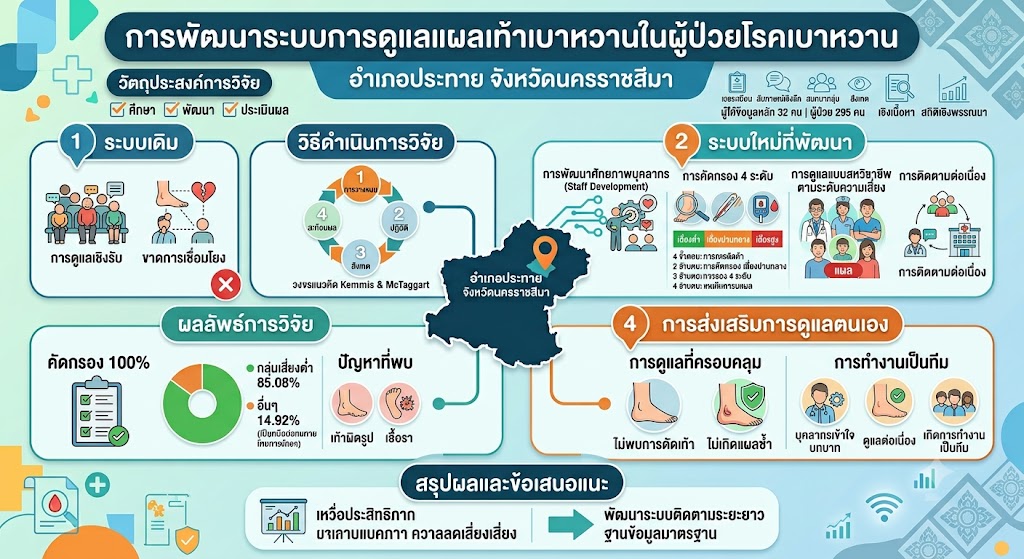
การวิจัยเชิงปฏิบัติการครั้งนี้มีวัตถุประสงค์เพื่อศึกษา พัฒนา และประเมินผลระบบการดูแลแผลเท้าเบาหวานในผู้ป่วยโรคเบาหวาน อำเภอประทาย จังหวัดนครราชสีมา โดยใช้แนวคิดของ Kemmis และ McTaggart ดำเนินการตามวงจร 4 ขั้นตอน ได้แก่ การวางแผน ปฏิบัติ สังเกต และสะท้อนผล เก็บข้อมูลจากเวชระเบียน การสัมภาษณ์เชิงลึก การสนทนากลุ่ม และการสังเกต ผู้ให้ข้อมูลหลัก 32 คน และนำระบบไปใช้กับผู้ป่วย 295 คน วิเคราะห์ข้อมูลเชิงเนื้อหาและสถิติเชิงพรรณนา
ผลการวิจัยพบว่า ระบบเดิมเป็นการดูแลเชิงรับ ขาดการเชื่อมโยงการคัดกรองกับการดูแลต่อเนื่อง ระบบที่พัฒนาประกอบด้วย 1) การพัฒนาศักยภาพบุคลากร 2) การคัดกรองและจำแนกระดับความเสี่ยง 4 ระดับ 3) การดูแลตามระดับความเสี่ยงโดยทีมสหสาขาวิชาชีพ และ 4) การติดตามต่อเนื่อง ผลการดำเนินงานพบว่า ผู้ป่วยได้รับการคัดกรองร้อยละ 100 ส่วนใหญ่อยู่ในกลุ่มเสี่ยงต่ำ (85.08%) พบปัญหาเท้าผิดรูปและเชื้อรา ผู้ป่วยกลุ่มเสี่ยงได้รับการดูแลตามแนวทางอย่างครอบคลุม ส่งผลให้ไม่พบการตัดเท้าและไม่เกิดแผลซ้ำในกลุ่มที่ได้รับการดูแลครบถ้วน บุคลากรมีความเข้าใจบทบาทชัดเจนขึ้น การดูแลมีความต่อเนื่อง และเกิดการทำงานเป็นทีม สรุประบบที่พัฒนาช่วยเพิ่มประสิทธิภาพการดูแลเชิงป้องกันและความต่อเนื่องของการดูแล ลดความเสี่ยงการเกิดแผลเท้าเบาหวาน ควรพัฒนาระบบติดตามระยะยาวและฐานข้อมูลมาตรฐานเพื่อความยั่งยืน
เอกสารอ้างอิง
Armstrong, D. G., Boulton, A. J. M., & Bus, S. A. (2017). Diabetic foot ulcers and their recurrence. New England Journal of Medicine, 376(24), 2367–2375.
Auewattana, A., Chitdee, A., & Nissiakla, P. (2018). Care system for patients with diabetic foot ulcer at Amnatcharoen Hospital. Journal of Nursing and Health Care, 36(1),198–206.
Boulton, A. J. M. (2004). The diabetic foot: From art to science. Diabetologia, 47, 1343–1353.
Bus, S. A., et al. (2020). IWGDF guidelines on the prevention of foot ulcers in persons with diabetes. Diabetes/Metabolism Research and Reviews, 36(Suppl. 1), e3269.
Bus, S. A., Sacco, I. C. N., Monteiro-Soares, M., Raspovic, A., Paton, J., Rasmussen, A., Lavery, L. A., & van Netten, J. J. (2024). Guidelines on the prevention of foot ulcers in persons with diabetes (IWGDF 2023 update). Diabetes/Metabolism Research and Reviews, 40(3), e3651. https://doi.org/10.1002/dmrr.3651
Chonthong, R., & Pimpava, A. (2021). Diabetic foot: Preventive nurses’ role according to the pathophysiology. Christian University Journal of Nursing Science, 8(1), 47–64.
Chueamthong, P. (2020). The effects of an educative supportive program on self-care behaviors and HbA1c in persons newly diagnosed with type 2 diabetes. Journal of Nursing Science & Health, 43(1), 78–86.
Chuepan, S. (2016). Impact of an integrative podiatric care programme on foot-care behaviour, foot conditions, and HbA1c levels in diabetes patients with high susceptibility to foot wounds. Thai Journal of Nursing Council, 31(1), 111–123.
Diabetes Association of Thailand under the Patronage of Her Royal Highness Princess Maha Chakri Sirindhorn. (2024). Clinical practice guidelines for diabetes (2nd ed.). Bangkok, Thailand: Srimuang Printing Co., Ltd.
Health Intervention and Technology Assessment Program, Department of Medical Services, Ministry of Public Health. (2009). Guidelines for foot care in patients with diabetes. Nonthaburi, Thailand: Author. ISBN 978-974-422-576-4
Harutaithaworn, R., Nuysri, M., & Iemsawasdikul, W. (2020). Effects of a foot care program for risk foot ulcer of type 2 diabetes mellitus patients at Samrong Thap District, Surin Province. Thai Journal of Nursing, 69(4), 21–30.
Kemmis, S., & McTaggart, R. (1988). The action research planner (3rd ed.). Deakin University. Lavery, L. A., et al. (2006). Risk factors for foot infections in diabetes. Diabetes Care, 29,1288–1293.
International Diabetes Federation. (2025). IDF Diabetes Atlas (11th ed.). Brussels: IDF.Medical Records Department, Prathai Hospital. (2023). Summary report of diabetes patients for fiscal years 2021–2023. Prathai Hospital.
Meloni, M., Scatena, A., Lascar, N., Giurato, L., Stefanini, M., & Uccioli, L. (2024). Effect of a multidisciplinary team approach in patients with diabetic foot ulcers on major adverse limb events and healing: A systematic review and meta-analysis. Acta Diabetologica, 61(5), 557–570.
Nualthong, W., Kunsongkeit, W., & Dungpaeng, S. (2018). Predictors of preventing behaviors for foot ulcer in patients with type II diabetes mellitus. Boromarajonani College of Nursing, Uttaradit Journal, 10(1), 94–105.
Panyawan, K., Tuanrat, W., & Aungwattana, S. (2022). Effect of the buddy care innovation on assessment of diabetic foot complications among persons with type 2 diabetes in Huai Khrai Sub-district, Maesai District, Chiang Rai Province. Nursing Journal CMU, 49(2), 69–79.
Prompayak, D., Acharayasakchai, M., & Premthaisong, S. (2020). Relationship between health literacy and foot care behaviors among patients with diabetes mellitus. Health Research and Development Journal, Nakhon Ratchasima Provincial Public Health Office, 6(2), 353–361.
Simasingha, N., Paholpak, P., & Suraamornkul, S. (2021). Prevalence of stratified risk to develop diabetic foot ulcer in patients with type 2 diabetes. Vajira Medical Journal: Journal of Urban Medicine, 65(Suppl.), S63–S74.
Singh, N., Armstrong, D. G., & Lipsky, B. A. (2005). Preventing foot ulcers in patients with diabetes. JAMA, 293(2), 217–228.
Tangcheewinsirikul, K. (2022). An understanding of diabetic foot self-care practices among patients with type 2 diabetes at Chalermprakiat Hospital, Buri Ram Province. Medical Journal of Srisaket Surin Buriram Hospitals, 37(3), 569–578.
Udonswai, P., & Chomnirat, W. (2021). Development of the self-management supporting system for patients with diabetic foot ulcer risk at Najan Health Promoting Hospital, Kalasin Province. Research and Development Health System Journal, 14(3), 97–110.
Wagner, E. H. (1998). Chronic disease management: What will it take to improve care? Effective Clinical Practice, 1, 2–4.
Wild, S., Roglic, G., Green, A., Sicree, R., & King, H. (2004). Global prevalence of diabetes: Estimates for the year 2000 and projections for 2030. Diabetes Care, 27(5), 1047–1053.
World Health Organization. (2024). Diabetes. https://www.who.int/news-room/fact sheets/detail/diabetes
ดาวน์โหลด
เผยแพร่แล้ว
รูปแบบการอ้างอิง
ฉบับ
ประเภทบทความ
สัญญาอนุญาต
ลิขสิทธิ์ (c) 2026 วารสารสาธารณสุขและวิทยาศาสตร์สุขภาพ

อนุญาตภายใต้เงื่อนไข Creative Commons Attribution-NonCommercial-NoDerivatives 4.0 International License.
บทความทุกบทความที่ได้รับการตีพิมพ์ถือเป็นลิขสิทธิ์ของ วารสารสาธารณสุข