Development of Diabetic Foot Ulcer Care System for Diabetic Patients in Prathai District, Nakhonratchasima Province
Keywords:
Action research, Diabetic foot ulcer, Care system, Continuity of care, PreventionAbstract
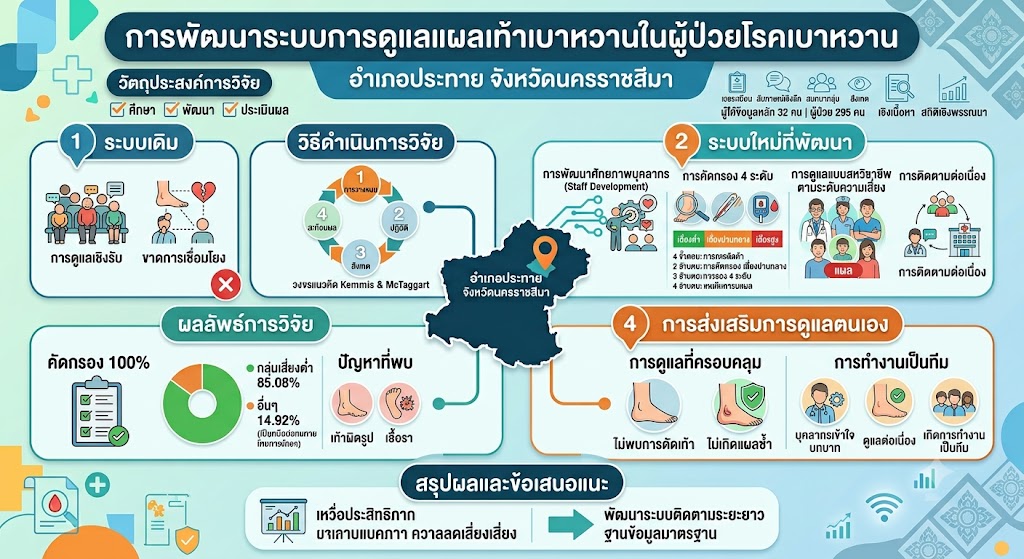
This action research aimed to develop and evaluate a diabetic foot care system for patients with diabetes in Prathai District, Nakhon Ratchasima Province. The study was conducted based on the Kemmis and McTaggart framework, following a four-stage cyclical process: planning, action, observation, and reflection. Data were collected through medical record reviews, in-depth interviews, focus group discussions, and observation. The study involved 32 key informants, and the developed system was implemented among 295 diabetic patients. Data were analyzed using content analysis and descriptive statistics.
Results: The findings indicated that the previous care system was predominantly reactive and lacked integration between screening and continuous care. The developed system comprised four main components: 1) capacity building for healthcare personnel, 2) classification into four levels of risk based on diabetic foot screening, 3) risk-based care delivered by a multidisciplinary team, and 4) continuous follow-up. Following implementation, 100% of patients were screened, with the majority classified as low risk (85.08%). Common clinical findings included foot deformities and fungal infections. Patients in higher-risk groups received comprehensive care according to standardized clinical pathways. No cases of foot amputation or ulcer recurrence were observed among patients who completed the care protocol. Additionally, healthcare providers demonstrated improved role clarity, resulting in enhanced continuity of care and strengthened multidisciplinary collaboration in conclusion, The developed system improved the effectiveness of preventive and continuous care, thereby reducing the risk of diabetic foot ulcer development. Establishing long-term monitoring systems and standardized data management is recommended to ensure sustainability.
References
Armstrong, D. G., Boulton, A. J. M., & Bus, S. A. (2017). Diabetic foot ulcers and their recurrence. New England Journal of Medicine, 376(24), 2367–2375.
Auewattana, A., Chitdee, A., & Nissiakla, P. (2018). Care system for patients with diabetic foot ulcer at Amnatcharoen Hospital. Journal of Nursing and Health Care, 36(1),198–206.
Boulton, A. J. M. (2004). The diabetic foot: From art to science. Diabetologia, 47, 1343–1353.
Bus, S. A., et al. (2020). IWGDF guidelines on the prevention of foot ulcers in persons with diabetes. Diabetes/Metabolism Research and Reviews, 36(Suppl. 1), e3269.
Bus, S. A., Sacco, I. C. N., Monteiro-Soares, M., Raspovic, A., Paton, J., Rasmussen, A., Lavery, L. A., & van Netten, J. J. (2024). Guidelines on the prevention of foot ulcers in persons with diabetes (IWGDF 2023 update). Diabetes/Metabolism Research and Reviews, 40(3), e3651. https://doi.org/10.1002/dmrr.3651
Chonthong, R., & Pimpava, A. (2021). Diabetic foot: Preventive nurses’ role according to the pathophysiology. Christian University Journal of Nursing Science, 8(1), 47–64.
Chueamthong, P. (2020). The effects of an educative supportive program on self-care behaviors and HbA1c in persons newly diagnosed with type 2 diabetes. Journal of Nursing Science & Health, 43(1), 78–86.
Chuepan, S. (2016). Impact of an integrative podiatric care programme on foot-care behaviour, foot conditions, and HbA1c levels in diabetes patients with high susceptibility to foot wounds. Thai Journal of Nursing Council, 31(1), 111–123.
Diabetes Association of Thailand under the Patronage of Her Royal Highness Princess Maha Chakri Sirindhorn. (2024). Clinical practice guidelines for diabetes (2nd ed.). Bangkok, Thailand: Srimuang Printing Co., Ltd.
Health Intervention and Technology Assessment Program, Department of Medical Services, Ministry of Public Health. (2009). Guidelines for foot care in patients with diabetes. Nonthaburi, Thailand: Author. ISBN 978-974-422-576-4
Harutaithaworn, R., Nuysri, M., & Iemsawasdikul, W. (2020). Effects of a foot care program for risk foot ulcer of type 2 diabetes mellitus patients at Samrong Thap District, Surin Province. Thai Journal of Nursing, 69(4), 21–30.
Kemmis, S., & McTaggart, R. (1988). The action research planner (3rd ed.). Deakin University. Lavery, L. A., et al. (2006). Risk factors for foot infections in diabetes. Diabetes Care, 29,1288–1293.
International Diabetes Federation. (2025). IDF Diabetes Atlas (11th ed.). Brussels: IDF.Medical Records Department, Prathai Hospital. (2023). Summary report of diabetes patients for fiscal years 2021–2023. Prathai Hospital.
Meloni, M., Scatena, A., Lascar, N., Giurato, L., Stefanini, M., & Uccioli, L. (2024). Effect of a multidisciplinary team approach in patients with diabetic foot ulcers on major adverse limb events and healing: A systematic review and meta-analysis. Acta Diabetologica, 61(5), 557–570.
Nualthong, W., Kunsongkeit, W., & Dungpaeng, S. (2018). Predictors of preventing behaviors for foot ulcer in patients with type II diabetes mellitus. Boromarajonani College of Nursing, Uttaradit Journal, 10(1), 94–105.
Panyawan, K., Tuanrat, W., & Aungwattana, S. (2022). Effect of the buddy care innovation on assessment of diabetic foot complications among persons with type 2 diabetes in Huai Khrai Sub-district, Maesai District, Chiang Rai Province. Nursing Journal CMU, 49(2), 69–79.
Prompayak, D., Acharayasakchai, M., & Premthaisong, S. (2020). Relationship between health literacy and foot care behaviors among patients with diabetes mellitus. Health Research and Development Journal, Nakhon Ratchasima Provincial Public Health Office, 6(2), 353–361.
Simasingha, N., Paholpak, P., & Suraamornkul, S. (2021). Prevalence of stratified risk to develop diabetic foot ulcer in patients with type 2 diabetes. Vajira Medical Journal: Journal of Urban Medicine, 65(Suppl.), S63–S74.
Singh, N., Armstrong, D. G., & Lipsky, B. A. (2005). Preventing foot ulcers in patients with diabetes. JAMA, 293(2), 217–228.
Tangcheewinsirikul, K. (2022). An understanding of diabetic foot self-care practices among patients with type 2 diabetes at Chalermprakiat Hospital, Buri Ram Province. Medical Journal of Srisaket Surin Buriram Hospitals, 37(3), 569–578.
Udonswai, P., & Chomnirat, W. (2021). Development of the self-management supporting system for patients with diabetic foot ulcer risk at Najan Health Promoting Hospital, Kalasin Province. Research and Development Health System Journal, 14(3), 97–110.
Wagner, E. H. (1998). Chronic disease management: What will it take to improve care? Effective Clinical Practice, 1, 2–4.
Wild, S., Roglic, G., Green, A., Sicree, R., & King, H. (2004). Global prevalence of diabetes: Estimates for the year 2000 and projections for 2030. Diabetes Care, 27(5), 1047–1053.
World Health Organization. (2024). Diabetes. https://www.who.int/news-room/fact sheets/detail/diabetes
Downloads
Published
How to Cite
Issue
Section
License
Copyright (c) 2026 Thai Journal of Public Health and Health Sciences

This work is licensed under a Creative Commons Attribution-NonCommercial-NoDerivatives 4.0 International License.
บทความทุกบทความที่ได้รับการตีพิมพ์ถือเป็นลิขสิทธิ์ของ วารสารสาธารณสุข