Health Literacy about Dietary Supplements and Traditional Medicine Among The Elderly in Non Udom Subdistrict, Chum Phae District, Khon Kaen Province, Thailand
Keywords:
Health literacy, Elderly, Dietary supplements, Traditional medicinesAbstract
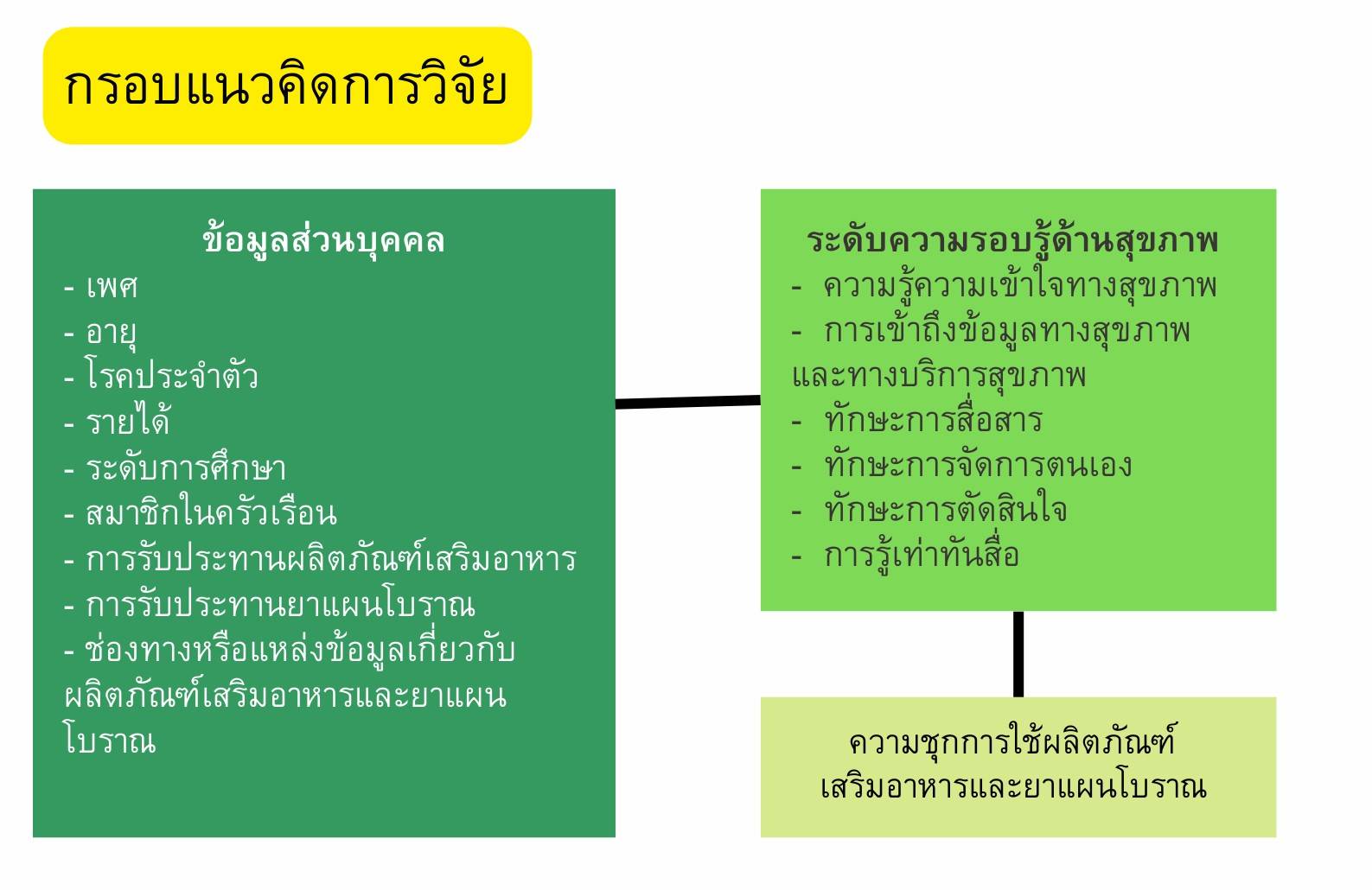
This cross-sectional descriptive research study aimed to examine health literacy, as well as the prevalence of using dietary supplements and traditional medicines among the elderly in the Non Udom Sub-district, Chum Phae District, Khon Kaen Province, Thailand. The study participants included elderly people between the ages of 60-79 years (n=202) in the Non Udom Subdistrict, Chum Phae District, Khon Kaen Province. They were recruited using a stratified random sampling method. Data were collected between January and February 2020 using a questionnaire interview. We analyzed data using descriptive statistics including frequency, percentage, mean, standard deviation, median, minimum, and maximum.
Most of the participants were female and aged between 60-69 years old (73.21%). The prevalence of using dietary supplements was 12.38%, while the prevalence of using traditional medicines was 8.42%. When measuring the level of health literacy, we found that a majority (61.88%) of participants had a low level of cognitive skills. A little over half of participants (51.49%) had access skills. High percentages of participants had self-management skills (77.72%) and decision skills (64.85%). Moderate percentages of participants had communication skills (55.45%) and media literacy (50.50%).
References
Asipong, S. (2015). Health Product Use Behavior with No Medical Indications among Patients with Chronic Diseases at Rasi Salai, Sisaket Province. Thai Journal of Pharmacy Practice, 7(2), 105-113. (In Thai).
Bowley, A. L. (1925). Measurement of the precision attained in sampling. Cambridge: Cambridge University Press
Bloom.B.S. (1968). Mastery learning. UCLA – CSEIP Evaluation Comment. 1 (2)
Losangeles. University of California at Los Angeles.
Dinkhuntod, C. & Loifar, S. (2016). Health Iinformation Behavior of the Elderly in Nakhon Ratchasima. Journal of Information Science. . 34(2), 75-89. (In Thai)
Foundation of Thai Gerontology Research and Development institute (2560). Situation of the Thai elderly 2017. (1st ed). Bangkok: October printing company limited. (In Thai)
Health Education Division. (2018). A Strengthening and evaluation of health literacy and health behavior in children and adolescent (17-24 years old), people (15 years old or greater) Revised version in 2018. Retrieved October 13, 2019 from http://www.hed.go.th/linkhed/file/575
Jaemtim, N. & Yuenyong, S. (2019). The Usedof Online Media and Perceptionsof Health Literacy among the Elderly in Suphanburi Province. The Journal of Baromarajonani College of Nusing, Nakhonratchasima, 25(2), 168-180. (In Thai)
Mahidol University. (2015). Articles disseminate knowledge to the public “precautions for using herbs”. Retrieved October 13, 2019 from shorturl.at/aqxFT.
Official Statistics Registration Systems Department of Provincial Administration. (2018). Statistics of the elderly, Khon Kaen Province. Retrieved October 18, 2019 from https://stat.bora.dopa.go.th/stat/statnew/statTDD/
Phromphak, C. (2013). Aging society in Thailand. The Secretariat of the Senate, 3(16), 1-19. (In Thai).
Romero, SS., Scortegagna, HM. & Doring M. (2019). Functional health literacy level and behavior in the health of the elderly. Texto Contexto – Enferm; 27: e5230017.
Ruenruay, S. & Saokaew, S. (2017). Situation of Medicines and Dietary Supplements in the Health Provider Board Region 3. Thai Journal of Pharmacy Practice, 9 (1), 225-235. (In Thai)
Suramitmaitri, B. (2013). A study of health literacy intelligence and operational situations to promote health intelligence of the Thai people, to support the entry into the ASEAN community. Bangkok: Devawongse Varopakarn Institute of Foreign Affairs, Ministry of Foreign Affairs. (In Thai)
Speak, D. L.; Cowert, M. E. & Pellet, K. (1989). Health perceptions and lifestyles of the elderly. Research in Nursing & Health Care, 12, 93-100.
The Secretariat of the House of Representatives (2018). Situation of the elderly in foreign country. Retrieved October 1, 2019 from https://library2.parliament.go.th/ejournal/content_af/2561/jul2561-1.pdf
Tipkanjanaraykha, K. & Yingrengreung, S. (2017). Health information seeking behaviors of elderly through online media Accordingto perceivedhealth status. Journal of Health Science Research. 11(supplement): 12-22. (In Thai).
Tayati, P., Disathaporn, C. & Onming, R. (2017). The Model of Thai Elderly Learning Management for Information and Communication Technology Literacy. Veridian E-Journal, Silpakorn University (Humanities, Social Sciences and arts), 10(3), 1613-1629. (In Thai)
Vongverapant, M. (2016). Mental health promotion for best practice communitie's elderly in Chiang Mai province. Journal of clinical psychology, 47(1), 38-47. (In Thai)
Wongwattanasathien, O., Tongsodsang, K. & Ngamgleng, C. (2015). Problems of Medicine and Dietary Supplement Use of the Elders in Town Municipality, Maha Sarakham Province. RMU.J. (Humanities and Social Sciences), 9(3), 67-74. (In Thai)
Wongboonnak, P., Wongtrakul, P., Mahamongkol, H. & Neimkhum, W. (2016). The Survey of Medicine, Food Supplement and Herbal Products Used Problems among Elderly a Case Study at the Community of Tumbon Srisa Chorakhe Noi, Samut Prakan Province. HCU Journal, 20(39), 97-108. (In Thai)
Vacharaporn Choeisuwan. (2017). Health Literacy: Concept and Application for Nursing Practice. Royal Thai Navy Medical Journal; 44(3). 183-197.
Downloads
Published
How to Cite
Issue
Section
License
Copyright (c) 2022 Thai Journal of Public Health and Health Sciences

This work is licensed under a Creative Commons Attribution-NonCommercial-NoDerivatives 4.0 International License.
บทความทุกบทความที่ได้รับการตีพิมพ์ถือเป็นลิขสิทธิ์ของ วารสารสาธารณสุข