A Study of Biological Contamination, Nutritional Status, Amount of Energy and Nutrients in Lunch Among Grade 4-6 Students in Thalang, Phuket Province, Thailand
Keywords:
Nutritional Status, Nutrients, INMUCAL- Nutrients Program, school age childAbstract
We conducted a Study of biological contamination, nutritional status, amount of energy and nutrients in lunches among primary school students in grades 4-6 in the Thalang District, Phuket Province, Thailand. We collected data on biological contamination in students’ dishware and eating utensils, students’ nutritional status, as well as amount of energy and nutrients from the school lunches in two public primary schools in Thalang District, Phuket Province. We collected six samples of dishware and eating utensils per school such as such as dish, bowl, spoon, spade of frying pan, ladle and pot, resulting in 12 samples total from 2 schools. We used the SI-2 test to determine if Coliform bacteria contaminated the samples. Our research instruments included a student health record book, record of students’ weight, and height measurement record. We calculated students’ nutritional status by examining the standard score according to students’ body weight by height, which has been developed by the Thai Bureau of Nutrition, Department of Health and Ministry of Public Health. Nutritional status was calculated for 124 students, ranging from age 9-12 years and who in grades 4-6. We also collected quantitative secondary data including a list of school’s lunches within thirty days. We used the software INMUCAL V.4.0 to use the lunch data to estimate the amount of energy and nutrients each student received in a day. We also calculated descriptive statistics (mean and the standard deviation).
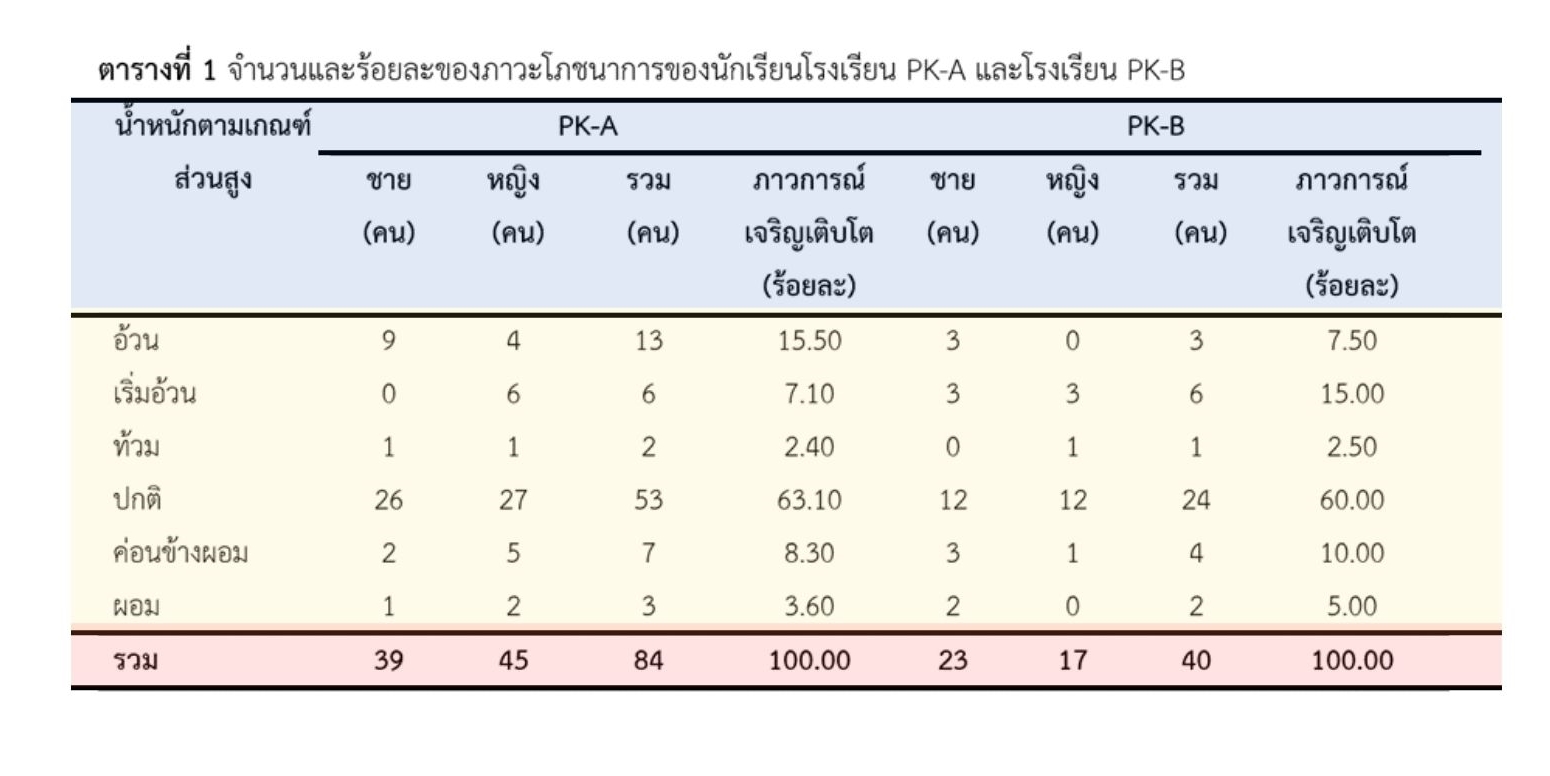
We found no contamination of student dishware or utensils with coliform bacteria. Our assessment of nutritional status showed that most students were at normal level of growth status (n=77, 62.06%), 31 students (25.00 %) were overweight, and 16 students (12.90 %) were underweight. The estimated percentage distribution of energy in the lunches for the first and second schools were 57.59% (SD=7.89) and 51.57 % (SD=9.38) for carbohydrates distribution, 22.62 % (SD=6.58) and 24.74 % (SD=6.68) for protein, and 19.79 % (SD=5.57) and 23.69% (SD=6.69) for lipids, respectively. For the first and second schools, the amount of vitamin A was 224.52 mg (SD=95.63) and 264.55 (SD=102.38), for vitamin C was 41.23 mg (SD=43.11) and 42.40 (SD=55.17) mg, and for Vitamin B1 was 0.61 mg (SD=0.25) and 0.96 (SD=0.40) mg, respectively. The results could be utilized to improve the operation level of school and coordinate within community to improve the school’s food service according to nutritional needs and values which students should receive. The results can also assist improving food sanitation in school, continuously and systematically, as well as developing the relationship and cooperation between school and student’s family to monitor the students’ nutritional status.
References
Department of Disease Control. (2020). Food-Borne Disease [Online].Retrieved December 16, 2021, from https://ddc.moph.go.th/brc/news.php. (in Thai).
Food Sanitation Division Health Department BMA. (2003).Principles of Food Sanitation Inspector [Online].Retrieved November 17, 2020, from http://www.oic.go.th/FILEWEB/CABI.PDF. (in Thai).
Department of Health. (2020). Daily Nutrient Requirements [Online].Retrieved November 17, 2020, from https://nutrition2.anamai.moph.go.th/th/book/194515. (in Thai).
lakum, J, Siribunpiphat, J, kankong, V. (2017). Food Sanitation in Child Center at Sri-kai Sub-dristrict Warinchumrab District,Ubon Ratchathani Province. Ubon-Ratchathani University Journal of Science and Technology,19(3),108-118.(in Thai).
Katunyu, J. (2018). Nutritional status of upper elementary school students in schools affiliated with Chiang Mai Municipality.Lampang Journal,39(2),62-71.(in Thai).
Kwamrum,J. (2019). Nutrition and Types of Nutrients [Online].Retrieved August 17, 2019, from https://sites.google.com/site/phochnakarnaruann/xaharsar-xahar-1. (in Thai).
Jinamu, J. (2018). Report on the results of the inspection of the Ministry of Public Health [Online].Retrieved August 17, 2019, from http://bie.moph.go.th/e-insreport/file.doc. (in Thai).
Kumsuk,k. (2017). Food Consumption Behavior on Nutritional Status of Primary Students at Nongyow School in Nakhon Ratchasima Province. [Online].Retrieved December 16, 2019, from https://norther.ac.th/research. (in Thai).
Phochan, N, Kankhwao, B, Kankhwao , P. (2019).Quantity of Food Consumption and Nutrition Stats of Primary School Syudents a Public School in Municipal,Muang District,Khon Kaen Province. The Southern College Network Journal of Nursing and Public Health,2(2),64-74.(in Thai)
Thongchim, N, Sumadho, P, PhrakhuPhitsuphakan. (2020). The Operation of Buddhist Oriented School to Become a Leading Buddhist School Under Songkhla Primary Educational Service Area office 1. Journal of MCU Ubon Review,5(2),311-326.(in Thai)
Thada, A, Abuwa, S, Abuwa, D.(2018).Food Sanitation Situation in Primary School,Yala Primary Education Service Area2.YRU Journal of Science and Technology,3(1),1-7.(in Thai).
Nuntapong, S. (2019). Knowledge of Food Arrangements for Children [Online].Retrieved August 18, 2019, from http://kasetsartjournal.ku.ac.th/kuj_files/2014/A1409121536082968.pdf
. (in Thai).
Chamchuklin,S. (2017).The situation of Drinking Water and Food Sanitation Management in the School under the Office of Basic Education Commission of Thailand [Online].Retrieved August 18, 2017, from https://www.Health Promotion Center5. (in Thai).
Sangtiyon, C.(2015). The administration of the lunch project of basic educational institutes under the Chiang Rai Primary Educational Service Area 3.Independent Study of degree of Master of Education Program in Educational Administration. Chiang Rai Rajabhat University. (in Thai).
Thai Health Promotion Foundation. (2019). Explore the Malnutrition of Thai Children [Online].Retrieved August 18, 2019, from https://www.thaipost.net/main/detail. (in Thai).
Downloads
Published
How to Cite
Issue
Section
License
Copyright (c) 2022 Thai Journal of Public Health and Health Sciences

This work is licensed under a Creative Commons Attribution-NonCommercial-NoDerivatives 4.0 International License.
บทความทุกบทความที่ได้รับการตีพิมพ์ถือเป็นลิขสิทธิ์ของ วารสารสาธารณสุข