ผลของน้ำลูกหม่อนต่อระดับน้ำตาลในเลือดและระดับความอิ่มในอาสาสมัครสุขภาพดี
คำสำคัญ:
น้ำลูกหม่อน, ระดับน้ำตาลในเลือด, ความอิ่มบทคัดย่อ
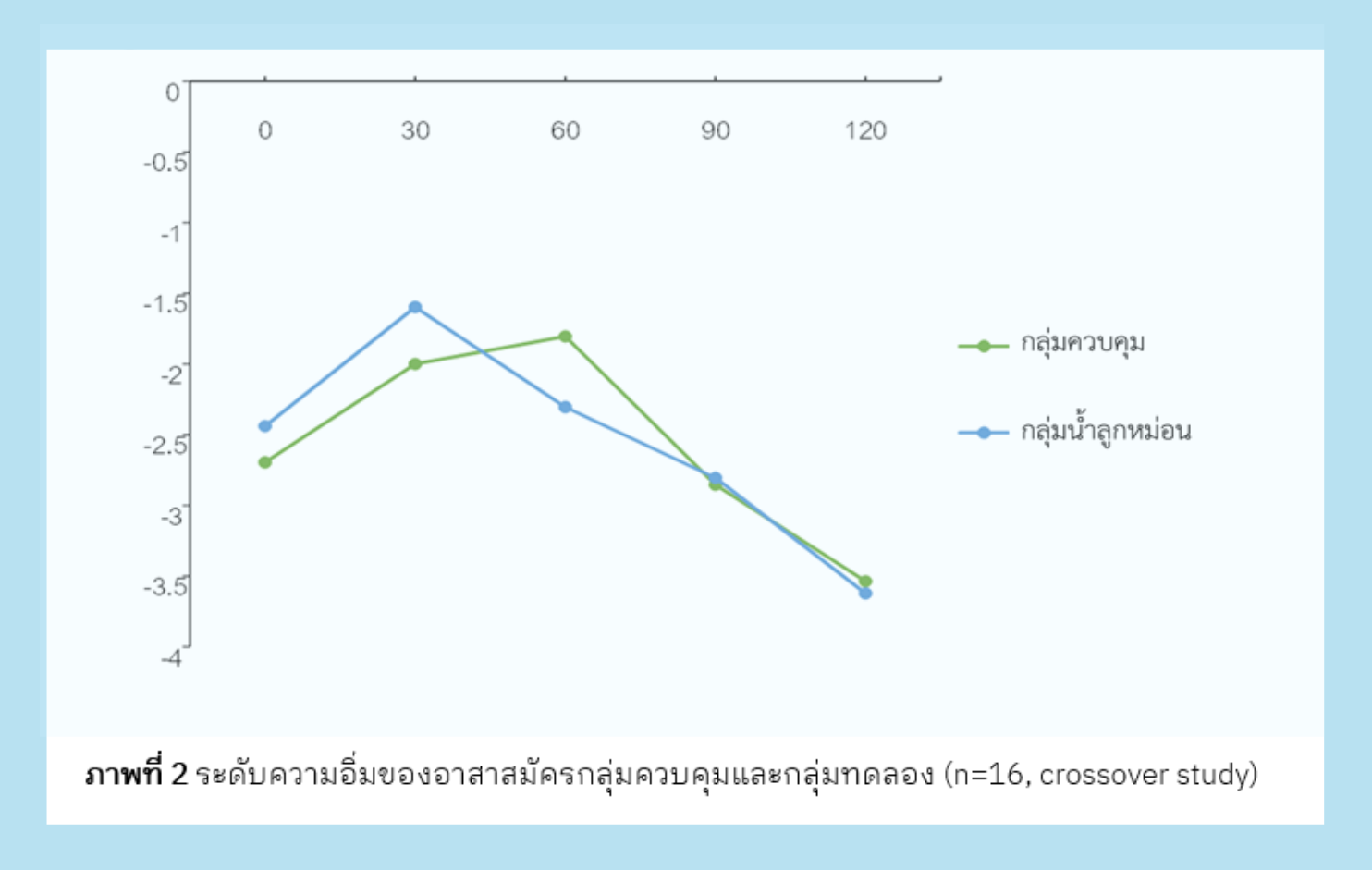
ลูกหม่อนประกอบด้วยแอนโทไซยานินที่เป็นสารต้านอนุมูลอิสระในกลุ่มฟลาโวนอยด์ ช่วยควบคุมระดับน้ำตาลและระดับอินซูลินในเลือดของหนูที่เป็นเบาหวานได้ การศึกษานี้มีวัตถุประสงค์เพื่อศึกษาผลของน้ำลูกหม่อนต่อระดับน้ำตาลในเลือดและระดับความอิ่มในอาสาสมัครสุขภาพดีเทียบกับกลุ่มควบคุม ทำการศึกษาข้ามกลุ่มในอาสาสมัครจำนวน 16 คน อายุเฉลี่ย 21 ± 0.83 ปี ดัชนีมวลกายเฉลี่ย 20.01 ± 1.28 กก./ตร.ม อาสาสมัครได้รับการวัดองค์ประกอบต่างๆ ของร่างกาย จากนั้นจับสลากเพื่อสุ่มเลือกดื่มเครื่องดื่มวิจัยสองชนิด ทดสอบห่างกัน 1 สัปดาห์ ชนิดแรกคือสารละลายน้ำตาลกลูโคสและฟรุกโตส 180 มิลลิลิตร (กลุ่มควบคุม) และชนิดที่สองคือน้ำลูกหม่อน 180 มิลลิลิตร (กลุ่มทดลอง) อาสาสมัครถูกวัดระดับน้ำตาลในเลือด ระดับความอิ่ม อุณหภูมิกาย ความดันโลหิตและอัตราการเต้นของหัวใจ ในนาทีที่ 0 ก่อนการดื่มและหลังการดื่มในนาทีที่ 30, 60, 90 และ 120 ผลการศึกษาพบว่าหลังจากการดื่มน้ำลูกหม่อนในนาทีที่ 30 อาสาสมัครมีระดับน้ำตาลในเลือดต่ำกว่ากลุ่มควบคุมอย่างมีนัยสำคัญทางสถิติ (p < 0.05) ส่วนระดับความอิ่ม อุณหภูมิกาย และความดันโลหิตไม่แตกต่างกันทางสถิติเมื่อเทียบกับกลุ่มควบคุม สรุปได้ว่าน้ำลูกหม่อนช่วยลดระดับน้ำตาลในเลือดหลังจากการดื่มในนาทีที่ 30
เอกสารอ้างอิง
Aba, P. E., & Asuzu, I. U. (2018). Mechanisms of actions of some bioactive anti-diabetic principles from
phytochemicals of medicinal plants: A review. Indian Journal of Natural Products and
Resources (IJNPR)[Formerly Natural Product Radiance (NPR)], 9(2): 85-96.
Banu, S., Jabir, N. R., Manjunath, N. C., Khan, M. S., Ashraf, G. M., Kamal, M. A., & Tabrez, S. (2015).
Reduction of post-prandial hyperglycemia by mulberry tea in type-2 diabetes patients. Saudi
Journal of Biological Sciences, 22(1): 32-36.
Bao, T., Xu, Y., Gowd, V., Zhao, J., Xie, J., Liang, W., & Chen, W. (2016). Systematic study on
phytochemicals and antioxidant activity of some new and common mulberry cultivars in
China. Journal of Functional Foods, 25: 537-547.
Enkhmaa, B., Shiwaku, K., Katsube, T., Kitajima, K., Anuurad, E., Yamasaki, M., & Yamane, Y. (2005). Mulberry (Morus alba L.) leaves and their major flavonol quercetin 3-(6-malonylglucoside) attenuate
atherosclerotic lesion development in LDL receptor-deficient mice. The Journal of nutrition,
(4): 729-734.
Gerasopoulos, D., & Stavroulakis, G. (1997). Quality characteristics of four mulberry (Morus sp) cultivars
in the area of Chania, Greece. Journal of the Science of Food and Agriculture, 73(2): 261-264.
Josic, J., Olsson, A. T., Wickeberg, J., Lindstedt, S., & Hlebowicz, J. (2010). Does green tea affect
postprandial glucose, insulin and satiety in healthy subjects: a randomized controlled trial.
Nutrition Journal, 9(1): 1-8.
Kadam, R. A., Dhumal, N. D., & Khyade, V. B. (2019). The Mulberry, Morus alba (L.): The medicinal
herbal source for human health. Int. J. Curr. Microbiol. Appl. Sci, 8(4): 2941-2964.
Kim, I., & Lee, J. (2020). Variations in anthocyanin profiles and antioxidant activity of 12 genotypes of
mulberry (Morus spp.) fruits and their changes during processing. Antioxidants, 9(3): 242.
Lin, Y. C., Wu, C. J., Kuo, P. C., Chen, W. Y., & Tzen, J. T. (2020). Quercetin 3‐O‐malonylglucoside in the
leaves of mulberry (Morus alba) is a functional analog of ghrelin. Journal of Food Biochemistry,
(9): e13379.
Nakamura, K., & Nakamura, Y. (2018). Hunger and satiety signaling: modeling two
hypothalamomedullary pathways for energy homeostasis. Bioessays, 40(8): 1700252.
Park, S. W., Shin, K. C., Yoou, S.-K., Park, H. J., Eun, S. H., Bae, Y. M., . . . Choi, B. H. (2019). Effects of an
ethanolic extract of mulberry fruit on blood pressure and vascular remodeling in spontaneous
hypertensive rats. Clinical and Experimental Hypertension, 41(3): 280-286.
Rolls, E. (2007). Understanding the mechanisms of food intake and obesity. Obesity Reviews, 8: 67-72.
Sami, W., Ansari, T., Butt, N. S., & Ab Hamid, M. R. (2017). Effect of diet on type 2 diabetes mellitus: A
review. International journal of health sciences, 11(2): 65.
Solah, V. A., Meng, X., Wood, S., Gahler, R. J., Kerr, D. A., James, A. P., . . . Johnson, S. K. (2015). Effect of
training on the reliability of satiety evaluation and use of trained panellists to determine the
satiety effect of dietary fibre: A randomised controlled trial. PLoS One, 10(5): e0126202.
Stefanut, M. N., Cata, A., Pop, R., Tănasie, C., Boc, D., Ienaşcu, I., & Ordodi, V. (2013). Anti-hyperglycemic
effect of bilberry, blackberry and mulberry ultrasonic extracts on diabetic rats. Plant foods for
human nutrition, 68: 378-384.
Wang, Y., Xiang, L., Wang, C., Tang, C., & He, X. (2013). Antidiabetic and antioxidant effects and
phytochemicals of mulberry fruit (Morus alba L.) polyphenol enhanced extract. PLoS One,
(7): e71144.
Wu, T., Tang, Q., Gao, Z., Yu, Z., Song, H., Zheng, X., & Chen, W. (2013). Blueberry and mulberry juice
prevent obesity development in C57BL/6 mice. PLoS One, 8(10): e77585.
Yan, F., Dai, G., & Zheng, X. (2016). Mulberry anthocyanin extract ameliorates insulin resistance by
regulating PI3K/AKT pathway in HepG2 cells and db/db mice. The Journal of Nutritional
Biochemistry, 36: 68-80.
ดาวน์โหลด
เผยแพร่แล้ว
รูปแบบการอ้างอิง
ฉบับ
ประเภทบทความ
สัญญาอนุญาต
ลิขสิทธิ์ (c) 2023 วารสารสาธารณสุขและวิทยาศาสตร์สุขภาพ

อนุญาตภายใต้เงื่อนไข Creative Commons Attribution-NonCommercial-NoDerivatives 4.0 International License.
บทความทุกบทความที่ได้รับการตีพิมพ์ถือเป็นลิขสิทธิ์ของ วารสารสาธารณสุข