Relationships of Affective Domains, Health Literacy, and Self-care Behaviors with the Complications in Patients with Type 2 Diabetes Mellitus in Wang Somboon District, Sa Kaeo Province, Thailand
Keywords:
Psychoactive components, Risk of complications, Type 2 diabetesAbstract
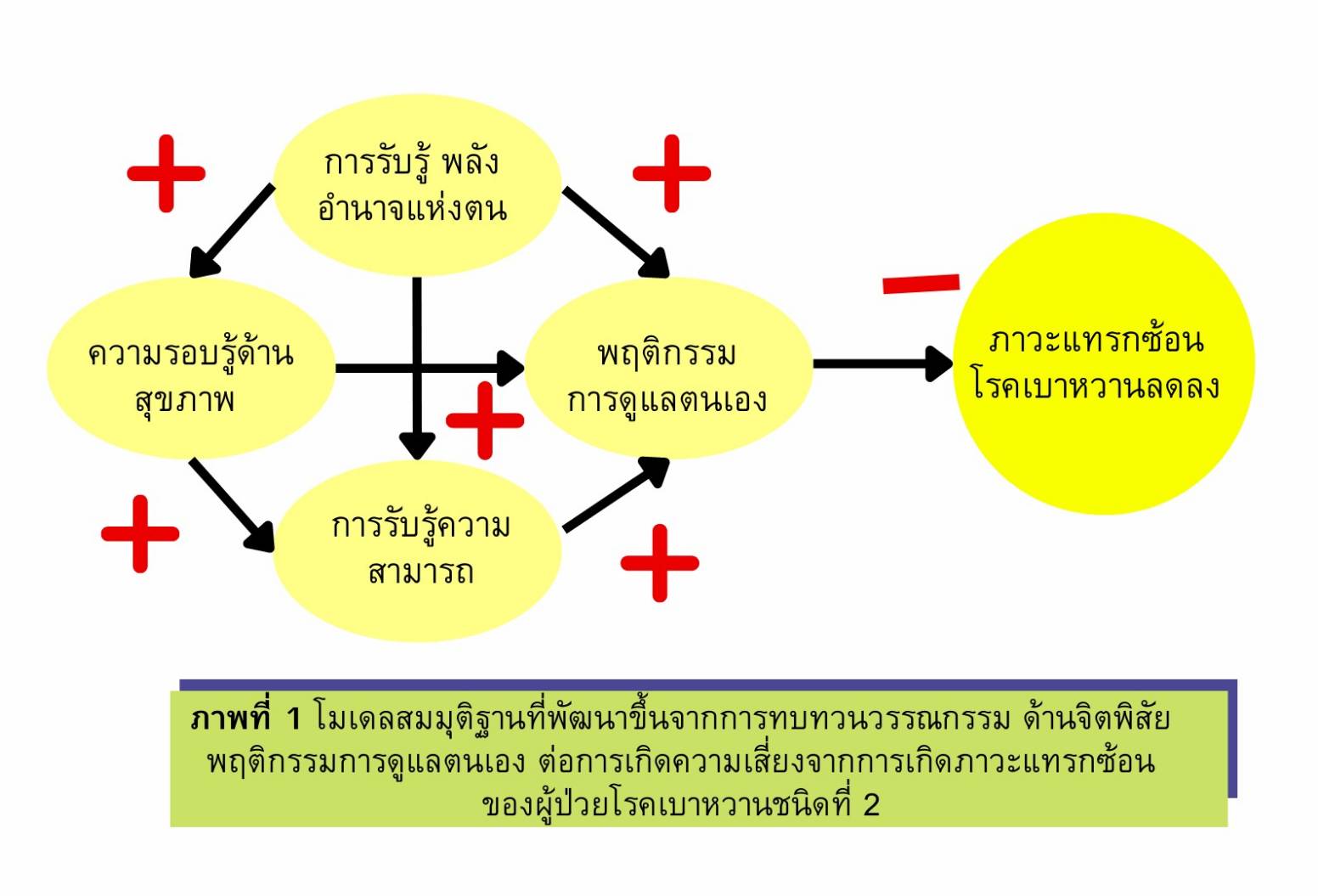
We conducted a cross-sectional, quantitative research study among patients with type 2 diabetes in Wang Somboon District, Sa Kaeo Province, Thailand. We aimed to develop and validate the coherence of correlation model between the perception of self-power, health literacy, self-efficacy perception, self-care behaviors with the risk of developing complications among patient with type 2 diabetes. The sample consisted of 216 patients with type 2 diabetes selected by purposive sampling from 7 diabetes clinics in Wang Somboon District Sa Kaeo Province. The research instrument was an interview form. Basic statistics were analyzed by using the software package. The AMOS program was used to analyze a causal relationship model.
The results showed that the developed model was consistent with the empirical data. The Chi-square statistic was 168.9, df = 148, /df = 1.1, p-value =0.115, AGFI=0.90 GIF =0.92 RMSEA =0.036 SRMR=0.029. The factors affecting the incidence of complications in type 2 diabetes patients at the highest levels were self-care behaviors, self-efficacy perception, self-power perception, and health literacy. The perception of self-power had a positive direct influence on health literacy and self-efficacy perception. Furthermore, the perception of self-power had a positive indirect influence on self-care behaviors. The health literacy and self-efficacy perception had a positive direct effect on self-care behaviors that in turn led to a decrease in the incidence of diabetes complications. All variables in our model could explain 45% for the variability of the incidence of risk of developing complications in patients with type 2 diabetes in our study.
In conclusion, this research study demonstrated that self-power perception, health literacy, self-efficacy perception and self-care behaviors affected the risk of developing complications in patients with type 2 diabetes. Therefore, during the implementation and development of the public health service system to reduce such risks, it was necessary to encourage patients with type 2 diabetes to become empowered, increase their health literacy, establish their self-efficacy perception, and optimize their self-care behaviors.
References
Anderson, R. M., & Funnell, M. M. (2010). Patient empowerment: myths and misconceptions.
Patient Educ Couns, 79(3): 277-282.
Arnstine, D. (1965). Taxonomy Of Educational Objectives, Handbook II: Affective Domain by David R. Krathwohl, Benjamin S. Bloom, and Bertram B. Masia. New York: David McKay Company, Inc., 1964. 196 pp. The Educational Forum, 29(3), 371-372. doi:10.1080/00131726509339406
Bailey, S. C., Brega, A. G., Crutchfield, T. M., Elasy, T., Herr, H., Kaphingst, K., Schillinger, D. (2014).
Update on health literacy and diabetes. Diabetes Educ, 40(5): 581-604.
Bandura, A. (1986). Social foundations of thought and action: A social cognitive theory. (6th ed.).
Englewood Cliffs, NJ: Prentice-Hall, Inc.
Bloom, B. S., Hastings, J. T., & Madaus, G. F. (1971). Handbook on formative and summative
evaluation of student learning. New York: McGraw-Hill.
Charoensrimuean, S., Suphanakun, P., Ngernjang, J. (2018). Factors Influencing Glycemic Control among Pre-Diabetes in Maung District, Phitsanulok Province. Journal of Health Science, 28(4); 628-638. (In Thai)
Diabetes association Thailand. (2017). Clinical practice guideline for diabetes. Patumthani: Romyen
Media Ltd. (in Thai)
Hair, J., Black, W., Babin, B., & Anderson, R. (2010). Multivariate Data Analysis: A Global Perspective.
(7th ed.). Upper Saddle River, NJ: Prentice-Hall.
International Diabetes Federation (IDF) (2017) IDF Diabetes Atlas. 8th Edition, International
Diabetes Federation, Brussels. https://diabetesatlas.org/atlas/eighth-edition/
International Diabetes Federation (IDF) (2019) IDF Diabetes Atlas. 9th Edition, International
Diabetes Federation, Brussels. https://diabetesatlas.org/atlas/ninth-edition/
J.Gao, J. Wang, P. Zheng, R.Harrdorfer, M.C. Kegler, Y. Zhu, H.Fu. (2013). Effects of self-care,
selfefficacy, social support on glycemic control in adults with type 2 diabetes. BMC Fam
Pract, 14; 1-6.
Karnjanapiboonwong, A., Khamwangsaga,P.,& Kaewtha, S. (2019) NCDs Report. Bangkok: Akashson
graphic and design. (in Thai)
Lee, Y. J., Shin, S. J., Wang, R. H., Lin, K. D., Lee, Y. L., & Wang, Y. H. (2016). Pathways of
empowerment perceptions, health literacy, self-efficacy, and self-care behaviors to
glycemic control in patients with type 2 diabetes mellitus. Patient Educ Couns, 99(2); 287-294.
Ngamumpornara, P. (2017). Health literacy for patients with type 2 diabetes in Bangkok
metropolits and perimeter. Journal of Health, Physical Education and Recreation, 46(2); 68-79. (In Thai)
Nithiyanan, W. (2017). Diabetes situation 2017. Retrieved 11,2019 from: https://www.hfocus.org/content/2019/11/18054. (In Thai)
Pha-khotom, W., Thaithae, S. (2013). The effectiveness of spiritual well-being promoting program
on perceived self- efficacy for continuous breast-feeding of teenage mothers at home. Journal of Public Health Nursing, 27(2); 27-39. (In Thai)
Ryan, R. M., & Deci, E. L. (2000). Self-determination theory and the facilitation of intrinsic
motivation, Social development and well-being. American Psychologist, 55(1); 68-78.
Sa Kaeo Provincial Health Office. (2017) Annual Report 2017. Sa Kaeo: Ministry of Public Health.
(in Thai)
Shiu, A. T., Wong, R. Y., & Thompson, D. R. (2003). Development of a reliable and valid Chinese
version of the diabetes empowerment scale. Diabetes Care, 26(10); 2817-2821.
Suksawa, N., Pranprawit, A. & Phechmanee, S. (2016). Effect of Health Education Program using
ApplingSelf-Efficacy Theory together with Social Support for Self Care of Diabetes Elder
Patients of Tha Sa Thon Health Promoting Hospital, Phun Phin District, Surat Thani Province.
Community Health Development Quarterly Khon Kaen University, 4(1); 49-65. (In Thai)
Suksawang, P. (2013). Structural equation model. (1st ed.). Bangkok: Wattana Panich. (In Thai)
Tangkittiwat, K. (2013). A causal model of cumulative average glucose levels of diabetic patients in
Mueang District, Nakhon Pathom Province. The Journal of Prapokklao Hospital Clinical
Medical Education center, 34(1); 17-31. (In Thai)
Wang, R.-H., Wu, L.-C., & Hsu, H.-Y. (2011). A path model of health-related quality of life in Type 2
diabetic patients: a cross-sectional study in Taiwan. Journal of Advanced Nursing, 67(12);
-2667.
Downloads
Published
How to Cite
Issue
Section
License
Copyright (c) 2022 Thai Journal of Public Health and Health Sciences

This work is licensed under a Creative Commons Attribution-NonCommercial-NoDerivatives 4.0 International License.
บทความทุกบทความที่ได้รับการตีพิมพ์ถือเป็นลิขสิทธิ์ของ วารสารสาธารณสุข