ผลของการบริโภคผงซูเปอร์ฟู้ดออร์แกนิคต่อความสามารถในการต้านอนุมูลอิสระในผู้มีน้ำหนักเกินและอ้วนร่วมกับมีไขมันในเลือดผิดปกติ
คำสำคัญ:
ซูเปอร์ฟู้ด, ความสามารถในการต้านอนุมูลอิสระ, ผู้มีน้ำหนักเกินและอ้วนบทคัดย่อ
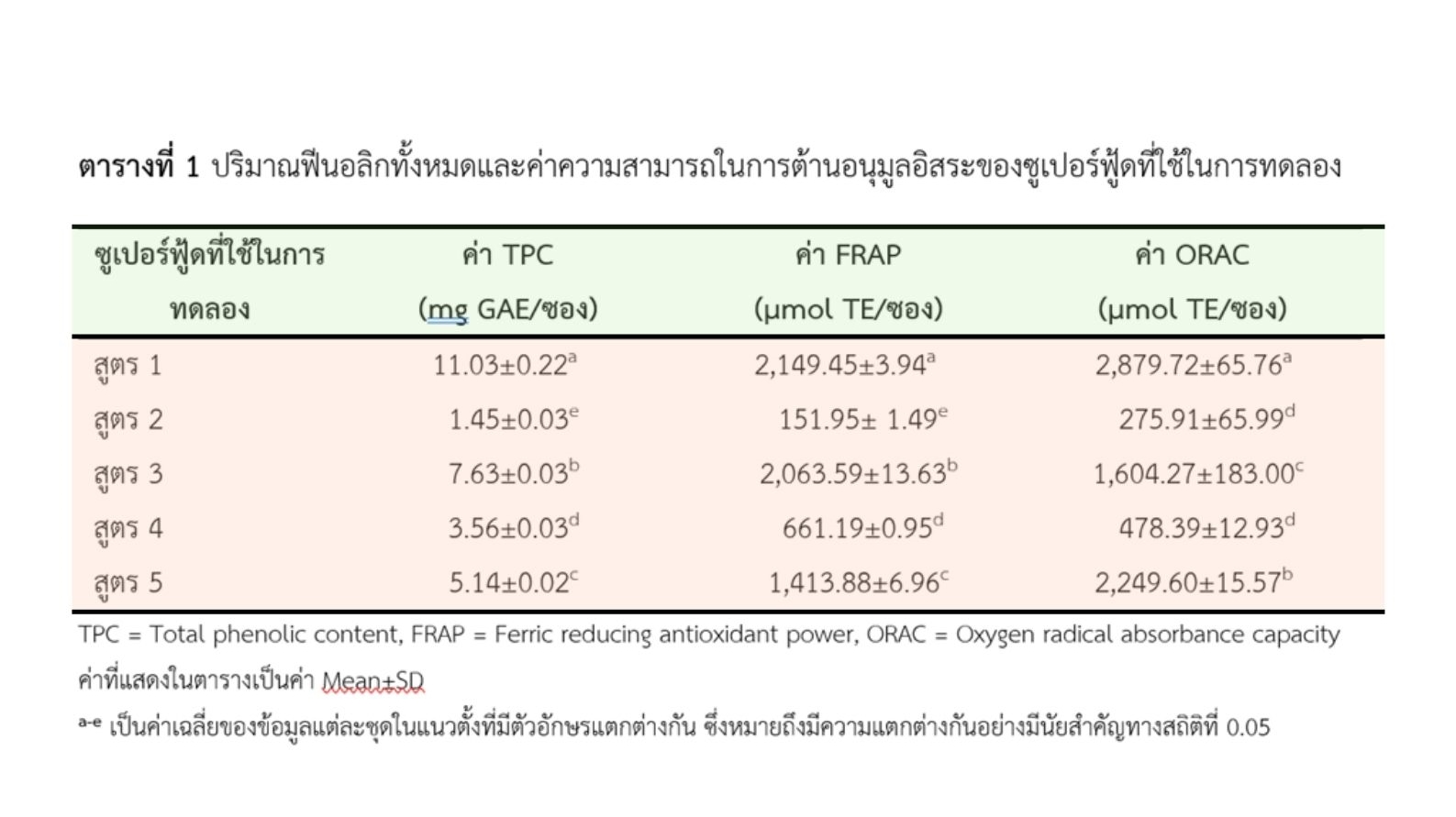
น้ำหนักเกินและโรคอ้วนทำให้เสี่ยงต่อโรคไม่ติดต่อเรื้อรัง ซูเปอร์ฟู้ดเป็นอาหารที่มีคุณค่าทางโภชนาการสูง อุดมด้วยวิตามิน แร่ธาตุ และสารพฤกษเคมีที่มีฤทธิ์ในการต้านอนุมูลอิสระ วัตถุประสงค์เพื่อศึกษาผลการบริโภคเครื่องดื่มผงซูเปอร์ฟู้ด 5 สูตรต่อการเปลี่ยนแปลงค่าความสามารถในการต้านอนุมูลอิสระในเลือด เป็นการศึกษาวิจัยเชิงทดลองแบบสุ่มชนิดมีกลุ่มควบคุมแบบคู่ขนานในผู้ที่มีน้ำหนักเกินและอ้วนร่วมกับมีไขมันในเลือดผิดปกติจำนวน 89 คน สุ่มเป็น 6 กลุ่ม กลุ่มเปรียบเทียบไม่ได้รับซูเปอร์ฟู้ด กลุ่มทดลอง 5 กลุ่มได้รับซูเปอร์ฟู้ดสูตร 1: คามูคามู อาซาอิเบอรี่ มากิเบอรี่ 10 กรัม สูตร 2: ผักรวมผสมเมล็ดเจียกับถั่วดาวอินคา 15 กรัม สูตร 3: เบอรี่รวมผสมเมล็ดเจีย 15 กรัม สูตร 4: อาซาอิเบอรี่ 5 กรัม และสูตร 5: อาซาอิเบอรี่ 10 กรัม บริโภควันละ 1 ซอง ผสมกับน้ำเปล่า 200-250 มิลลิลิตร ดื่มหลังตื่นนอนตอนเช้าเป็นเวลา 6 สัปดาห์ ประเมินผลโดยการตรวจค่าความสามารถในการต้านอนุมูลอิสระในเลือดด้วยวิธี Oxygen radical absorbance capacity (ORAC) และ Ferric reducing antioxidant power (FRAP) ในสัปดาห์ที่ 0 และ 6 วิเคราะห์ความแตกต่างภายในกลุ่มด้วย Paired t-test และ Wilcoxon signed rank test และระหว่างกลุ่มด้วย One way ANOVA และ Kruskal-Wallis test ผลการศึกษาพบว่าหลังการทดลองกลุ่มทดลองทั้ง 5 กลุ่ม มีค่า ORAC และ FRAP เพิ่มขึ้นอย่างมีนัยสำคัญทางสถิติที่ระดับ p-value <0.05 ส่วนกลุ่มเปรียบเทียบไม่เปลี่ยนแปลง เปรียบเทียบระหว่างกลุ่มหลังการทดลองพบกลุ่มทดลองมีค่า ORAC และ FRAP สูงกว่ากลุ่มเปรียบเทียบอย่างมีนัยสำคัญทางสถิติที่ระดับ p-value <0.05 ดังนั้นการบริโภคซูเปอร์ฟู้ดออร์แกนิคสามารถเพิ่มค่าความสามารถในการต้านอนุมูลอิสระในเลือด
เอกสารอ้างอิง
Aekplakorn W, Pakjaroen H, & Satheannoppakao W. (2021). Thai National Health Examination Survey VI 2019-2020. Bangkok: Faculty of Medicine Ramathibodi Hospital, Mahidol University.
Akter, M. S., Oh, S., Eun, J.-B., & Ahmed, M. (2011). Nutritional compositions and health promoting phytochemicals of camu-camu (myrciaria dubia) fruit: A review. Food Research International, 44(7), 1728-1732. doi:10.1016/j.foodres.2011.03.045
Aparecida de Assis, S., Vellosa, J. C. R., Brunetti, I. L., Khalil, N. M., Leite, K. M. d. S. C., Martins, A. B. G., & Oliveira, O. M. M. d. F. (2009). Antioxidant activity, ascorbic acid and total phenol of exotic fruits occurring in Brazil. International Journal of Food Sciences and Nutrition, 60(5), 439-448.
Basu, A., Betts, N. M., Ortiz, J., Simmons, B., Wu, M., & Lyons, T. J. (2011). Low-energy cranberry juice decreases lipid oxidation and increases plasma antioxidant capacity in women with metabolic syndrome. Nutrition Research, 31(3), 190-196.
Bohn, T. (2014). Dietary factors affecting polyphenol bioavailability. Nutrition Reviews, 72(7), 429-452.
Chirinos, R., Zuloeta, G., Pedreschi, R., Mignolet, E., Larondelle, Y., & Campos, D. (2013). Sacha inchi (Plukenetia volubilis): A seed source of polyunsaturated fatty acids, tocopherols, phytosterols, phenolic compounds and antioxidant capacity. Food chemistry, 141(3), 1732-1739.
De Liz, S., Cardoso, A. L., Copetti, C. L. K., de Fragas Hinnig, P., Vieira, F. G. K., da Silva, E. L., . . . Di Pietro, P. F. (2020). Açaí (Euterpe oleracea Mart.) and juçara (Euterpe edulis Mart.) juices improved HDL-c levels and antioxidant defense of healthy adults in a 4-week randomized cross-over study. Clinical Nutrition, 39(12), 3629-3636.
Ford, E. S., Mokdad, A. H., Giles, W. H., & Brown, D. W. (2003). The metabolic syndrome and antioxidant concentrations: findings from the Third National Health and Nutrition Examination Survey. Diabetes, 52(9), 2346-2352.
Guerrero, J., Ciampi, L., Castilla, A., Medel, F., Schalchli, H., Hormazabal, E., . . . Alberdi, M. (2010). Antioxidant capacity, anthocyanins, and total phenols of wild and cultivated berries in Chile. Chilean journal of agricultural research, 70(4), 537-544.
Jin, F., Nieman, D. C., Sha, W., Xie, G., Qiu, Y., & Jia, W. (2012). Supplementation of milled chia seeds increases plasma ALA and EPA in postmenopausal women. Plant Foods for Human Nutrition, 67(2), 105-110. doi:10.1007/s11130-012-0286-0
Justi, K. C., Visentainer, J. V., Evelázio de Souza, N., & Matsushita, M. (2000). Nutritional composition and vitamin C stability in stored camu-camu (Myrciaria dubia) pulp. Archivos Latinoamericanos de Nutricion, 50(4), 405-408.
Manach, C., Williamson, G., Morand, C., Scalbert, A., & Rémésy, C. (2005). Bioavailability and bioefficacy of polyphenols in humans. I. Review of 97 bioavailability studies. The American Journal of Clinical Nutrition, 81(1), 230S-242S. doi:10.1093/ajcn/81.1.230S
Masoodi, H., Villaño, D., & Zafrilla, P. (2019). A comprehensive review on fruit Aristotelia chilensis (Maqui) for modern health: towards a better understanding. Food & function, 10(6), 3057-3067.
Mullen, W., Edwards, C. A., Serafini, M., & Crozier, A. (2008). Bioavailability of pelargonidin-3-O-glucoside and its metabolites in humans following the ingestion of strawberries with and without cream. Journal of agricultural and food chemistry, 56(3), 713-719.
Proestos, C. (2018). Superfoods: Recent data on their role in the prevention of diseases. Current Research in Nutrition and Food Science Journal, 6(3), 576-593.
Ratti, C. (2001). Hot air and freeze-drying of high-value foods: a review. Journal of food engineering, 49(4), 311-319.
Rothwell, J. A. (2016). Systematic analysis of the polyphenol metabolome using the Phenol-Explorer database. Molecular nutrition & food research, 60(1), 203-211. doi:10.1002/mnfr.201500435
Roura, E., Andrés-Lacueva, C., Estruch, R., Mata-Bilbao, M. L., Izquierdo-Pulido, M., Waterhouse, A. L., & Lamuela-Raventós, R. M. (2007). Milk does not affect the bioavailability of cocoa powder flavonoid in healthy human. Annals of Nutrition and Metabolism, 51(6), 493-498.
Sakpal, T. (2010). Sample size estimation in clinical trial. Perspectives in Clinical Research, 1(2), 67-69.
Schramm, D. D., Karim, M., Schrader, H. R., Holt, R. R., Kirkpatrick, N. J., Polagruto, J. A., . . . Keen, C. L. (2003). Food effects on the absorption and pharmacokinetics of cocoa flavanols. Life Sciences, 73(7), 857-869.
Xie, Z., Sintara, M., Chang, T., & Ou, B. (2015). Daily consumption of a mangosteen‐based drink improves in vivo antioxidant and anti‐inflammatory biomarkers in healthy adults: a randomized, double‐blind, placebo‐controlled clinical trial. Food science & nutrition, 3(4), 342-348.
ดาวน์โหลด
เผยแพร่แล้ว
รูปแบบการอ้างอิง
ฉบับ
ประเภทบทความ
สัญญาอนุญาต
ลิขสิทธิ์ (c) 2022 วารสารสาธารณสุขและวิทยาศาสตร์สุขภาพ

อนุญาตภายใต้เงื่อนไข Creative Commons Attribution-NonCommercial-NoDerivatives 4.0 International License.
บทความทุกบทความที่ได้รับการตีพิมพ์ถือเป็นลิขสิทธิ์ของ วารสารสาธารณสุข