Evaluating Blended Learning Program in Emergency Medical Care Practices
Keywords:
Bleanded Learning, Critical Thinking, Quality of Basic Cardiopulmonary ResuscitationAbstract
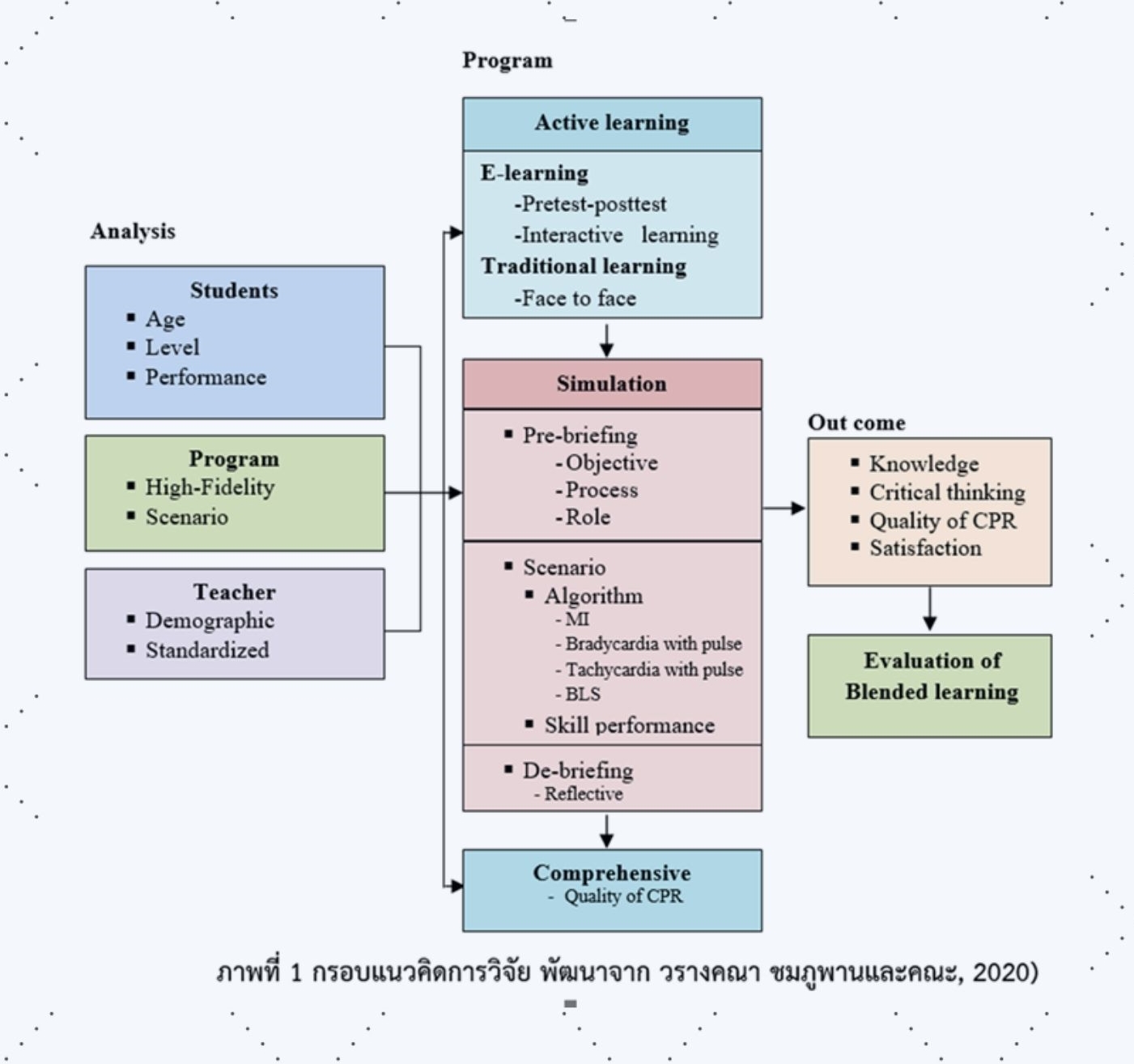
This study aimed to evaluate the impact of a blended learning (BL) program in emergency medical care practices. We examined emergency medical care knowledge, critical thinking, quality of basic cardiopulmonary resuscitation, and satisfaction with the learning experience among students before and after using the BL program. Participants included 33 second-year students studying to be Advanced Emergency Medical Technicians at the Sirindhorn College of Public Health, Khon Kaen Province, Thailand.
Results revealed that all 6 lesson plans set for the BL program included all crucial sections. Overall, the mean score for evaluation of the lesson plans was at a very good level. Mean scores of the students’ knowledge, critical thinking, quality of basic cardiopulmonary resuscitation, and satisfaction of their learning experience after the BL program were 4.15, 27.38, 15.47, and 5.85, respectively. The mean scores after learning in the BL program were all statistically significantly higher compared to the mean scores before learning in the program.
Therefore, the BL program could foster and increase learners’ cognitive and psychomotor skills for emergency medical care. Furthermore, the BL program had the effect of improving learner competencies in emergency medical care.
References
Adib-Hajbaghery, M., & Sharifi, N. (2017). Effect of simulation training on the development of nurses and nursing students' critical thinking: A systematic literature review. Nurse Educ Today, 50, 17-24. doi: 10.1016/j.nedt.2016.12.011
Berga, K.-A., Vadnais, E., Nelson, J., Johnston, S., Buro, K., Hu, R., & Olaiya, B. (2021). Blended learning versus face-to-face learning in an undergraduate nursing health assessment course: A quasi-experimental study. Nurse education today, 96, 104622.
Berger, B. A., & Villaume, W. A. (2016). A new conceptualization and approach to learning and teaching motivational interviewing. INNOVATIONS in pharmacy, 7(1).
Berger, C., Brinkrolf, P., Ertmer, C., Becker, J., Friederichs, H., Wenk, M., . . . Hahnenkamp, K. (2019). Combination of problem-based learning with high-fidelity simulation in CPR training improves short and long-term CPR skills: a randomised single blinded trial. BMC medical education, 19(1), 1-10.
Chompoopan, W., Chompoopan, W., Chanaboon, A., Seedaket, S., & Yomseeken, J. (2020). Effects of a Simulation-Based Learning Model for Medical Management of Patients with Cardiovascular Diseases. Nursing Journal of The Ministry of Public Health, 30(2), 93-103. (in Thai)
de Brito Lima, F., Lautert, S. L., & Gomes, A. S. (2021). Contrasting levels of student engagement in blended and non-blended learning scenarios. Computers & Education, 104241.
De Gagne, J. C., Kim, S. S., Schoen, E. R., & Park, H. K. (2018). Assessing the Impact of Video-Based Assignments on Health Professions Students’ Social Presence on Web: Case Study. JMIR medical education, 4(2), e11390.
Demirtas, A., Guvenc, G., Aslan, Ö., Unver, V., Basak, T., & Kaya, C. (2021). Effectiveness of simulation-based cardiopulmonary resuscitation training programs on fourth-year nursing students. Australasian Emergency Care, 24(1), 4-10.
Ennis, R. H. (1985). A logical basis for measuring critical thinking skills. Educational leadership, 43(2), 44-48.
Gerdprasert, S., Pruksacheva, T., Panijpan, B., & Ruenwongsa, P. (2010). Development of a web-based learning medium on mechanism of labour for nursing students. Nurse Educ Today, 30(5), 464-469. doi: 10.1016/j.nedt.2009.10.007
Grossman, P., Hammerness, K., & McDonald, M. (2009). Redefining teaching, re‐imagining teacher education. Teachers and Teaching: theory and practice, 15(2), 273-289.
Hellermann, C., Gold, B., & Holodynski, M. (2015). Förderung von Klassenführungsfähigkeiten im Lehramtsstudium. Zeitschrift für Entwicklungspsychologie und pädagogische Psychologie.
Jensen, K. T., Knutstad, U., & Fawcett, T. N. (2018). The challenge of the biosciences in nurse education: A literature review. Journal of clinical nursing, 27(9-10), 1793-1802.
Kang, J., & Seomun, G. (2018). Evaluating web-based nursing education’s effects: a systematic review and meta-analysis. Western Journal of Nursing Research, 40(11), 1677-1697.
Korpershoek, H., Harms, T., de Boer, H., van Kuijk, M., & Doolaard, S. (2016). A meta-analysis of the effects of classroom management strategies and classroom management programs on students’ academic, behavioral, emotional, and motivational outcomes. Review of Educational Research, 86(3), 643-680.
Larson, D. K., & Sung, C.-H. (2009). Comparing student performance: Online versus blended versus face-to-face. Journal of Asynchronous Learning Networks, 13(1), 31-42.
Li, C., He, J., Yuan, C., Chen, B., & Sun, Z. (2019). The effects of blended learning on knowledge, skills, and satisfaction in nursing students: A meta-analysis. Nurse education today, 82, 51-57.
Murray, B., Judge, D., Morris, T., & Opsahl, A. (2019). Interprofessional education: A disaster response simulation activity for military medics, nursing, & paramedic science students. Nurse education in practice, 39, 67-72.
Narciss, S. (2013). Designing and evaluating tutoring feedback strategies for digital learning. Digital Education Review(23), 7-26.
Owston, R., York, D. N., & Malhotra, T. (2019). Blended learning in large enrolment courses: Student perceptions across four different instructional models. Australasian Journal of Educational Technology, 35(5), 29-45.
Pannee leekitwattana (2016). Research methods in education. Bankok: min service and supply 2559. (in Thai)
Panumaporn, J., Soisudarat, C., & Meechanphet, V. (2014). Development of Learning Program to Enhance Critical Thinking Skills Based on Bloom’s Theory in Advertising Media Consumption. Bangkok: Faculty of Psychology, Chulalongkorn University. (in Thai)
Porter, W. W., Graham, C. R., Bodily, R. G., & Sandberg, D. S. (2016). A qualitative analysis of institutional drivers and barriers to blended learning adoption in higher education. The internet and Higher education, 28, 17-27.
Prilop, C. N., Weber, K. E., & Kleinknecht, M. (2020). Effects of digital video-based feedback environments on pre-service teachers’ feedback competence. Computers in Human Behavior, 102, 120-131.
Rogers, C. R. (1995). On becoming a person: A therapist's view of psychotherapy: Houghton Mifflin Harcourt.
Rungswang, P., Ngudgartoke, S., Prommapun, B., & Subsombat, W. (2013). Development of an Evaluation Model for Authentic Assessment of Upper Secondary Students. Journal of education Khon Kaen University, 36(2): 64-73. (in Thai)
Shang, F., & Liu, C.-Y. (2018). Blended learning in medical physiology improves nursing students’ study efficiency. Advances in physiology education, 42(4), 711-717.
Smith, K., & Hill, J. (2019). Defining the nature of blended learning through its depiction in current research. Higher Education Research & Development, 38(2), 383-397.
Wangsrikoon, A. (2014). Education in Thailand towards 21st Century: Productivity and Trends of Educational Development. Humanities and Social Sciences Journal of Graduate School, Pibulsongkram Rajabhat University, 8(1), 1-17. (in Thai)
Yimyam, S., Charuwatcharapaniskul, U., Chareonsanti, J., Indarangkura Na Ayutthaya, A., Xuto, P., & Chaloumsuk, N. (2015). Developing on Blended Learning for Developing the 21st Century Learning Skills. Nursing Journal, 42, 129-140. (in Thai)
Zhang, J.-H., Zou, L.-c., Miao, J.-j., Zhang, Y.-X., Hwang, G.-J., & Zhu, Y. (2020). An individualized intervention approach to improving university students’ learning performance and interactive behaviors in a blended learning environment. Interactive Learning Environments, 28(2), 231-245.
Downloads
Published
How to Cite
Issue
Section
License
Copyright (c) 2022 Thai Journal of Public Health and Health Sciences

This work is licensed under a Creative Commons Attribution-NonCommercial-NoDerivatives 4.0 International License.
บทความทุกบทความที่ได้รับการตีพิมพ์ถือเป็นลิขสิทธิ์ของ วารสารสาธารณสุข