Health Perception Factors associated with Quality of Life among Elderly Dependents in Chanae District, Narathiwat Province, Thailand
Keywords:
Health Perception, Quality of life, Elderly dependentAbstract
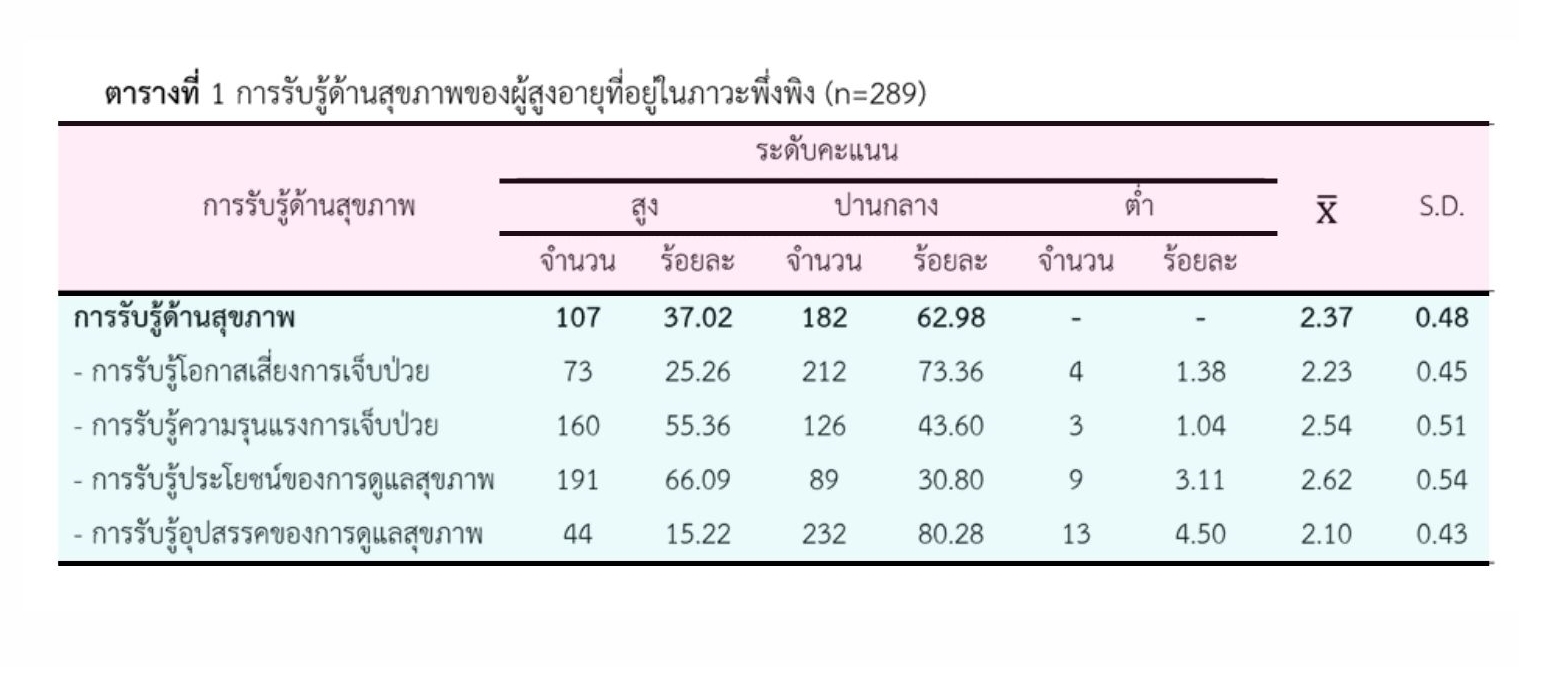
This cross-sectional descriptive research study aimed to examine the health perception factors associated with quality of life among elderly dependents. The sample size in this study consisted of 289 elderly dependents, who were registered in Chanae district, Narathiwat province, Thailand during the 2019 fiscal year. Participants were recruited via systematic random sampling. We collected data using a questionnaire that was composed of 3 parts including: 1) participant characteristics, 2) health perception, and 3) quality of life. In addition to checking the questionnaire’s standardization, 3 experts checked the questionnaire’s validity and reliability (Cronbach’s alpha = about 0.81). We analyzed data using statistics such as the Pearson’s product-moment correlation coefficient. The results showed that for elderly dependents the mean score for health perception was at a moderate level (=2.37, S.D.=0.48) and mean score for quality of life was at a moderate level (=1.95, S.D.=0.63). We found statistically significant associations between various health perception factors with quality of life among elderly dependents including: perceived risk of illness (r=0.19, p-value=0.001) perceived severity of illness (r=0.16, p-value=0.04) perceived benefit of health care behavior (r=0.11, p-value=0.05) and perceived barriers of health care behavior (r=-0.14, p-value=0.01).
References
Becker, M.H. (1974). The health belief model and personal health behavior. Health Education
Monographs, 2: 324-473.
Best, John W. (1977). Research is Evaluation. (3rded). Englewood Cliffs: N.J. Prentice-Hall.
Cronbach, Lee J. (1951). Essentials of Psychological Testing. 3rd ed. New York: Harper.
Daniel W.W. (2010). Biostatistics: Basic Concepts and Methodology for the Health Sciences. (9th
ed). New York: John Wiley & Sons.
Department of Older Persons, Ministry of Social Development and Human Security (2018).
OLDER STATISTIC. Retrieved 27 January 2021 from http://www.dop.go.th/download/knowledge/th1550973505-153_0.pdf.
Janz, N.K., & Becker, M.H. (1984). The health belef model: A decade later. Health education
quarterly; 11(1): 1-47.
Narathiwat provincial Public Health Office. (2019). Annual report of older. Retrieved 27 January
from https://nwt.hdc.moph.go.th
Phanpum, A., Sooknirundorn, S., Chanthaphinit, S., Nilbanphot, I.O., Poomphakwaen, K. (2019).
Quality of Life of the Elders in Toobkob Village, Kokdu Sub-district, Mueang District, Loei Province. 1th National Conference in Science, Technology and Innovation 2019. 20 April 2019. Faculty of Science and Technology, Loei Rajabhat University. (in Thai).
Rosenstock, I.M. (1974). Historical originals of the Health Belief Model. Health Education
Monographs, 2: 1-9.
Seehawong, M. (2019). Health Perception Associated with Dental Health Behaviors of
the Elders in Phetchabun Municipality, Amphur Muang, Phetchabun Province. Journal of Health Science; 28(3): 418-431. (in Thai).
United Nation, Department of Economic and social Affairs, Population Division. (2015). World
Population Prospects: The 2015 Revision, United Nations: New York, pp.30.
World Health Organization. [WHO] (2002). Active ageing: A policy framework
(WHO/NMH/NPH/02.8). Retrieved 27 January 2021 from http://www.unati.uerj.br/doc_gov/destaque/Madri2.pdf.
Yodkul, S. Srijakkot, J. (2012). Predicting Factors of Depression among Older People with
Chronic Disease in Buriram Hospital. Journal of Nurses, Association of Thailand, North-eastern Division; 33(3): 50-57. (in Thai).
Downloads
Published
How to Cite
Issue
Section
License
Copyright (c) 2022 Thai Journal of Public Health and Health Sciences

This work is licensed under a Creative Commons Attribution-NonCommercial-NoDerivatives 4.0 International License.
บทความทุกบทความที่ได้รับการตีพิมพ์ถือเป็นลิขสิทธิ์ของ วารสารสาธารณสุข