Efficacy and Safety of Kerra, Mixed Thai Traditional Herbal Medicines, on The Initial Stage of COVID-19 Symptoms
Keywords:
COVID-19, Kerra, Molnupiravir, Randomized Controlled Trial, Alternative Medicine, Herbal FormulaAbstract
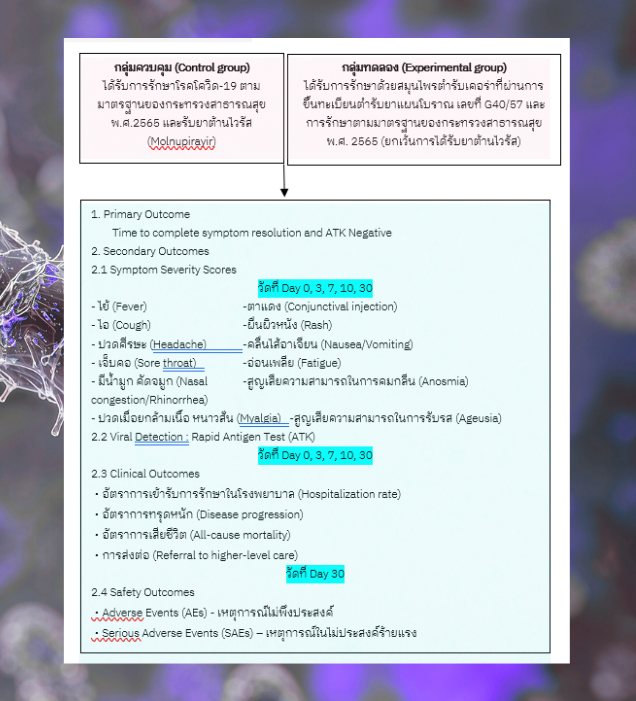
COVID-19 is an infectious disease that is spreading both in Thailand and around the world. Affecting life, economy and society at the micro and macro levels. Therefore, it is important that effective treatment and management be in place. Molnupiravia treatment is one standard of treatment. But there are other alternatives in Thailand that have herbal medicines that have been used to treat diseases for thousands of years. Hence, Kerra herbs are used in the treatment of COVID-19. The researcher was therefore interested in comparing the efficacy and safety of herbal medicines Kerra and Molnupiravia on symptoms of early COVID-19 disease, a randomized controlled trial (RCT).
The subjects were randomly assigned to the group by computer. data analysis Comparing the occurrence of COVID-19 patients between day one and days 3, 7, 10, 30 for each treatment regimen. Cochran's Q test comparing the occurrence of COVID-19 patients and ATK results between Kerra and The use of Molnupiravia on days 0, 3, 7, 10, 30 using Chi-square statistics showed that the incidence of COVID-19 patients between day one and days 3, 7, 10, 30 in each treatment regimen. The Cochran's Q test shows a trend in the number of asymptomatic cases of COVID-19. At the .001 level, the Kerra herb group and the Molnupiravia group were significantly different on day 7. The ATK test results were significantly different at the .05 level. 54.9% positive for ATK by drug treatment, while 69% by Kerra treatment. Checked on day 10 and up, no difference No severe symptoms were found and were referred to the sample. to receive further treatment at the hospital From the research, it will be seen that the herb Kerra will continue to be an alternative medicine for treating COVID-19.
References
Al-Aly, Z., Bowe, B., & Xie, Y. (2022). Long COVID after breakthrough SARS-CoV-2 infection. Nature Medicine, 28(7), 1461–1467. https://doi.org/10.1038/s41591-022-01840-0
Barbara, G., Minucci, G., Cremon, C., Stanghellini, V., & GISCAD. (2022). Prevalence of gastrointestinal symptoms in severe acute respiratory syndrome coronavirus 2 infection: Results of the prospective controlled multinational GI-COVID-19 study. American Journal of Gastroenterology, 117(1), 147–157. https://doi.org/10.14309/ajg.0000000000001541
Benjapholpitak, A., Visitthanon, K., Sawaengdham, T., Thaneerat, T., & Wonarat, K. (2021). Summary report on the use of Andrographis paniculata in the treatment of COVID-19 patients. Journal of Thai Traditional and Alternative Medicine, 19(1), 229-233.
Department of Thai Traditional and Alternative Medicine, Ministry of Public Health, Thailand. (2019). Guidelines for treatment of coronavirus disease 2019 (COVID-19) with Thai traditional medicine formulas and herbal medicine. https://moph.go.th/content/17118/
Department of Disease Control, Ministry of Public Health. (2021, June 4). Coronavirus disease 2019 (COVID-19) situation report No. 518. https://ddc.moph.go.th/viralpneumonia/file/situation/situation-no518-040664.pdf
Department of Medical Services, Ministry of Public Health. (2022, July 11). Clinical practice guidelines for diagnosis, treatment, and prevention of COVID-19 in hospitals for physicians and healthcare personnel (24th ed.). https://covid19.dms.go.th/backend/Content/Content_FIle/Bandner_(Big)/Attach/25650712141035PM_CPG_COVID-19_v.24.1.n_20220711.pdf
Fernandez-de-Las-Penas, C., Rodríguez-Jimenez, J., Fuensalida-Novo, S., Palacios-Cena, M., Gomez-Mayordomo, V., Florencio, L. L., Hernandez-Barrera, V., & Arendt-Nielsen, L. (2021). Myalgia as a symptom at hospital admission by severe acute respiratory syndrome coronavirus 2 infection is associated with persistent musculoskeletal pain as long-term post-COVID sequelae: A case-control study. Pain, 162(12), 2832–2840. https://doi.org/10.1097/j.pain.0000000000002306
Fischer, W. A., Eron, J. J., Holman, W., Cohen, M. S., Fang, L., Szewczyk, L. J., Sheahan, T. P., Baric, R., Mollan, K. R., Wolfe, C. R., Duke, E. R., Azizad, M. M., Borroto-Esoda, K., Wohl, D. A., Coombs, R. W., Loftis, A. J., Alabanza, P., Lipansky, F., & Painter, W. P. (2022). A phase 2a clinical trial of molnupiravir in patients with COVID-19 shows accelerated SARS-CoV-2 RNA clearance and elimination of infectious virus. Science Translational Medicine, 14(628), eabl7430. https://doi.org/10.1126/scitranslmed.abl7430
Herbal Research Institute. (2023). Kera-Acute Toxicity Test (Test Report R6060800201). Department of Medical Sciences.
Jayk Bernal, A., Gomes da Silva, M. M., Musungaie, D. B., Kovalchuk, E., Gonzalez, A., Delos Reyes, V., Martín-Quiros, A., Caraco, Y., Williams-Diaz, A., Brown, M. L., Du, J., Pedley, A., Assaid, C., Strizki, J., Grobler, J. A., Shamsuddin, H. H., Tipping, R., Wan, H., Paschke, A., ... MOVe-OUT Study Group. (2022). Molnupiravir for oral treatment of Covid-19 in nonhospitalized patients. New England Journal of Medicine, 386(6), 509–520. https://doi.org/10.1056/NEJMoa2116044
Lechien, J. R., Chiesa-Estomba, C. M., Place, S., Van Laethem, Y., Cabaraux, P., Mat, Q., Huet, K., Plzak, J., Horoi, M., Hans, S., Rosaria Barillari, M., Cammaroto, G., Fakhry, N., Martiny, D., Ayad, T., Jouffe, L., Hopkins, C., Saussez, S., & COVID-19 Task Force of YO-IFOS. (2020). Clinical and epidemiological characteristics of 1420 European patients with mild-to-moderate coronavirus disease 2019. Journal of Internal Medicine, 288(3), 335–344. https://doi.org/10.1111/joim.13089
Lee, Y., Min, P., Lee, S., & Kim, S. W. (2020). Prevalence and duration of acute loss of smell or taste in COVID-19 patients. Journal of Korean Medical Science, 35(18), e174. https://doi.org/10.3346/jkms.2020.35.e174
Malik, P., Patel, K., Pinto, C., Jaiswal, R., Tirupathi, R., Pillai, S., & Patel, U. (2021). Post-acute COVID-19 syndrome (PCS) and health-related quality of life (HRQoL)—A systematic review and meta-analysis. Journal of Medical Virology, 94(1), 253–262. https://doi.org/10.1002/jmv.27309
Mandelkorn, U., Genzer, S., Choshen-Hillel, S., Reiter, J., Meira e Cruz, M., Hochner, H., Kheirandish-Gozal, L., Gozal, D., & Gileles-Hillel, A. (2021). Escalation of sleep disturbances amid the COVID-19 pandemic: A cross-sectional international study. Journal of Clinical Sleep Medicine, 17(1), 45–53. https://doi.org/10.5664/jcsm.8800
Mao, L., Jin, H., Wang, M., Hu, Y., Chen, S., He, Q., Chang, J., Hong, C., Zhou, Y., Wang, D., Miao, X., Li, Y., & Hu, B. (2020). Neurologic manifestations of hospitalized patients with coronavirus disease 2019 in Wuhan, China. JAMA Neurology, 77(6), 683–690. https://doi.org/10.1001/jamaneurol.2020.1127
Sa-Ngiamsuntorn, K., Suksatu, A., Pewkliang, Y., Thongsri, P., Kanjanasirirat, P., Manopwisedjaroen, S., Charoensutthivarakul, S., Wongtrakoongate, P., Pitiporn, S., Chaopreecha, J., Kongsomros, S., Jearawuttanakul, K., Wannalo, W., Khemawoot, P., Chutipongtanate, S., Borwornpinyo, S., Thitithanyanont, A., & Hongeng, S. (2021). Anti-SARS-CoV-2 activity of Andrographis paniculata extract and its major component andrographolide in human lung epithelial cells and cytotoxicity evaluation in major organ cell representatives. Journal of Natural Products, 84(4), 1261–1270. https://doi.org/10.1021/acs.jnatprod.0c01324
Seetaha, S., Khamplong, P., Wanaragthai, P., Aiebchun, T., Ratanabunyong, S., Krobthong, S., Yingchutrakul, Y., Rattanasrisomporn, J., & Choowongkomon, K. (2022). KERRA, mixed medicinal plant extracts, inhibits SARS-CoV-2 targets enzymes and feline coronavirus. COVID, 2(5), 621–632. https://doi.org/10.3390/covid2050046
Shang, Y.-X., et al. (2022). Adverse effects of andrographolide derivative medications: a review. Frontiers in Pharmacology, 13, 773282. https://doi.org/10.3389/fphar.2022.773282. FrontiersSrathong, P., Butcha, R., , K., Thepaksorn, P., Mongkolsiri, P., Sarakshetrin, A., & Sroisong, S. (2022). Effects of herbal product (Kerra capsule) on clinical features of COVID-19 among home isolation patients in all age groups (A retrospective study). Journal of Positive Psychology & Wellbeing, 6(1), 3161–3170.
Sukati, S., Pikulthong, K., Rerkswattavorn, C., Chanprasertpinyo, W., Thepaksorn, P., Thonglor, N., Boonchu, A., Khamthong, R., Sroisong, S., & Srathong, P. (2022, June). Safety assessment of Kerra formula capsules by oral administration in healthy volunteers: A phase I clinical trial [Conference poster]. Walailak Research Symposium, Walailak University, Thailand.
Thepaksorn, P., Thabsri, K., Denbaes, P. E., Sroisong, S., Srathong, P., & Sukati, S. (2023). Traditional Thai herbal medicine for treating COVID-19. Journal of Applied Pharmaceutical Science, 13(11), 32–39. https://doi.org/10.7324/JAPS.2023.126979
Vetchakorn Osot. (2021). Development of Keera capsule from traditional Thai medicine formula.
World Health Organization. (2022). Coronavirus disease 2019 (COVID-19): WHO Thailand situation report – 233. https://reliefweb.int/report/thailand/coronavirus-disease-2019-covid-19-who-thailand-situation-report-233-27-april-2022
World Health Organization Thailand. (2022). COVID-19 situation report Thailand. https://www.who.int/countries/tha
Worakunphanich, W., et al. (2021). Safety of Andrographis paniculata: A systematic review and meta-analysis. Pharmacoepidemiology and Drug Safety.
Downloads
Published
How to Cite
Issue
Section
License
Copyright (c) 2025 Thai Journal of Public Health and Health Sciences

This work is licensed under a Creative Commons Attribution-NonCommercial-NoDerivatives 4.0 International License.
บทความทุกบทความที่ได้รับการตีพิมพ์ถือเป็นลิขสิทธิ์ของ วารสารสาธารณสุข